Tag: fantastically wealthy

  • Don’t Pretend the ‘War on Drugs’ Has Anything to Do With Fighting Drugs

    Spread the love

    Article by Belén Fernández republished form FAIR under a Creative Commons Attribution-NonCommercial-NoDerivs 3.0 Unported License.

    Addressing the UN General Assembly in September, Donald Trump gloated about his strategy toward “narcoterrorist” cartels, the menace du jour in the United States’ self-declared backyard. Pulling numbers out of his ass per usual, Trump claimed that the manic bombing campaign against alleged seafaring narcoterrorists (read: fishermen) in Central and South America has cut maritime drug trafficking by 97%, and called drug cartels the “ISIS of the Western Hemisphere.”

    While it was by no means the president’s intention, he accidentally hit the nail on the head with the ISIS comparison. Both the Islamic State and Latin American drug trafficking outfits are a direct result of US policy—as well as a convenient excuse for the Americans to continue terrorizing people under the pretext of combating the very phenomena they caused in the first place. Just as ISIS owes its origins to the US invasion of Iraq, drug traffickers wouldn’t be in big business if not for—what else?—the US’s so-called “war on drugs” that renders the international movement of illicit substances so lucrative.

    ‘Same effect on land’
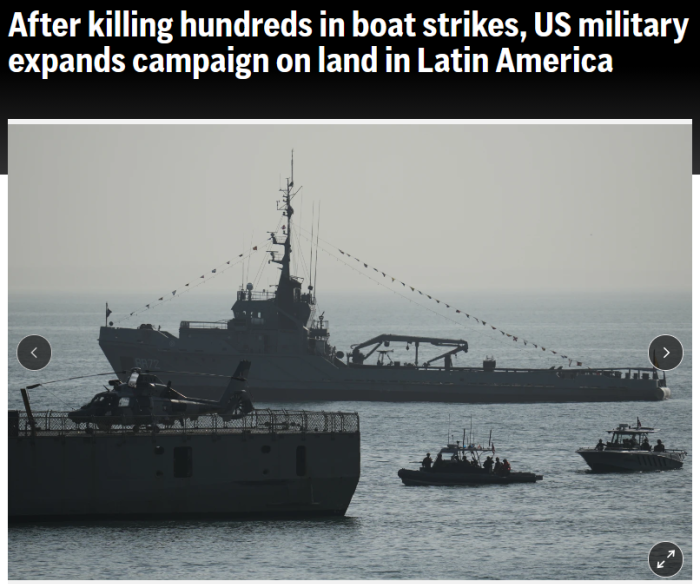
    AP: After killing hundreds in boat strikes, US military expands campaign on land in Latin America

    AP (8/17/26) describes the US military’s role in Latin America as “supplying allies with weapons, intelligence and training to fight drug trafficking”—while acknowledging “a fraught legacy of support for military coups and dictatorships.”

    This year, the Trump administration has significantly ramped up its drug war beyond just randomly blowing people up in the ocean. In August, the Associated Press (8/17/26) reported on the government’s plans to expand operations to terra firma, quoting Secretary of War Pete Hegseth:

    It will be “like you saw with the strikes on the drug boats,” Hegseth said during a military drill in the jungle in Panama. “Same effect on land.”

    But since there are generally more people on land than in the middle of the sea, there will no doubt be far greater opportunities for extrajudicial execution in this new terrestrial phase of operations.

    The escalated campaign takes place against the backdrop of the US-led “Shield of the Americas,” a hemispheric “anti-cartel coalition” inaugurated in March that now boasts the participation of 19 countries. Ecuador has been among the most gung-ho about joining forces with the US to launch “anti-cartel” raids, with such impressive feats to show for it as the joint bombing of a drug trafficking compound that turned out to be a dairy farm.

    ‘Long and bloody history’
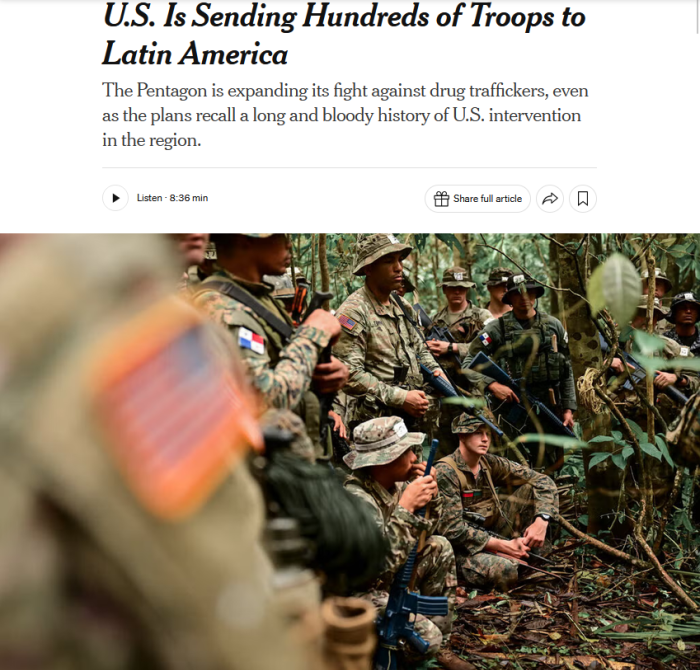
    NYT: U.S. Is Sending Hundreds of Troops to Latin America

    The New York Times (10/14/26) describes the US sending hundreds of combat troops to Latin America as “expanding its fight against drug traffickers.”

    This month, the New York Times (10/14/26) was the first to report that the US had begun deploying a shit ton of troops to Latin America, and that a “new jungle training facility” in Panama was receiving “the first elements of a 600-soldier battalion from the 10th Mountain Division at Fort Drum, NY.” The Times also mentioned the Defense Department’s “recent movement of several MQ-9 Reaper drones from Africa to Colombia and Ecuador.”

    The article’s subhead—“The Pentagon is expanding its fight against drug traffickers, even as the plans recall a long and bloody history of US intervention in the region”—leaves us with the expectation that we might be hearing something about, I dunno, the long and bloody history of US intervention in the region. And yet the only reference to that history in the body of the article occurs in a single sentence that is a modified replica of the subhead: “But the prospect of US operations on Latin American soil has raised concerns about sovereignty, and has recalled a long and bloody history of US intervention in the region.”

    Surely an example or three of “intervention” wouldn’t have taken up too much space on the pages of the Times; the authors could have mentioned that time in 1989 the US military bombed to smithereens an impoverished neighborhood in Panama City, killing as many as several thousand civilians, in a bid to capture Panamanian leader Manuel Noriega. A longtime US buddy who had been on the CIA payroll for decades despite common knowledge of his involvement in the drug trade, Noriega had outlived his usefulness, and his drug dealings were suddenly so wrong and horrible as to necessitate the psychotic bombardment of poor Panamanians living in wooden shacks.

    Or the Times could have delved into disproportionate US financial and moral support for the homicidal regime of Colombia’s far-right President Alvaro Uribe during the first decade of this century. Uribe himself appeared on a 1991 US Defense Intelligence Agency list of the “more important Colombian narco-traffickers contracted by the Colombian narcotic cartels”—but that was no reason he couldn’t be promoted to the role of America’s Super Drug War Ally and vanquisher of narcoterrorists.

    As president, Uribe oversaw what came to be known as the “false positives” scandal, in which potentially more than 10,000 Colombian civilians were slaughtered by members of the Colombian army, who disguised the corpses as left-wing guerrillas in order to accrue promotions and vacation time. The Uribe administration then used these ostensible battlefield achievements to petition the US for yet more aid.

    Last but not least, the Times could have brought up the Contra war on Nicaragua in the 1980s, when CIA-backed mercenaries unleashed terror on that nation while overseeing a profitable side hustle trafficking drugs to the US. The ensuing crack cocaine epidemic devastated Black communities across the country, but, hey, it was all in the name of saving the world from Communism.

    Indeed, not only would such details give the Times’ readers an idea of the extent to which the US has traditionally been up to no good in Latin America (and at home), they would also soundly obliterate the official “drug war” narrative and expose it for what it is: a façade for imperial domination that really has nothing to do with stopping the flow of drugs at all.

    ‘Fight against drug traffickers’
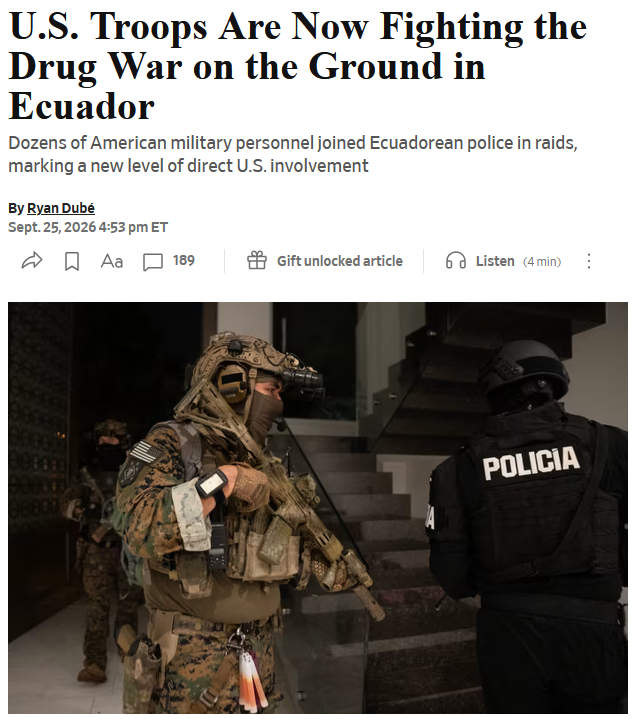
    Wall Street Journal: U.S. Troops Are Now Fighting the Drug War on the Ground in Ecuador

    The Wall Street Journal headline (9/25/26) called the US military carrying out assassinations in Ecuador “Fighting the Drug War on the Ground.”

    But for the New York Times and other corporate media, speaking truth to power is not part of the job description. While they may critique the methods or effectiveness of the “war on drugs,” these media stop far short of questioning its entire premise, and time and again the US government is allowed to set the terms of the discourse. Thus we have the Times droning on about the “fight against drug traffickers,” the “war against drugs,” the “escalating US-led military campaign against drug traffickers,” and the move “to target cartels.”

    In a typical example from September, the Wall Street Journal (9/25/26) announced that “US Troops Are Now Fighting the Drug War on the Ground in Ecuador.” This month, the Washington Post (10/16/26) reported on shifting tactics in US “anti-drug strikes at sea.” The Hill’s Filip Timotija (10/7/26) observed that “the Pentagon is expanding the US military’s multifront war against drug cartels in South America.” And so on.

    For its part, Reuters (9/22/26) has described Trump’s escalation as an “expanding campaign against drug cartels,” even while diplomatically cautioning that “rights groups” have said the US boat strikes “amount to extrajudicial killings.” This sort of diplomatic maneuver is another hallmark of a corporate media that can never come right out and say that spontaneously pulverizing people on fishing vessels actually counts as extrajudicial killing, whether you’re a “rights group” or not.

    Mechanism for control
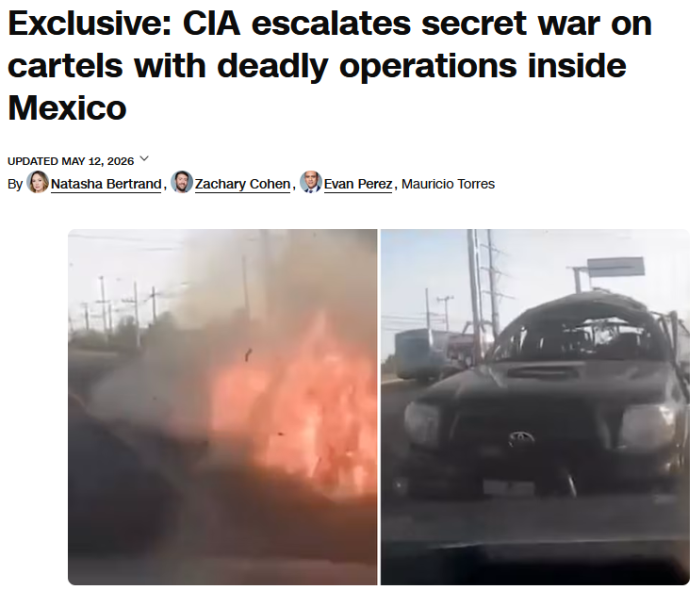
    CNN: CIA escalates secret war on cartels with deadly operations inside Mexico

    CNN (5/12/26) reported on an alleged CIA assassination in Mexico as being part of an effort “to dismantle the entrenched cartel networks.” 

    In May, CNN (5/12/26) published an exclusive report titled: “CIA Escalates Secret War on Cartels With Deadly Operations Inside Mexico.” This is the same CIA, of course, that has been up to its ears in drug trafficking since the Korean war—including, as it so happens, in Mexico. (For a rundown on CIA narco-exploits over the decades, see the 1993 article “The CIA Drug Connection Is as Old as the Agency,” which somehow made it onto the New York Times website. It begins with a “recent news item: The Justice Department is investigating allegations that officers of a special Venezuelan anti-drug unit funded by the CIA smuggled more than 2,000 pounds of cocaine into the United States with the knowledge of CIA officials.”)

    The CNN piece details the targeted assassination of alleged Sinaloa Cartel operative Francisco Beltrán, whose car was blown up in March on a highway outside Mexico City. According to CNN:

    The Beltrán operation was part of an expanded, and previously unreported, CIA campaign inside Mexico—spearheaded by the agency’s elite and secretive Ground Branch—to dismantle the entrenched cartel networks.

    On the surface, at least, CNN is thus being insubordinate by publishing information that the US government does not want people to know; as the article specifies, the news outlet even gets dramatically accused by the CIA spokesperson of “false and salacious reporting that serves as nothing more than a PR campaign for the cartels and puts American lives at risk.”

    And yet the apparent defiance of the government only goes so far. At the end of the day, the CNN exposé simply reinforces the narrative that the US is in fact fighting against drug cartels—and not using the “drug war” apparatus as a politico-economic weapon and mechanism for control.

    No reference is made to the history of US government agencies collaborating with Mexican drug trafficking groups, including the Sinaloa Cartel itself, or to the preponderant role of US weapons manufacturers in arming criminal organizations in Mexico. (Recall that brilliant experiment during the Barack Obama presidency when the US Bureau of Alcohol, Tobacco, Firearms and Explosives facilitated the illegal purchase of thousands and thousands of guns on the off chance the trail would lead them to Mexican cartel leaders.)

    ‘Politics of extermination’
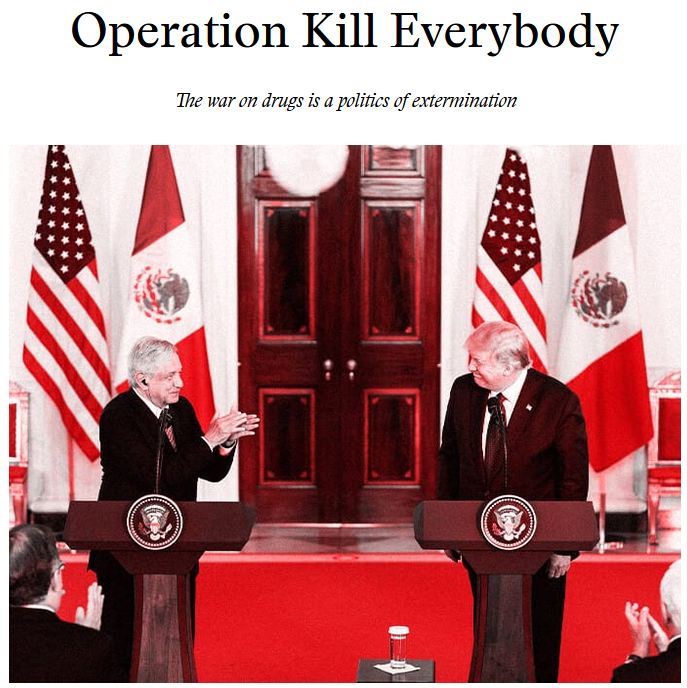
    Baffler: Operation Kill Everybody

    Oswaldo Zavala (Baffler, 6/18/26): “Government-sanctioned extrajudicial murders have been part of US military operations across the planet for several decades.”

    Many corporate media interventions do take care to note that the current US approach in Latin America has not had any apparent effect on the drug trade; the New York Times (10/14/26), for instance, notes that “experts say that killing members of trafficking groups—even top leaders—does little to stem the flow of drugs.”

    But media are never compelled to entertain the idea that stemming the flow of drugs may not even be the point—not even when, after using the drug war as a pretext, Trump straight-up admits that he attacked Venezuela and kidnapped its president for oil, plain and simple.

    Since President Richard Nixon launched the “war on drugs” in 1971, the US still hasn’t managed to stem the flow, but the war has provided a whole lot of opportunities for the US militarization of Latin America and alliances with an array of regional right-wing nutjobs who are only too happy to facilitate imperial intrusion and neoliberal corporate assault at the expense of their populations.

    The scholar Oswaldo Zavala, author of Drug Cartels Do Not Exist, contends in a recent essay for the Baffler (6/18/26) that “the ‘war on drugs’ is an overt politics of extermination.” It’s part of a panorama in which

    from the Middle East to Latin America, a transnational military use of force has consistently been deployed against impoverished people in developing countries and sold as a war against “narcos,” “terrorists,” the artificial hybrid “narco-terrorists.”

    Mexico, Zavala writes, has hosted the “most devastating such campaign in Latin America”; since the launch of the US-imposed war on drugs in 2006, more than 460,000 people have been killed and more than 134,000 disappeared, “a disproportionate number [of whom] have been poor, young, brown, uneducated men living in the outskirts of major cities.”

    In their book Cocaine, Death Squads and the War on Terror: US Imperialism and Class Struggle in Colombia, Oliver Villar and Drew Cottle illustrate how the US-backed drug war in Colombia has traditionally not been against drugs, but rather for the control of the drug trade, which in the 1980s became a significant “source of profit for US capital.” To this day, the overwhelming majority of profits from the ongoing drug trade remain in the US.

    ‘Failed to curb cocaine supply’
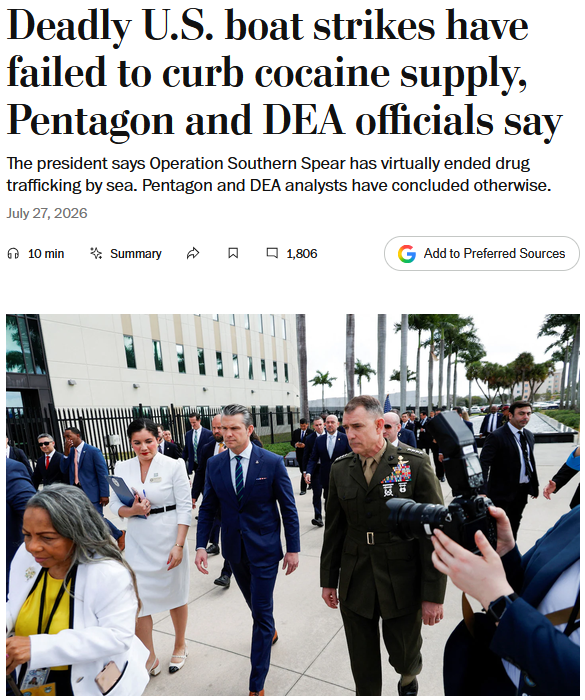
    WaPo: Deadly U.S. boat strikes have failed to curb cocaine supply, Pentagon and DEA officials say

    Washington Post (7/27/26): “Trump has transformed traditional US drug enforcement into a military campaign that fuses the legal and strategic approaches of the war on drugs and the war on terror.”

    But corporate media continue to portray the “war on drugs” as just that, casting hints to the contrary as mere failures of drug war tactics and strategy. In an article headlined “Deadly US Boat Strikes Have Failed to Curb Cocaine Supply, Pentagon and DEA Officials Say,” the Washington Post (7/27/26) speculates that “there might, in fact, now be more cocaine circulating in the United States.” But for the Post, it’s still all ultimately part of a “decades-long war on drugs”—and no need to turn the entire concept on its head.

    It should be quite clear, after 250 years of the United States of America, that the government is very often lying through its teeth. But corporate media outlets just can’t bring themselves to integrate the mass of incriminating material on the political expedience of the “drug war” into one cohesive anti-systemic analysis that would upend the government narrative.

    Forty years ago, in September 1986, then-President Ronald Reagan solemnly addressed the nation about the dangers of drugs, even as he was funding the drug-running Contras: “Drugs are menacing our society. They’re threatening our values and undercutting our institutions. They’re killing our children.”

    And judging from the behavior of the media, it seems that defying the government line might be equally menacing to society.


    Featured Image: Secretary of Defense Pete Hegseth speaks at a forum of the Americas Counter Cartel Coalition in Panama City, August 12, 2026 (AP Photo: Matias Delacroix).

    FAIR’s work is sustained by our generous contributors, who allow us to remain independent. Donate today to be a part of this important mission.

    Belén Fernández

    Belén Fernández is the author of The Darién Gap: A Reporter’s Journey through the Deadly Crossroads of the Americas and Inside Siglo XXI: Locked Up in Mexico’s Largest Immigration Center, among other titles. She is an opinion columnist at Al Jazeera.

    Article by Belén Fernández republished form FAIR under a Creative Commons Attribution-NonCommercial-NoDerivs 3.0 Unported License.

    Orcas discuss Donald Trump and the killer apes' concept of democracy. Front Orca warns that Trump is crashing his country's economy and that everything he does he does for the fantastically wealthy.
    Orcas discuss Donald Trump and the killer apes’ concept of democracy. Front Orca warns that Trump is crashing his country’s economy and that everything he does he does for the fantastically wealthy.

  • From aristocracy to ‘assetocracy’ – how wealth has transformed the House of Lords

    Spread the love
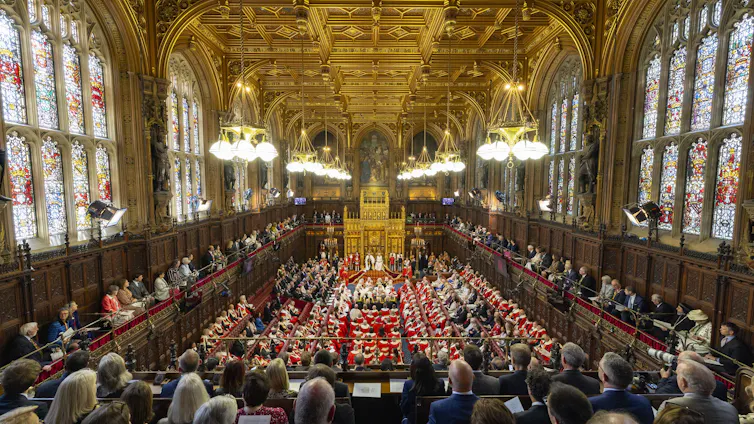
    peers in ermine in the house of lords chamber for the state opening of parliament 2026 with the king and queen.
    The State Opening of Parliament 2026. House of Lords / Roger Harris, CC BY-NC-ND

    Huw Macartney, University of Birmingham

    On April 29, 2026, the remaining hereditary peers left the House of Lords. These 92 individuals were the last vestiges of an era in which the landed aristocracy dominated the UK’s second chamber. In the recent past, as many as 800 aristocrats filled the red benches. Now though, a new financial elite appears to have taken their place.

    Gradually, the dominance of the aristocrats gave way to a more meritocratic order of life peers. In 1999, Tony Blair’s government removed most of the hereditary peers; in 2026, Keir Starmer’s government finished the job. But did removing them really make the House of Lords any less elitist?

    These were some of the issues I sought to explore with a team of graduate researchers at the University of Birmingham. We set about gathering what is, to the best of our knowledge, the largest-ever repository of the financial and political activities of the Lords. Over 18 months, we collected details of all the shareholdings, company directorships, landholdings, rental properties, education, attendance and speeches in the second chamber, as well as voting records for all Lords. These are presented in my new book, The Assetocracy.

    What we uncovered was staggering. More than 260 peers hold multiple, individual shareholdings – stakes in listed companies – worth more than £100,000 apiece. In fact, some Lords held more than 200 individual holdings, each valued in excess of £100,000. Even assuming each asset was only worth £100,000, that would put the combined value of those shareholdings alone at more than £22 million.

    Put simply, this reflects a level of wealth far beyond that of all but the richest people in Britain. In fact, 14 Lords appear in The Sunday Times Rich List of the UK’s wealthiest people, with a combined net worth of £27.8 billion.

    Moreover, half of the House are landlords with rental income. And 250 peers hold one or more paid company directorship. In short, this is an extraordinary concentration of wealth at the heart of Britain’s second chamber.

    The social profile of the Lords is equally revealing. Nearly half of peers were privately educated, compared with just 7% of the wider population. Around one third went to Oxford or Cambridge, compared with just 1% nationally. And 11% attended some of Britain’s most elite schools, where annual fees can now top £60,000.

    Our conclusion? The Lords is not merely wealthy, it is an institution steeped in economic, educational and social privilege. Yet remarkably little is known about the extent of this wealth. Disclosure requirements remain limited, leaving many of the peers’ financial interests hidden from public view.

    And that matters. Membership of the Lords can sit alongside extremely lucrative private-sector careers. Several peers, for example, declared earning between £100,000 and £300,000 a year from company directorships and advisory positions – on top of their parliamentary roles and Lords allowances (a £371 daily rate).

    Aristocrats have gone – but privilege has not

    This is the paradox at the heart of the modern House of Lords. The old aristocracy may be disappearing from the red benches, but wealth and privilege have not disappeared with it. The aristocracy has increasingly given way to what we termed an “assetocracy” – members of the new financial elite whose power rests on property, finance and accumulated asset-based wealth.

    Reforming the second chamber has previously been tied to either removing the aristocratic hereditary peers or (ostensibly) increasing the scope for non-elite appointments. This is primarily done through the House of Lords Appointments Commission and the introduction of crossbenchers, whose appointment does not depend on prime ministerial patronage or political donations.

    Yet while these efforts appeared to be producing a diverse collection of Lords through the early 2000s, the trend was reversed with the arrival of the Conservative governments of the 2010s. Since then, my research shows that the second chamber has seen a striking influx of the new “assetocratic” elite.

    Appointments of peers with shareholdings over £100,000 (by political party)

    My research also reveals a small but clear relationship between wealth and participation in the Lords. Previous accounts have shown that some political donors appear to treat a peerage as a status symbol, playing little part in the day-to-day work of the House. My findings suggest however, that the pattern extends beyond political donors. On average, the wealthiest peers tend to attend less, speak less and contribute less to the work of the House.

    One of the book’s central conclusions is that the rise of the assetocrats in the Lords coincided with a wider transformation of British society. It was a period when wealth inequality grew and asset ownership became an increasingly important source of economic advantage.

    The Lords did not create these changes, nor are its members the only or primary beneficiaries. But my research shows how peers have often sought to narrow the terms of political debate around wealth and redistribution. They have defended a system that privileges asset ownership and particular forms of wealth accumulation.

    For example, Lord Leigh of Hurley, a Conservative peer and businessman, told the House in 2025 that “we need to teach kids that so-called ‘earned income’ is paid, weekly or monthly, without any risk whatever, while ‘unearned income’ is typically generated from an investment, which involves risk to capital and, therefore, deserves greater reward”.

    The research points to three conclusions. The first may seem paradoxical, but the more I researched the Lords, the more convinced I became that – certainly on issues beyond wealth and inequality – it is a remarkable source of expertise that often improves and strengthens legislation. That is why abolishing the Lords would throw away an institution that still performs an important democratic function.

    Second, reform is nonetheless overdue. Prime ministerial patronage should be curtailed; minimum expectations for attendance and participation introduced; transparency over financial affairs should be increased; and outside employment more tightly regulated where it creates conflicts of interest.

    But there is a bigger issue. The transformation of the Lords reflects a much more profound transformation of society. Over the past five decades, the UK has become an economy in which owning property, shares and other assets is an increasingly important route to extraordinary wealth. Removing the last vestiges of the old aristocracy from the Lords will not solve the problem. The deeper challenge is confronting the structural forces that have allowed a new asset-owning elite to take its place.

    This article features references to books that have been included for editorial reasons, and may contain links to bookshop.org. If you click on one of the links and go on to buy something from bookshop.org The Conversation UK may earn a commission.

    Huw Macartney, Associate professor in Political Economy, University of Birmingham

    This article is republished from The Conversation under a Creative Commons license. Read the original article.

    Orcas discuss Donald Trump and the killer apes' concept of democracy. Front Orca warns that Trump is crashing his country's economy and that everything he does he does for the fantastically wealthy.
    Orcas discuss Donald Trump and the killer apes’ concept of democracy. Front Orca warns that Trump is crashing his country’s economy and that everything he does he does for the fantastically wealthy.

  • Groups Call Senate Permitting Deal a ‘Blatant Giveaway to Big Oil and Big Tech’

    Spread the love

    Article by Brett Wilkins republished from Common Dreams under Creative Commons (CC BY-NC-ND 3.0).

    Green-winged teals are seen flying over water at Seedskadee National Wildlife Refuge in Wyoming on April 25, 2019. (Photo by Tom Koerner/US Fish and Wildlife Service/flickr/cc)

    “If it comes to pass, this deal would bulldoze America’s most important wildlife law,” said one campaigner.

    A bipartisan Senate proposal to overhaul federal permitting rules drew fierce opposition Wednesday from environmental and wildlife advocates, who warn that the legislation could significantly weaken the Endangered Species Act and other key protections in service of boosting President Donald Trump’s pro-fossil fuel and artificial intelligence agenda.

    Senate negotiators—chiefly Democrats Martin Heinrich (NM) and Sheldon Whitehouse (RI) and Republicans Shelley Moore Capito (W.Va.) and Mike Lee (Utah)—reportedly reached an agreement Monday on the text of a sweeping permitting package intended to speed construction of energy and infrastructure projects.

    RECOMMENDED…

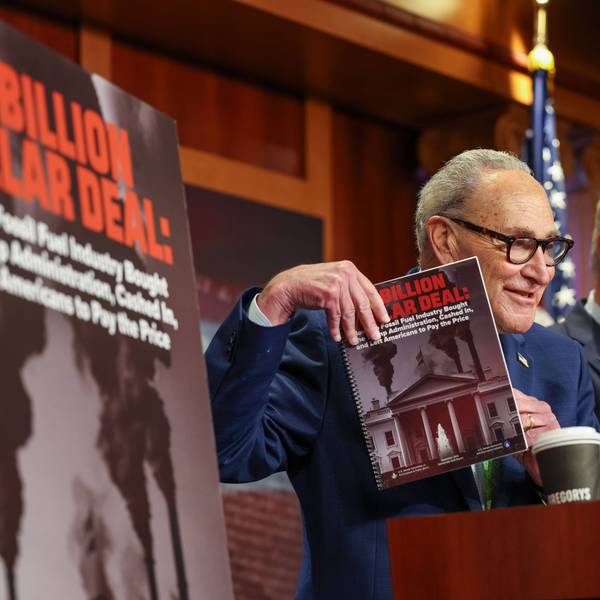
    Senators Schumer And Whitehouse Unveil Report On Fossil Fuel Industry's Connections To Trump Administration

    ‘The Billion Dollar Deal’: Senate Democrats Detail How Trump Serves Fossil Fuel Industry

    White House Airs 'Illegal' Trump Propaganda Ad ‘Paid For By the US Government’

    White House Airs ‘Illegal’ Trump Propaganda Ad ‘Paid For By the US Government’

    While the full legislative text of the “Bipartisan American Affordability and Jobs Act of 2026” had not been publicly released as of Wednesday, reported provisions have prompted alarm among conservation groups, who warn that the proposal would weaken endangered species protections, shift federal authority and responsibility to states, limit scientific review and judicial oversight, and exempt some projects from key environmental consultations.

    “If it comes to pass, this deal would bulldoze America’s most important wildlife law,” Defenders of Wildlife president and CEO Andrew Bowman said Wednesday. “We can build the infrastructure America needs without sacrificing the wildlife we have a responsibility to protect and that Americans cherish. Development should not come at the expense of science, accountability, or the ability of America’s most imperiled wildlife to survive.”

    Oil Change International called the proposal “a blatant giveaway to Big Oil and Big Tech.”

    “This ‘dirty deal’ threatens to raise electricity prices for working families by accelerating the buildout of energy-guzzling AI data centers and liquefied natural gas export projects,” said Oil Change International US campaigns manager Collin Rees. “Our recent research shows that the Trump administration’s support for reckless AI development and greater gas exports drives up energy costs for households.”

    Brett Hartl, government affairs director at the Center for Biological Diversity (CBD), said that “this is a climate kill shot that condemns our most vulnerable communities to suffer decades more fossil fuel pollution.”

    “It’s absurd to ensure our planet chokes with greenhouse gases, gut endangered species protections, and eviscerate the Clean Water Act for what seems to be a nearly meaningless victory against Trump’s war on offshore wind,” Hartl continued. “The minor benefits for renewable energy corporations are massively dwarfed by the gifts to the fossil fuel industry.”

    “If this grotesque legislation becomes law, the paltry increases in renewable energy will be instantly devoured by AI data centers,” he added. “The only winners here are Elon Musk, Mark Zuckerberg, tech oligarchs, and the shareholders of fossil fuel companies.”

    According to CBD:

    Today’s package contains numerous provisions that lock in thousands of fossil fuel projects, including oil and gas pipelines, [liquefied natural gas] export terminals, and expanded fossil fuel drilling onshore and offshore approved by President Trump over the past two years. It also ensures that future fossil fuel pipelines and methane gas-generated electricity can never be challenged in court.

    Additional provisions gut parts of the Clean Water Act, including the Section 401 authority of states to protect their rivers and streams from the impacts of building pipelines and the [Environmental Protection Agency’s] Section 404(c) permit veto authority, which has been used to stop projects like the Pebble Mine in Alaska.

    The legislation weakens the National Historic Preservation Act and Tribal consultations, leaving most Tribal nations with no meaningful way to protect their sovereignty when faced with potential fossil fuel projects on their lands.

    Furthermore, CBD noted, “the legislation guts the Endangered Species Act by allowing states to take over the Section 7 consultation process with minimal safeguards, turning one of the law’s strongest provisions into a state-run rubber stamp of dangerous projects.”

    The Western Environmental Law Center described the proposal as a “five-alarm fire,” warning that it could weaken the Clean Water Act, Endangered Species Act, [National Environmental Policy Act], and other safeguards.

    “The permitting deal is a betrayal of public lands, water, and wildlife, and environmental justice values that Westerners depend on,” said Erik Schlenker-Goodrich, the group’s executive director, who warned that the measure could ultimately “hobble the ability of future administrations to enact an ambitious climate and conservation agenda.”

    Hartl called out Democrats Heinrich and Whitehouse for “giving away our most cherished environmental laws based on fantastical models that project a renewable energy utopia.”

    “They’re rewarding a ruthless fossil fuel industry that will always put its quarterly profits ahead of a livable planet and future generations,” he said. “Trump promised fossil fuel companies that he’d do everything in his power to assist them in his second term, and Sen. Heinrich and Sen. Whitehouse seem hell-bent on helping Trump fulfill that promise.”

    Bowman contended that “Congress should be looking for ways to make permitting more efficient rather than a Trojan horse to weaken the Endangered Species Act.”

    “Efficiency and conservation are not opposing goals,” he added. “A durable permitting bill should deliver both. Congress should not lock in permanent damage to the Endangered Species Act simply to get a deal today.”

    Article by Brett Wilkins republished from Common Dreams under Creative Commons (CC BY-NC-ND 3.0).

    Orcas discuss Donald Trump and the killer apes' concept of democracy. Front Orca warns that Trump is crashing his country's economy and that everything he does he does for the fantastically wealthy.
    Orcas discuss Donald Trump and the killer apes’ concept of democracy. Front Orca warns that Trump is crashing his country’s economy and that everything he does he does for the fantastically wealthy.
    Climate science denier Donald Trump confirms that he knows nothing about democracy and that more liquid gold is being secured according to his policy of global privateering.
    Climate science denier Donald Trump confirms that he knows nothing about democracy and that more liquid gold is being secured according to his policy of global privateering.
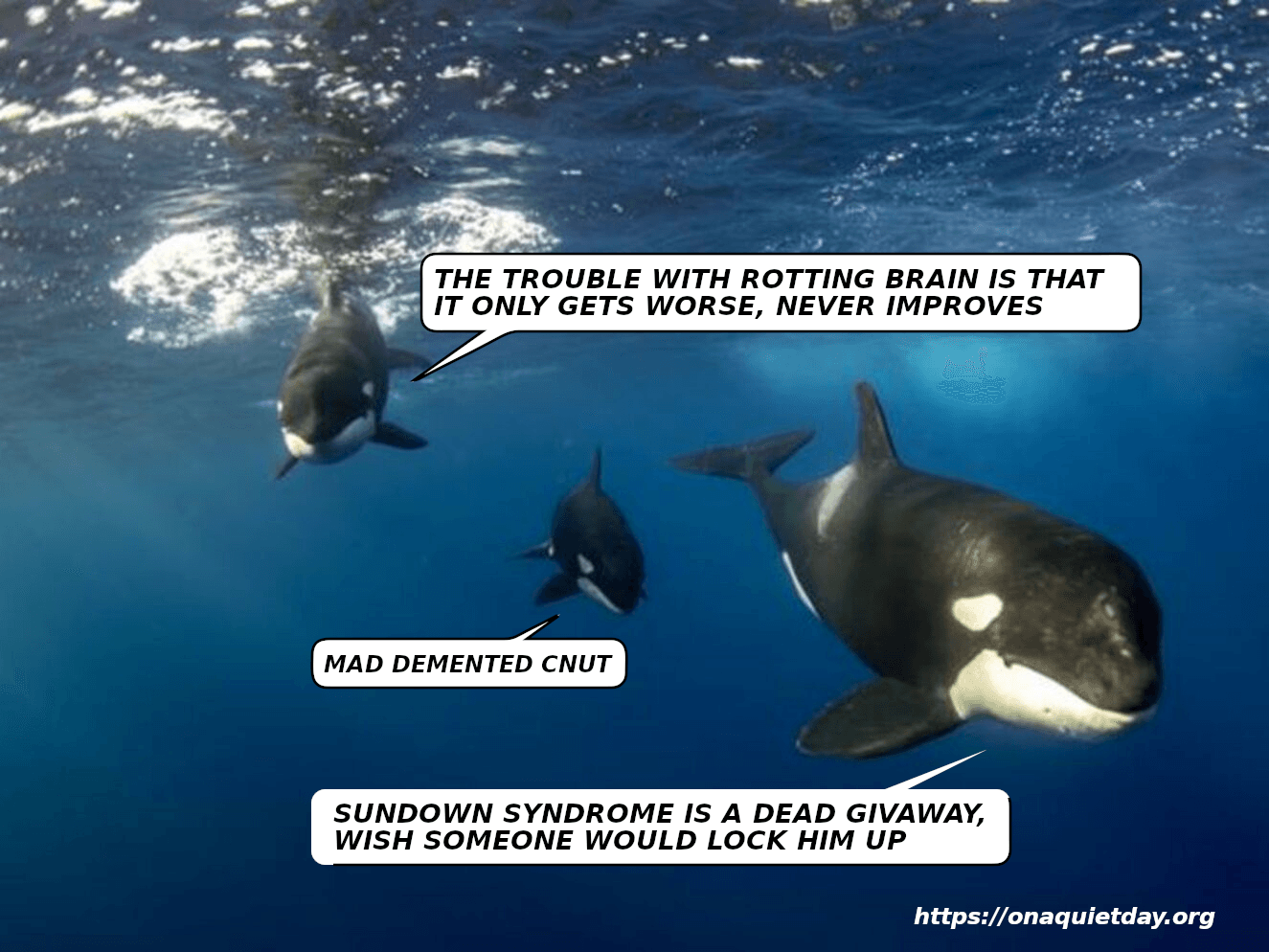
    Orcas discuss rotting brain, front Orca says Sundown Syndrome is a dead givaway and he wishes someone would Lock Him Up
    Orcas discuss rotting brain, front Orca says Sundown Syndrome is a dead givaway and he wishes someone would Lock Him Up
  • Report Delivers ‘Starkest Warning Yet’ on How Climate Emergency Is Causing ‘Profound Changes’ for Oceans

    Spread the love

    Article by Julia Conley republished from Common Dreams under Creative Commons (CC BY-NC-ND 3.0).

    A coral reef around Taravai Island with many acropora corals is seen on February 16, 2018 in the Gambier Islands, French Polynesia. (Photo by Alexis Rosenfeld/Getty Images)

    “The ocean is transforming before our eyes: Warming, rising seas, and ecosystem degradation are interconnected signs of significant and long-term change.”

    The 10th annual Copernicus Ocean State Report, released Wednesday by a team of more than 100 international scientists, provided the latest reminder that, as one United Nations official said, “the ocean is one of the clearest indicators of the profound shifts” that the climate crisis is causing.

    Data gathered by Mercator Ocean International, the nonprofit that produced the report, revealed “an ocean warming at an alarming pace, with far-reaching consequences for marine life, coastlines, and communities worldwide,” said the group.

    RECOMMENDED…

    A protester is seen during a climate change demonstration

    ‘The Diagnosis Is Unambiguous’: 2026 Planetary Health Report Finds Pressure Mounting on Earth Systems

    White House Airs 'Illegal' Trump Propaganda Ad ‘Paid For By the US Government’

    White House Airs ‘Illegal’ Trump Propaganda Ad ‘Paid For By the US Government’

    The study delivers ocean scientists’ “starkest warning yet of the profound changes sweeping across the ocean, as a likely unprecedented El Niño takes shape in the Pacific,” said Mercator, referring to the natural warming trend that is expected to be made more intense this year by planetary heating.

    Drawing on four decades of data from satellites, buoys, sensors, and modeling, the scientists found that 2024 was marked by record-breaking marine heatwaves as well as an unprecedented extreme low sea level event, causing levels in the Bothnian Bay between Sweden and Finland to plunge 60 inches, bringing ferries to a halt for 18 hours.

    Heatwaves in the Mediterranean and Black seas lasted more than 30 days and raised water temperatures by more than 8.3°F (4.6°C) above average.

    “These are not isolated hot spells; they are occurring against a backdrop of sustained ocean warming that is changing the conditions marine ecosystems experience,” Blanca Fernández-Álvarez, a report author and a conresearcher at the Mediterranean Institute for Advanced Studies, told CNN.

    But along with extreme events documented in the report, the scientists found unmistakable trends showing no sign of letting up, including persistent damage to marine life due to ocean heating fueled by continued oil and gas extraction.

    Small island states—some of the countries least responsible for carbon emissions that are leading to record heat absorption by the oceans—face worsening, “overlapping pressures” including sea-level rise that could wipe out coastal and island communities and the growing threat of more intense tropical cyclones.

    Over the last three decades, reads the report, “ongoing reorganization of marine ecosystems around the world” hasr been made clear by persistent changes in growth patterns of phytoplankton, which support food webs and carbon flows, in nearly 5% of the ocean.

    Heat stress also contributed to coral bleaching in 84% of the world’s reefs, threatening marine ecosystems as well as coastal communities that rely on reefs for protection and tourism.

    “The ocean is transforming before our eyes: Warming, rising seas, and ecosystem degradation are interconnected signs of significant and long-term change,” said Pierre Bahurel, director general of Mercator Ocean International.

    As humans have continued to emit carbon and other greenhouse gases despite warnings from energy experts and scientists, the rate of ocean heating has doubled over the past two decades, causing sea surface temperatures to skyrocket to record highs in 2023, 2024, and this year.

    In 2025, the report says, the ocean absorbed an additional 23 zettajoules—about 40 times the energy consumed by the entire world last year. The energy absorption is equivalent to 12 atomic bombs going off every second for one year.

    The global mean sea level rose by 3.8 ± 0.3 millimeters each year between 1999-2025, and the ocean has become about 17% more acidic over the last four decades, wreaking havoc on crucial underwater ecosystems.

    Peter Thomson, the UN secretary-general’s special envoy for the ocean, emphasized that the dangers posed to the world’s oceans by continued fossil fuel extraction have been made clear over 10 years of reports by Mercator, as well as other warnings from scientists.

    “What it tells us is unmistakable: The ocean is changing, and those changes are reaching into the lives, livelihoods, and security of people everywhere,” said Thomson. “We have the knowledge. We have the evidence. Now we need the political will to act.”

    Article by Julia Conley republished from Common Dreams under Creative Commons (CC BY-NC-ND 3.0).

    Orcas discuss Donald Trump and the killer apes' concept of democracy. Front Orca warns that Trump is crashing his country's economy and that everything he does he does for the fantastically wealthy.
    Orcas discuss Donald Trump and the killer apes’ concept of democracy. Front Orca warns that Trump is crashing his country’s economy and that everything he does he does for the fantastically wealthy.
    Climate science denier Donald Trump confirms that he knows nothing about democracy and that more liquid gold is being secured according to his policy of global privateering.
    Climate science denier Donald Trump confirms that he knows nothing about democracy and that more liquid gold is being secured according to his policy of global privateering.
    Orcas discuss rotting brain, front Orca says Sundown Syndrome is a dead givaway and he wishes someone would Lock Him Up
    Orcas discuss rotting brain, front Orca says Sundown Syndrome is a dead givaway and he wishes someone would Lock Him Up
  • Trump’s Horrific, Illegal Iran War Has ‘Costs Us Billions While Making Us Less Safe’

    Spread the love

    Article by Brad Reed republished from Common Dreams under Creative Commons (CC BY-NC-ND 3.0).

    Protesters march to show opposition to the war in Iran in Austin, Texas, on April 8, 2026. 
    (Photo by Mikala Compton/The Austin American-Statesman via Getty Images)

    “This is a self-inflicted wound, it’s a choice, and it can be undone.”

    A group of experts says that President Donald Trump’s illegal war with Iran, which has been massively expensive and has made Americans less safe, shows the need for a radical overhaul of US foreign policy.

    Scholars at the Political Economy Research Institute (PERI) at the University of Massachusetts on Wednesday are holding a webinar to present ideas for reducing the US military footprint and using the savings to invest in programs that will directly benefit working-class Americans.

    RECOMMENDED…

    Win Without War Billboard Truck Circles U.S. Capitol On State Of The Union Day, Calling On Congress For No War On Iran

    CBO Finds Trump’s Iran War Has Already Cost Nearly $40 Billion—And That’s a ‘Conservative’ Estimate

    US Vice President JD Vance

    ‘I Wouldn’t Call It a War,’ Says JD Vance After 6 Months of Trump’s Failed, Costly, and Illegal War on Iran

    In a video posted on social media ahead of the webinar, PERI experts advocated for making major changes to US foreign policy, which they argued has left the country overstretched.

    “The Iran War costs us billions while making us less safe,” says a message accompanying the video on PERI’s social media account. “By reining in military spending and taxing the wealthy to pay their fair share, we can fund critical services like universal preschool, infrastructure investments, and Medicare for All.”

    Lindsay Koshgarian, program director of the National Priorities Project (NPP), made the case that the US can no longer enforce a policy of “maintaining dominance over the entire world.”

    “We have endless wars in the Middle East, a war of choice with Iran at the moment,” said Koshgarian. “Clearly, something is broken about our foreign policy. It’s extremely costly and, in fact, it actually makes us less safe.”

    Koshgarian then outlined her plan for what she described as “a smaller, safer military” that would slash US presence overseas and generate between $200 billion to $500 billion of savings per year.

    Heidi Peltier, senior researcher at the Watson School of International and Public Affairs at Brown University, pointed to Trump’s request for an “astronomical” $1.5 trillion military budget to argue that America’s priorities have become completely warped.

    “The money is there,” Peltier said. “The question really is, what are our priorities?”

    Peltier’s research aims to “demilitarize” federal spending by reducing the annual US Department of Defense budget by 10%, which would free up $100 billion more to spend on domestic priorities.

    Aaron Medlin, professor of international studies at Boston College, pointed to the ways Trump’s illegal war had made the price of energy more expensive and was inflicting economic pain on working-class Americans.

    Medlin said that his work focuses on raising taxes on the wealthy by taxing income generated from owning assets at the same rate as income generated from working, while also imposing a minimum tax on fortunes over $100 million, and small levies on stock, bond, and derivatives trades.

    In total, Medlin estimates that the proposed tax package would raise more than $2 trillion annually.

    “The United States is just becoming unaffordable for a huge share of Americans,” he said. “This is a self-inflicted wound, it’s a choice, and it can be undone.”

    The experts’ proposals for reducing the US military footprint and taxing extreme wealth came on the same day that petroleum industry analyst Patrick De Haan estimated that Americans have now spent over $75 billion more on gasoline since the start of the Iran War.

    When higher gas prices are combined with rising rates for diesel, the Costs of War Project at Brown’s Watson Institute estimates that Americans have spent an extra $121.7 billion.

    Article by Brad Reed republished from Common Dreams under Creative Commons (CC BY-NC-ND 3.0).

    Orcas discuss Donald Trump and the killer apes' concept of democracy. Front Orca warns that Trump is crashing his country's economy and that everything he does he does for the fantastically wealthy.
    Orcas discuss Donald Trump and the killer apes’ concept of democracy. Front Orca warns that Trump is crashing his country’s economy and that everything he does he does for the fantastically wealthy.
    Climate science denier Donald Trump confirms that he knows nothing about democracy and that more liquid gold is being secured according to his policy of global privateering.
    Climate science denier Donald Trump confirms that he knows nothing about democracy and that more liquid gold is being secured according to his policy of global privateering.
    Orcas discuss rotting brain, front Orca says Sundown Syndrome is a dead givaway and he wishes someone would Lock Him Up
    Orcas discuss rotting brain, front Orca says Sundown Syndrome is a dead givaway and he wishes someone would Lock Him Up