A Year After Trump Package, Report Shows Rich ‘Got a Handout, and Working Families Got the Bill’

Spread the love

Article by Stephen Prager republished from Common Dreams under Creative Commons (CC BY-NC-ND 3.0).

A banner with a portrait of US President Donald Trump is displayed on the front US Department of Labor Frances Perkins Building which is lined with American flags for the 250th anniversary celebration on July 2, 2026 in Washington, DC. (Photo by Kevin Carter/Getty Images)

“I’ve never seen a more dangerous and purposeful attempt to make people sick and hungry,” said one Pennsylvania state lawmaker.

Last week marked the first anniversary of President Donald Trump signing H.R. 1, known as the One Big Beautiful Bill Act.

But a new report from the progressive advocacy group Defend America Action, obtained exclusively by Common Dreams, demonstrates that while the bill has indeed been beautiful for the richest households, it has been anything but for working-class Americans.

RECOMMENDED…

President Trump Signs His "Big, Beautiful Bill" Into Law And Celebrates Independence Day At The White House

One Year In, Trump’s ‘Big, Ugly Bill’ Is the Kick In the Face Worker Advocates Warned About

Thousands Look For Employment At Job Fair In Los Angeles

Jobs Report Offers ‘Grim Warning Signs’ for Cash-Strapped Working Families Under Trump

Republicans sacrificed the American people’s financial future, healthcare, and food security to pay for massive tax breaks for big corporations and the ultrawealthy,” the report said. “The richest people on the planet got a handout, and working families got the bill.”

According to an analysis by the Institute on Taxation and Economic Policy (ITEP), the richest 1% of Americans will see $117 billion in net tax cuts in 2026, an average windfall of roughly $66,000 each and more than the entire bottom 60% will receive combined.

At the same time, the law contained the largest cuts to federal healthcare funding in US history, slashing over $1 trillion from Medicaid and the Affordable Care Act (ACA) over the next decade.

The report found that as of March 2026, less than a year after the bill passed, enrollment in Medicaid and the Children’s Health Insurance Program (CHIP) had already fallen by 3.8 million.

And after Republicans allowed ACA marketplace subsidies to expire, insurance premiums are projected to increase 114% on average, leading one in five enrollees—over 4.2 million people—to drop their coverage entirely.

Additionally, 11 million low-income Americans no longer receive zero-dollar premiums through the marketplace, while deductibles rose an average of 37% for those buying insurance on their own.

In total, more than 8 million people are estimated to have lost insurance coverage due to cuts to these programs, according to Protect Our Care. The nonpartisan Congressional Budget Office has projected that as many as 15 million could lose insurance by 2034 as a result of the law and other policy changes over the next decade.

US Rep. Dina Titus (D) said that the cuts have hit her state of Nevada especially hard, as many people work in the service industry and don’t receive employer-sponsored insurance.

“An estimated 100,000 Nevadans are impacted by this, [could be] kicked off Medicaid, including 22,000 just in my one congressional district, and it’s children, it’s seniors, and it’s people with disabilities who are going to be impacted so directly.”

“The failure to continue the [ACA] tax credits… has knocked more people off,” she said. “Then people who do have it pay higher rates to cover that. So it doesn’t just impact the people who are on Obamacare. It impacts everybody.”

According to an analysis by Protect Our Care, more than 1,000 hospitals, nursing homes, maternity wards, and other critical care facilities around the country have either shut down, are at risk of closing, or have cut essential services since the law went into place.

“In my more than 25 years as a practicing physician and now a legislator for the last four years, I’ve never seen a more dangerous and purposeful attempt to make people sick and hungry,” said Pennsylvania state Rep. Arvind Venkat (D-30), an emergency physician who represents the suburbs outside Pittsburgh.

“There are a number of hospitals in Pennsylvania that have closed or are under threat to close as a result of the devastation that’s being caused by this legislation,” he said.

After $187 billion was cut from the Supplemental Nutrition Assistance Program (SNAP), more than 4 million low-income people—10 % of enrollees—no longer receive food assistance, according to the Center on Budget and Policy Priorities.

Millions more are expected to also lose benefits as stringent new work requirements go into effect. This includes 3 million people aged 18-24, according to a report from the Urban Institute, which noted that young adults often have greater difficulty finding stable jobs that allow them to meet the work requirements.

An analysis from ProPublica last month found that across just 12 states that break down data based on age, at least 776,000 children are no longer appearing on SNAP rolls.

“I think when we’re talking about SNAP, we should start from the fact that the average benefit per person is [less than] $3 per meal,” said Jared Bernstein, who served as the chair of the United States Council of Economic Advisers under former President Joe Biden.

“Nobody’s getting rich off of SNAP,” he said. “What’s happening is people, including a lot of children, are getting fed.”

“There’s a long line of careful research showing long-term benefits for not just the beneficiaries themselves, but for the broader society,” he said, noting that receiving benefits early in life is associated with “better academic performance, long-run health, educational attainment, and economic self-sufficiency.”

The report from Defend America Action also said the Trump budget law squashed “an unprecedented American clean energy and manufacturing boom” that began during the Biden years, which created hundreds of thousands of jobs.

The law eliminated clean energy tax credits and led hundreds of projects to be canceled. Citing an analysis by Climate Power, the report said that over 140,000 clean energy jobs have been lost, are at risk, or have been delayed due to H.R. 1, stemming from 382 canceled or delayed projects that represented $69 billion in investment.

This has also contributed to the $92 billion spike in energy bills since Trump took office, the report said. Those canceled projects could have powered more than 17 million homes.

The law also killed the $7,500 electric vehicle (EV) tax credit, which has locked consumers into driving gas-powered cars that cost more to power, especially as Trump’s war with Iran has sent gas prices soaring.

Bernstein noted that EV sales “fell off a cliff” after the tax credits were canceled.

“I can’t begin to describe how shortsighted this is,” he said. “Not just in terms of the environment, but also in terms of the US ever having a chance to capture market share in what I believe already is a do-or-die product development for the auto sector.”

He noted that the US abandonment of clean energy, even as its use grows worldwide, has led China to dominate the market.

“This isn’t China just eating our lunch,” Bernstein said. “This is us serving our lunch to them.”

Defend America Action’s report notes that at the time of its passage, H.R. 1 was the most unpopular piece of legislation to pass through Congress since at least 1990, with just 31% approving and 55% disapproving, according to an average of four major polls.

Just months before the midterm elections, the bill remains equally unpopular, with only 33% of Americans saying they favor it and 48% opposing it, according to a recent survey by Navigator Research.

Titus told Common Dreams that one year ago, her colleagues in the GOP were very excited to pass H.R. 1.

Now, she said, “They don’t really talk about it.”

“They always are up for cutting programs,” Titus said. “They call it fraud, waste, and abuse, but it’s not. It’s benefits that people needed.”

“I think as you get closer to the election, there will be more concern about it,” Titus said. “You know they cleverly made some of these cuts not go into effect until after the election, so they had to have been aware that they weren’t very popular.”

“I think we need to get the message out as much and as often as we can,” she said, “and that’s been kind of focused on affordability because all these different programs that we mentioned tie together.”

“It’s not just one little hit,” Titus said. “It’s across-the-board hits.”

Article by Stephen Prager republished from Common Dreams under Creative Commons (CC BY-NC-ND 3.0).

Orcas discuss how Trump was re-elected and him being an obviously insane, xenophobic Fascist.

Continue ReadingA Year After Trump Package, Report Shows Rich ‘Got a Handout, and Working Families Got the Bill’

UN Report Estimates Bold Climate Action Would Deliver $100 Trillion in Benefits by 2100

Spread the love

Original article by Brad Reed republished from Common Dreams under Creative Commons (CC BY-NC-ND 3.0).
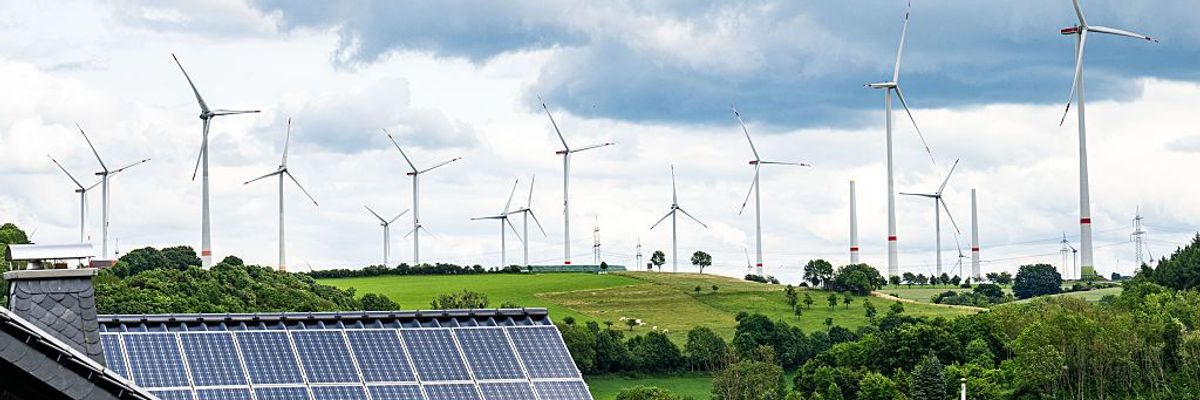
Houses in the so-called ‘smart city’ of Etteln, Germany, are seen equipped with solar panels on the roofs on June 6, 2025. (Photo by David Inderlied/picture alliance via Getty Image

“If we choose to stay on the current path—powering our economies with fossil fuels, extracting virgin resources, destroying nature, polluting the environment—the damages would stack up.”

A new report from the United Nations Environment Program has found that addressing the global climate emergency would deliver major economic benefits, in addition to creating a cleaner and more habitable planet.

The seventh edition of the Global Environmental Outlook (GEO), released on Tuesday, estimates that making up-front investments in climate action now would begin to yield global macroeconomic benefits starting in 2050, potentially growing to $20 trillion per year by 2070 and $100 trillion by 2100.

RECOMMENDED…

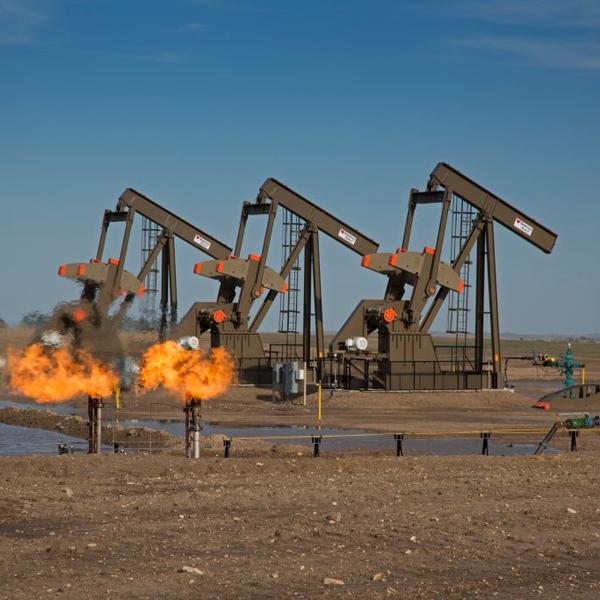
Natural Gas is Burned During Oil Production in North Dakota's Bakken Shale

‘Little to No Measurable Progress’ on Climate as World on Track for 2.6°C: Report

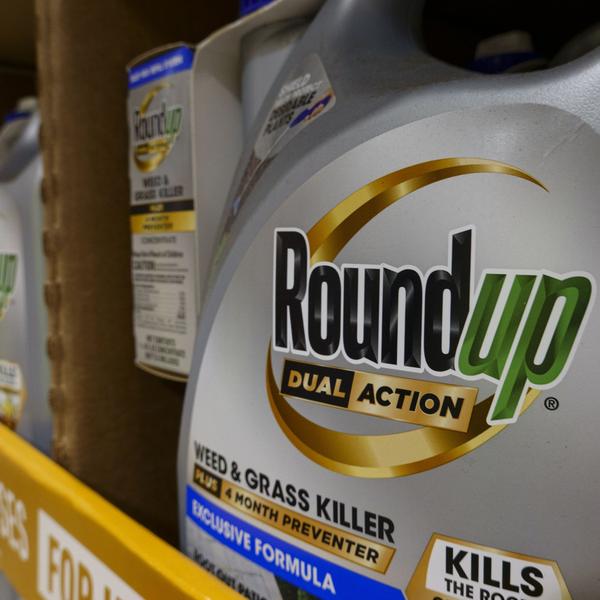
Roundup Weed And Grass Killer At Costco Wholesale

Trump DOJ Sides With Roundup Manufacturer Over Cancer Victims in Supreme Court Case

The report, which was the product of nearly 300 multi-disciplinary scientists across more than 80 countries, argues that a total of $8 trillion in annual investment from this year until 2050 would be needed to achieve its climate goals. But, the report stresses, the cost of inaction would be far greater.

“If we choose to stay on the current path—powering our economies with fossil fuels, extracting virgin resources, destroying nature, polluting the environment—the damages would stack up,” the report warns. “Climate change would cut 4% off annual global GDP by 2050, claim many lives, and increase forced migration.”

Other likely consequences of inaction, warns the report, include “Amazon forest dieback and ice-sheet collapse,” along with the loss of “hundreds of millions more hectares of natural lands.” The report also projects that global food availability will fall if the climate crisis is not addressed, and that increased air pollution will cause an additional 4 million premature deaths per year.

The report recommends a rapid move away from fossil fuels, as well as a drastic rethinking of agricultural subsidies so that they no longer “directly favor activities that have significant harmful effects on the environment, including on biodiversity.”

Robert Watson, a co-chair of the GEO assessment, said in an interview with the Guardian that the climate crisis cannot simply be seen as an environmental issue given that it is now “undermining our economy, food security, water security, human health,” and also creating national security problems by increasing “conflict in many parts of the world.”

In an interview with BBC, Watson also accused US President Donald Trump’s administration of sabotaging the report by refusing to even accept its conclusions about the damage being done by human-induced climate change.

“The US decided not to attend the meeting at all,” he explained. “At the very end they joined by teleconference and basically made a statement that they could not agree with most of the report, which means they didn’t agree with anything we said on climate change, biodiversity, fossil fuels, plastics, and subsidies.”

Original article by Brad Reed republished from Common Dreams under Creative Commons (CC BY-NC-ND 3.0).
Donald Trump urges you to be a Climate Science denier like him. He says that he makes millions and millions for destroying the planet, Burn, Baby, Burn and Flood, Baby, Flood.
Nigel Farage urges you to ignore facts and reality and be a climate science denier like him and his Deputy Richard Tice. He says that Reform UK has received £Millions and £Millions from the fossil fuel industry to promote climate denial and destroy the planet.
Elon Musk urges you to be a Fascist like him, says that you can ignore facts and reality then.

Continue ReadingUN Report Estimates Bold Climate Action Would Deliver $100 Trillion in Benefits by 2100

Global wheat yields would be ‘10%’ higher without climate change

Spread the love

Original article by Orla Dwyer republished from Carbon Brief under a CC license.

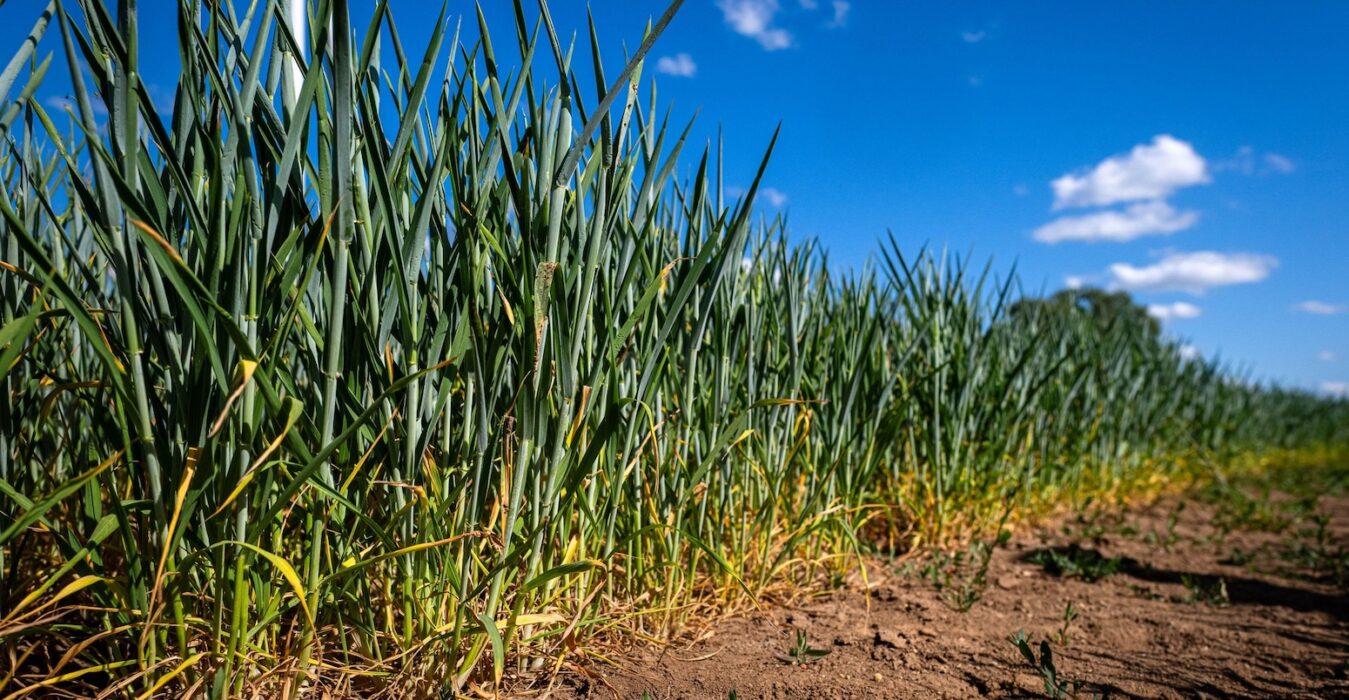
Wheat affected by drought conditions in Bremen, Germany in May 2025. Credit: dpa picture alliance / Alamy Stock Photo.

Global yields of wheat are around 10% lower now than they would have been without the influence of climate change, according to a new study. 

The research, published in the Proceedings of the National Academy of Sciences, looks at data on climate change and growing conditions for wheat and other major crops around the world over the past 50 years. 

It comes as heat and drought have this year been putting wheat supplies at risk in key grain-producing regions, including parts of Europe, China and Russia. 

The study finds that increasingly hot and dry conditions negatively impacted yields of three of the five key crops examined. 

Overall, global grain yields soared during the study period due to technological advancements, improved seeds and access to synthetic fertilisers. 

But these yield setbacks have “important ramifications for prices and food security”, the study authors write. 

Grain impacts 

Most parts of the world have experienced “significant” yield increases in staple crops since the mid-20th century. 

The new study notes that, in the past 50 years, yields increased by 69-123% for the five staple crops included in the research – wheat, maize, barley, soya beans and rice. 

But crop production is increasingly threatened by climate change and extreme weather. A 2021 study projected “major shifts” in global crop productivity due to climate change within the next two decades.

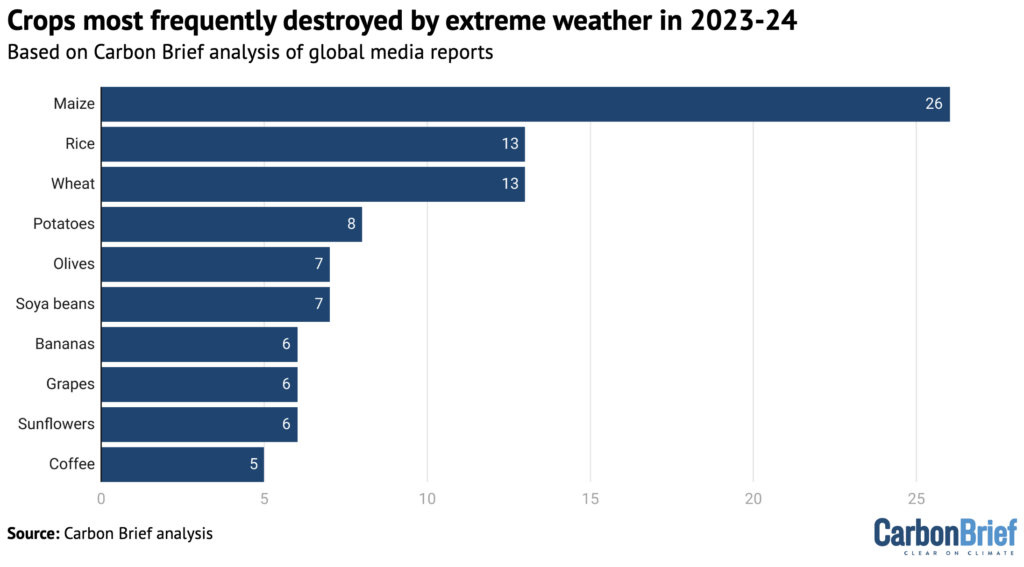
Earlier this year, Carbon Brief mapped out news stories of crops being destroyed around the world by heat, drought, floods and other weather extremes in 2023-24. Maize and wheat were the crops that appeared most frequently in these reports. 

The crops that appeared most frequently in media reports of extreme weather impacts analysed by Carbon Brief, ranked in order of most to least frequent: maize, wheat, rice, potatoes, soya beans, olives, bananas, grapes, sunflowers and coffee. Credit: Carbon Brief.

Hot and dry weather is currently threatening wheat crops in parts of China, the world’s largest wheat producer, Reuters reported this month.

In the UK, wheat crops are struggling amid the “driest start to spring in England for almost 70 years”, the Times recently reported. Farm groups say some crops are already failing, the Guardian said. 

As a result, global wheat supplies are “tight”, according to Bloomberg, with price rises possible depending on weather conditions in parts of Europe, China and Russia. 

Food security and prices

The study uses climate datasets, modelling and national crop statistics from the UN Food and Agriculture Organization to assess crop production and climate trends in key grain-producing countries over 1974-2023, including Argentina, Brazil, Canada, China, the EU, Russia and the US. 

The researchers assess climate observations and then use crop models to calculate what yields would have been with and without these climate changes. 

For example, “if it has warmed 1C over 50 years and the model says that 1C leads to 5% yield loss, we’d calculate that the warming trend caused a loss of 5%”, Prof David Lobell, the lead study author and a professor at Stanford University, tells Carbon Brief. 

The study looks at two reanalysis climate datasets that include information on temperature and rainfall over the past 50 years: TerraClimate (TC) and ERA5-Land. (Reanalysis data combines observations with a modern forecasting model.)

The researchers find that yields of three of the five crops are lower than they would have been without warmer temperatures and other climate impacts in the past 50 years. 

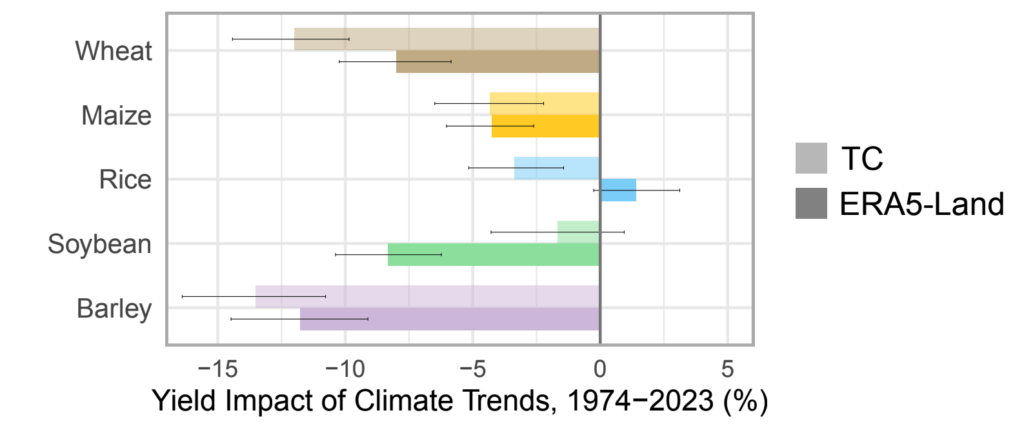
Yields were lower than they otherwise would have been by 12-14% for barley, 8-12% for wheat and 4% for maize. 

The impacts on soya beans were less clear as there were “significant differences” between data sources. But both datasets show a negative impact on yields, ranging from 2% to 8%.

The effects on rice yields were inconclusive, with one dataset showing a positive effect of around 1% while the other showed a negative effect of about 3%.   

The chart below shows the estimated yield impacts for each crop based on the calculations from the two climate datasets.

The estimated percentage impact of climate factors on yields of wheat (brown), maize (yellow), rice (blue), soya bean (green) and barley (purple) from 1974-2023, using two different historical climate datasets. Source: Lobell et al. (2025).

Given soaring overall crop yields during this time, impacts of 4-13% “may seem trivial”, the researchers write. But, they say, it can have “important ramifications for prices and food security” given growing food demand, noting: 

“The overall picture of the past half-century is that climate trends have led to a deterioration of growing conditions for many of the main grain-producing regions of the world.” 

Water stress and heat

The study also assesses the impacts that warming and vapour pressure deficit – a key driver of plant water stress – have on crop yields. 

Vapour pressure deficit is the difference between the amount of water vapour in the air and the point at which water vapour in the air becomes saturated. As air becomes warmer, it can hold more water vapour. 

A high deficit can reduce plant growth and increase water stress. The models show that these effects may be the main driver of losses in grain yield, with heat having a more “indirect effect”, as higher temperatures drive water stress. 

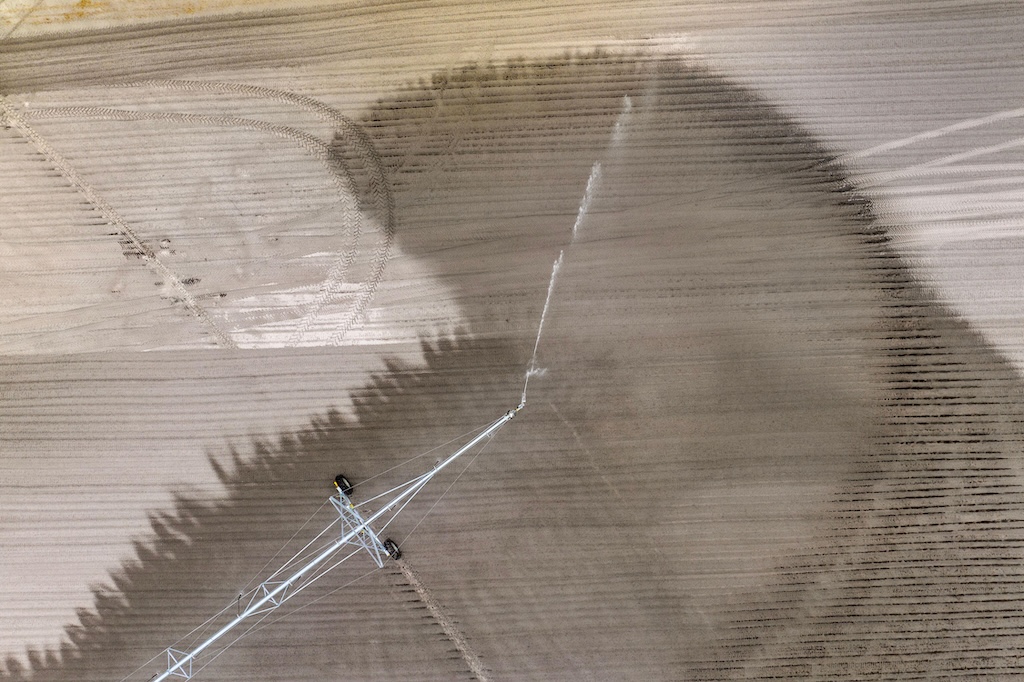
Agricultural irrigation system watering dry soil on a crop field in the US. Credit: Andrii Biletskyi / Alamy Stock Photo. Image ID: 3AKGHEX.
Agricultural irrigation system watering dry soil on a crop field in the US. Credit: Andrii Biletskyi / Alamy Stock Photo.

The study finds that vapour pressure deficit increased in most temperate regions in the past 50 years. 

The researchers compare their data to climate modelling simulations covering the past 50 years. They find largely similar results, but notice a “significant underestimation” of vapour pressure deficit increases in temperate regions in most climate models. 

Many maize-growing areas in the EU, China, Argentina and much of Africa have vapour deficit trends that “exceed even the highest trend in models”, they write. 

The researchers also find that most regions experienced “rapid warming” during the study period, with the average crop-growing season now warmer than more than 80% of growing seasons 50 years ago. 

The findings indicate that, in some areas, “even the coolest growing season in the present day is warmer than the warmest season that would have occurred 50 years ago”. 

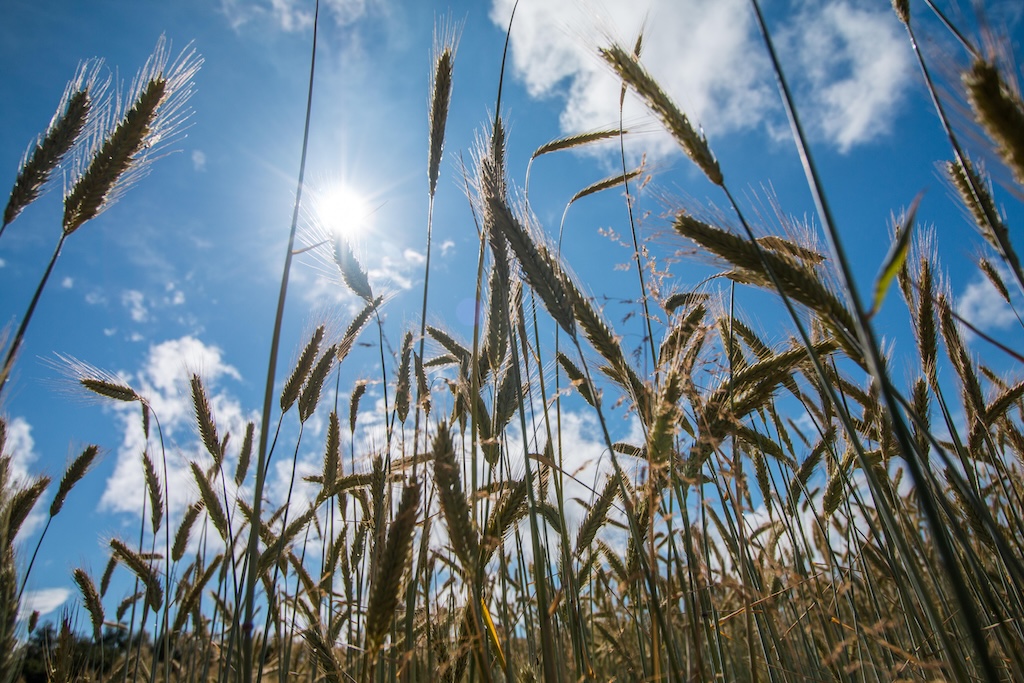
Wheat growing in a field. Credit: Jon Freeman / Alamy Stock Photo. Image ID: EXYNXR.
Wheat growing in a field. Credit: Jon Freeman / Alamy Stock Photo.

An exception to this is in the US and Canada, they find, with most maize and soya bean crop areas in the US experiencing lower levels of warming than other parts of the world and a “slight cooling” in wheat-growing areas of the northern Great Plains and central Canada.

(The central US has experienced a cooling trend in summer daytime temperatures since the middle of the 20th century, according to the National Oceanic and Atmospheric Administration. There are many theories behind this “warming hole”, which has continued despite climate change.) 

CO2 greening 

Dr Corey Lesk, a postdoctoral researcher at Dartmouth College who studies the impacts of climate on crops, says these findings are in line with other recent estimates. He tells Carbon Brief: 

“There are some uncertainties and sensitivity to model specification here – but it’s somewhat likely climate change has already reduced crop yields in the global mean.” 

The study’s “main limitation” is that it is “behind” on including certain advances in understanding how soil moisture impacts crops, Lesk adds: 

“Moisture changes and CO2 [carbon dioxide] effects are the largest present uncertainties in past and future crop impacts of climate change. This paper is somewhat limited in advancing understanding on those aspects, but it’s illuminating to pause and take stock.”

The research looks at whether the benefits of CO2 increases during the past 50 years exceed the negative effects of higher levels of the greenhouse gas. 

Rising CO2 levels can boost plant growth in some areas in a process called “CO2 fertilisation”. However, a 2019 study found that this “global greening” could be stalled by growing water stress. 

Yield losses for wheat, maize and barley “likely exceeded” any benefits of CO2 increases in the past 50 years, the study finds. 

The opposite is true for soya beans and rice, they find, with a net-positive impact of more than 4% on yields. 

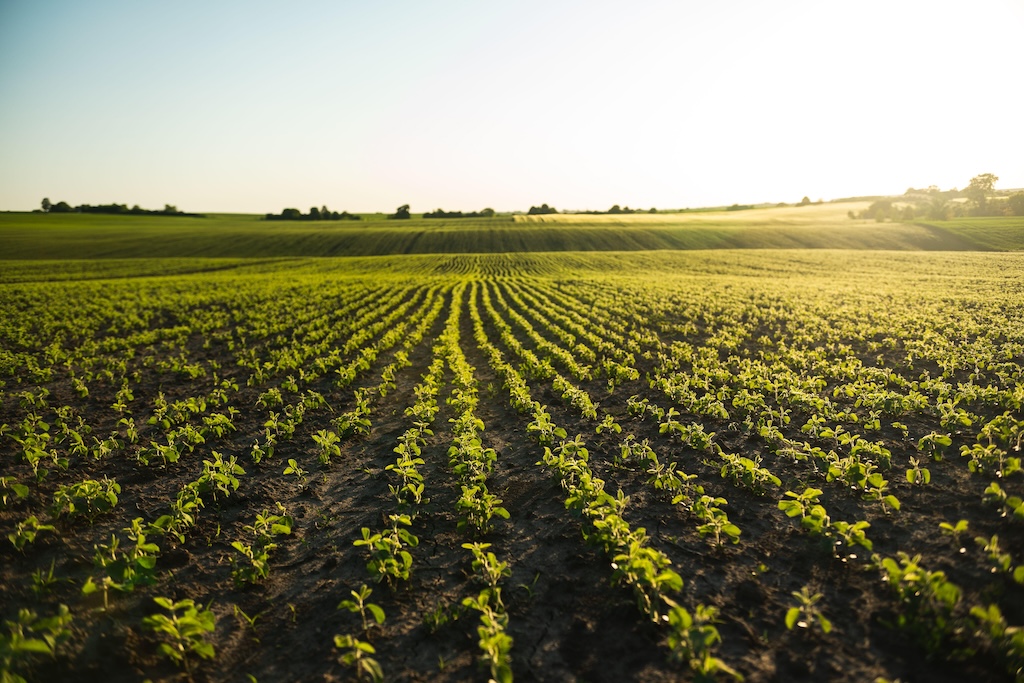
Soya beans growing in a field. Credit: Volodymyr Shtun / Alamy Stock Photo. Image ID: 3B84F7G.
Soya beans growing in a field. Credit: Volodymyr Shtun / Alamy Stock Photo.

Climate science has “done a remarkable job of anticipating global impacts on the main grains and we should continue to rely on this science to guide policy decisions”, Lobell, the lead study author, says in a press release

He adds that there may be “blind spots” on specialised crops, such as coffee, cocoa, oranges and olives, which “don’t have as much modelling” as key commodity crops, noting: 

“All these have been seeing supply challenges and price increases. These matter less for food security, but may be more eye-catching for consumers who might not otherwise care about climate change.”

 Lobell et al. (2025), A half-century of climate change in major agricultural regions: Trends, impacts, and surprises, Proceedings of the National Academy of Sciences, doi:10.1073/pnas.2502789122

Original article by Orla Dwyer republished from Carbon Brief under a CC license.

Neo-Fascist Climate Science Denier Donald Trump says Burn, Baby, Burn.
Orcas discuss Donald Trump and the killer apes' concept of democracy. Front Orca warns that Trump is crashing his country's economy and that everything he does he does for the fantastically wealthy.
Orcas discuss Donald Trump and the killer apes’ concept of democracy. Front Orca warns that Trump is crashing his country’s economy and that everything he does he does for the fantastically wealthy.
Continue ReadingGlobal wheat yields would be ‘10%’ higher without climate change