“The US and Israel should stop waging and expanding wars, and considering themselves as above international legality.”
A dozen United Nations experts on Thursday denounced the United States and Israel for waging wars of aggression against Iran and Lebanon, a statement that contrasted sharply with a UN Security Council resolution adopted hours earlier condemning Iranian retaliation without mentioning the US-Israeli bombing campaign.
“The US and Israel should stop waging and expanding wars, and considering themselves as above international legality,” said the group of experts. The statement’s signatories include Francesca Albanese, special rapporteur on human rights in the Palestinian territory and a target of US sanctions; Balakrishnan Rajagopal, special rapporteur on adequate housing; and Michael Fakhri, special rapporteur on the right to food.
The experts decried US President Donald Trump’s push for the Iranian government’s “unconditional surrender” and regime change, warning that such demands could “lead to prolonged war and enormous human suffering.”
“No violations of human rights in Iran or elsewhere provide any legal or moral justification for an unwarranted interference with the sovereignty of a UN member state and an illegal attack,” the experts said. “Any loss of life in an illegal war is a violation of the right to life.”
UN experts denounce aggression on Iran & Lebanon, warn of devastating regional escalation: "U.S. and Israel should stop waging and expanding wars, and considering themselves as above international legality”.https://t.co/yYhNfFUMvNpic.twitter.com/8Qv4OSeVEr
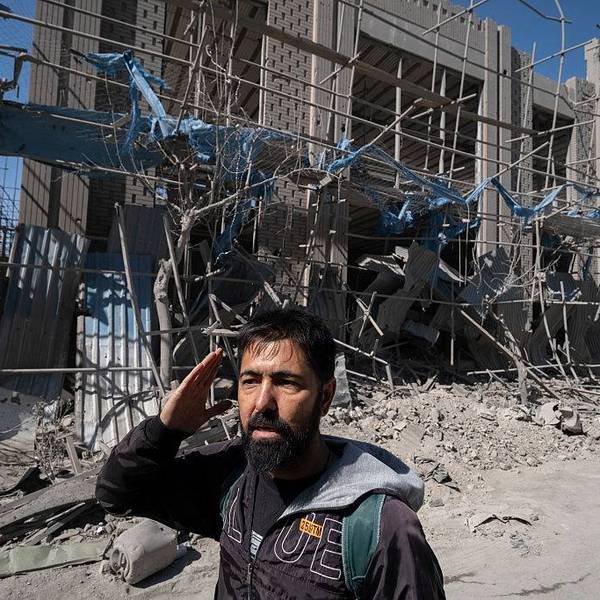
The statement came as evidence of US-Israeli war crimes in Iran and Lebanon continued to mount and the humanitarian crisis sparked by the regional war intensified, with millions already displaced and around 2,000 killed—including many children.
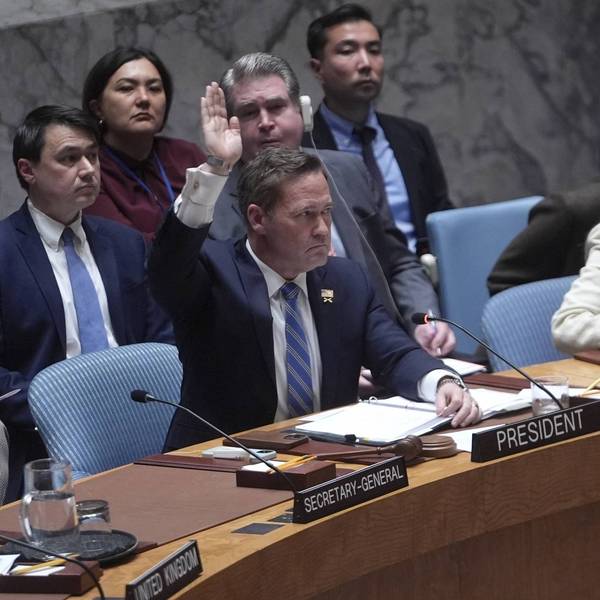
On Wednesday, the UN Security Council adopted by a vote of 13-0 a resolution condemning “in the strongest terms the egregious attacks by the Islamic Republic of Iran against the territories of Bahrain, Kuwait, Oman, Qatar, Saudi Arabia, the United Arab Emirates, and Jordan,” countries that host US military installations. Russia and China abstained from voting on the resolution, which did not condemn or mention the ongoing US-Israeli bombing.
Amir Saeid Iravani, Iran’s ambassador to the UN, told reporters at UN Headquarters in New York on Thursday that “yesterday was a shameful day for the Security Council.”
“Those members, especially Western, who constantly assert their commitment to protecting civilians, especially children, proved that these claims are little more than empty rhetoric,” said Iravani. “They were unwilling even to condemn—or express concern over—the heinous crimes committed by the United States and Israel against innocent people in Iran, including the massacre of 170 girl students at a school in Minab.”
Orcas discuss how Trump was re-elected and him being an obviously insane, xenophobic Fascist.Donald Fuhrump says that Amerikkka doesn’t bother with crimes or charges anymore, not being 100% Amerikkkan and opposing his real estate intentions is enough.Elon Musk urges you to be a Fascist like him, says that you can ignore facts and reality then.
This work by Middle East Monitor is licensed under a Creative Commons Attribution-NonCommercial-ShareAlike 4.0 International License.
UN Special Rapporteur on Palestine Francesca Albanese holds a press conference at the lower house of the Italian Parliament, the Chamber of Deputies, to present her new report titled “Genocide in Gaza: A Collective Crime” in Rome, Italy on February 03, 2026. [Barış Seçkin – Anadolu Agency]
Francesca Albanese has become one of the most polarising figures in contemporary diplomacy, not because she commands armies or signs treaties, but because she insists on describing what she sees. Since assuming her mandate as United Nations Special Rapporteur on the situation of human rights in the Palestinian territories in 2023, the Italian jurist has delivered reports that cut through diplomatic euphemism with the precision of a scalpel.
In her October 2024 report to the General Assembly, pointedly titled Genocide as Colonial Erasure, she concluded there were ‘reasonable grounds’ to believe that Israel’s conduct in Gaza met the legal threshold of genocide and formed part of a ‘century-long project of eliminatory settler-colonialism’. Few phrases in international law carry such moral weight. Fewer still are uttered so plainly in the marble halls of New York and Geneva.
The reaction was immediate and ferocious. Israeli officials labelled her ‘one of the most antisemitic figures in modern history’. France, Germany, Italy, Austria and the Czech Republic publicly called for her removal after a February 2026 address to a Doha forum in which she condemned ‘the planning and making of a genocide’ in Gaza and decried the complicity of states that had armed and politically shielded Israel since October 2023 (a speech later distorted through a truncated clip that falsely claimed she had labelled Israel “the common enemy of humanity,” a narrative she categorically rejected).
The edited clip of that speech ricocheted across social media, falsely suggesting she had called Israel ‘the common enemy of humanity’. She responded with weary clarity: the ‘common enemy’, she said, was the system — financial capital, algorithms and weapons — that enables atrocities, not a people or a state.
The United Nations moved swiftly to defend the independence of its mandate.
Special rapporteurs, a spokesperson reminded reporters, are not political appointees but independent experts commissioned by the Human Rights Council and protected by UN privileges and immunities.
Reuters noted there is no precedent for removing a rapporteur mid-term, and diplomats privately concede such an attempt would likely fail. Yet the calls for her resignation were not merely procedural skirmishes.
They were signals — about who is permitted to speak, and how far the language of international law may stretch before it snaps under political strain.
What makes Albanese’s work so unsettling to some capitals is not only the gravity of her conclusions, but the breadth of her analysis. In her 2025 Human Rights Council report, she traced what she termed a shift ‘from economy of occupation to economy of genocide’, mapping the corporate and financial networks that sustain settlement expansion and military operations.
She placed Western governments within that ecosystem, arguing that political cover and arms transfers had ‘stabbed international law in the heart’.
Amnesty International echoed this concern, warning that silencing her would distract from ‘Israel’s genocide in Gaza, its system of apartheid and unlawful occupation’.
Whether one agrees with her characterisation or not, the data underpinning the crisis are sobering. By late 2025, Gaza’s health authorities and UN agencies reported tens of thousands of Palestinians killed since October 2023, with vast swathes of housing, hospitals and water infrastructure destroyed. The World Bank estimated economic contraction in Gaza exceeding 80 per cent. UNICEF described levels of child malnutrition unseen in decades. These figures are not rhetorical flourishes; they are the raw arithmetic of devastation.
They form the backdrop to South Africa’s genocide case before the International Court of Justice and to repeated UN General Assembly resolutions demanding a ceasefire and humanitarian access.
Across global capitals, the language of a “rules-based order” is spoken with conviction. Yet those words hollow out when rules are applied selectively. If international law binds adversaries but spares allies, it ceases to be law and becomes leverage.
The strength of the global system rests on independent scrutiny. When UN experts can be undermined through doctored clips, coordinated outrage and political pressure, the foundations of accountability begin to shake. Today it is Gaza. Tomorrow it could be Ukraine, Myanmar, Sudan, or any conflict where truth unsettles power. Disinformation does not respect borders. Precedents travel fast. If the world tolerates the silencing of inconvenient investigators, it signals that multilateralism is conditional — firm in rhetoric, fragile in practice.
Trust erodes. Cynicism grows. The Global South watches and remembers.
Defending independent mandates is not an attack on any state. It is a defence of the very order governments claim to uphold. If the guardians of international law bend it when tested, the damage will not stay confined to one region. It will echo wherever justice depends on courage rather than convenience.
There is, of course, genuine sensitivity in Europe, shaped by the Holocaust and by the resurgence of antisemitism. Albanese herself has apologised for past remarks that were widely criticised. These complexities demand care.
Yet conflating sharp legal criticism of a state’s conduct with hatred of a people risks trivialising real antisemitism and impoverishing serious debate. The joint statement of 116 human rights organisations condemning what they described as a ‘targeted smear campaign’ warned that such tactics threaten freedom of expression and the integrity of UN mechanisms.
The UN human rights office has observed an alarming rise in personal attacks and misinformation directed at independent experts.
International relations theory offers several lenses through which to view this moment. Realists see states defending allies and interests. Liberals see institutions under strain. Constructivists note how narratives of historical trauma and identity shape policy reflexes. Yet beyond theory lies a simpler question: can the international system tolerate uncomfortable truths when they implicate powerful actors?
Albanese’s language is undeniably stark. She speaks of apartheid, of settler colonialism, of genocide. For some diplomats, such words close doors. For others, they are the only vocabulary adequate to the scale of suffering. History suggests that terms once dismissed as inflammatory — apartheid in South Africa, ethnic cleansing in the Balkans — can become anchors for accountability.
The 1963 UN Special Committee against Apartheid was once derided as politicised; it later formed part of the scaffolding that supported global sanctions and eventual transition.
The future of Gaza and Palestine will not be secured by rhetoric alone. Reconstruction will require tens of billions of dollars, credible governance reform within Palestinian institutions, security guarantees for Israel, and a political horizon that restores dignity and agency to Palestinians. A common argument is that the absence of a viable political process will simply harden cycles of violence. Sustainable development in the region hinges on accountability and inclusion; impunity breeds instability.
There is space here for Australian diplomacy — measured, principled, pragmatic. Supporting humanitarian ceasefire efforts, backing the independence of international courts, conditioning arms exports on compliance with international humanitarian law, and investing in Palestinian civil society are not radical steps. They are consistent with long-stated commitments. A middle power need not shout to be heard; it must simply be consistent.
Francesca Albanese’s tenure has illuminated an uncomfortable paradox. The United Nations is often criticised as toothless, yet when one of its independent experts speaks with legal bluntness, the reaction suggests that words still matter. Attempts to sideline her have so far failed, not because she is beyond reproach, but because the mandate she holds embodies a principle larger than any individual: that human rights scrutiny must not bend to political convenience.
For a global audience weary of endless conflict, the path to a better future for Gaza and Palestine lies not in silencing dissenting voices but in confronting evidence with honesty. The credibility of the international system — and of those states that claim to steward it — depends on that courage.
In the end, the debate is less about one rapporteur than about whether the promise of ‘never again’ retains meaning when tested by the tragedies of the present.
The views expressed in this article belong to the author and do not necessarily reflect the editorial policy of Middle East Monitor.
This work by Middle East Monitor is licensed under a Creative Commons Attribution-NonCommercial-ShareAlike 4.0 International License.
Genocide denier and Current UK Prime Minister Keir Starmer is quoted that he supports Zionism without qualification. He also confirms that UK air force support has been essential in Israel’s mass-murdering genocide. Includes URLs https://www.declassifieduk.org/keir-starmers-100-spy-flights-over-gaza-in-support-of-israel/ and https://youtu.be/O74hZCKKdpAKeir Starmer objects to criticism of the IDF. He asks how could anyone object to them starving people to death, forced marches like the Nazis did, bombing Gaza’s hospitals and universities, mass-murdering journalists, healthworkers and starving people queuing for food, killing and raping prisoners and murdering children. He calls for people to stop obstructing his genocide for Israel.Orcas discuss Genocide-supporting and complicit Zionists. Donald Trump, Keith Starmer, David Lammy, Rachel Reeves, Angela Rayner and Wes Streeting are acknowledged as evil genocide-complicit and supporting cnuts.
This work by Middle East Monitor is licensed under a Creative Commons Attribution-NonCommercial-ShareAlike 4.0 International License.
Francesca Albanese UN Special Rapporteur gives a speech in Bogota, Colombia, on July 15, 2025. [Juancho Torres – Anadolu Agency]
The UN Special Rapporteur on human rights in the Palestinian territories, Francesca Albanese, has refused calls to resign and rejected criticism from states that fail to condemn genocide in Palestine. She stressed that she will not accept “lessons from countries that violate international law and fail to condemn genocide.”
Earlier on Wednesday, French Foreign Minister Jean-Noel Barrot called for the resignation of the UN rapporteur over comments she made allegedly targeting Israel at a conference on Gaza.
In an interview with Al Jazeera Mubasher, she urged Western governments to discuss the reports she has submitted on alleged Israeli violations, rather than target her personally. She said the debate should focus on the content of her reports, not on her as an individual.
Albanese stated that she is facing what she described as a smear campaign because of her condemnation of what she called Israel’s genocidal war in Gaza and the West Bank. She said: “The campaign of attack against me is nothing compared to the genocide suffered by the Palestinians.”
Responding to accusations that she had exceeded her UN mandate, Albanese said she had not overstepped her authority. She argued that the intensity of the criticism reflects the impact of her human rights work.
She also said she does not receive a salary for her role and that she has faced personal pressure and sanctions. However, she added that she draws strength from the suffering of Palestinians, especially mothers in Gaza, and that she seeks to inspire others to stand up for justice.
In a related development, Albanese said remarks by French Foreign Minister Jean-Noel Barrot confirmed her position on what she described as “special protection for Israel”. She said he should have condemned Israeli crimes instead of attacking her.
This work by Middle East Monitor is licensed under a Creative Commons Attribution-NonCommercial-ShareAlike 4.0 International License.
Genocide denier and Current UK Prime Minister Keir Starmer is quoted that he supports Zionism without qualification. He also confirms that UK air force support has been essential in Israel’s mass-murdering genocide. Includes URLs https://www.declassifieduk.org/keir-starmers-100-spy-flights-over-gaza-in-support-of-israel/ and https://youtu.be/O74hZCKKdpAKeir Starmer objects to criticism of the IDF. He asks how could anyone object to them starving people to death, forced marches like the Nazis did, bombing Gaza’s hospitals and universities, mass-murdering journalists, healthworkers and starving people queuing for food, killing and raping prisoners and murdering children. He calls for people to stop obstructing his genocide for Israel.Orcas discuss Genocide-supporting and complicit Zionists. Donald Trump, Keith Starmer, David Lammy, Rachel Reeves, Angela Rayner and Wes Streeting are acknowledged as evil genocide-complicit and supporting cnuts.
Genocide denier and Current UK Prime Minister Keir Starmer is quoted that he supports Zionism without qualification. He also confirms that UK air force support has been essential in Israel’s mass-murdering genocide. Includes URLs https://www.declassifieduk.org/keir-starmers-100-spy-flights-over-gaza-in-support-of-israel/ and https://youtu.be/O74hZCKKdpAKeir Starmer objects to criticism of the IDF. He asks how could anyone object to them starving people to death, forced marches like the Nazis did, bombing Gaza’s hospitals and universities, mass-murdering journalists, healthworkers and starving people queuing for food, killing and raping prisoners and murdering children. He calls for people to stop obstructing his genocide for Israel.Orcas discuss Genocide-supporting and complicit Zionists. Donald Trump, Keith Starmer, David Lammy, Rachel Reeves, Angela Rayner and Wes Streeting are acknowledged as evil genocide-complicit and supporting cnuts.
Francesca Albanese, United Nations special rapporteur on the Occupied Palestinian Territories (left) and (right) Robert Jenrick
The Morning Star sorts the good eggs from the rotten scoundrels of the year just gone
Heroes
The Birmingham Bin Strikers
…
Their struggle matters to us all: the largest local authority in the country seeks to tackle its financial problems by attacking the pay and conditions of its workforce, and if it gets away with it other councils will follow suit.
…
Francesca Albanese
…
Sanctioned by US Secretary of State Marco Rubio in revenge for her UN report From an Economy of Occupation to an Economy of Genocide, her bank accounts have been frozen, and this UN special rapporteur is blacklisted and barred from the international banking system like a terrorist, forcing her to manage all transactions in cash.
…
The Palestine solidarity movement
So many people deserve special mentions, but the entire movement must be honoured: the heroic hunger strikers putting their lives on the line for justice; the thousands risking 14-year prison terms to expose the absurdity of the government’s ban on Palestine Action by sitting down peacefully in public; the leading peace activists arrested and charged for organising mass demonstrations, including Palestine Solidarity Campaign director Ben Jamal and Stop the War Coalition vice-chair Chris Nineham; the millions who have marched or fundraised or spread the word about a genocide, who forced Trump to tell Netanyahu in October that he cannot “fight the world” and must concede a ceasefire.
…
The Campaign for Nuclear Disarmament
…
Under its new leader Sophie Bolt, CND has stepped up to the challenge across 2025, holding a tour bringing the arguments against rearmament to military bases across Britain and a fortnight’s peace camp in protest at Britain’s return to being Washington’s Air Strip One.
…
Villains
“Tommy Robinson”
Stephen Yaxley-Lennon has disfigured the British political scene for years but 2025 has seen ominous new developments, from his sponsorship by the world’s richest man — far-right megalomaniac Elon Musk — to the largest far-right demonstration in British history that brought well over 100,000 onto the streets of London in September.
…
Sarah Pochin and Robert Jenrick
…
These two deserve public shaming for pushing the boundaries of explicit racism in public life: Pochin by complaining about the number of black people on telly and Jenrick with his no-white-faces-in-Handsworth drivel. Pure poison from two politicians we need to see the back of as soon as possible.
David Lammy
…
Lammy, because the so-called Justice Secretary is presiding over horrendous abuses of justice — refusing to meet lawyers for the Palestine Action hunger strikers, who are being held for months and years behind bars without trial, and now planning the withdrawal of the right to jury trials just as the police are getting into gear with mass arrests of obviously innocent people.
Donald Trump
…
The White House declares active support for far-right movements across the world (particularly in Europe), expresses open contempt for international law, blows up boats, killing their crews, in a murderous rampage across the Caribbean while seizing Venezuelan tankers in acts of naked piracy. And all while moving closer to war.
In the Middle East, Trump breaks new ground by publicly endorsing the ethnic cleansing of Palestine and has already joined a direct Israeli attack on Iran — just days ago he mooted another.
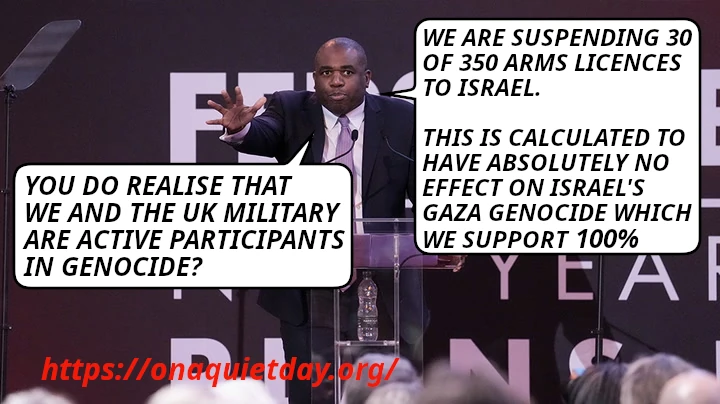
Orcas discuss Genocide-supporting and complicit Zionists. Donald Trump, Keith Starmer, David Lammy, Rachel Reeves, Angela Rayner and Wes Streeting are acknowledged as evil genocide-complicit and supporting cnuts.Keir Starmer objects to criticism of the IDF. He asks how could anyone object to them starving people to death, forced marches like the Nazis did, bombing Gaza’s hospitals and universities, mass-murdering journalists, healthworkers and starving people queuing for food, killing and raping prisoners and murdering children. He calls for people to stop obstructing his genocide for Israel.Genocide denying UK Foreign Secretary David Lammy says that UK is suspending 30 of 350 arms licences to Israel. He also confirms the UK government’s support for Israel’s Gaza genocide and the UK government and military’s active participation in genocide.


 Francesca Albanese, United Nations special rapporteur on the Occupied Palestinian Territories (left) and (right) Robert Jenrick