‘Unacceptable’: Campaigners Decry Climate Finance Failures as COP29 Enters Final Hours

Spread the love

Original article by Eloise Goldsmith republished from Common Dreams under Creative Commons (CC BY-NC-ND 3.0).
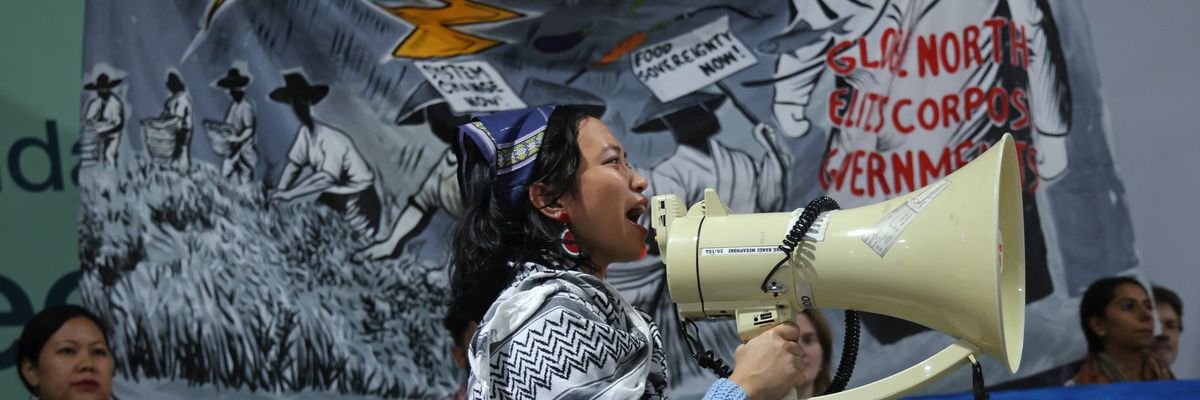
Activists demonstrate against industrial agriculture and agribusiness lobbyists on day eight at the UNFCCC COP29 Climate Conference on November 19, 2024 in Baku, Azerbaijan. (Photo by Sean Gallup/Getty Images)

“By the end of the UN climate talks, we must see at least a trillion dollars in public finance on the table,” said one campaigner.

As the clock winds down at the UN climate summit taking place in Baku, Azerbaijan, green groups are sounding the alarm Thursday following the release of a draft climate finance deal that they say falls short of what’s needed to support climate-vulnerable countries and adequately address the planetary crisis.

“The clock is ticking. COP29 is now down to the wire,” said UN Secretary-General António Guterres on Thursday, just a day before the two-week conference is set to conclude.

Finance has been a major focus of this year’s summit. Under the 20125 Paris Agreement, countries are supposed to come up with a “new collective quantified goal”—or NCQG in COP jargon—that will govern how much money from rich countries will be transferred to developing countries in order to help the latter cut their emissions and adapt to climate change.

No equivalent climate finance arrangement has been agreed to before, though countries at the summit broadly agree that richer countries, who are responsible for much of historic CO2 emissions, should help poorer and more climate-vulnerable nations deal with natural disasters and their transition to green energy.

The draft text that dropped early Thursday, however, was received poorly.

Oxfam International’s climate justice lead, Safa’ Al Jayoussi, said “COP29 must do more than simply repeat the same threadbare promises. Rich countries have spent decades now stalling and blocking genuine progress on climate finance. This has left the Global South suffering the most catastrophic consequences of a climate crisis they did not create. The draft text scandalously misses the crucial element of declaring a clear public commitment to a new climate finance goal.”

Instead of specifying how much annually should be funneled towards developing countries via climate finance, the NCQG draft text displayed “X” in place of any actual figures or monetary commitments.

Oscar Soria, a director at the Common Initiative think tank, told the Guardian: “The negotiating placeholder ‘X’ for climate finance is a testament of the ineptitude from rich nations and emerging economies that are failing to find a workable solution for everyone.”

“By the end of the UN climate talks, we must see at least a trillion dollars in public finance on the table,” added Andreas Sieber, 350.org associate director of policy and campaigns. Economists told the summit attendees last week that developing countries need at least $1 trillion annually by 2030 to deal with climate change.

A specific and shared concern from campaigners was the draft text’s inclusion of carbon market schemes as a way “to scale up” climate finance. While the draft promotes “high-integrity voluntary carbon markets” and other “instruments that mobilize new sources of climate finance and private finance” as part of the equation, critics have long warned that these market-based approaches are nothing but false solutions designed to benefit corporate investors, wealthier nations, and the fossil fuel industry itself.

“Labelling carbon credits as climate finance—which they are unreservedly not—should be axed from the text or risk creating a dangerous escape route for polluters. The same goes for explicitly allowing investments in fossil fuel infrastructure. This is fundamentally incompatible with the goals of the Paris Agreement,” said Laurie van der Burg, Oil Change International’s global public finance manager, in response to the draft text.

While Article 6 of the Paris Agreement allows for the international transfer of carbon credits, groups warned the changes in the COP29 draft would dramatically strengthen the foothold of such schemes.

“Shockingly, COP29 is set to agree to carbon markets that are even worse than the voluntary carbon markets,” said Kirtana Chandrasekaran, a climate campaigner with Friends of the Earth International. “We know these markets have failed. They are riddled with fraud and they do not reduce emissions or provide finance. Communities everywhere and, in fact, the planet itself is on the line.”

Without addressing these concerns, advocates of a meaningful deal at the conference say COP29 is headed for failure.

As 350.org‘s Sieber argued, paying the “historic debt that rich countries owe will enable all nations to take action on climate at home and meet the collective goal agreed last year at COP28—to triple renewable energy, and transition away from fossil fuels. Right now, we only see cowardice and a void in leadership, ignoring the undeniable science that we can’t keep polluting our planet with dirty oil, gas and coal.”

“The time to course correct is now—the European Union and other rich countries must stop playing poker with the planet and humankind’s future at stake,” Sieber added. “It’s time to put their cards on the table and commit real, transformative funding—no more excuses, no more delays, it’s time.”

Original article by Eloise Goldsmith republished from Common Dreams under Creative Commons (CC BY-NC-ND 3.0).

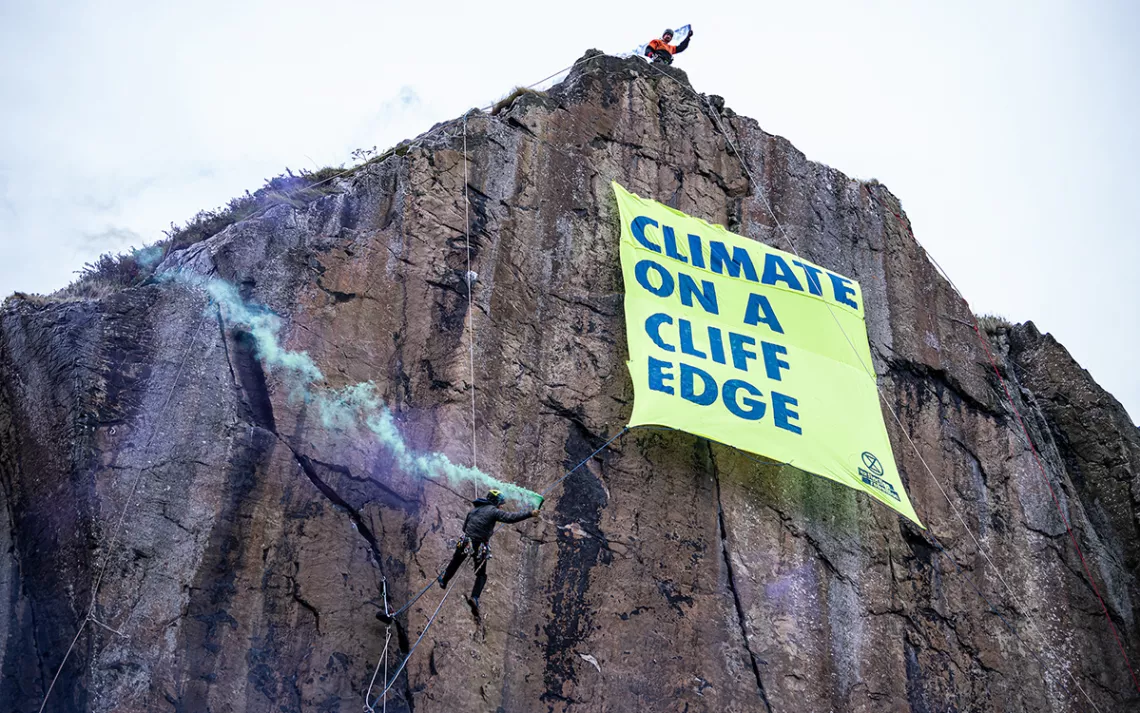
Experienced climbers scale a rock face near the historic Dumbarton castle in Glasgow, releasing a banner that reads “Climate on a Cliff Edge.” One activist, dressed as a globe, symbolically looms near the edge, while another plays the bagpipes on the shores below. | Photo courtesy of Extinction Rebellion and Mark Richards
Orcas comment on killer apes destroying the planet by continuing to burn fossil fuels. Second version, corrected text.
Continue Reading‘Unacceptable’: Campaigners Decry Climate Finance Failures as COP29 Enters Final Hours

Climate Groups Call for Rich to Pay More as International Meetings Begin

Spread the love

Original article by EDWARD CARVER republished from Common Dreams under Creative Commons (CC BY-NC-ND 3.0). 

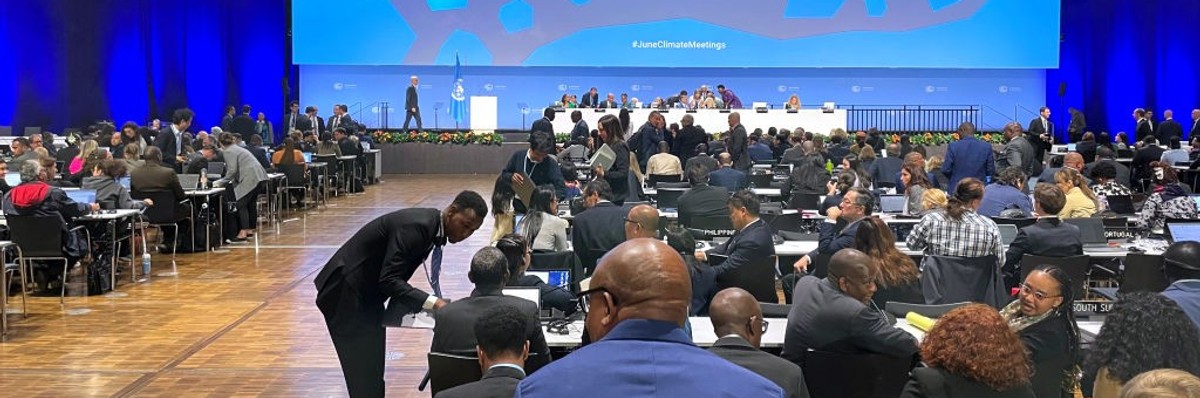
Delegates from around the world meet at an annual climate change conference in Bonn, Germany, on June 3, 2024, in preparation for the COP29 conference in November in Azerbaijan. (Photo: Christoph Driessen/Getty Images)

“We have to put the social justice element upfront,” an architect of the 2015 Paris agreement said as the world’s climate delegates gathered in Germany.

Advocates on Tuesday issued strong calls to action on climate finance for developing countries and an international agency released a report on the need to ramp up renewable energy production as the Bonn Climate Change Conference continued in Germany and G7 nations prepared to meet in Italy next week.

At the conference in Bonn, Friends of the Earth International pushed for more rich-country financing to pay for the rising costs of climate impacts in the Global South, while Laurence Tubiana, head of the European Climate Foundation and an architect of the 2015 Paris agreement, called for the global rich to pay their share through taxes and consumption levies.

Meanwhile, two organizations warned that countries aren’t on track to meet targets they set just last year. Oil Change International (OCI) published a briefing showing that G7 nations are expanding oil and gas commitments that undermine goals set at the United Nations Climate Change Conference (COP28) meeting in Dubai, and the International Energy Agency (IEA) issued a report showing that the world’s nations are not on track to meet their Dubai pledge to triple renewable energy production by 2030.

“The world is on fire because of decades of inaction by rich countries on reducing emissions, and their failure to pay the climate finance they owe to developing countries to transition to renewable energy systems for all, and to pay for rising costs for loss and damage and adaptation,” Sara Shaw, Friends of the Earth International program coordinator, said in a statement. “What is on the table to date is scales of magnitude away from what it needed. This year must be a year of breakthrough on climate finance.”

Climate representatives are meeting in Bonn this week and next to prepare for COP29 in November in Azerbaijan, where a key agenda item is expected to be financing for a green transition in the Global South. COP negotiations are conducted under the aegis of the United Nations Framework Convention on Climate Change (UNFCCC). At COP21 in 2015, nations signed the Paris agreement, a treaty that sought to limit global warming to less than 2°C above preindustrial levels.

Tubiana, an architect of that deal, said Tuesday that tackling climate change requires centering global justice in order to avoid conflict and gain public acceptance of climate measures.

“We have to put the social justice element upfront,” Tubiana, a French economist and diplomat, told The Guardian.

Tubiana said that raising the funds required for low-income nations will require holding both rich nations and people to account, via taxes and consumption levies, given that inequities exist not just between nations but also within them.

“This inequality is true not only between developed countries and developing ones, but within each country—the 1% of rich Chinese, or the 1% of very rich Indians, or the U.S. citizen—they have a lifestyle which is very, very similar, in terms of overconsumption,” she said.

The world’s richest and most powerful nations are not taking responsibility for climate action as they should, the new OCI briefing argues.

“Some G7 countries are massively expanding fossil fuel production at home, while others are investing in more fossil fuel infrastructure abroad,” the briefing states. “Both are catastrophic failures of leadership.”

OCI cites the United States, Italy, and Japan as particularly bad climate actors. The U.S. is the largest oil and gas producer in the world and has plans for massive expansions of the industry, despite President Joe Biden’s climate promises, the briefing notes. Italy has announced plans to double natural gas production. And both the U.S. and Japan have financed billions of dollars worth of oil and gas production in other countries just since the end of 2022, the document states, citing earlier OCI findings.

The IEA also spelled out unfulfilled commitments, while detailing progress that has been made on the energy transition. The agency looked at the domestic policies and targets of 150 countries to see how far along they were toward reaching the international target of tripling renewable power generation by 2030. It found that once added together, the nations’ domestic plans would get them about 70% of the way toward the 11,000 gigawatts of additional capacity required to meet the goal.

“There is a gap, but the gap is bridgeable,” Heymi Bahar, a senior energy analyst at the IEA and co-author of the report, toldThe Guardian.

Governments have not in most cases written these domestic plans into their Nationally Determined Contributions (NDCs) under the Paris agreement. The IEA report says that countries need to “bring their NDCs in line with their current domestic ambitions” and scale those ambitions up further still, to get from 70% to 100%. Moreover, they must follow through with their promises and achieve the targets they’ve set.

“This report makes clear that the tripling target is ambitious but achievable—though only if governments quickly turn promises into plans of action,” Fatih Birol, the IEA’s executive director, said in a statement.

The world added about 560 gigawatts of renewable capacity in 2023, a record increase, more than half of which came from China, according to the IEA. About half of planned capacity increases are in solar, with a quarter from wind power, the IEA report states.

Original article by EDWARD CARVER republished from Common Dreams under Creative Commons (CC BY-NC-ND 3.0). 

Continue ReadingClimate Groups Call for Rich to Pay More as International Meetings Begin