Tag: fuel

  • Israel’s siege now blocks 83% of food aid reaching Gaza, new data reveals

    Spread the love
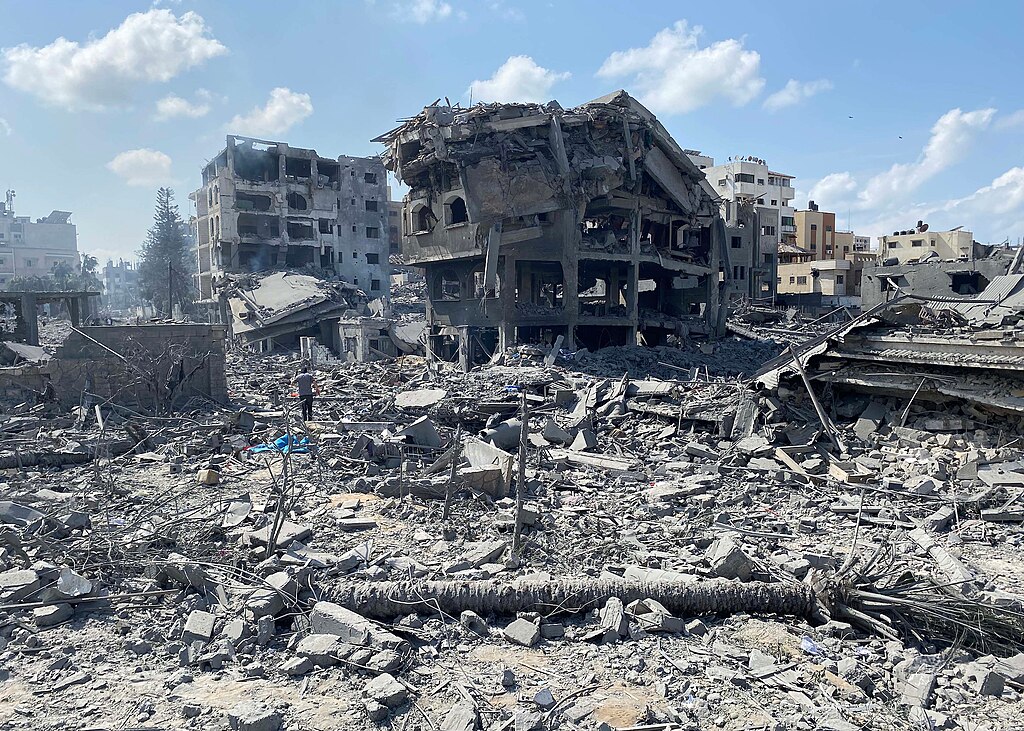
    Palestinians inspect the damage following an Israeli airstrike on the El-Remal aera in Gaza City on October 9, 2023. Israel continued to battle Hamas fighters on October 10 and massed tens of thousands of troops and heavy armour around the Gaza Strip after vowing a massive blow over the Palestinian militants' surprise attack. Photo by Naaman Omar apaimages. licensed under the Creative Commons Attribution-Share Alike 3.0 Unported license.
    Palestinians inspect the damage following an Israeli airstrike on the El-Remal aera in Gaza City on October 9, 2023. Israel continued to battle Hamas fighters on October 10 and massed tens of thousands of troops and heavy armour around the Gaza Strip after vowing a massive blow over the Palestinian militants’ surprise attack. Photo by Naaman Omar apaimages. licensed under the Creative Commons Attribution-Share Alike 3.0 Unported license.

    15 aid organisations demand international pressure for an immediate ceasefire, arms embargo, and end to Israel’s systematic aid obstruction

    New data has revealed the scale of aid obstruction, and the consequential drastic fall in aid entering Gaza. This is driving a humanitarian disaster, with the entire population of Gaza facing hunger and disease, and almost half a million at risk of starvation. 

    While Israeli military attacks on Gaza intensify, lifesaving food, medicine, medical supplies, fuel, and tents have been systematically blocked from entering for almost a year. 

    Data analysis by organisations working in Gaza has found that as a consequence of the Israeli government’s obstruction of aid: 

    • 83% of required food aid does not make it into Gaza, up from 34% in 2023.This reduction means people in Gaza have gone from having an average of two meals a day to just one meal every other day. An estimated 50,000 children aged between 6-59 months urgently require treatment for malnutrition by the end of the year.
    • 65% of the insulin required and half of the required blood supply are not available in Gaza. 
    • Availability of hygiene items has dropped to 15% of the amount available in September 2023. One million women are now going without the hygiene supplies they need. 
    • Only around 1,500 hospital beds in Gaza remain operational, compared to around 3,500 beds in 2023 which was already well below sufficient to meet the needs of a population of more than 2 million people. By comparison, cities of similar size, such as Chicago and Paris average 5 to 8 times more beds than in Gaza. 
    • 1.87 million people are in need of shelter with at least 60% of homes destroyed or damaged (January 2024). Yet tents for around just 25,000 people have entered Gaza since May 2024.

    A record low average of 69 aid trucks per day entered Gaza in August 2024, compared to 500 per working day last year; which was already not enough to meet people’s needs. In August more than 1 million people did not receive any food rations in southern and central Gaza. 

    Now, only 17 out of 36 hospitals remain partially functional. Critical infrastructure such as water networks, sanitation facilities and bread mills have been razed to the ground. 

    While humanitarian needs are ever increasing, agencies have detailed six main ways their life-saving aid is systematically obstructed on a daily basis.

    These include the denial of safety, with more than 40,000 Palestinians and nearly 300 aid workers killed since last October; the sharp tightening of a 17-year blockade to a full siege, which prevents aid from entering Gaza; delays and denials which restrict the movement of aid around Gaza; tightly restrictive and unpredictable control of imports; the destruction of public infrastructure such as schools and hospitals; and the displacement of civilians and humanitarian workers (witnessed again in recent displacement orders from the so-called “humanitarian zone” in Deir el-Balah.)

    Ahead of the UN General Assembly in New York this week, aid agencies are calling on governments to demand Israel end aid obstruction and to:

    • Secure an immediate and lasting ceasefire in Gaza. 
    • Implement an arms embargo and end the export of weapons and military equipment that risk being used in violations of international humanitarian law and human rights law. 
    • Demand compliance with the International Court of Justice’s findings and recommendations, an end to the Israeli government’s siege of Gaza, and heed the call of the ICJ in its advisory opinion to end the occupation of Palestinian territory. 

    Jolien Veldwijik, CARE Country Director in the West Bank and Gaza, said:

    “The situation was intolerable long before last October’s escalation and is beyond catastrophic now. Over 11 months, we have reached shocking levels of conflict, displacement, disease and hunger. Yet, aid is still not getting in, and humanitarian workers are risking their lives to do their jobs while attacks and violations of international law intensify. Aid, which is urgently required for 2.2 million people at risk of dying in the coming weeks and months, should never be politicised. We demand an immediate and sustained ceasefire, and the free flow of humanitarian aid into and throughout Gaza.” 

    Amjad Al Shawa, the director of the Palestinian NGOs Network (PNGO), an umbrella organisation of 30 Palestinian NGOs and a partner of ActionAid, said:

     “There is a shortage of all humanitarian items. We are overwhelmed [with] these needs and [these] urgent requirements…People [are] starving due to the shortage of aid…100% of the population depend on humanitarian aid…It’s the worst situation that we [witnessed] during …. the Israel war in Gaza.”

    1. CARE International
    2. Save the Children
    3. ActionAid
    4. Christian Aid
    5. War Child
    6. Islamic Relief
    7. HelpAge International 
    8. American Friends Service Committee
    9. Oxfam
    10. DanChurchAid
    11. Norwegian Church Aid
    12. Mennonite Central Committee
    13. Danish Refugee Council
    14. Norwegian Refugee Council
    15. KinderUSA

  • UN Rights Chief Says Israel’s Collective Punishment in Gaza Is a War Crime

    Spread the love
    Palestinians inspect the damage following an Israeli airstrike on the El-Remal aera in Gaza City on October 9, 2023. Israel continued to battle Hamas fighters on October 10 and massed tens of thousands of troops and heavy armour around the Gaza Strip after vowing a massive blow over the Palestinian militants' surprise attack. Photo by Naaman Omar apaimages. licensed under the Creative Commons Attribution-Share Alike 3.0 Unported license.
    Palestinians inspect the damage following an Israeli airstrike on the El-Remal aera in Gaza City on October 9, 2023. Israel continued to battle Hamas fighters on October 10 and massed tens of thousands of troops and heavy armour around the Gaza Strip after vowing a massive blow over the Palestinian militants’ surprise attack. Photo by Naaman Omar apaimages. licensed under the Creative Commons Attribution-Share Alike 3.0 Unported license.

    Original article by JESSICA CORBETT republished from Common Dreams under Creative Commons (CC BY-NC-ND 3.0). 

    “We have fallen off a precipice. This cannot continue.”

    United Nations High Commissioner for Human Rights Volker Türk declared Wednesday that “the collective punishment by Israel of Palestinian civilians amounts… to a war crime, as does the unlawful forcible evacuation of civilians.”

    Israel’s monthlong war on Gaza has killed over 10,500 Palestinians, wounded thousands more, displaced 70% of the strip’s 2.3 million residents, and decimated civilian infrastructure, including homes, religious buildings, and hospitals.

    Türk’s comments came after he visited the Rafah border crossing that connects Egypt to Gaza, which he described as “the gates to a living nightmare—a nightmare where people have been suffocating, under persistent bombardment, mourning their families, struggling for water, for food, for electricity and fuel.”

    Long before October 7, when a Hamas-led attack killed over 1,400 Israelis and triggered Israel’s retaliation, Gaza was “described as the world’s biggest open-air prison… under a 56-year occupation and a 16-year blockade by Israel,” he highlighted.

    “Even in the context of a 56-year-old occupation, the current situation is the most dangerous in decades, faced by people in Gaza, in Israel, in the West Bank, but also regionally.”

    The U.N. rights chief also stressed that “the atrocities perpetrated by Palestinian armed groups… were heinous, brutal, and shocking. They were war crimes—as is the continued holding of hostages.” Israeli officials say there are about 240 hostages.

    “We have fallen off a precipice. This cannot continue,” he warned. “Even in the context of a 56-year-old occupation, the current situation is the most dangerous in decades, faced by people in Gaza, in Israel, in the West Bank, but also regionally.”

    Türk emphasized that “parties to the conflict have the obligation to take constant care to spare the civilian population and civilian objects,” and as an occupying power, Israel is required “to ensure a maximum of basic necessities of life can reach all who need it.”

    “I call—as a matter of urgency—for the parties now to agree [to] a cease-fire on the basis of three critical human rights imperatives: We need urgent delivery of massive levels of humanitarian aid, throughout Gaza,” he declared.

    The official also called for all hostages to be freed without condition and said that “crucially, we need to enable the political space to implement a durable end to the occupation, based on the rights of both Palestinians and Israelis to self-determination and their legitimate security interests.”

    U.N. Secretary-General António Guterres—who has also been pushing for a cease-fire—called out Israel’s aerial and ground operations for their impact on civilians during a Reuters conference on Wednesday.

    “There are violations by Hamas when they have human shields. But when one looks at the number of civilians that were killed with the military operations, there is something that is clearly wrong,” he said.

    “We have in a few days in Gaza thousands and thousands of children killed, which means there is also something clearly wrong in the way military operations are being done,” the U.N. leader added.

    According to the Palestinian Ministry of Health in Gaza, the Israeli war against Hamas has killed over 4,300 children.

    “It is also important to make Israel understand that it is against the interests of Israel to see every day the terrible image of the dramatic humanitarian needs of the Palestinian people,” Guterres said. “That doesn’t help Israel in relation to the global public opinion.”

    While French President Emmanuel Macron’s plans to hold a Gaza-focused “humanitarian conference” in Paris on Thursday, the government of Israeli Prime Minister Benjamin Netanyahu is refusing to participate in the event.

    Ahead of the conference, 13 human rights and relief groups called on attendees “to do everything in their power to achieve an immediate cease-fire; take concrete steps to free civilian hostages and protect all civilian populations; and ensure the entry of humanitarian aid into Gaza and respect for international humanitarian law.”

    Among them was Amnesty International—which, over the past month, has compiled “damning evidence of war crimes as Israeli attacks wipe out entire families.” Some global experts and critics have demanded action from the International Criminal Court on “escalating Israeli war crimes and genocide of the Palestinian people” in Gaza.

    In a resignation letter to Türk last month, Craig Mokhiber, who was serving as the New York director for the Office of the High Commissioner for Human Rights, condemned Israel’s war as “a textbook case of genocide.”

    “In the immediate term,” Mokhiber wrote, “we must work for an immediate cease-fire and an end to the long-standing siege on Gaza, stand up against the ethnic cleansing of Gaza, Jerusalem, and the West Bank (and elsewhere), document the genocidal assault in Gaza, help to bring massive humanitarian aid and reconstruction to the Palestinians, take care of our traumatized colleagues and their families, and fight like hell for a principled approach in the U.N.’s political offices.”

    Original article by JESSICA CORBETT republished from Common Dreams under Creative Commons (CC BY-NC-ND 3.0). 

  • ‘As a Human Being, I Beg’: Doctors Say Cease-Fire in Gaza Only Way to Save Countless Lives

    Spread the love

    Original article by BRETT WILKINS republished from Common Dreams under Creative Commons (CC BY-NC-ND 3.0). 

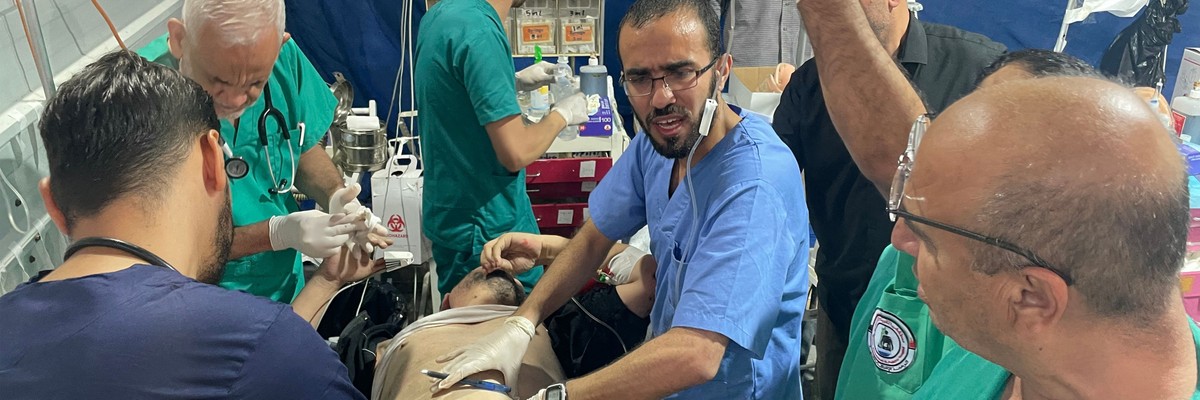
    Trauma surgeons treat an injured man after Israeli bombardment, at the Kuwaiti hospital in Rafah in the southern Gaza Strip on October 21, 2023  (Photo: Said Khatib/AFP via Getty Images)

    Fresh demands for a major increase in humanitarian aid and an end to the bombing came as Gaza’s only cancer hospital shut down due to a lack of fuel.

    As the World Health Organization warns of an “imminent public health catastrophe” in Gaza amid Israeli attacks on medical workers and infrastructure, doctors and other frontline medics said Wednesday that only an immediate cease-fire would give them a fighting chance to save countless lives.

    Responding Wednesday to the shutdown of the Turkish-Palestinian Friendship Hospital—Gaza’s only cancer treatment center—due to lack of fuel and damage from Israeli airstrikes, WHO Director-General Tedros Adhanom Ghebreyesus said that “no words can describe our concern for the patients who have just lost the only possibility to receive lifesaving cancer treatment or palliative care.”

    Tedros added: “I urge and I plead—for full medical and fuel aid access NOW! The more we wait, the more we put these fragile lives at risk.”

    The WHO chief’s plea came a day after Christian Lindmeier, a spokesperson for the Geneva-based United Nations agency, warned that “an imminent public health catastrophe… looms with the mass displacement, the overcrowding, the damage to water and sanitation infrastructure.”

    Meanwhile, James Elder, a spokesperson for the United Nations Children’s Fund (UNICEF), said Tuesday that “child deaths due to dehydration, particularly infant deaths due to dehydration, are a growing threat.”

    The U.N. Office for the Coordination of Humanitarian Affairs (OCHA) called Gaza a “graveyard” for children, more than 3,600 of whom have been killed by Israeli bombardment, with another 1,000 minors reported missing, according to Palestinian and other officials.

    Israeli forces have attacked numerous hospitals, clinics, ambulances, and medical workers, including the Turkish-Palestinian Friendship Hospital and al-Hilu Hospital. The Gaza Health Ministry said Wednesday that the bombardment that damaged al-Hilu “endangers the lives of women in the maternity wards and medical staff.”

    According to an “urgent call for protecting healthcare workers in Gaza” published Tuesday in the British medical journal The Lancet, Israeli forces have attacked 57 medical facilities since launching the war on Gaza on October 7, killing 73 workers—including doctors, nurses, paramedics, and others—as of October 24. Sixteen of the medical personnel were killed while on duty.

    As Israel’s bombardment of Gaza exacts a heavy toll on overwhelmed medical workers and infrastructure in the besieged strip, frontline medics like Dr. Noureddein al-Khateeb—a 38-year-old resident doctor in the emergency department at the Nasser Medical Center in the southern Gaza city of Khan Younis—say they are living “in a constant state of threat and fear.”

    “It’s constant fear on top of the exhaustion we’re experiencing,” al-Khateeb toldThe New Humanitarian on Wednesday. “But one shouldn’t think of that too much. I can’t. If I do, I won’t get any work done.”

    Al-Khateeb added that “we’re also afraid for our families’ safety, but what can we do?”

    Dr. Mohamed Abu Mousa, a radiologist at Nasser, said one of the few trips he’s made outside the hospital since Israeli bombardment began was to bury his 7-year-old son after he was killed in an October 15 Israeli airstrike on their family home.

    “We don’t have the luxury of pausing to grieve,” he told The New Humanitarian. “The heartache is immense, but the wounded are endless. We have to keep going.”

    Conditions are dire inside Gaza’s hospitals, which are running out of or low on fuel, medicines, equipment, and other essential services and supplies.

    “We’re operating on children without anesthetics,” Léo Cans, who heads the Doctors Without Borders (MSF) mission in Palestine, toldCNN Tuesday. “We don’t have morphine for them.”

    On Wednesday, MSF international president Dr. Christos Christou said in a video published on social media that “we’ve seen and heard the stories of the hell being unleashed on Gaza” as “helpless people are being subjected to horrific bombing” and “families have nowhere to run or hide.”

    Christou continued:

    So many people need help. What medical staff can do is just a drop in the ocean compared to the immense needs. Our teams working in Gaza are exhausted and terrified. Our staff tell us that pregnant women can’t get to hospitals to deliver. People are stuck under the rubble of shelled-out buildings. Children are having limbs amputated while lying on the floor.

    “An immediate cease-fire is the only way the people of Gaza can find safety and the essential aid they urgently need,” Christou asserted. “The bombing, the all-out assault, needs to stop now… As a human being, I beg—stop the bombing and allow people in Gaza to live.”

    The Gaza Health Ministry said Wednesday afternoon that at least 8,796 Palestinians—including nearly 2,300 women and over 3,600 children—have been killed in Israeli attacks, while around 23,000 other people have been injured.

    Original article by BRETT WILKINS republished from Common

    Dreams under Creative Commons (CC BY-NC-ND 3.0).