Student movement for Palestine stands defiant in face of police repression

Spread the love

Original article republished from peoples dispatch under a Creative Commons Attribution-ShareAlike 4.0 (CC BY-SA) license.

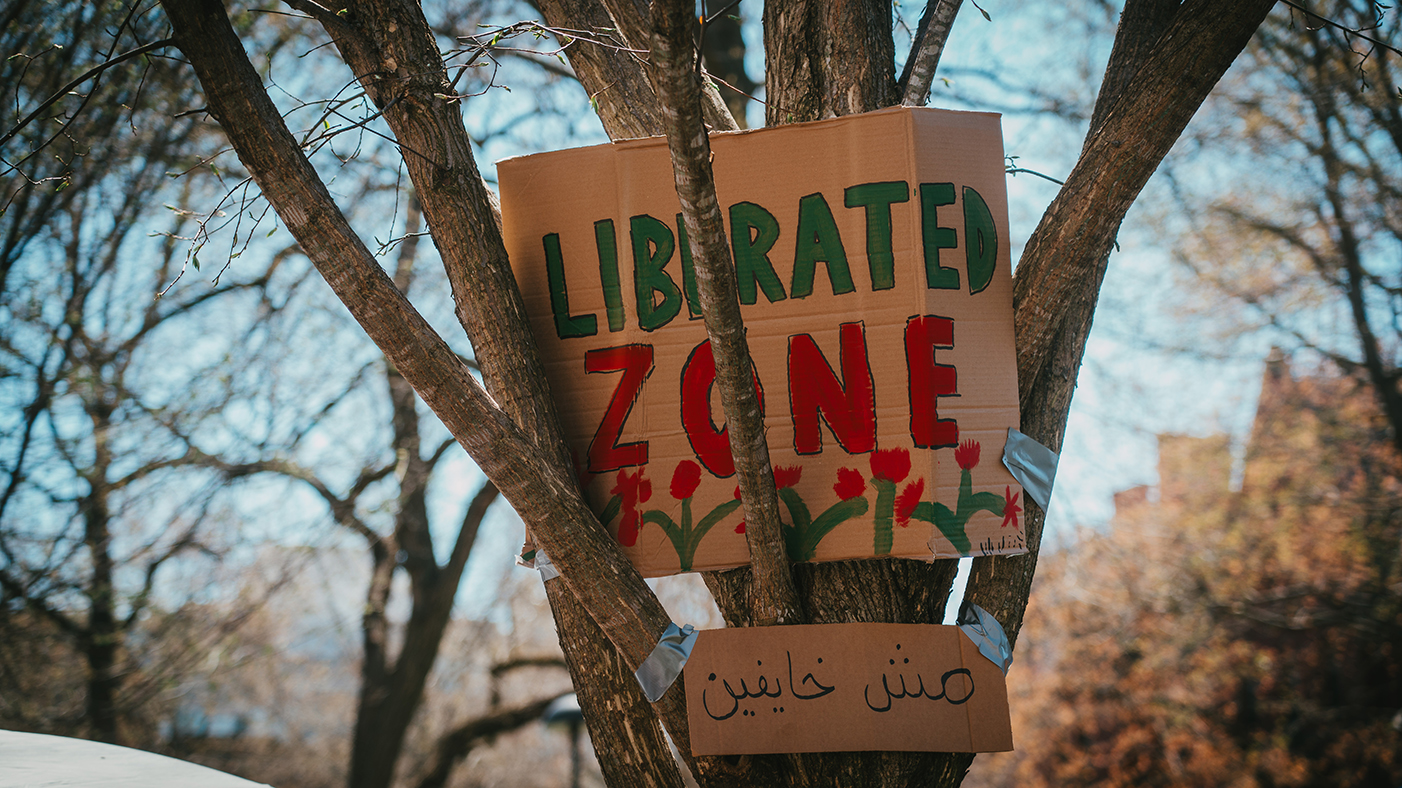
Students set up a Gaza Solidarity Encampment on Harvard Yard (Photo: Micah Fong)

Police continue to crack down on growing movement of Gaza Solidarity Encampments, students stand their ground

Police throughout the country have continued to heavily repress students engaging in protest in solidarity with Gaza. Despite the brutalization of student protesters on campuses such as University of Texas – Austin and the University of Southern California, students continue to stage encampments across the globe.

This is happening in the backdrop of US President Biden signing a bill into law that would provide USD 26 billion to Israel as it conducts genocide in Gaza. Even the European Union has backed a UN call for an investigation (which the US refuses to support) into the over 300 killed Palestinians found in mass graves beneath the ruins of two hospitals. Israel has also begun its attack on Rafah, killing five people in an air strike on a residential building in Rafah City. 

Students at UT Austin have had to withstand brutal repression, as ultra-right wing Texas Governor Greg Abbot called in State Troopers, some mounted on horses, who violently clashed with protesters and made multiple arrests. 

Despite the downpour of state violence, student protesters held their ground, chanting ““You don’t scare us!” and “Get off our campus!”

Protesters also experienced a wave of repression at the University of Southern California, where arrests are currently underway as Los Angeles Police attempt to clear the encampment.

Earlier in the day, Los Angeles police used batons and fists to violently beat organizers. Organizers continued to be defiant in the face of such repression, however, and managed to successfully de-arrest a protester who had been detained in a police car, surrounding the car and chanting, “Let him go!”

On the morning of April 24, Columbia student organizers made important announcements to those participating in the week-long protest, the “Gaza Solidarity Encampment” at Butler Lawn. The previous night, Columbia administration had threatened to bring in the National Guard to sweep the encampment, in a disturbing echo of the Kent State massacre in 1970 of four students protesting the US war in Vietnam by the Ohio National Guard. 

However, that morning, students announced to the entire encampment that “we won a huge concession—we have it in writing that we are here for 48 hours and we will not be swept; we will not be moved!”

Due to a mass mobilization of both students and supporters, inside and outside campus gates, the administration was deterred from sweeping the camp, according to organizers. The administration has set a new deadline for an encampment sweep: Friday at 3 am.

As student organizers at Columbia plan for repression, other campuses across the country and around the world continue to establish their own encampments in solidarity with Gaza at universities such as Harvard and Brown. On April 24, students Sciences Po in Paris erected their own encampment in solidarity with Gaza.

https://twitter.com/maryamalwan/status/1783202588235817024?ref_src=twsrc%5Etfw%7Ctwcamp%5Etweetembed%7Ctwterm%5E1783202588235817024%7Ctwgr%5E1ceddb18ed05504dde6bf351868508f2fb8efbc4%7Ctwcon%5Es1_c10&ref_url=https%3A%2F%2Fpeoplesdispatch.org%2F2024%2F04%2F25%2Fstudent-movement-for-palestine-stands-defiant-in-face-of-police-repression%2F

Students across the globe have issued messages of solidarity with the US students braving repression in solidarity with Gaza. The Arab and Maghreb Youth Student Front Against Normalization and in Support of Peoples’ Causes has called for a “global youth student battle in support of Palestinian resistance and all solidarity forces with it,” stating that “what happened at Columbia University in the United States today is the best evidence of what we say, as after six days of sit-ins inside the campus, many other American universities like the University of California witnessed student movements supporting Palestine, shaking the throne of the entity and pushing the Biden administration to ruthlessly suppress protests supporting the Palestinian people and demanding an end to the genocide in Gaza.” 

The Student Front has called for a mobilization of all Arab and Maghreb youth students to “to intensify field movements in support of the Palestinian cause and to stop the genocidal war in steadfast Palestine, strengthening the Boycott, Divestment, and Sanctions (BDS) movement and protesting in front of American embassies and their symbols.”

The International People’s Assembly (IPA) also issued a statement denouncing the  “brutal repression and mass arrests of students peacefully protesting their administrations’ investments in the Zionist entity and demanding an end to all academic partnerships and cooperation.” 

Original article republished from peoples dispatch under a Creative Commons Attribution-ShareAlike 4.0 (CC BY-SA) license.

Continue ReadingStudent movement for Palestine stands defiant in face of police repression

Amnesty condemns UK for ‘appalling’ domestic policies in damning report

Spread the love

https://leftfootforward.org/2024/04/amnesty-condemns-uk-for-appalling-domestic-policies-in-damning-report/

‘The UK is deliberately destabilising the entire concept of universal human rights’

The world’s leading human rights organisation has issued a damning condemnation of the UK government’s domestic policies and failure in Gaza, accusing the UK of “deliberately destabilising” global human rights.

In a truly bleak assessment, Amnesty International said Britain had breached international human rights commitments at a “perilous” time in global history, as a result of the UK government’s policies targeting asylum seekers and protesters. 

Amnesty’s 2024 annual global report notes Britain’s weakening global and domestic human rights protections for the sake of the government’s own political gain, and at a time when the global community is failing to uphold international law.

Amnesty also accused the UK Government of ‘grotesque double-standards’ for bolstering the actions of Israel and the US in Gaza, as the UK continues to arm Israel while failing to condemn Israel’s actions in the region which ‘likely amounts to war crimes’. 

The UK’s weak support for the international criminal court (ICC) investigation into human rights violations in Israel and Palestine was also condemned, along with its failure to stand up as a strong voice in the UN to stop human rights violations in Gaza. 

https://leftfootforward.org/2024/04/amnesty-condemns-uk-for-appalling-domestic-policies-in-damning-report/

Continue ReadingAmnesty condemns UK for ‘appalling’ domestic policies in damning report

How Israel continues to censor journalists covering the war in Gaza

Spread the love
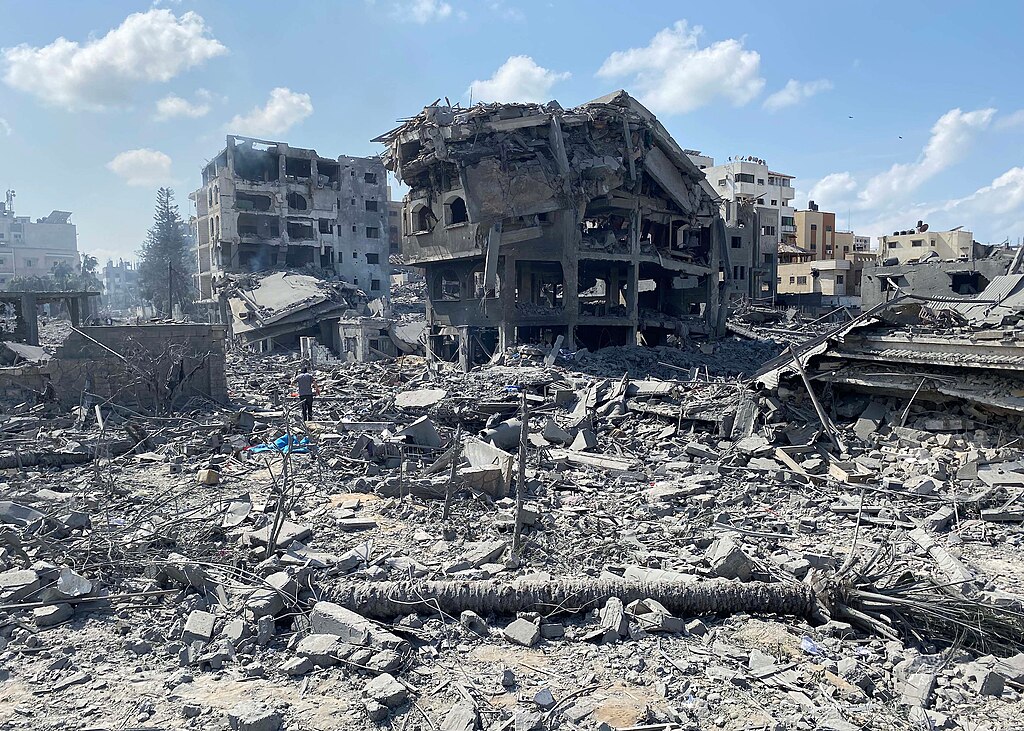
Palestinians inspect the damage following an Israeli airstrike on the El-Remal aera in Gaza City on October 9, 2023. Israel continued to battle Hamas fighters on October 10 and massed tens of thousands of troops and heavy armour around the Gaza Strip after vowing a massive blow over the Palestinian militants' surprise attack. Photo by Naaman Omar apaimages. licensed under the Creative Commons Attribution-Share Alike 3.0 Unported license.
Palestinians inspect the damage following an Israeli airstrike on the El-Remal aera in Gaza City on October 9, 2023. Israel continued to battle Hamas fighters on October 10 and massed tens of thousands of troops and heavy armour around the Gaza Strip after vowing a massive blow over the Palestinian militants’ surprise attack. Photo by Naaman Omar apaimages. licensed under the Creative Commons Attribution-Share Alike 3.0 Unported license.

Colleen Murrell, Dublin City University

Accusations about Israeli censorship of the media went mainstream in the US recently when the New York Times published an opinion piece headlined: The Israeli Censorship Regime is Growing. That Needs to Stop..

In the piece Jodie Ginsberg, the chief executive of the Committee to Protect Journalists (CPJ), wrote: “The high rate of journalists’ deaths and arrests, including a slew in the West Bank; laws allowing its government to shut down foreign news outlets deemed a security risk, which the prime minister has explicitly threatened to use against Al Jazeera; and its refusal to permit foreign journalists independent access to Gaza all speak to a leadership that is deliberately restricting press freedom. That is the hallmark of a dictatorship, not a democracy.”

As well as restrictions on media access to Gaza, particular broadcasters face other restrictions. At the start of April Israeli prime minister Benjamin Netanyahu had proclaimed he would “act immediately to stop” Qatar-based broadcaster Al Jazeera’s operations inside Israel.

Israel’s parliament passed a bill allowing it to close Al Jazeera’s office in Israel, block its website and ban local channels from using its coverage. However ongoing ceasefire negotiations with Hamas, brokered through Qatar, were perhaps a bulwark against haste. The company is still broadcasting from Israel, but its future status is uncertain.

At the annual International Journalism Festival in Perugia on April 17-21, one of Al Jazeera’s former Gaza-based correspondents Youmna ElSayed, spoke of the dangers of covering the war as a Palestinian journalist, including the belief that she, along with others, had been targeted by the Israeli military. “Journalists were under fire from day one,” she said. Despite having little equipment and the destruction of media offices, “We did what we could to show the world what was really going on,” she said.

The CPJ said on April 20 that at least 97 journalists and media workers were among the more than 34,000 people killed since the war began.

ElSayed regretted leaving Gaza but said it was her only choice to save the lives of her children. She said: “This entire world would have known nothing, seen nothing of what has been happening in Gaza … if it wasn’t for those Palestinian journalists.”

She claimed that international journalists had given up on forcing the Israeli army to let them into Gaza. “This is something that is unprecedented and has not happened anywhere else in the world. But yet, international journalists have given up on that right.”

Access to Gaza

However, journalists’ organisations and the correspondents themselves have been lobbying for access to Gaza for months now. But the Israeli government appears to be not giving way.

The BBC’s international editor Jeremy Bowen, also speaking in Perugia, confirmed that it had been a really difficult story to cover, principally, “because the main meat of it – which is what’s happening in Gaza, we can’t get close to”.

From a production point of view, he said sometimes it feels like, “climbing through mud trying to generate the material that’s necessary to put together a report for television news”. He added it was very hard “to be a TV reporter on a story that you can’t see yourself”.

The Israeli government says the number of international journalists given press accreditation to work in Israel since October 2023 is 3,400. This has given journalists access to the West Bank and enabled coverage of settler violence against the local Palestinian population, but not to Gaza.

But as I wrote in November, the only permitted trips into Gaza have been via Israel Defense Forces-controlled embeds (where the journalist travels with the military and therefore their ability to see or cover stories is restricted).

CNN’s Clarissa Ward was the first foreign journalist who made it into Gaza without the army, and she did this by accompanying an aid convoy supported by the United Arab Emirates in December 2023. During this two-hour trip to Rafah, where 2.3 million residents are now based, the area was bombed and she filmed operations in a field hospital, and talked to doctors and injured children.

With 20 years of war reporting under her belt, she concluded: “Like Grozny, Aleppo and Mariupol, Gaza will go down as one of the great horrors of modern warfare.”

From outside the country, media outlets keep trying to check and verify information on the bombings from the IDF by using geo-location and AI software to scan satellite imagery for bomb craters and destruction. In December this enabled the New York Times to conclude that “during the first six weeks of the war in Gaza, Israel routinely used one of its biggest and most destructive bombs in areas it designated safe for civilians”.

Israeli media coverage

Within Israel, the media are mostly publishing the IDF version of events unchallenged. According to Israeli journalist and activist Anat Saragusti: “Hebrew-speaking Israelis watching television news are not exposed at all to what’s going on in Gaza. We don’t see atrocities, the rubble, the destruction and the humanitarian crisis. The world sees something completely different.”

Meanwhile, the left-wing newspaper Haaretz (published in Hebrew and in English) has been threatened with financial penalties for “sabotaging Israel in wartime” through its more nuanced journalism. According to reporter Ido David Cohen, writing in December, it is the television news channels that present the most extreme example of censorship, as they have “devoted themselves to national morale, exclusively relying on official military statements and completely ignoring Palestinian casualties”.

In the same article, cultural commentator and academic David Gurevitz claimed the numbers of Palestinians killed remains an abstract concept for many Israelis: “The Israeli audience isn’t capable of accommodating two kinds of pain together, seeing and identifying with the human victim of the other side as such, and the media follow suit.”

This argument was backed up this month by Israeli journalist Yossi Klein who wrote: “The most taboo number in Israel is 34,000. You can’t talk about it, you can’t mention it, and if someone speaking on a panel accidentally blurts it out, they should add, disdainfully: ‘according to Palestinian sources’.”The Conversation

Colleen Murrell, Full Professor in Journalism, Dublin City University

This article is republished from The Conversation under a Creative Commons license. Read the original article.
Continue ReadingHow Israel continues to censor journalists covering the war in Gaza

Led by US, Global Military Spending Surged to Record $2.4 Trillion Last Year

Spread the love

Original article by JAKE JOHNSON republished from Common Dreams under Creative Commons (CC BY-NC-ND 3.0). 

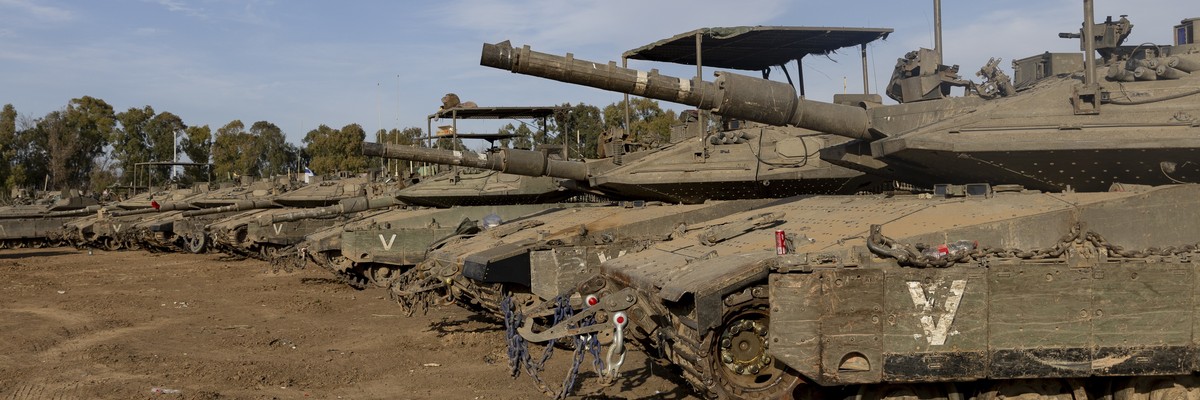
A row of tanks is pictured in southern Israel on March 14, 2024.  (Photo: Amir Levy/Getty Images

“Can we get some healthcare please, or maybe feed some of the 40 million+ Americans who can’t get enough food?” asked the watchdog group Public Citizen.

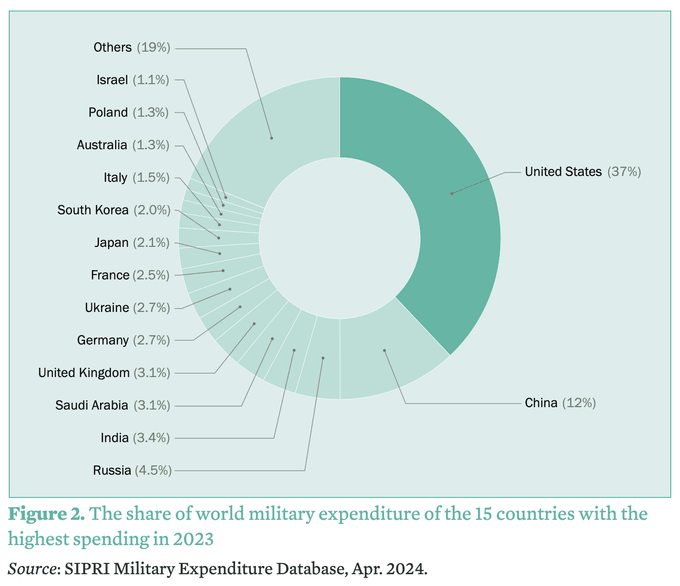
New research published Monday shows that global military spending increased in 2023 for the ninth consecutive year, surging to $2.4 trillion as Russia’s assault on Ukraine and Israel’s war on the Gaza Strip helped push war-related outlays to an all-time high.

The Stockholm International Peace Research Institute (SIPRI) recorded military spending increases in every geographical region it examined last year, from Europe to Oceania to the Middle East. Last year’s global increase of 6.8% was the largest since 2009, SIPRI said.

The United States was by far the largest military spender at $916 billion in 2023, up 2.3% compared to the previous year. The next biggest spender was China, which poured an estimated $296 billion into its military last year—three times less than the U.S.

“Can we get some healthcare please, or maybe feed some of the 40 million+ Americans who can’t get enough food?” asked the watchdog group Public Citizen in response to SIPRI’s report, which found that the U.S. accounted for 37% of the world’s total military spending last year.

separate analysis of U.S. military spending in 2023 found that 62% of the country’s federal discretionary budget went to militarized programs, leaving less than half of the budget for healthcare, housing, nutrition assistance, education, and other domestic priorities.

Together, SIPRI found, the top five biggest military spenders last year—the U.S., China, Russia, India, and Saudi Arabia—accounted for 61% of global military outlays.

“The unprecedented rise in military spending is a direct response to the global deterioration in peace and security,” Nan Tian, senior researcher with SIPRI’s Military Expenditure and Arms Production Program, said in a statement. “States are prioritizing military strength but they risk an action-reaction spiral in the increasingly volatile geopolitical and security landscape.”

In the Middle East, military spending jumped by 9% last year—the highest annual growth rate in the past decade. Israel, which relies heavily on weapons imports from the U.S., spent 24% more on its military last year than in 2022, according to SIPRI, an increase fueled by the country’s devastating assault on Gaza.

SIPRI found that NATO’s 31 member countries dumped a combined $1.3 trillion into military expenditures in 2023, accounting for 55% of the global total.

U.S. military spending, which is poised to continue surging in the coming years, made up 68% of NATO’s 2023 total.

Original article by JAKE JOHNSON republished from Common Dreams under Creative Commons (CC BY-NC-ND 3.0). 

‘Blood on Their Hands’: 79 US Senators Approve Billions More in Military Aid for Israel

US Dodges Growing Calls for Probe of Mass Graves at Gaza Hospitals

Israel’s War on Gaza Has Helped Fuel ‘Near Breakdown of International Law’: Amnesty

Continue ReadingLed by US, Global Military Spending Surged to Record $2.4 Trillion Last Year

Jeremy Corbyn: Our leaders seem determined to give war a chance. Their thirst for conflict endangers us all

Spread the love

https://www.theguardian.com/commentisfree/2024/apr/23/leaders-war-gaza-jeremy-corbyn

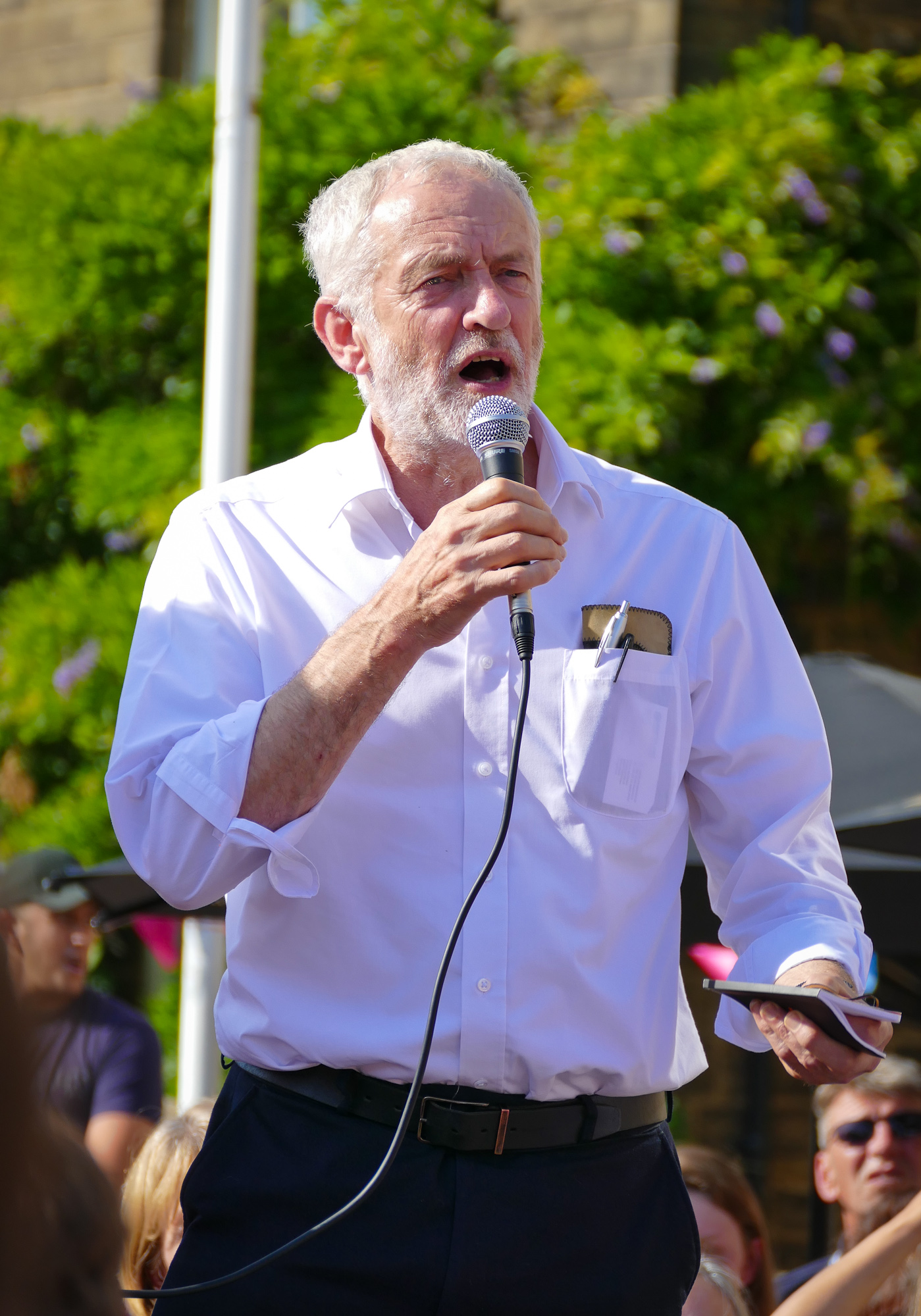
Image of Jeremy Corbyn MP, former leader of the Labour Party
Jeremy Corbyn MP, former leader of the Labour Party

We seek peace in Gaza, Ukraine, Yemen, Sudan, the DRC and elsewhere, but we’re ignored. History will damn the warmongers

“The protagonists of 1914 were sleepwalkers, watchful but unseeing, haunted by dreams, yet blind to the reality of the horror they were about to bring into the world.”

Christopher Clark’s The Sleepwalkers retells the story of the outbreak of the first world war. Mapping a multipolar world enthralled by imperialism and paranoia, Clark refuses to pin the blame on a single power. Instead, he explains how political leaders narrowed the prospects for peace one misstep at a time, and sleepwalked into a global catastrophe that left around 20 million people dead.

Today, once more, our political leaders are stumbling through crisis after crisis to convince themselves that war is the only solution. The principal difference is that this time they are not sleepwalking into war. They are doing so with their eyes wide open.

For months, millions of us have demonstrated for a ceasefire in Gaza to stop the loss of life, end the perpetual cycle of violence and prevent a wider escalation. We have been ignored, maligned and demonised. Last week, Israel conducted missile strikes against Iran in a fast-widening conflict across the Middle East. Even without the involvement of more global players, the human, economic and environmental consequences of all-out war with Iran would be catastrophic for the entire world.

We need not imagine the worst-case scenario in order to put the brakes on. As the Israeli government weighed up its options in response to Iran’s attack on 14 April, bombs continued to fall on Palestinians in Gaza. Over the past few months, human beings have been forced to endure a level of horror that should haunt us for ever. Entire families have been wiped out – and survivors will face lifelong mental health consequences for generations to come. Neighbourhoods have been completely obliterated, strewn with corpses and limbs. Doctors are performing amputations without anaesthesia. Children are gathering sticks and leaves from the ground and fashioning “bread” from animal feed to stay alive. If the unfolding genocide of the Palestinian people does not already constitute a worst-case scenario, what does?

https://www.theguardian.com/commentisfree/2024/apr/23/leaders-war-gaza-jeremy-corbyn

Continue ReadingJeremy Corbyn: Our leaders seem determined to give war a chance. Their thirst for conflict endangers us all