The Israeli army reinforces its ground forces as military mobility continues in Golan Heights, Israel on December 9, 2024 [Mostafa Alkharouf – Anadolu Agency]
Israel has seized more Syrian territory close to the occupied Golan Heights following the collapse of the Assad regime, citing potential threats Tel Aviv may face from the former rebels.
On Sunday, Syrian rebels conquered the capital, Damascus, concluding a rapid new offensive which saw the Syrian opposition capture numerous towns and major cities from Bashar Al-Assad’s regime, effectively ending almost 14 years of civil war and over five decades of the Assad dynasty’s rule.
Amid mixed messages and reactions from much of the international community, Israel’s Prime Minister, Benjamin Netanyahu, stated in a video that the collapse of the Assad regime and “the tyranny in Damascus” was a “historic day in the Middle East” which “offers great opportunity”, but claimed that it is also “fraught with significant dangers”.
Emphasising that the 1974 disengagement agreement with Syria over Israel’s occupation of the Golan Heights had “collapsed” due to the rebel takeover of the country, Netanyahu announced the Israeli military’s entering of the buffer zone and seizure of “commanding positions nearby”, calling the move a “temporary defensive position until a suitable arrangement is found”.
Warning that Tel Aviv “will not allow any hostile force to establish itself on our border”, Netanyahu claimed that “if we can establish neighbourly relations and peaceful relations with the new forces emerging in Syria, that’s our desire. But if we do not, we will do whatever it takes to defend the State of Israel and the border of Israel.”
Destroyed buildings at a commercial street that was hit Saturday night by Israeli airstrikes, are seen in Nabatiyeh town, south Lebanon, October 13, 2024
ISRAELI Prime Minister Benjamin Netanyahu demanded today that the United Nations remove its peacekeepers from Lebanon’s “danger zone.”
He told UN secretary-general Antonio Guterres: “Your refusal to evacuate the Unifil soldiers makes them hostages of Hezbollah.
“Mr secretary-general, get the Unifil forces out of harm’s way. It should be done right now, immediately.”
Israeli forces have been responsible for wounding five UN peacekeepers since Thursday.
Mr Netanyahu’s demand came after 40 countries with troops in Unifil demanded security guarantees for the peacekeepers.
The UN Interim Force in Lebanon (Unifil) has been operating since 1978, when it was deployed following an invasion by Israel.
The forces currently has more than 10,000 soldiers from 50 countries and around 800 civilian staff.
Their role is to maintain calm and reduce tensions along the “blue line” dividing Lebanon from Israel and the Israeli-occupied Golan Heights.
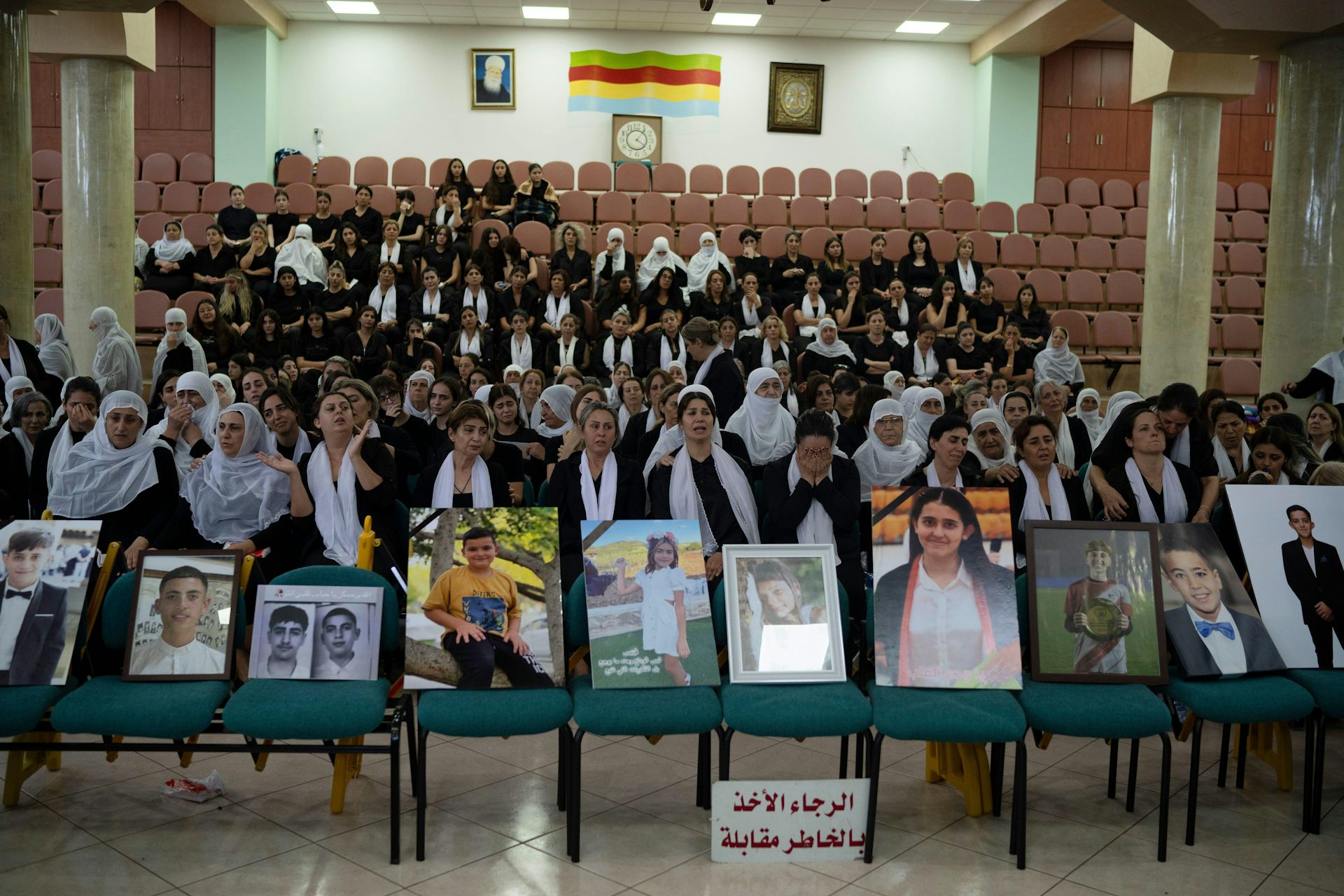
Israel’s prime minister, Benjamin Netanyahu, has threatened a harsh response to a rocket attack that on July 27 struck the Israeli-occupied Syrian Golan Heights, killing 12 children and injuring about 30 more.
Visiting the small town of Majdal Shams, where the children had been playing football when the strike occurred, Netanyahu blamed Hezbollah for the attack and said it would pay a “hefty price”. He said: “Our response will come, and it will be harsh.”
While Israel is claiming the attack targeted their citizens, all the victims of the strike were members of the Druze religious minority group located across Israel, Lebanon and Syria. Hezbollah has denied responsibility for the attack, but without an independent investigation, it remains unclear who fired the rocket.
The Golan Heights, a rocky 1,000 square kilometre region south-west of Damascus, was occupied by Israel after the 1967 Arab-Israeli war in a move that, half a century on, is often referred to as the “forgotten occupation”.
After defeating Egypt, Jordan, and Syria in the short conflict, Israel occupied the West Bank, Gaza and East Jerusalem as well as the Sinai desert and two-thirds of the Syrian Golan. Around 127,000 indigenous Syrians (95% of the population) – including Christians, Muslims and Druze – fled or were forcibly displaced. Depopulated villages were razed to the ground.
Later in 1981, Israel illegally annexed the territory, passing the Golan Heights Law. The UN security council immediately condemned this as illegal and passed resolution 497 (1981) calling on Israel to rescind its action, which would have “serious consequences for peace and security in the Middle East”.
Israel’s annexation of the Golan Heights was not recognised internationally until 2019 when the then US president Donald Trump released a “Proclamation on Recognizing the Golan Heights as Part of the State of Israel”.
Israel views its control over the Golan Heights as crucial to its security, as the region shares a border with Israel, Jordan and Lebanon. There is a buffer zone between the Israeli-occupied area of the Golan Heights and Syria, which is administered by the United Nations Disengagement Observer Force (Undof). The Golan gives whoever controls the land a vantage point overlooking Syria, which has never given up on its claim over the land.
Forgotten people
But what of the indigenous people of the Golan? Roughly 20,000 Druze people now remain, members of an Arab sect which is an offshoot of Islam that allows no intermarriage or joining from outside the religion. There are about 150,000 Druze in Israel and about 1 million across the Middle East. Druze men with Israeli citizenship are subject to military service.
Historically, Golanis have resisted the occupation via non-violent means, drawing on Druze religious beliefs, secular political ideas and the continuing assertion of their Syrian identity. The main industry in the region is agriculture and the area is known for its production of apples, cherries and olive oil.
Golanis in Majdal Shams participating in peaceful demonstration in solidarity with Palestinians. Al-Marsad
Resistance
In the years before annexation of the Golan, Israel attempted to introduce Israeli identity cards for the population. But this was rejected by Syrian communities in the Golan, who issued a wathiqa wataniya (Syrian national document), which asserted their Syrian-Arab national identity and connection to the land and opposed the annexation of the Golan.
The annexation also triggered what became known as the aldrab alkabir (great strike) that began in the February of 1982 and lasted almost six months. All segments of Golani society took part in demonstrations, discarded their Israeli ID cards and refused to pay taxes or participate in Israeli land surveys. The aim was to resist the imposition of Israeli citizenship and assert their Syrian identity.
Israel responded by placing curfews on the Druze villages, setting up blockades and restricting goods from entering, including milk and baby food. Some residents were arrested, including women who played a central role in the strike.
The Golani community responded to these restrictions by sharing resources and offering free services to one another. Palestinians also mobilised in support of Golanis by taking part in demonstrations and solidarity visits to the Golan.
This non-violent action was successful in achieving its primary aim and to this day around 80% of Golani Druze have rejected citizenship. They identify as Syrian and, unlike the Druze living in Israel, do not serve in the Israeli military.
This does mean that they are “stateless” (though not landless like many stateless people) and instead of passports they hold “laissez passer” travel documents that state their nationality is “undefined”. Without Israeli citizenship they are not allowed to vote, though they can attend Israeli educational institutions.
Meanwhile there are also an estimated 25,000 Jewish-Israelis living in the Golan Heights, across more than 30 settlements, considered illegal under international law. They are supported by the Israeli military and now together control 95% of the Golan, including much of its agriculture and industries.
Fear of escalation
There are now fears in the region that an Israeli retaliation against Hezbollah could significantly escalate the conflict. I’ve been working with local partners in the Golan Heights on a research project about Golani youth and human rights.
I spoke with a colleague in Majdal Shams this week. She told me that the people of the Golan “don’t want any other mother to scream and cry”. She said: “The Golani people are and have always been a peaceful people. Our message would be, ‘Stop the killing.’”
The 12 children were killed while playing football. Let that sink in. Then remember that it should not take their deaths to bring this forgotten occupation and these people who are forced to live under a foreign power to the world’s attention.
Smoke billows following an Israeli airstrike in the southern Lebanese border village of Chihine on July 28, 2024. (Photo by Kawnat Haju/AFP via Getty Images)
A barrage of Israeli strikes across Gaza killed many dozen Palestinians over the weekend, while a strike attributed to Hezbollah killed 12 children in Israeli-controlled territory.
Israel’s war in Gaza continued in full force on Saturday and Sunday, with at least 66 Palestinians killed in roughly the last 24 hours, as international attention shifted to concern about an all-out war with Lebanon following an attack on Israeli-controlled territory that killed 12 children, with international diplomats pushing for deescalation.
At least 66 people were killed in Israeli strikes across Gaza in a 24-hour period, and another 241 were injured, the enclave’s health ministry reported Sunday. Fifteen were also killed in strikes on Khan Younis that apparently weren’t included in the 24-hour count, including a four-month-old girl, Al Jazeera reported.
The strikes in Gaza came as the conflict between Israel and Hezbollah, a heavily armed militia and political party in Lebanon, intensified. A rocket attack on a soccer field in the town of Majdal Shams in the Golan Heights, an Israeli-controlled territory, killed 12 children—the most deadly attack on Israeli-controlled land since October. The victims were Druze Arab; it’s not clear from media reports if they were Israeli citizens.
Israel blamed Hezbollah for the attack, and U.S. Secretary of State Antony Blinken said there was “every indication” that the group was behind it, though Hezbollah denied responsibility, which it hasn’t done for previous strikes.
“Hezbollah will pay a heavy price, which it has not paid up to now,” Israel Prime Minister Benjamin Netanyahu’s office said in an overnight statement.
The Israel-Hezbollah conflict, featuring cross-border strikes, has killed more than 500 since October, including more than 100 civilians, but has thus far remained relatively contained, with both sides saying that they are willing to engage in full-scale war but want to avoid it. About 100,000 people in Lebanon and 60,000 in Israel have been already displaced due to the strikes.
Hezbollah is seen as far stronger and better equipped than Hamas, the Palestinian militant and political group which Israel is seeking to eliminate, following the group’s massacre of more than 1,100 Israelis on October 7. Both groups are classified by the U.S. State Department as foreign terrorist organizations.
Israel’s conflicts with the two groups are related and ending one could help end the other. Hezbollah has said it would stop its attacks if a cease-fire in Gaza is reached.
Experts are calling on U.S. diplomats not just to diffuse Israel-Hezbollah tensions but also to use its leverage, as the main arms supplier and backer of Israel, to bring an end to the assault on Gaza.
“The U.S. administration has not done enough to [reach a ceasefire] in Gaza,” Heiko Wimmen, an analyst at the International Crisis Group, told Al Jazeera on Sunday. “The incident in Majdal Shams is a potent reminder of why it is necessary to bring this unending conflict to an end.”
For now, the violence continues on multiple fronts. An Israeli drone strike killed two Palestinians in the West Bank on Saturday and injured 28, according to Al Jazeera.