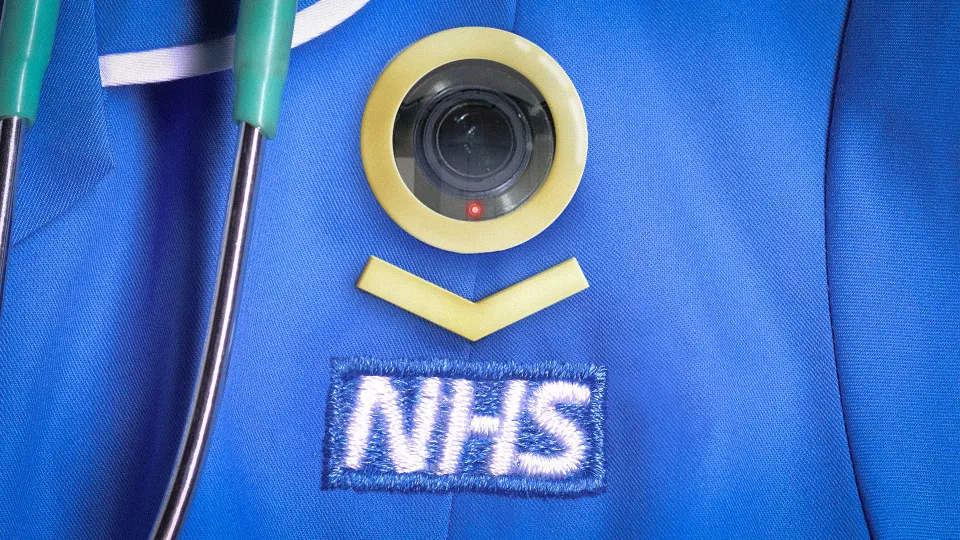
Campaigners rally against Palantir. Photo: Neil Terry Photography
DOZENS of campaigners rallied outside the year’s biggest NHS conference today to demand health chiefs and the government pull the plug on US surveillance tech firm Palantir.
The NHSConfedExpo, organised by the NHS Alliance, brings together health policy-makers from around the country, but has in recent times been a target for protest by those concerned at the encroachment of the US-based data analytics firm on the service.
Palantir has been implicated in genocide as a supplier of AI technologies for battlefield decision-making and the creation of target lists to the IDF as it set about its slaughter of over 75,000 civilians, an estimated 22,000 of them children, and as many as 1,700 health workers in Gaza.
Speakers at the rally included representatives of Unison, Amnesty International, the Good Law Project, Young Struggle Manchester, and Angela, who did not give her surname, from local mental health campaign CHARM, which last year joined demands for Manchester’s Integrated Joint Board to drop the firm.
“As an organisation of service users, survivors, carers, trade unionists and allies, we believe this is about far more than technology,” she said.
“It’s about trust. That is not a minor issue. In mental healthcare, trust can be lifesaving.
“Healthcare data should be protected by organisations that reflect the stated values of the NHS. These values include care, transparency, accountability and respect for human rights.
Kicking out Palantir, experts warn, may not solve the problems its Federated Data Platform has created.
NHS England’s Federated Data Platform, run primarily by controversial US military contractor Palantir, would give a future UK government the ability to use patients’ healthcare data to unleash unprecedented mass surveillance, experts and technologists have warned openDemocracy.
“We have already seen in the US how Palantir’s reach into so many different areas of government has allowed it to build a system that provides detailed profiles of people to enable ICE raids,” said Duncan McCann of the Good Law Project, referring to how President Donald Trump’s mass deportation programme has used Palantir’s tools. “The exact same thing is being enabled by the integration of Palantir into the UK public sector.”
This risk is only exacerbated by the fact that nearly three years after Palantir was awarded the £330m contract to run the FDP, it remains unclear what patient data it gathers, on what basis and to what end. Despite this, 69% of regional NHS Trusts have already adopted the platform, which provides the health service with a new operating system intended to link up otherwise unconnected databases and disparate software across different NHS services and regions.
This lack of clarity was laid bare this week, when the UK’s cross-party Science, Innovation and Technology Committee urged the government to break the NHS’s contract with Palantir. Its report contained a stark recommendation to the government: reveal “the exact nature of Palantir’s access to identifiable and non-identifiable patient data, on what statutory basis this was authorised, when, and by whom.”
McCann and the Good Law Project are part of an unusually wide coalition demanding the UK cut ties with Palantir, but technologists who have worked closely on the FDP warn that the genie is now out of the bottle; kicking the US giant out of the NHS may not be enough to solve the data privacy problems its Federated Data Platform has created.
“You know you could pull Palantir out,” Tom Bartlett, an NHS technologist who worked on the FDP and has spoken publicly in favour of the project, told openDemocracy. “But the danger remains.”
“You still might get a government that says, ‘We need to have the data from the NHS and the data from the Home Office connected, and we want to use it for the purpose of denying people healthcare or deporting people or whatever’.”
Coalition of Resistance
To understand how deeply Palantir is enmeshed in the UK’s public sector, consider the coalition opposed to it.
NHS data analysts and chief data and analytical officers have spoken out against the FDP. The British Medical Association, a union representing doctors and medical students, has urged GPs to reject it. The Greater Manchester Integrated Care Board, which oversees NHS services for 2.8 million people, has refused to sign up to the platform, claiming outstanding security risks haven’t been addressed, and that it has better technology in-house.
It’s not just the NHS, either. London’s mayor has blocked a £50m Palantir contract with the Metropolitan Police, arguing that it was improperly awarded. The housing ministry replaced a Palantir system to match British hosts with Ukrainian refugees with its own technology. In Coventry, local politicians and unions are protesting the renewal of a £750,000 Palantir contract with the council’s children’s services department. Financial Conduct Authority employees are seeking to orchestrate a cross-union campaign against a 12-week trial contract with Palantir that they fear could expose the UK’s sensitive financial data to US law enforcement authorities.
“Our pilot with Palantir allows the Met for the first time to bring together data it already lawfully holds in one place to identify potential standards, welfare or cultural concerns,” said a spokesperson for The Met over email. “It also allows us to identify early issues so we can act more fairly and consistently, ensuring officers receive support or face appropriate action before problems escalate.” In April, Met officers expressed outrage at the “intrusive” use of Palantir’s technology to assess them for misconduct.
The Financial Conduct Authority’s contract with Palantir involves testing an AI search tool for its data. “The data used in the trial will be fully encrypted and under our control,” wrote a spokesperson for the regulator over email. “No-one is able to access the unencrypted data without our authorisation.”
Coventry City Council did not respond to questions about its Palantir contract.
He co-founded the company with $2 million from the venture capital arm of the CIA in the early 2000s, when the failure to prevent 9/11 was being debated across Washington and Silicon Valley. It was suspected, and would be confirmed by the public report a year later, that the CIA, the FBI, and the National Security Agency had separately held the data required to have foreseen the terror attacks, but had “failed to connect the dots”.
That finding has since been the basis of much of Palantir’s success. It argues that governments, militaries, law enforcement authorities and businesses already have much of the data they need to make decisions, but that it is not readily available in the forms needed.
Palantir, it tells them, is the solution.
“The actual thing that’s difficult is organising all your data together,” Alex Bores, a member of the New York State Assembly and a former Palantir employee turned critic, told The New York Times. “That requires hard work, and there’s no magic to do that yet. The software, plus engineers going on site and doing a lot of that hard work to do the manual hookups, was always going to be the true source of value.”
Databasing the Nation
In the NHS, Palantir’s work involves organising, hooking up, and streamlining vast troves of patient data currently scattered across, by one count, 44,000 healthcare IT systems in 26,000 organisations. “The fragmentation is absolutely massive,” said Bartlett, who helped build the FDP. “There’s all this information, and it’s all sat in different pockets.”
Palantir’s solution has two layers. Bartlett describes one layer as an “operating system” analogous to the software that runs your iPhone, which will allow NHS Trusts and third-party developers to create applications (or what Palantir calls “products”) that allow for efficiency gains. An ambulance crew, for example, could input information about an accident victim to a product that would pass it onto the hospital, so that “the A&E department could prepare, rather than being sort of hit in the face” with information when the ambulance arrives, he said.
Yet, much like how your iPhone decisively locks you into the ecosystem of Apple products, running this system efficiently requires as much of the NHS as possible to sign on to the Palantir system – something experts call “vendor lock-in” – and to draw on a staggering library of data held across the health service.
The FDP’s public documentation reveals that the platform is already in the process of ingesting several hundred databases, covering a vast array of variables that include mental healthcare contact activity, mortality, flu vaccination status, covid vaccination status, emergency services data, race and ethnicity, aggregated data for persons held in secure mental health facilities in adult prisons and immigration removal centres, and much more.
As the cross-party committee of MPs noted in their report last week, there is little clarity around exactly what data will make it into the FDP, and how it will be accessed. The debate around patient data held by GP practices offers a useful illustration.
Back in 2023, the then secretary of state for health and social care, Victoria Atkins, told the House of Commons: “No new data will be collected, and GP data will not be part of the national platform.” However, an NHS FAQ page last updated in April 2026 admits that “some of the data” in the FDP “may have been sourced from GP records”, and GP data lawfully shared with NHS trusts that use the FDP could end up on the platform.
More worryingly, the FDP uses all this data to create detailed profiles of individual patients that it calls the ‘Person Ontology’. To quote from an NHS Data Protection Impact Assessment: “The Person Ontology serves as the single source of the truth for pseudonymised patient level datasets”.
Elsewhere, the document says that “the Person Ontology currently holds activity data for citizens in different care settings”, explaining that the platform assigns individual patients a unique ID that can be cross-referenced across multiple databases.
The NHS says that as the data held in the FDP is pseudonymised, it does not directly identify individuals. But pseudonymisation, as has been pointed out by the Information Commissioner’s Office, the UK’s data protection watchdog, is a reversible process. “Take care not to confuse pseudonymisation with anonymisation,” the ICO warns.
A person’s healthcare data is their “most intimate information,” said a spokesperson and legal officer at Privacy International, a UK-based charity focusing on technology and rights. “We’re talking about the breadth of the data, how personal it is, and the severity of what could be done with it if it were to land in the wrong hands.”
Big Data Means Big Brother
Consolidating so much data brings very real risks of surveillance, say those familiar with the platform, particularly since Palantir also holds contracts with police forces in the UK. In principle, all that’s stopping the Home Office from accessing NHS data are legal safeguards that can be reversed.
Here in the UK, Palantir UK CEO Louis Mosley has said that if Nigel Farage’s Reform comes into power, the company will follow the party’s professed directives to use NHS data to target individuals based on their immigration status.
Such a scenario played out in the US when Trump first became president in 2016, as Bores, the former Palantir employee, told The New York Times.
“Palantir had signed a contract with a department within ICE called HSI, Homeland Security Investigations. During the Obama administration, it was focused on anti-human trafficking, anti-drug trafficking, sometimes counterfeiting,” Bores said. “Then, when Trump comes in in 2017, they try to change the nature of that work. They try to get another part of ICE called ERO, Enforcement and Removal Operations – the part that everyone thinks of as ICE – to get access to the software and to use it for deportations.”
In the US, Palantir already uses data from the Department of Health and Human Services to track people targeted for deportation by ICE. Here in the UK, junior doctor Rhiannon Mihranian Osborne, who is organising against Palantir in the NHS with health justice organisation Medact, described what she said was a disturbing pattern: “Reform’s policy ‘Operation Restoring Justice’ wants to create a powerful immigration surveillance system by mining data from health, police and financial databases. Louis Mosley said his company would comply with this.
“Palantir’s police contracts in the UK include collating highly sensitive information on victims of crime, including sexual orientation and trade union membership. The home secretary says she wants to create a panopticon of state surveillance. The synergy between Palantir and governments who use data to abuse human rights is deeply alarming, and a sign of what could be coming in the UK.”
This is a real risk, conceded Bartlett. “Let’s take [a] Reform government and the immigration question coming in, I do worry about that scenario,” he said – but he questioned whether that means the NHS doesn’t need a Federated Data Platform. “So is the answer to that bad scenario playing out to keep the data in such a bad state that nobody could ever use it at all for good or bad?”
Palantir, NHS England, the Cabinet Office, the Department of Health and Social Care and The Reform Party did not respond to requests for comment.
Critics of the FDP, however, have pushed back against what they see as a narrative that the NHS’s systems are so hopelessly complex and tangled that the only way to solve them is with a mass surveillance tool built by Palantir.
“There’s no magic here,” Sam Smith, a technologist with patient rights organisation medConfidential, said of the FDP. “It’s not like Palantir is doing anything that other people can’t do… They’re just doing the thing because they have the mythos that they can do the thing.”
Andrew Holway, the founder of UK-based medical software startup Darwinist, told the cross-party committee that “the primary barrier to NHS innovation” is mega contracts with companies such as Palantir. These, he said, hold the NHS “hostage, preventing the implementation of modern productivity tools that could save tens of billions of pounds”.
Some in the NHS have also questioned whether the service has tried different approaches that are less intrusive and data-centric. The NHS Greater Manchester Integrated Care Board, for instance, uses its own Analytics and Data Science Platform because it believes it offers better technology and access to better data.
“Public trust isn’t a side issue for the Federated Data Platform,” wrote Matt Hennessey, the chief data and analytics officer at Manchester Integrated Care Board, in a post on LinkedIn. He outlined the “effect that ethical concern, moral unease or perceived opacity has on trust–and, in turn, on participation.”
The platform’s “main problem is that it isn’t clear what it actually is,” he wrote. “Where trust is eroded, people disengage, patients opt out, and clinicians become cautious about involvement.”
Ultimately, as Osborne said, “any NHS data system must be built on public trust, buy-in from staff, and most importantly, protection from abuse by private corporations and governments themselves”.
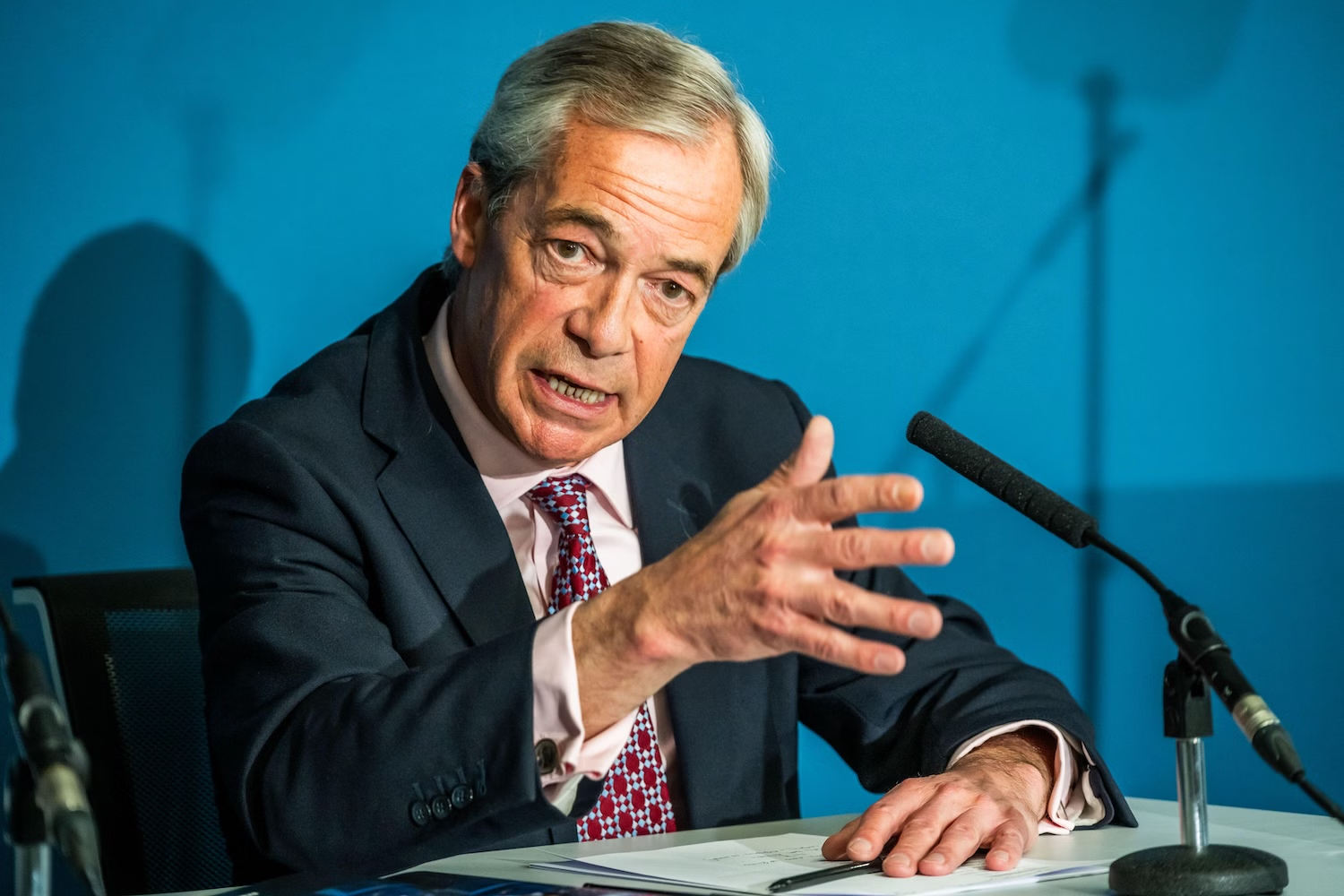
Reform UK leader Nigel Farage. Credit: Guy Bell/Alamy Live News
Nigel Farage’s anti-climate party has received two thirds of its income from oil investors.
Reform UK has received £24 million from oil and gas interests, accounting for more than two thirds of its total income, DeSmog can reveal.
Led by Nigel Farage, the party is calling for new North Sea oil and gas drilling ahead of UK-wide elections in May on the ill-founded claim that it will cut energy bills.
DeSmog’s analysis reveals that 67 percent of Reform’s funding to date has come from donors with financial interests in fossil fuels, totalling more than £24 million.
A further £2.4 million has been donated by individuals who have disputed basic scientific facts about climate change.
“What these extraordinary numbers make clear is that Reform is less a political party and more a very highly paid public-facing lobby group for oil and gas interests,” said Jolyon Maugham, executive director of the Good Law Project campaign group.
The biggest chunk (£22 million) has been gifted by Thailand-based crypto billionaire Christopher Harborne, whose firm AML Global sells jet fuel, which is made from crude oil. More than half (£12 million) of this figure was donated in 2025.
Another £1.7 million has come from hedge fund boss Jeremy Hosking, whose investment firm Hosking Partners has $440.8 million (around £326.5 million) invested in oil, gas, and coal. As revealed by DeSmog, Hosking Partners has ramped up its fossil fuel investments in recent months during the war in Iran, which has caused energy shortages and windfall profits for oil giants.
Reform has received more than £2 million from its deputy leader Richard Tice, a property millionaire who has denied that man-made carbon dioxide (CO2) emissions are causing climate change – instead calling it “plant food”.
Farage has himself claimed it’s “absolutely nuts” for CO2 to be considered a pollutant.
The party has also accepted £230,000 from management consultancy First Corporate Consultants, whose owner Terence Mordaunt is a former chair of the Global Warming Policy Foundation (GWPF). The GWPF is the UK’s foremost climate denial group, and has claimed CO2 emissions are a “benefit to the planet”.
In total, Reform has received almost £26.7 million from climate deniers and fossil fuel interests since it was set up by Farage as the Brexit Party in 2019 – roughly three quarters (74 percent) of its total £36 million income.
IN NUMBERS: Reform’s smoggy £26 million
Christopher Harborne
Fossil fuel interest
£22,190,000
Richard Tice
Climate science denier
£2,257,919
Jeremy Hosking
Fossil fuel interest
£1,718,000
Terence Mordaunt
Climate science denier
£230,000
Ashley Mark Levett
Fossil fuel interest
£200,000
Jacques J. Tohme
Fossil fuel interest
£50,000
TOTAL
£26,652,919
Reform – which is leading UK-wide polls at 25 percent – has vowed to “scrap net zero”, end subsidies for wind and solar power, approve new oil and gas exploration, lift the ban on fracking for shale gas, and open new coal power plants.
The party has doubled down on these policies during the Iran war. Earlier this month, Tice called for the UK to extract “every last drop” of oil and gas in the North Sea, and described new drilling as “our patriotic duty”.
Green Party MP Ellie Chowns told DeSmog: “When you receive nearly two thirds of your funding from vested interests, it is no surprise you dance to their tune.
“This exposes precisely why Reform wants to promote fossil fuels and undermine the green transition to renewables that would provide us with cheaper, secure energy.”
New climate modelling has indicated that a critical Atlantic current is significantly more likely to collapse than previously thought, while scientists have warned of a “rapidly closing window” to limit temperatures rises to 1.5C and avoid the worst impacts of climate change.
In March, the UK’s independent Climate Change Committee said the entire cost of cutting emissions to net zero by 2050 would be less than a single fossil fuel price shock – two of which have been experienced by the UK in the past five years.
Meanwhile, a report by the New Economics Foundation last year concluded that Reform’s anti-renewables agenda could cost 60,000 jobs and wipe £92 billion off the economy.
“It isn’t exactly a shock to discover that the party most reliant on fossil fuel funding is also ignoring climate science and claiming that more drilling will solve all of our energy problems,” Angharad Hopkinson, political campaigner for Greenpeace UK, told DeSmog.
“But can they continue to hold that line as Trump’s war in Iran makes it more and more obvious that our dependence on oil and gas gives control over our energy prices to dictators and petrostates with no loyalty to the UK?”
Hopkinson added: “Reform is trying to walk a tightrope, presenting themselves as the party of patriotism while working to preserve foreign influence, rather than saving Britain money by switching to home-grown renewable energy and taking back control.”
Reform was approached for comment.
Reform’s Fossil Fuel Donors
Reform’s biggest donor is crypto investor Harborne, whose company AML Global supplies aviation and maritime fuel to a distribution network that includes “main and regional oil companies”, according to its website.
As reported by Private Eye, the price of jet fuel has doubled since the start of the war in Iran, which would benefit Harborne’s business interests.
One of AML Global’s past clients is the U.S. military, which made payments worth £115 million to AML Global’s Hong Kong division between 2020 and January 2026. It’s unclear if the U.S. military is still a client.
Harborne and AML Global didn’t respond to DeSmog’s request for comment. In response to a similar enquiry in 2024, he posted a lengthy statement on the AML Global website, stating: “Firstly, I am not a climate science denier and secondly, I do not seek to influence any government through donations or lobbying regarding their policies on climate change or in favour of corporate interests.”
However, Harborne is by far the biggest donor to the UK’s leading anti-climate party. In addition to his £22 million in donations to Reform, The Guardian has revealed that he gave £5 million personally to Farage before the 2024 general election.
DeSmog analysed Electoral Commission data going back to Reform’s founding, along with company accounts and investment registers.
Reform has also received £1.7 million from hedge fund boss Hosking, whose firm Hosking Partners has extensive fossil fuel holdings.
Its latest filings at the U.S. Securities and Exchange Commission show the hedge fund has $369.7 million (around £273.7 million) invested in oil and gas companies, and $71 million (around £52.6 million) invested in coal firms.
Hosking’s total fossil fuel investments increased by almost 54 percent in the first three months of 2026.
Hosking previously told DeSmog: “I do not have millions in fossil fuels; it is the clients of Hosking Partners who are the beneficiaries of these investments.”
Reform also received £50,000 last year from Nova Venture Holdings. The company’s sole director, Jacques J. Tohme, is an oil executive with a long history in the industry. He is founder and managing partner at Samos Energy, which finances oil and gas projects in Southeast Asia. He previously founded Tailwind Energy – later merged with Serica Energy – an oil and gas company which operated in the North Sea and which “transacted” with Shell, BP, and ExxonMobil.
In November, the party accepted a further £200,000 from Ashley Mark Levett. He currently sits on the board of Monaco-based company, Levmet – a global commodities trader whose interests include fossil fuels.
Climate Denier Donors
Reform has also received more than £2.5 million from donors who have promoted climate science denial.
The party’s deputy leader Tice has provided £2.3 million via his companies TISUN investments, Britain Means Business, and Leave Means Leave since the party’s founding in 2019.
Tice has described carbon dioxide as “plant food”, and told Sky News: “There’s no evidence that man-made CO2 is going to change the climate. Given that it’s gone on for millions of years, it will go on for millions of years.”
The UN’s Intergovernmental Panel on Climate Change (IPCC), the world’s leading climate science body, has said it is “unequivocal” that human influence has caused “unprecedented” global warming.
Tice has been accused of hypocrisy for calling renewable energy “a massive con” while fitting solar panels and electric vehicle charging stations on his commercial properties.
In 2023, Reform received £230,000 from First Corporate Consultants, a company owned by Terence Mordaunt, who chaired the GWPF from November 2019 to October 2021.
The GWPF has claimed that carbon dioxide has been “mercilessly demonised” when in fact it should be “two or three times” higher than current levels.
In reality, the IPCC has said CO2 emissions are causing dangerous climate change, fuelling extreme weather, crop failure, and excess deaths around the world.
Despite their opposition to climate science and their fossil fuel donations, Reform MPs represent some of the constituencies most at risk from extreme heat and flooding, including Farage’s constituency of Clacton and Tice’s seat of Boston and Skegness.
Reform UK leader Nigel Farage looking at the floodwater in Burrowbridge, Somerset.
Credit: PA Images / Alamy
Other Big Donors of Note
Outside the scope of this analysis is Zia Yusuf, a multi-millionaire former tech entrepreneur and Reform’s home affairs spokesman, who has donated £206,000 to the party.
While he has attacked climate action, Yusuf has not explicitly denied the role of man-made CO2 emissions to global warming.
Yusuf donated to Reform ahead of the 2024 election, after which he was appointed as the party’s chairman.
Following the election, Yusuf attacked the Labour Party’s clean energy policies, saying: “Labour champagne socialists are restricting supply of the cheapest form of energy for ordinary citizens.”
He has called net zero “religious madness” and described North Sea oil and gas as “a gift from god”. He welcomed Donald Trump’s election as U.S. president in 2024 as a rejection of “net zero fanaticism”.
The same year, Reform received £247,000 from David Lilley, a metals and mining executive and a director at the investment firm Drakewood Capital. The company holds a 20 percent stake in VSA Capital, which claims to have “a deep knowledge of mining and oil and gas” and which provides banking and brokerage services to the industry.
Lilley – an old friend of Farage – is also a director of Resolute 1850, a Reform-linked think tank rebranded as the Centre for a Better Britain. It was launched last year by right-wing academic James Orr to “support Reform with policy development, briefing and rebuttal”. Orr joined Reform as head of policy in February, having previously been a senior advisor to the party.
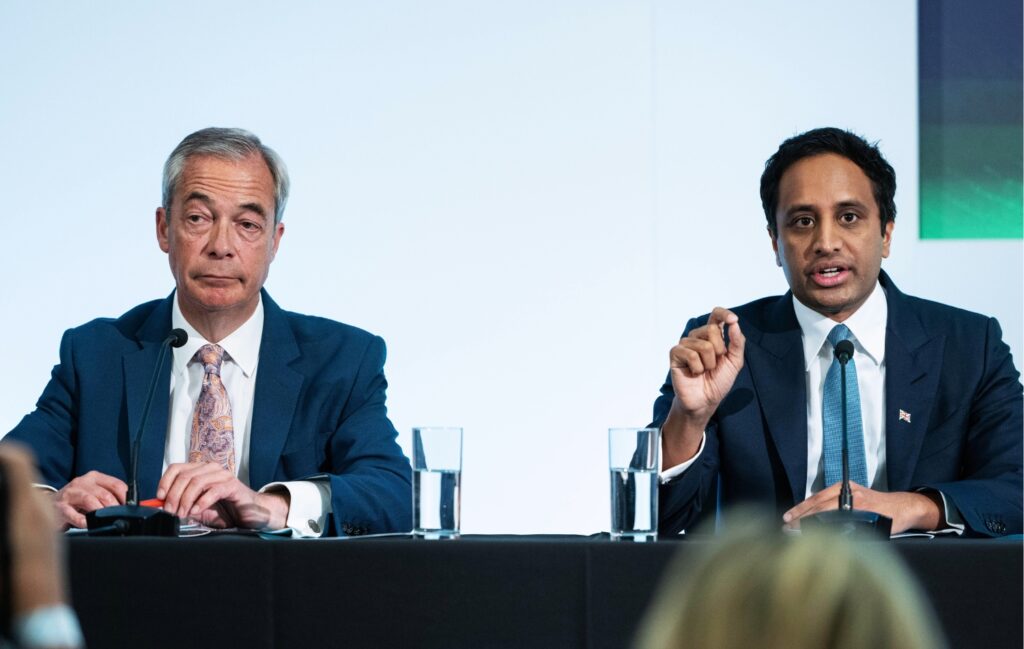
Reform UK leader Nigel Farage and home affairs spokesperson Zia Yusuf.
Credit: ZUMA Press, Inc. / Alamy
Reform has received a further £990,000 from property billionaire Nick Candy, who is Reform’s treasurer and who claims to have sought party funding from oil and gas executives.
As DeSmog has reported, Candy also has financial interests in the United Arab Emirates (UAE), a Gulf petrostate. In late 2024, his firm Candy Capital entered into a “strategic joint venture partnership” with Modon Holding, which is chaired by a board member of the Abu Dhabi National Oil Company (ADNOC).
Between 2023 and 2025, the party accepted £95,000 from Panther Securities, a property investment company chaired by former UKIP donor Andrew Perloff, who has blamed rising inflation on climate policies and defended climate science deniers.
In June 2022, Perloff wrote: “Whilst they [scientists], of course, could be correct that global warming is happening, I feel it is worrying that those with different opinions are often prevented from presenting them for consideration.”
Reform has also received £36,000 from Heathrow Airport, which was found to be the world’s second most carbon-emitting airport in 2019. Heathrow has also donated to Labour and the Conservatives in recent years.
Farage’s Millions
Alongside these donations, Farage has received £664,000 since July 2024 from the anti-climate broadcaster GB News, which employs him as a presenter. The platform is co-owned by Paul Marshall, whose hedge fund had £1.8 billion invested in fossil fuels as of June 2023.
As revealed by DeSmog, Farage has received gifts from the UAE, and has been lavished with £150,000 worth of flights to give speeches to U.S. anti-climate groups.
Last year, Farage helped launch a UK-Europe branch of the Heartland Institute, a U.S. climate denial group which has described itself as “the world’s most prominent think tank supporting skepticism about man-made climate change”.
In total, Farage has received almost £2 million in earnings and gifts since his election in 2024, including £675,000 from foreign sources.
Nigel Farage urges you to ignore facts and reality and be a climate science denier like him and his Deputy Richard Tice. He says that Reform UK has received £Millions and £Millions from the fossil fuel industry to promote climate denial and destroy the planet.
Sophie Ellis Bextor performing in 2023. Photograph: Tin!y/Alamy Live News/Alamy Live News.
Organised by Olly Alexander and the Mighty Hoopla festival to ‘fight back against the politics of fear and exclusion’, Trans Mission will take place at Wembley Arena in March
Artists including Sugababes, Wolf Alice, Romy, Sophie Ellis-Bextor, Christine and the Queens, Beth Ditto, Beverley Knight, Jasmine.4.T, Kae Tempest and more will perform at an all-star charity concert at Wembley Arena in support of trans rights next year.
Organised by Olly Alexander and the Mighty Hoopla festival, Trans Mission will also feature appearances from figures including Green party leader Zack Polanski, actor Ian McKellen, comedian Grace Campbell, author Shon Faye, actor Mawaan Rizwan, model Munroe Bergdorf and actor Nicola Coughlan.
The concert will raise funds for the Good Law Project, a charity that uses the law to push for change and government accountability, and trans-led charity Not a Phase.
Alexander said in a statement: “I believe that in these times, community action isn’t just important – it’s essential! We need real and lasting change. Through solidarity, creativity and collective fundraising, we can fight back against the politics of fear and exclusion and build a world where everyone can thrive.
“I am very fortunate to know and work closely alongside incredible trans and non-binary people whose creativity and presence are essential to the cultural fabric we all share. Trans Mission is going to be a special and unforgettable night, and I’m excited to share the stage with so many wonderful people I hugely admire.”
Organisers said the show was in response to rising hate crimes and discrimination against trans people, particularly after the UK supreme court’s ruling on biological sex and the subsequent interim advice of the Equality and Human Rights Commission.
INVESTMENT in Britain’s water utilities took a dive under Thatcher’s government. By 1980 investment by the regional water authorities dropped by two-thirds as the neoliberal straitjacket into which public expenditure was confined limited their ability to raise capital.
Contrast this to the present situation where the now privatised water companies have racked up millions in loans that seem more valued as a source of ready cash to pay bonuses, dividends and sweeteners than infrastructure investment.
The total debt burden of the dozen privately owned water companies stands at £65 billion which this year’s Commons report says is perilously close to the 70 per cent gearing at which commercial credibility is compromised.
Jo Maugham, director of the Good Law Project, which has been involved in legal challenges to a number of water companies, says: “The water sector has been poorly regulated for decades. It has been poorly regulated primarily by allowing water companies to over extract water from aquifers and reservoirs but also cash from operating entities within the water companies, and they’ve been allowed to underinvest in water infrastructure.”
…
The logical case for public ownership is sometimes challenged by the suggestion that taking these failing enterprises into public ownership would be prohibitively expensive.
This is, of course, true if these enterprises were to offered for sale at the price their owners value them. A socialist government armed with a popular mandate and backed by a working class armed with both resolve and the necessary instruments of coercion might simply dispossess these rapacious incompetents and instruct them, individually and as a class, to find an alternative way of making a living freed of the responsibilities of ownership.
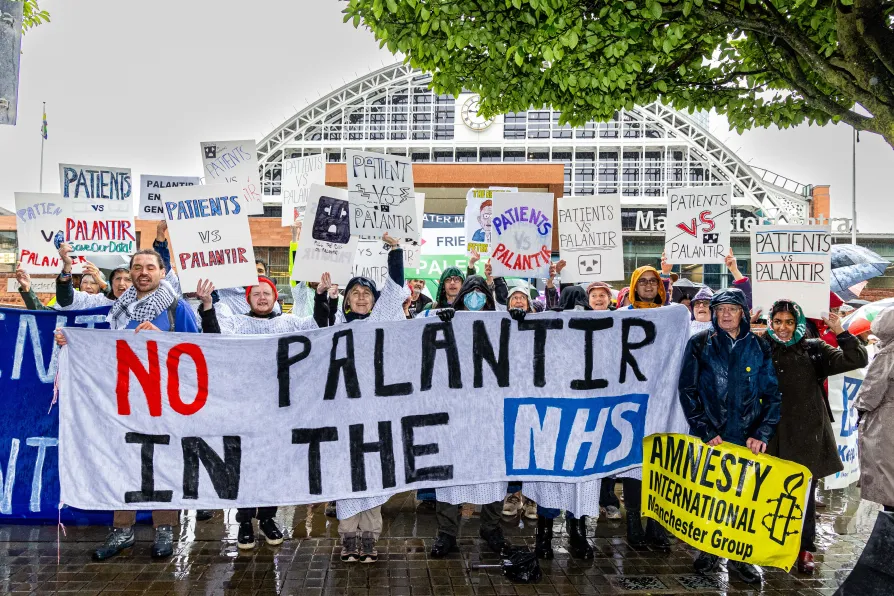
 Campaigners rally against Palantir. Photo: Neil Terry Photography