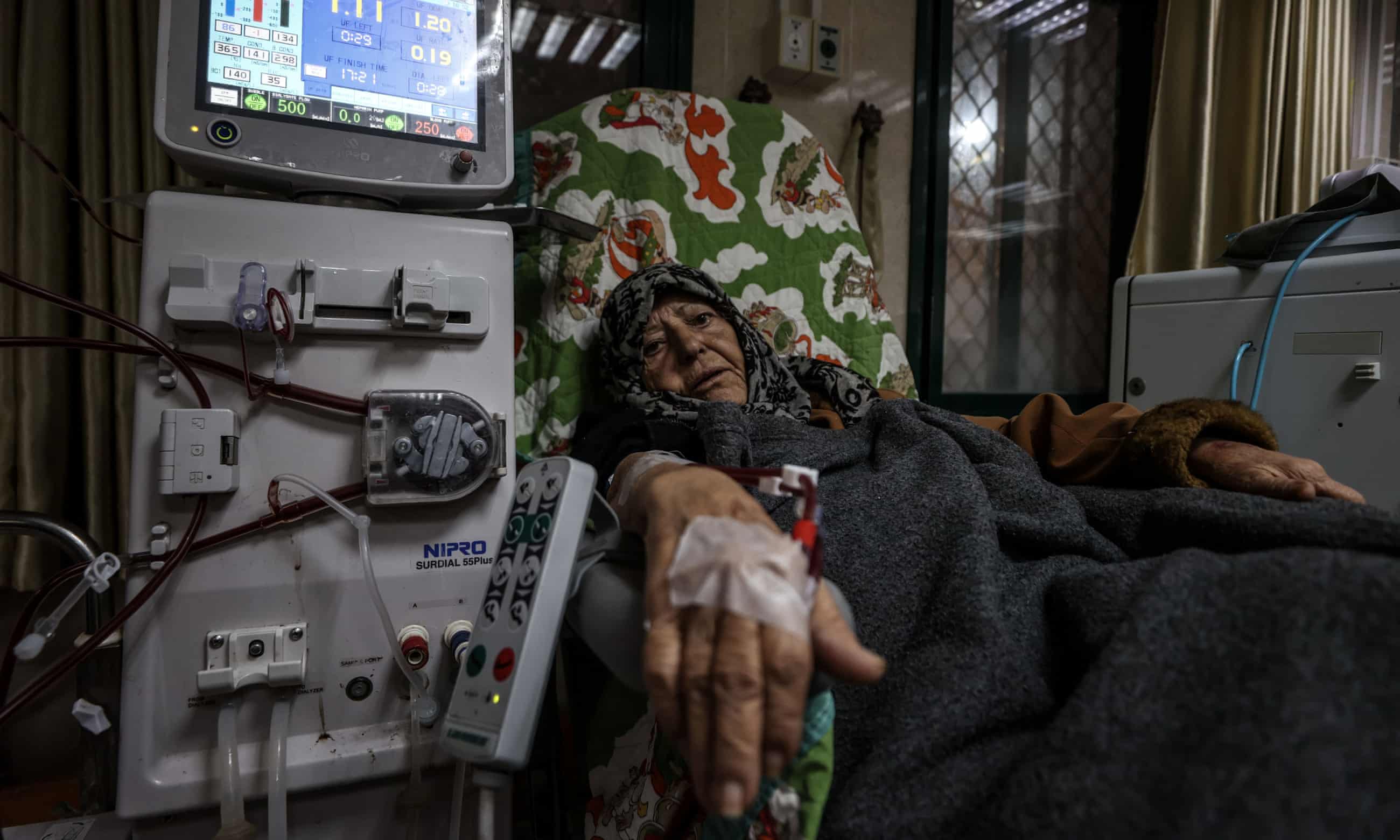
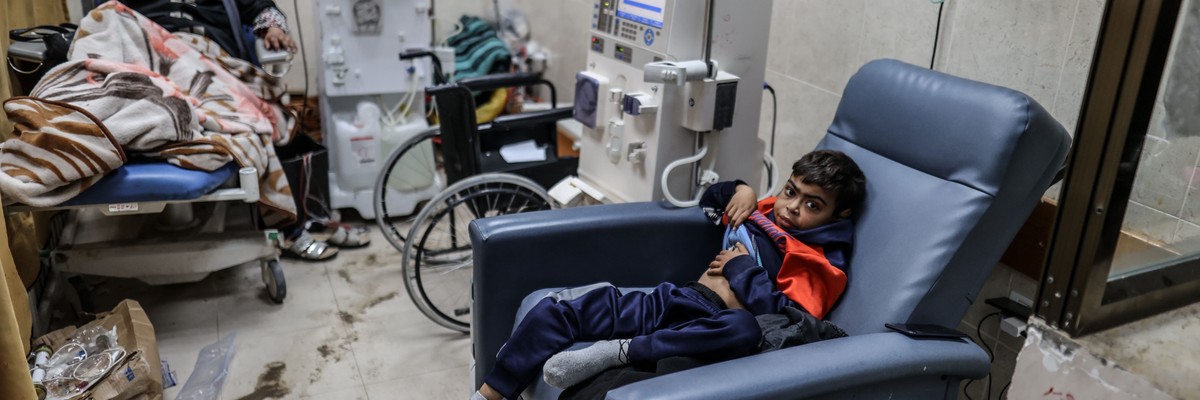
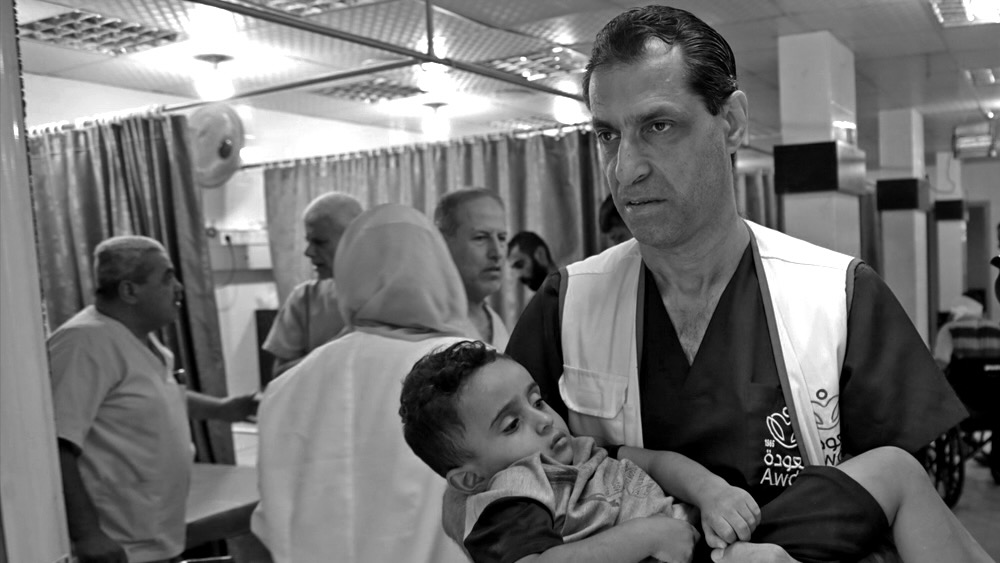
A Palestinian woman receives dialysis treatment at the Al-Aqsa Martyrs Hospital on February 8, 2024. Photograph: Anadolu/Getty Images
The lack of medicine, food and water means thousands of people with asthma, kidney disease or diabetes are unable to treat or control their conditions
Four months of conflict in Gaza is jeopardising the health of thousands of people with chronic illnesses such as kidney disease, diabetes and asthma, doctors have warned.
The chronically ill are the hidden casualties of the war, as access to water, food and medicine is severely restricted, said Guillemette Thomas, the Médecins Sans Frontières (MSF) medical coordinator for Palestine.
“Hospitals that are still functioning are overwhelmed with injured people, they are not able to deal with chronic illness at all,” she said. “Before the war there were 3,500 hospital beds in Gaza, now there are fewer than 1,000, and hundreds and hundreds of injured. We don’t know how many people are dying because they can’t access healthcare.”
When medication is allowed into the territory there are no safe ways of distributing it, Thomas said. “We have some insulin coming in aid trucks, but patients can’t get to the places where it is stocked because of the airstrikes. People are bombed on their way to the hospital.”
Palestinians receiving dialysis treatment are pictured at the Al-Aqsa Martyrs Hospital in Deir Al Balah, Gaza on February 8, 2024. (Photo: Ali Jadallah/Anadolu via Getty Images)
“There is a particularly cruel circular logic at play here: Israeli forces, as they bomb and besiege Gaza, are creating an urgent need for medical care among civilians while simultaneously denying them access to it.”
A pair of human rights experts on Friday urged the International Criminal Court to prosecute any Israelis who have played a part in the assault on Gaza’s healthcare system, which is in tatters after months of relentless airstrikes, shelling, and a suffocating blockade.
“Since Hamas’ horrific October 7 attack, Israel has repeatedly targetedhealthcare facilities, ambulances, and access roads,” Annie Sparrow, a practicing clinician in war zones, and Kenneth Roth, former executive director of Human Rights Watch, wrote in an op-ed for Foreign Policy.
“It has arrested healthcare workers, blockaded fuel needed for generators, and withheld critical medical and surgical supplies—all of which are intended to undermine Gaza’s healthcare system,” they added. “There is a particularly cruel circular logic at play here: Israeli forces, as they bomb and besiege Gaza, are creating an urgent need for medical care among civilians while simultaneously denying them access to it.”
Sparrow and Roth called on the International Criminal Court (ICC), which is currently investigating alleged war crimes in the occupied Palestinian territories and Israel, to “prosecute Israelis responsible for bombing hospitals, denying access to medicines and vaccines, and causing excessive civilian harm.”
“These attacks could be part of a plan to make Gaza uninhabitable and drive Palestinians out, an outcome that senior Israeli ministers—whose support Israeli Prime Minister Benjamin Netanyahu needs to remain in power—continue to promote,” they wrote.
The near-total collapse of Gaza’s healthcare system under Israel’s assault, combined with the scarcity of clean water and other necessities, has left millions of Gazans at growing risk of disease. There is no longer a single fully functional hospital in the Gaza Strip, according to the United Nations.
“Israel’s destruction of Gaza’s healthcare system is not only an important part of the genocide charges [brought by South Africa]—it is also a blatant war crime that should be prosecuted outright by the International Criminal Court,” Sparrow and Roth wrote Friday, noting that while the International Court of Justice “resolves disputes between states, the ICC adjudicates criminal prosecutions of individuals.”
“Targeting healthcare achieves little militarily while amplifying the death toll and suffering caused by indiscriminate bombardment,” the pair continued. “Such attacks flout the core purpose of international humanitarian law—to relieve civilian suffering—and are thus often an omen of broader atrocities to come.”
Destroying Gaza’s Healthcare system is a war crime.
The ICC should prosecute Israelis responsible for bombing hospitals, denying access to medicines and vaccines, and causing excessive civilian harm @ForeignPolicy
The World Health Organization (WHO) said Friday that it has documented more than 350 attacks on healthcare in the Gaza Strip since October 7. The attacks killed at least 645 people and injured 818 more, according to newly released WHO data.
“These attacks have affected 98 healthcare facilities, including 27 hospitals damaged out of 36, and affected 90 ambulances, including 50 which sustained damage,” WHO spokesperson Tarik Jasarevic told reporters in Geneva.
The WHO’s new figures came shortly before Israeli Prime Minister Benjamin Netanyahu instructed Israel’s military to craft a plan to forcibly “evacuate” civilians from Rafah, a densely crowded city whose hospitals are overwhelmed with injured patients and displaced people.
Netanyahu’s order intensified concerns that an Israeli ground invasion of Rafah is imminent.
Catherine Russell, head of the United Nations International Children’s Emergency Fund (UNICEF), warned that a Rafah assault could be catastrophic for the enclave’s already starving and desperate population.
“We need Gaza’s last remaining hospitals, shelters, markets, and water systems to stay functional,” Russell told The Associated Press. “Without them, hunger and disease will skyrocket, taking more child lives.”
Al-Awda Hospital Manager Dr. Ahmed Muhanna was arrested by Israeli Forces on December 17, 2023 and his whereabouts are unknown. Photo: People’s Health Movement
The status of health workers arrested by Israeli Occupying Forces in northern Gaza remains uncertain as attacks on health infrastructure continue
One month ago, Ahmed Muhanna, the director of Al-Awda Hospital in Jabalya, northern Gaza, was detained by the Israeli Occupation Forces (IOF). According to the most recent information made available to Awda Association, the anesthetist is currently being held in Naqab prison in the Negev desert, with other details about his status remaining unknown.
Dr. Muhanna’s fate is shared by many other health workers who were arrested during the ongoing Israeli war on the Gaza Strip. Mohammed Al-Ran, a surgeon who worked at the Indonesian, Kamal Adwan, and Al-Ahli hospitals since October 7, is currently also imprisoned by the Israeli authorities, although he had been granted permission to leave for Bosnia.
Sparse information about his health conditions and location, much like that of Dr. Muhanna, is communicated through friends and relatives who have either witnessed the arrest or met Dr. Al-Ran while in prison. The IOF has remained silent unless faced with pressure, usually from abroad.
The arrest of several directors of Gaza’s hospitals has mostly been interpreted as a sign of the next phase of Israel’s attacks on healthcare in the Strip. Some, like surgeon Ghassan Abu-Sittah, predict that this will lead to a series of show trials to further the criminalization and persecution of the sector. Others, including sources close to Awda, consider it possible that the doctors will be held in prison for a prolonged period of time, with their post-war destiny unknown.
Different interpretations converge on one point, though. They all note that the health workers taken by the IOF were strong voices speaking from northern Gaza and had refused to leave the area and abandon their patients. In other words, they constituted a thorn in the side of the army that breaks international law every time it targets health infrastructure in Palestine.
While arresting and targeting health workers to silence them, Israeli soldiers continue to attack hospitals and health centers in Gaza. As a result of the ongoing attacks, many international organizations have been forced to abandon their operations for good or move to the southern regions. Among them were the Medical Aid for Palestinians (MAP) and Médecins Sans Frontières (MSF) teams.
“Drone strikes, sniper fire and bombardments in the close vicinity of the hospital made the space too unsafe to work in. The volatile conditions leave us feeling incapacitated; there’s virtually no secure space to provide even minimal medical care to people,” said Enrico Vallaperta, MSF Project Medical Referent, commenting on the organization shifting its operations from Al-Aqsa Hospital.
Yet, health workers are not giving up on protecting health infrastructure in Gaza, including in Al-Awda centers in Nuseirat and Rafah. In fact, safeguarding and reactivating the local health system remains a priority for international organizations, including the World Health Organization (WHO).
The WHO also continues to conduct visits to the remaining hospitals in Gaza. Although the situation can change in a matter of hours – with hospitals going from partially operational at 10 am to completely out of function by 2 pm – generally they are all working multiple times over their capacity as well as trying to shelter thousands of forcibly displaced people.
During a visit conducted on January 13, the WHO team found Al-Aqsa Hospital and Nasser Medical Complex short-staffed and crowded. In Al-Aqsa, there were only 12 health workers remaining, providing care to 140 people and sharing space with over 1,000 displaced people. Nasser held twice the number of patients it was supposed to accommodate. “The hospital continues to receive a high volume of trauma and burn cases but the ICU and burns unit are severely understaffed, delaying lifesaving treatment for many,” the WHO team reported back.
Unsurprisingly, the situation continues to be ripe for the spread of communicable diseases. Before October 7, “immunization levels in Gaza were among the best globally,” according to Rana Ahmad Hajjeh from the WHO Eastern Mediterranean office. Now, without coolers and fuel to operate them, there is little hope in rolling out vaccination campaigns that could help curb major outbreaks.
Even when the WHO and other international organizations are able to get vaccines into Gaza, the IOF does not allow them to distribute them in the northern areas. Multiple missions over the past weeks had to be canceled due to the lack of security guarantees on the Israeli side. This has meant that medicines, as well as fuel needed to operate generators, are simply not where they should be.
“In the 21st century, most medical equipment operates on electricity. Unfortunately, electricity has become a scarce commodity [in Gaza],” observed Ayadil Saparbekov from WHO’s Health Emergencies program.
Amid ongoing communication blackouts, it is not only electricity that has become a scarce commodity. The same is true for information coming directly from health workers in Gaza; without that information, the fate of Dr. Muhanna, Dr. Al-Ran, and others remains difficult to predict.
Healthcare workers at Al-Awda hospital. Photo: Al-Awda
The number of people infected with contagious diseases in Gaza continues to rise. The latest data from the World Health Organization (WHO) warns that 180,000 people are currently suffering from respiratory infections. Additionally, the UN’s health agency reports that 55,000 people have lice and scabies, 42,000 are experiencing various forms of skin rashes, and 136,000, half of whom are children under 5 years old, have contracted diarrhea.
While these diseases would not be deadly under conditions with a functioning health system and adequate living conditions, in the current situation, they could be life-threatening. “Unless something changes, the world faces the prospect of almost a quarter of Gaza’s 2 million population – close to half a million human beings – dying within a year. These would be largely deaths from preventable health causes and the collapse of the health system,” estimated Devi Sridhar, Chair in Global Public Health at the University of Edinburgh, at the end of 2023.
If a permanent ceasefire does not take immediate effect, though, things are unlikely to change, as reiterated by WHO Director-General Tedros Adhanom Ghebreyesus in a statement. WHO teams, now participating in fairly regular missions on the ground, are sending reports about overcrowding in Gaza’s hospitals and shelters. According to the Palestinian Ministry of Health, on January 4, only 9 out of 36 hospitals were partially functioning in the Strip, resulting in an average bed occupancy of 351% and 261% occupancy in intensive care units.
Israel’s attacks on healthcare in Palestine are affecting everyone, especially the most vulnerable. Cancer and dialysis patients cannot access the specific care they need, and most have not yet been transferred to hospitals abroad as announced. The Ministry of Health estimates that 5,300 patients need to be transferred abroad for treatment, but until January 5, less than 1,000 were moved. This number includes 571 people injured in the attacks and 401 patients who required distinct forms of care, including cancer patients.
Children and pregnant women are also groups most at risk from the attacks and their consequences. Over 5,000 babies were born in Gaza just last month, all requiring adequate care and nutrition. With mothers and families going hungry, it is evident that some of them are also lacking proper food. Among the newborns are about 130 premature babies dependent on incubators, yet most incubators are located in northern Gaza, which, in terms used by the WHO, has become a medical disaster zone.
In addition to going hungry and sleeping in overcrowded tents, newborns and children are also not getting vaccinated. Recounting the experience of a woman who recently gave birth, Nareman, who was “taken from her tent in a temporary camp by horse-drawn carriage to a hospital to give birth to her daughter, before returning to her makeshift home straight after,” the WHO warned that the health system in Gaza is struggling to ensure standard immunization routines. Nareman’s baby is among those who are yet to receive planned vaccines, and she is staying with her sisters and brothers at the camp, who are reportedly in ill health themselves.
The UN Relief and Works Agency for Palestine Refugees in the Near East (UNRWA) has managed to deliver 600,000 key vaccines into Gaza in the period between December 25-29, 2023, and is planning to deliver some 960,000 more together with WHO and UNICEF. Yet, this is no easy feat as Israeli Occupying Forces (IOF) continue to target health infrastructure and health workers. Since the beginning of the attacks on October 7, 326 health workers in Palestine were killed by Israeli attacks, 764 were injured, and 65 were arrested, according to Ministry of Health data.
Many more experienced violence and intimidation by the IOF, including ambulances and partners of the Palestinian Red Crescent Society (PRCS). On January 4, Israeli soldiers attacked a PRCS ambulance. Not long before that, the organization reported attacks targeting the house of Anwar Abu Holi, Director of the Central Gaza Ambulance Center, as well as multiple attacks on the Al-Amal Hospital in Khan Younis.
As shelling in the proximity of the hospital began, Al-Amal offered shelter to approximately 14,000 forcibly displaced people. The attacks, said the PRCS, endangered the lives of thousands. “The displaced persons are living in an atmosphere of horror and panic.”
The attacks that have taken place since the beginning of January killed 7 people, including a days-old baby, injured 11 more, and were reported by the PRCS to be ongoing on January 5, without a meaningful indication they would stop anytime soon.
Coronavirus UK is a big issue so there will be a series of posts. I intend to explain in some detail why UK is pursuing it’s current course (essentially the NHS is totally overwhelmed so the purpose is to reduce infection as far as possible), how the Coronavirus crisis is also a crisis for Capitalism (and compare and contrast to the previous crisis of Capitalism 2008). Hopefully people are realising that good health and an adequately funded and otherwise properly resourced health system is of paramount importance.
One issue to note now: Official guidance to wash hands often is simplified. The reason behind it is that viruses spread through fomites – objects that are shared by people. The obvious ones I can think of are shared rails and handles on public transport, buttons on intercoms, elevators, entry or exit to blocks of flats, handles on supermarket baskets and trolleys. It is suggested that Coronavirus / Covid-19 can remain viable on metal and wood fomites for up to 48 hours.