EPA Administrator Lee Zeldin announcing the plan to repeal the endangerment finding on July 29, 2025 at a truck plant in Indiana. Credit: EPA
DeSmog has been tracking the efforts of fossil fuel trade associations, policymakers, and industry backed-groups out to demolish U.S. climate policy for years.
In late July, U.S. Environmental Protection Agency (EPA) Administrator Lee Zeldin announced at a trucking facility in Indiana that the Trump administration would be moving to rescind the “endangerment finding,” an agency declaration which provides the legal foundation for many major U.S. climate regulations.
Zeldin was joined at the press conference by U.S. Energy Secretary and former fracking executive Chris Wright, as well as Republican policymakers and representatives of auto groups including the American Trucking Associations (ATA).
This was just a small sampling of a powerful anti-climate coalition that for over a decade has attempted to overturn the endangerment finding, a 2009 scientific determination from the EPA that for the first time recognized carbon dioxide and five other greenhouse gases as “pollutants” that are “harmful” and therefore must be regulated.
It’s a finding that helps provide the legal justification for EPA regulations on greenhouse gases from power plants, methane pollution from oil and gas operations, and limits on tailpipe emissions from cars and trucks. Now, the Trump administration will be seeking public comments and moving to officially repeal the finding by sometime next year.
DeSmog has been tracking and building databases on the anti-endangerment coalition for years. Below is our guide to the top fossil fuel groups, conservative policymakers, and climate deniers leading the effort to demolish the bedrock of American climate policy.
American Petroleum Institute
When the EPA first issued the endangerment finding in 2009, the American Petroleum Institute (API), the main lobby group for U.S. oil and gas producers, was immediately opposed. “[It] poses an endangerment to the American economy and to every American family,” the institute’s then-president Jack Gerardclaimed.
API joined with other fossil fuel and industrial lobby organizations, including the National Association of Manufacturers, to wage an unsuccessful legal challenge against the finding. It recently applauded Zeldin’s announcement of rescinding endangerment and rolling back auto emissions regulations, arguing that the Trump administration is “protecting the freedom of all Americans to decide what they drive.”
U.S. Chamber of Commerce
Another early business opponent of the endangerment finding was the U.S. Chamber of Commerce, a lobby group representing millions of businesses whose membership has included oil and gas majors, fossil fuel utilities, and coal companies. Like API, it helped lead an unsuccessful legal action against the finding.
The Chamber of Commerce has a long record of climate obstruction, including being a member of an infamous climate denial organization known as the Global Climate Coalition. Yet its leadership is now trying to distance itself from Zeldin’s proposed repeal of endangerment, telling Reuters that, “While we did not call for this proposal, we are reviewing it and will consult with members so we can provide constructive feedback to the agency.”
Project 2025
The radical plan for dismantling the U.S. government published by the Heritage Foundation contains specific proposals for the EPA, calling for “a system, with an appropriate deadline, to update the 2009 endangerment finding.” One of the contributors to the EPA chapter is Aaron Szabo, now an assistant administrator at the agency.
Szabo was an advisor to a pro-Trump think tank known as the America First Policy Institute. He was also a former lobbyist “who pushed the interests of major polluters like members of the American Petroleum Institute,” according to Democratic Senator Sheldon Whitehouse, who spoke against Szabo at his EPA confirmation hearing.
One of Project 2025’s top architects, Russ Vought, now leads the White House Office of Management and Budget. He has also called for the repeal of the endangerment finding. “It’s long overdue to look at the impacts on our people of the underlying Obama endangerment finding,” he said in an EPA press release in March.
Trump’s Climate Working Group
The EPA has justified its repeal of the endangerment finding — which states unequivocally that greenhouse gases are harmful to human health and the climate — by citing a recent Department of Energy report written by five prominent climate crisis deniers.
This so-called “Climate Working Group” includes Steve Koonin, John Christy, Ross McKitrick, Judith Curry, and Roy Spencer, all of whom have worked for years to publicly downplay the urgency of the climate crisis or deny that it exists. They argue in their report that carbon dioxide is good for humankind because it boosts “agricultural productivity,” an assessment that isn’t shared by actual climate scientists warning of dire threats to the global food supply from higher global temperatures.
Heartland Institute
One of the longest-running U.S. climate denial groups, the Heartland Institute was a partner of Project 2025, and for years has advocated against the endangerment finding. It applauded Zeldin’s announcement, saying in a statement that “President Trump is doing the right thing for the economy, the environment, and the American people.”
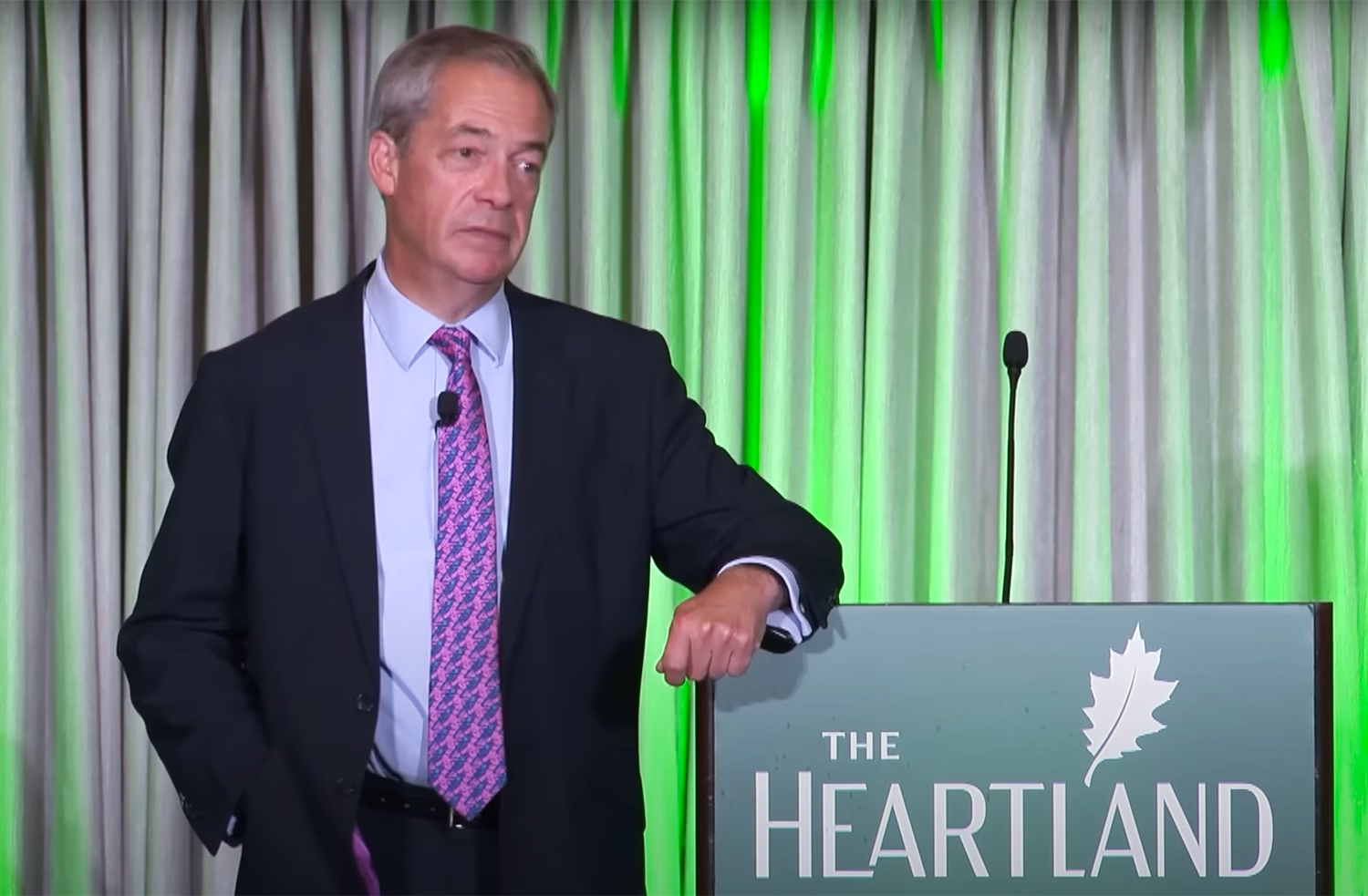
The Heartland Institute has a major UK ally in Nigel Farage, head of the right-wing political party Reform UK, who last year helped launch a European branch of the denial group. At the Jordan Peterson conference known as the Alliance for Responsible Citizenship (ARC) earlier this year, Farage invoked a frequent climate denier talking point about endangerment, claiming that it’s “absolutely nuts” that carbon dioxide is considered a pollutant.
Koch Network
Climate denial groups that have received funding from foundations linked to the oil and gas billionaires Charles and David Koch are some of the most stalwart opponents of the EPA’s greenhouse gas finding. They include the CO2 Coalition, whose co-founder William Happer was on the National Security Council in Trump’s first administration, as well as the American Energy Alliance and the Competitive Enterprise Institute.
Koch-backed groups have achieved key U.S. Supreme Court victories that have paved way to undo the endangerment finding, including the case West Virginia vs. EPA, which weakened the agency’s ability to address climate change.
Zeldin cited that legal precedent explicitly in his announcement on Tuesday, saying, “would you want the administrator of the EPA to be ignoring the Supreme Court decisions in West Virginia vs. EPA?” He also cited the court’s rejection of the Chevron Deference — a long-standing doctrine giving federal agencies power to interpret the law where vague — which was the result of legal efforts backed in part by Charles Koch.
Critics argue this powerful anti-climate coalition ultimately serves the interest of companies profiting from polluting and warming our atmosphere. Senator Whitehouse said in a statement that “the Trump Administration’s repeal [of the endangerment finding] has the fossil fuel industry’s oily fingerprints all over it.” He added that “Trump chose his fossil fuel megadonors over the American people.”
Donald Trump urges you to be a Climate Science denier like him. He says that he makes millions and millions for destroying the planet, Burn, Baby, Burn and Flood, Baby, Flood.Elon Musk urges you to be a Fascist like him, says that you can ignore facts and reality then.Orcas discuss Donald Trump and the killer apes’ concept of democracy. Front Orca warns that Trump is crashing his country’s economy and that everything he does he does for the fantastically wealthy.
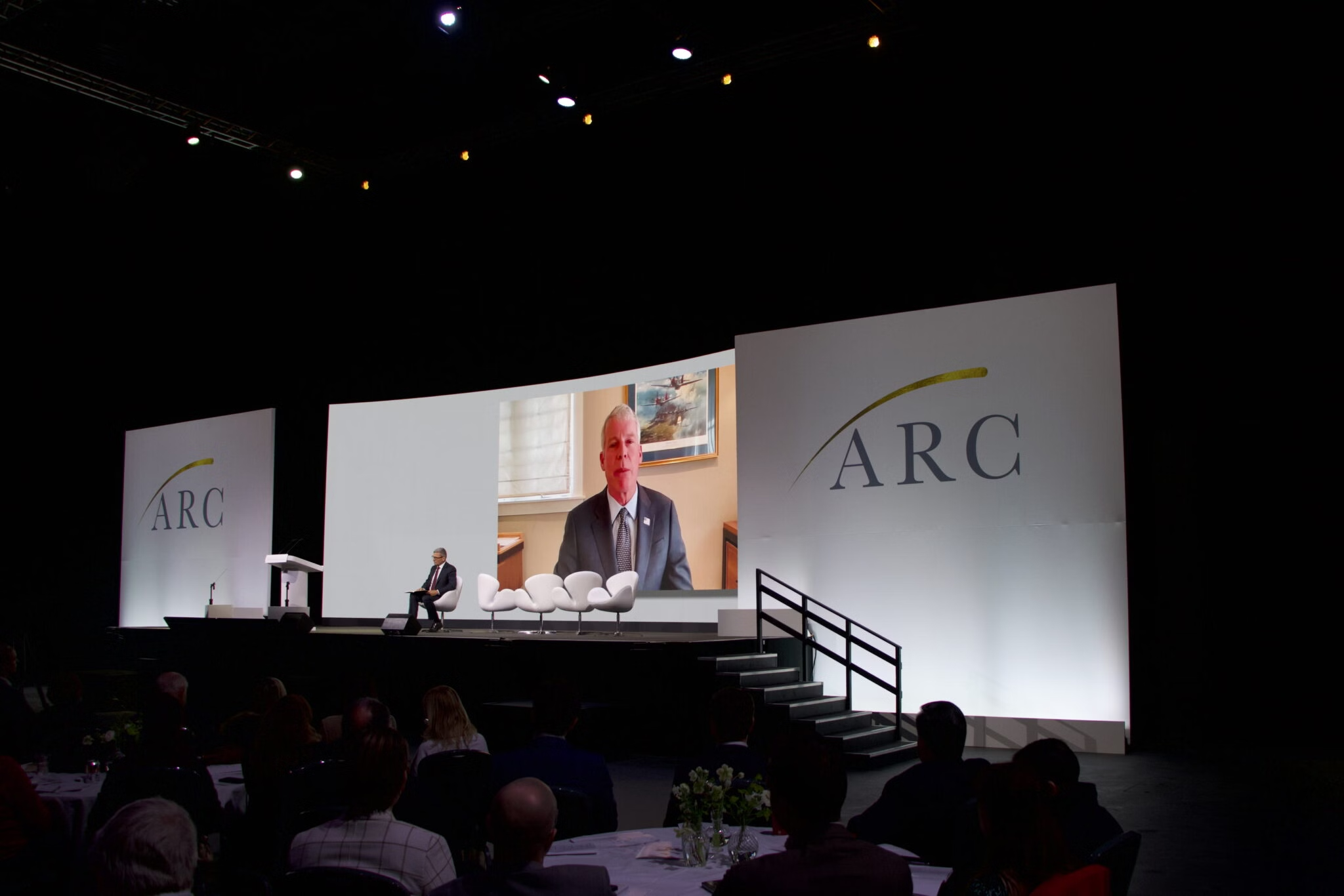
U.S. Energy Secretary Chris Wright speaks to ARC by video. Credit: Marc Fawcett-Atkinson
In exclusive interviews, they called the Trump administration official “terrific,” “very smart,” and someone who “gets it.”
In mid-February, U.S. Energy Secretary Chris Wright described the global effort to stabilize greenhouse gas emissions in dark and conspiratorial terms.
“Net zero 2050 is a sinister goal,” he told the Alliance for Responsible Citizenship (ARC), an international gathering of conservatives convened by Canadian podcaster, author, and anti-climate powerbroker Jordan Peterson. “It’s certainly been a powerful tool used to grow government power [and], top-down control, and shrink human freedom.”
Then in March, Wright did a speech at the 43rd annual CERAWeek where he attacked the Biden administration’s climate policies as a “quasi-religious” agenda “that imposed endless sacrifices on our citizens.”
Those views put Wright, formerly a CEO with the fracking company Liberty Energy, far outside the Paris Agreement consensus among many world leaders and heads of major corporations that climate change is an urgent issue that requires fundamental changes to our global energy system.
But Wright’s reactionary statements are winning him praise from fossil fuel advocates who acknowledge that human-caused climate change is real but deny that it presents existential threats to civilization – what watchdog nonprofits such as the Center for Countering Digital Hate refers to as “the new denial.”
In exclusive interviews with DeSmog and Canada’s National Observer conducted during the ARC conference, three prominent figures who deny there is a climate emergency explained why they’re excited that Wright holds one of the most consequential cabinet posts in the Trump administration, with one referring to the U.S. energy secretary as “a good friend.”
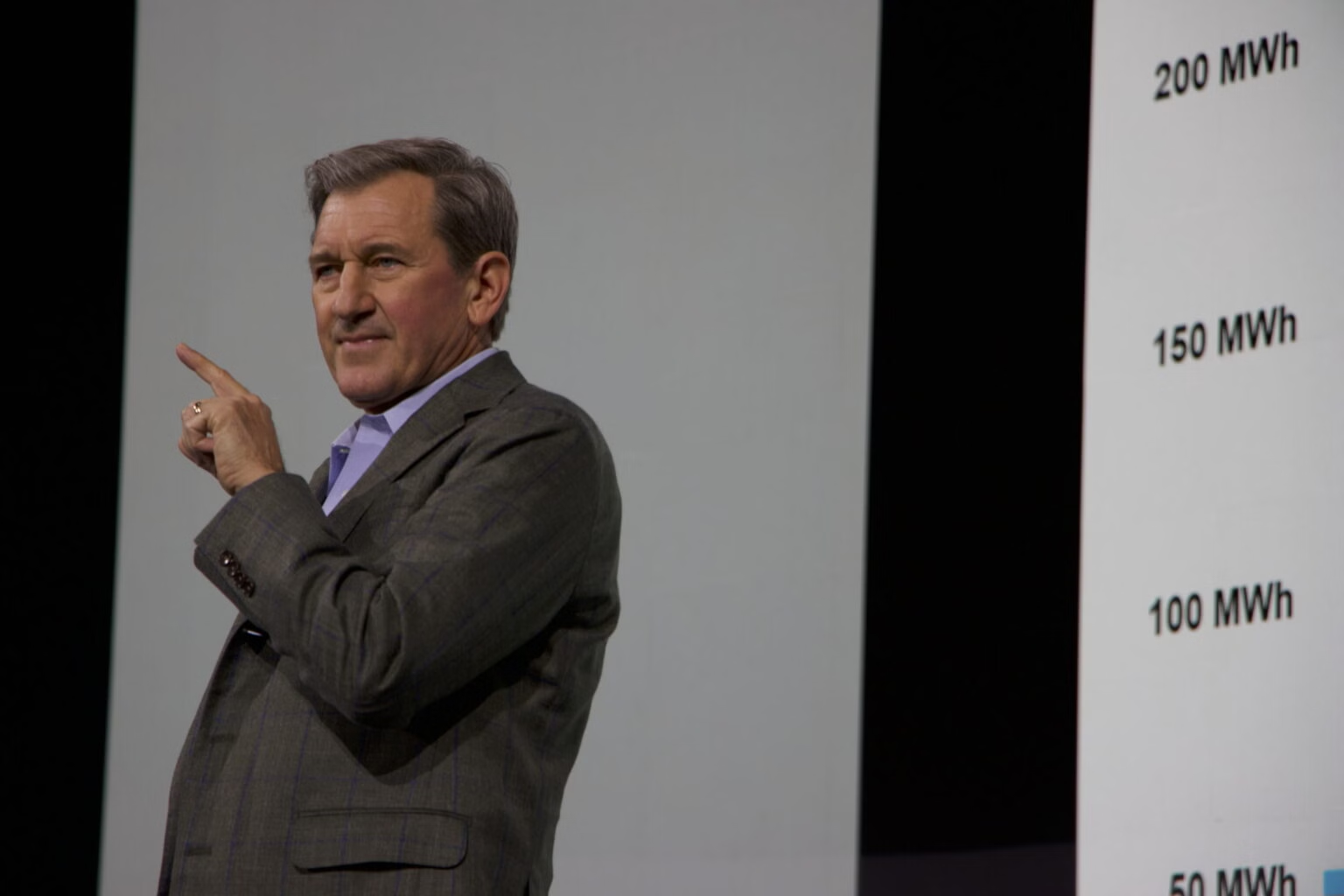
Bjorn Lomborg speaks about his most recent book during a press briefing at ARC. Credit: Marc Fawcett-Atkinson
Bjorn Lomborg
One particularly influential climate crisis denier is Bjorn Lomborg, a Danish political scientist who for decades has been trying to convince policymakers and the public that there are more important global challenges to address than climate change. This is the subject of his most recent book, Best Things First, which Lomborg was promoting at ARC. Last year, Peterson personally presented a copy of the book to Elon Musk.
“We’ll have to wait and see if he actually reads it,” Lomborg said of Musk in an interview with DeSmog and Canada’s National Observer at the conference.
Lomborg, who is an advisor to ARC, said during a keynote speech that efforts to transition off fossil fuels are a “green fantasy.” Lomborg acknowledges that climate change is real but claims, contrary to decades of scientific and economic evidence, that it will be relatively easy and painless for humankind to adapt.
Those arguments have resonated with Wright, who during a 2020 podcast referred to Lomborg’s previous book False Alarm as “fantastic,” and earlier this year described him as a “friend” on LinkedIn.
Asked what he thinks about Trump’s pick for energy secretary, Lomborg replied: “Look, Chris Wright is a great guy and he’s very smart. And I’m very happy that we can get a more sense-based approach to how we do energy.”
Part of that, according to Lomborg, is acknowledging — despite low-carbon investment surpassing $2 trillion in 2024 — that a transformative global shift to green energy isn’t happening anytime soon. “We’re not there yet,” he said. “And that, I think, is what Chris Wright can help us to do, which is to say, ‘let’s be realistic now and let’s find smarter ways to have greener energy sources in the future.’”
Scott Tinker does a speech at ARC. Credit: Marc Fawcett-Atkinson
Scott Tinker
During his 13-minute presentation at ARC, Scott Tinker outlined his view that energy has to be affordable, reliable, and clean, criteria that in his view disadvantages renewable energy. “If you want 100 percent clean you don’t get much of these other things,” he told the conference. “There are trade-offs in the real world.”
Tinker runs an organization called Switch Energy Alliance that creates videos about energy and climate change for classrooms, museums, and professional training sessions. The organization says that it wants an “energy-educated future that is objective, nonpartisan, and sensible.”
But Tinker tends to promote the benefits of fossil fuels while downplaying the urgency of addressing global temperature rise. During a podcast interview in March, Tinker said it was “a very strange form of economic colonialism” to argue against developing world countries burning fossil fuels “because we’ll wreck the climate.” We shouldn’t fear a bit of atmospheric warming, Tinker added, urging listeners to instead consider “all the positive things” countries gain from oil, gas, and coal.
Wright has used similar language, telling a gathering of African leaders in March that it would be “a paternalistic post-colonial attitude” for the U.S. to stand in the way of their fossil fuel resources.
The similarities between Wright’s and Tinker’s views aren’t a coincidence. Tinker told DeSmog in an interview at ARC that he and the U.S. energy secretary have known each other for years. “Chris is a good friend,” Tinker said. “We’ve bounced a lot back and forth.”
One other area they seem to agree on is rejecting carbon dioxide’s legal status as a pollutant in the U.S., which helps provide the basis for the Environmental Protection Agency to regulate emissions. That’s been a long-time goal of climate denial organizations such as the CO2 Coalition and Heartland Institute.
“We shouldn’t confuse [CO2] with being a pollutant,” Tinker said.
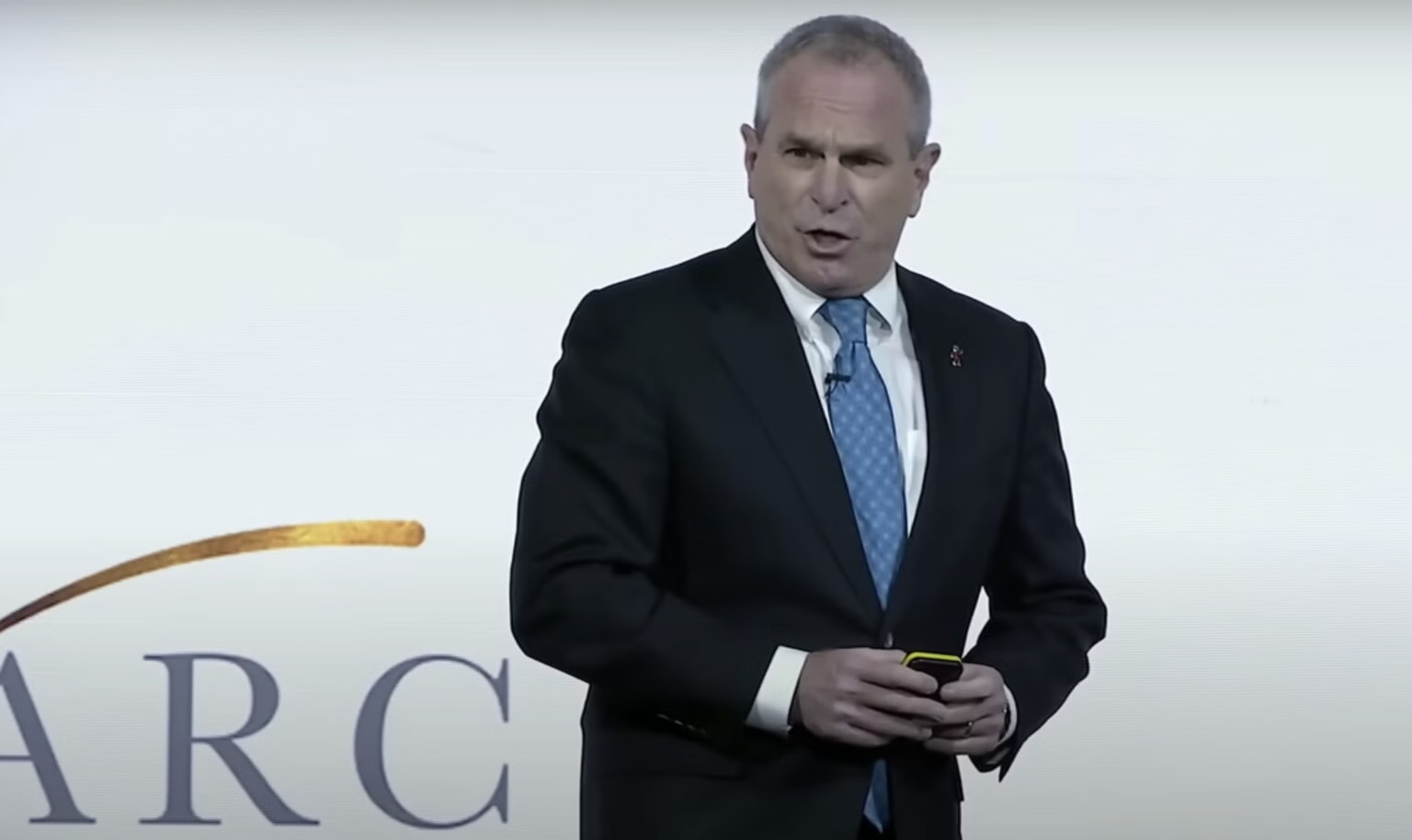
Robert Bryce speaks at ARC. Credit: ARC / YouTube
Robert Bryce
For years Robert Bryce has been on a mission to convince the world that renewable energy can never replace or out-compete coal, gas, and oil. Previously a senior fellow with the Manhattan Institute— a think tank with a long history of accepting fossil fuel money and questioning the scientific consensus on climate change — Bryce now attacks climate solutions as an author, speaker, and filmmaker.
During his speech at ARC, he claimed that “we are inundated with climate catastrophism,” and argued without evidence that the primary motivation for environmentalists to be opposed to fossil fuels is because their organizations have “enormous” budgets, saying “it’s a big business.”
Bryce is a long-time proponent of nuclear energy, something he shares in common with Wright, who stepped down as a member of the board of directors at the nuclear company Oklo after he was confirmed as energy secretary in February.
“Chris gets it,” Bryce said in an interview with DeSmog. “Chris knows what the score is. He’s a natural gas guy, a hydrocarbon guy. He’s promoting nuclear power. Hopefully this administration, now that they’re actually talking about nuclear, can actually move the ball forward, it’s overdue.”
Bryce and Wright also seem to share opposition to carbon capture and storage, a technology widely favored by oil and gas producers, which tout it as key to reducing emissions from their operations despite it being widely used to pull more oil from the ground. Under Wright, the U.S. Department of Energy is considering cutting billions of dollars’ worth of funding for projects utilizing the technology.
“There is only one reason why any of these hydrocarbon companies are doing carbon capture,” Bryce said. “Subsidies, that’s it.”
“It will never work at scale,” he added. “Once you get that CO2 super-compressed and you’re pushing it down underground, there are very few places where you can actually sequester it. So it’s a lot of money wasted.”
This special investigation between Canada’s National Observer and DeSmog was produced in collaboration with the I-SEA and TRACE Foundation.
Neo-Fascist Climate Science Denier Donald Trump says Burn, Baby, Burn.Elon Musk urges you to be a Fascist like him, says that you can ignore facts and reality then.
“I think you really are the best hope for Germany,” Elon Musk told the thousands attending the far-right Alternative for Germany party’s rally on January 25. France 24 English/YouTube
The tech billionaire is invigorating groups in the U.S. and Europe aiming to sabotage climate action, a DeSmog media analysis shows.
In December, a Chicago-based organization called the Heartland Institute, which for decades has attempted to undermine the scientific consensus on climate change, devoted an episode of its daily podcast to Elon Musk.
As recently as 2022, Heartland figures had ridiculed the Tesla CEO as a member of the “billionaire climate elite” based on Musk’s claim that as a top manufacturer of electric vehicles, his company was “doing the most to solve climate change.”
But perhaps, the podcast guests speculated, Musk was finally “abandoning the climate cult.”
The episode was recorded after Musk had given upwards of $277 million to get Donald Trump elected president, argued that “we don’t need to rush” on addressing climate change, and vowed to cut $2 trillion of federal government spending. One guest on the show was cautiously optimistic, saying: “I’m coming around on Musk.”
Heartland, which didn’t respond to a request for comment, isn’t the only anti-climate group embracing Musk these days.
DeSmog journalists in the European Union, the UK and the United States reviewed public materials from prominent climate deniers referencing Musk over recent months. Taken as a whole, these podcasts, opinion pieces, social media posts, newsletters, YouTube videos, and interviews with legacy media reveal an unmistakable trend: Musk’s public embrace of right-wing populists is invigorating a transatlantic movement aiming to spread doubt about the reality of climate change and sabotage action on the crisis.
His interventions ahead of Germany’s elections on Sunday have energized the far-right Alternative for Germany, or AfD, which says that climate policy “threatens our freedom,” a January poll suggests.
His courtship, along with Trump, of hardline leaders in Europe threatens to torpedo hopes of progressive climate action by the EU, think tanks warn.
And in the U.S., Musk’s ongoing war against the federal bureaucracy “erodes our collective ability to adapt to climate impacts,” Amanda Fencl, director of climate science for the nonprofit Union of Concerned Scientists, has warned.
Some longtime climate deniers are thrilled, however, recognising that even a brief endorsement from Musk to his 217.9 million followers on X — the social media platform formerly called Twitter, which he bought in 2022 — can confer instant visibility and excitement.
“We welcome Elon Musk into the climate red pill group,” Climate Depot executive director Marc Moranostated in December, using a phrase popular among Trump supporters that refers to rejecting liberal viewpoints.
Musk, contacted via Tesla, did not respond to a detailed list of questions about his shifting climate views.
‘Windmills of Shame’
When Germans vote for a new government on Sunday, the EU’s most populous country is widely predicted to shift to the right. Leading the polls at about 29 percent of voters is the centre-right Christian Democratic Union, or CDU, which intends to prioritise economic growth over accelerated climate measures endorsed by the ruling Greens and Social Democrats, or SPD.
Less certain is the influence that the surging far-right AfD will have on the next German government. On X, Musk has openly endorsed and platformed the party, which wants to ditch Germany’s climate commitments.
As migration and economic stagnation dominate German politics, the AfD is now polling close to 21 percent — potentially doubling the 10 percent of votes it won in the last national elections in 2021. The party states that the level of human contribution to global warming is “not scientifically proven,” and opposes state support for renewable energy and electrification of heat and transport, while advocating for Germany’s gas and coal power sectors.
The CDU says that it will not form a coalition government involving the AfD, and maintains its commitment to Germany’s 2045 net-zero emissions target. But despite its opposition status, the AfD is already shaping national political discourse — and even decision-making.
While the CDU and Germany’s other mainstream parties have traditionally refused to vote with the AfD due to its extreme stances on immigration and Germany’s Nazi past, the CDU broke this so-called “firewall” last month by voting with the AfD on a resolution to restrict migration.
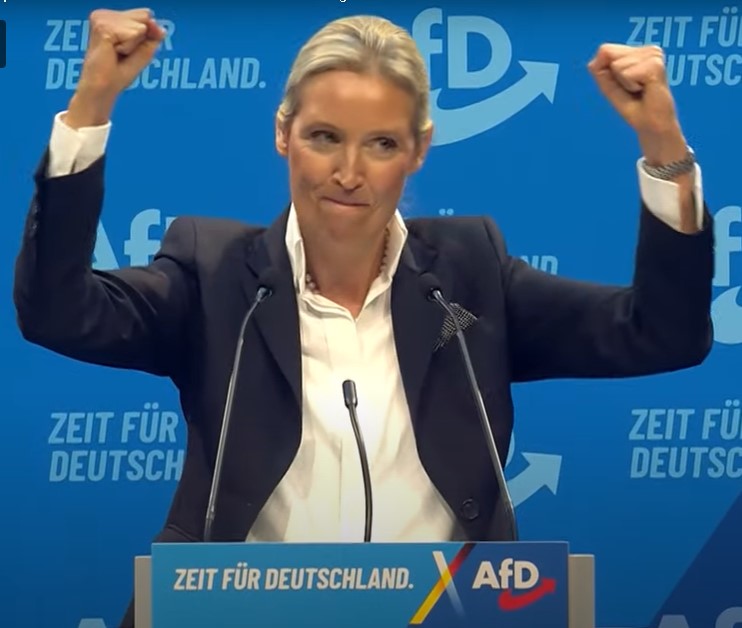
Musk has sided with the AfD on its hard-line immigration stance and nationalist messaging. In December, Musk openly endorsed the party, shocking liberal Germans by writing on X that “only AfD can save Germany.” He went on to join a 9 January livestream with the AfD co-leader Alice Weidel, who has attracted controversy for Islamaphobic remarks, such as in a 2018 Bundestag speech when she said “burqas, headscarf girls, publicly-supported knifemen, and other ‘good-for-nothings’ will not secure our prosperity, economic growth, and the social state.”
In terms of climate policy, Weidel has suggested that if the AfD takes power in Germany, it could dismantle wind turbines, recently calling them “windmills of shame,” The wind sector produced a third of the country’s electricity last year.
During their conversation, both Musk and Weidel expressed support for nuclear power — with Musk also saying he was a “big fan” of solar energy — and Weidel stating that Germany’s CO2 footprint was “obnoxiously very very high.” Both steered clear of the AfD’s official climate-denialist party platform.
Then, less than two weeks later, Musk sparked a global furore by raising his arm to the crowd at Trump’s January 20 inauguration in a gesture that many likened to a Nazi salute. The Amadeu Antonio Stiftung, a German organisation which advocates against right-wing extremism and anti-Semitism, saw no ambivalence in Musk’s move, describing it as a “Hitler salute.” Musk responded to the outpouring of criticism by posting on X: “The ‘everyone is Hitler’ attack is sooo tired.”
Five days after Trump was sworn-in, Musk ramped up his support for the AfD by addressing a party rally via videolink. He urged supporters to “take pride” in being German over “some sort of multiculturalism that dilutes everything”, and told them that there’s “too much of a focus on past guilt” — remarks condemned by Polish prime minister Donald Tusk.
YouTube Influencer
Musk had previously enjoyed support from Germany’s centrist parties. When Tesla opened a multi-billion dollar electric car factory in the State of Brandenburg in 2022, the move was billed as a boost to both the country’s manufacturing sector and climate credentials. But during his January livestream with Weidel, Musk expressed his disdain for the bureaucratic procedures needed to build the Tesla factory, which he said amounted to “25,000 pages”.
Musk’s public support for the AfD can be traced back to his interactions with Naomi Seibt, a 24-year-old German influencer who built a sizeable social media following attacking “climate alarmism” and cultivating a brand as the anti-green doppelganger of Swedish climate activist Greta Thunberg. Her rise to prominence was aided by the Heartland Institute, which featured her in a YouTube video it published in February 2020. Seibt has since told Reuters that the organisation had paid her $4,000 a month for three months as a “scholarship.” (Seibt no longer appears to be affiliated with the group).
German influencer Naomi Seibt appears on the Heartland Institute’s YouTube channel on February 11, 2020. Credit: Heartland Institute/YouTube
When Seibt posted on X last June that she’d voted for the AfD in the EU elections, which saw the formerly fringe party rise to 16 percent of the total vote — its best-ever result — Musk began sending her private messages asking for more information, according to Seibt. “And then he started following me,” Seibt told the BBC, noting that “it took him many months to decide to support the AfD.”
Musk’s backing could boost a party that’s heavily critical of the country’s decarbonization efforts. A January poll of German voters from the U.S.-based Democracy Institute think tank suggested that 28 percent of respondents say they are “more likely” to vote AfD due to Musk’s support, while 23 percent said it made their support “less likely.”
Germany’s center-right and center-left leadership have condemned Musks’s interventions. Friedrich Merz, head of the CDU, told The Wall Street Journal last week that Musk would face consequences for boosting the AfD. Chancellor Olaf Scholz, a member of the centre-left SPD, last month called Musk’s support for European far-right parties “disgusting.”
The new Trump administration is already mirroring the billionaire’s embrace of the AfD. Last week, U.S. Vice-President JD Vance met with Weidel, the AfD co-chief, on the sidelines of a security conference in Munich, while snubbing Scholz.
With the U.S. playing a major role in German trade and security, this budding transatlantic alliance could bode poorly for climate action in Europe’s biggest economy.
Neither Seibt nor the AfD responded to questions.
Courting the European Far-Right
Musk’s electrifying impact on the AfD builds on his years of dabbling in far-right politics in other European countries.
In December 2023, Musk appeared as a guest of honour at an annual convention in Rome hosted by the Brothers of Italy, the right-wing populist party of Italian Prime Minister Giorgia Meloni, who had said earlier that year that “ultra-ecological fanaticism” was an economic threat.
Santiago Abascal, leader of Spain’s far-right Vox party, also attended the 2023 convention. He had recently predicted that Spanish citizens would hang their current Socialist Prime Minister, Pedro Sánchez, by his feet, remarks that were so controversial that some Brothers of Italy members asked for his invitation to be withdrawn, the Spanish newspaper El País reported.
But whereas Abascal’s presence threatened to create divisions at the event, “Elon Musk’s case is somewhat different, arousing only enthusiasm and selfie fervor,” noted El País. “The tycoon is nowadays the darling of almost all those on the ultra-right who seek media and economic backing, and a cutting-edge image.”
A month later, in January 2024, Musk again signalled his interest in European politics.
With German farmers protesting the end of government diesel fuel subsidies and a new tax on agricultural vehicles, Anthony Lee, who had stood for the European Parliament as a candidate for Free Voters, a German conservative populist party, gave an interview to right-wing Dutch influencer Eva Vlaardingerbroek. Lee told Vlaardingerbroek that politicians “want our land to build industry, houses. Houses for refugees, whoever, I don’t care what for.”
After Musk reacted to the video on X, writing “Support the farmers!” Lee said in a video message that “I think it’s just awesome that Elon Musk himself tweeted this…This is only possible because we stand together.” The video was viewed over 200,000 times. Lee did not respond to a request for comment.
A year later, Musk was rubbing shoulders at Trump’s inauguration with a who’s-who of right-wing European politicians, including Spain’s Abascal, France’s Éric Zemmour and Reform UK leader Nigel Farage, all of whom have questioned the science and urgency of climate change.
Analysts with the independent European Policy Center think tank in Brussels sees the inauguration guestlist as a worrying sign that Trump and Musk are helping strengthen “ideological ties between significant radical forces on both sides of the Atlantic.” They are concerned about the impact a second Trump administration may have on a host of EU-wide initiatives, including a raft of climate reforms known as the European Green Deal.
“The most concerning possibility,” the analysts argue, is “Trump’s probable exploitation of far-right leaders or governments to block EU policies or advance his agenda.”
Musk’s Shift to ‘Climate Skeptic’
For years, Musk enjoyed a reputation as a crusading green energy entrepreneur on a mission to render the internal combustion engine obsolete, celebrated by climate activists and cleantech investors alike — despite growing signs of his right-ward political leanings. As recently as last August, the online news outlet E&E News ran a story speculating that “Musk might be the only person Trump listens to on climate.”
But Musk’s politics and business interests seemed to decisively converge during a 2024 meeting of Tesla executives in Palo Alto, California, where he shelved plans to develop a more budget-friendly compact car that could be marketed to lower-income customers around the world, according to a report in the Washington Post. This had previously been a key part of Tesla’s plan to “accelerate the world’s transition to sustainable energy.”
Instead, Musk approved a plan worth billions of dollars to purchase computer chips that could improve Tesla’s luxury vehicles, the Washington Post report said. Musk had shifted from calling for “a popular uprising” against the fossil fuel industry in 2016 to stating that there were more important global problems to address.
In a livestream with Trump last year, Musk stated that “we don’t need to rush” in fixing climate change.
This also happens to be the message of Bjørn Lomborg, a longtime Danish climate crisis denier (and apparent “friend” of Trump administration energy secretary Chris Wright) whose 2023 book Best Things First argued that there were more important global priorities to address than climate change. According to a recent edition of Lomborg’s newsletter, the Canadian conservative influencer Jordan Peterson shared a copy of Lomborg’s book with Musk in 2024.
Within U.S. denial networks, some leaders link Musk’s shift to the flourishing of anti-climate messages on Twitter after the billionaire purchased the platform, and renamed it X. “I mean, there are thousands, if not hundreds of thousands of climate skeptics on X/Twitter, and they’re constantly posting content that we put out here,” the Heartland Institute’s Anthony Watts argued on the group’s podcast. “Musk has had to have seen some of this stuff.”
Musk’s former critics in climate denial circles now see him as the best bet for implementing their most extreme ideas. Musk’s so-called Department of Government Efficiency has been attempting to shut down key climate-related agencies like the United States Agency for International Development, or USAID.
On the website of the conservative group CFACT, prominent denier Paul Dreissen — who previously accused Musk of holding “sanctimonious” views on “the alleged climate crisis” — has offered policy suggestions to the billionaire as he wages war on the federal bureaucracy: End subsidies for renewable energy; terminate funding for environmental and climate justice programs; and require applicants for climate research funding to “provide computer codes and analyses so that reviewers can view and evaluate their work.”
Parts of Musk’s plan seem to rely on two recent, pro-industry Supreme Court decisions to unwind regulatory authority long held by federal agencies — an overarching goal of the Heritage Foundation’s Project 2025 initiative, retooled with Musk’s Silicon Valley spin.
If successful, these cuts will dismantle decades of clean air and water protections, and hamstring the country’s ability to respond proactively to the worsening climate crisis, said Fencl, the director of climate science at the Union of Concerned Scientists.
Hurricane Helene made landfall in Florida in October 2024, but caused deadly and destructive flooding hundreds of miles from the coast due to extreme rain. At least 219 people died, and the damages are estimated at $78.7 billion. Credit: PBS NewsHour/YouTube.
“Our infrastructure systems are not going to withstand the climate impacts we’re expecting, and taking away the government’s spending in these spaces really erodes our collective ability to adapt to climate impacts,” Fencl said.
Raising the UK’s Political Temperature
Since throwing his fortune and social media influence behind Trump, Musk has teased the possibility of attempting a similar campaign in the UK.
In December, Musk met with Reform UK leader Farage, who also co-founded and formerly led the Brexit Party, at Trump’s Mar-a-Lago resort in Florida.
The two were in talks about Musk offering a £100 million (over $125 million) donation to Reform, The Times of London reported. Farage has said he finds it “extraordinary that people call carbon dioxide a pollutant, and Reform UK’s latest party manifesto recycles a long-debunked claim that “scientists disagree as to how much” human activity is causing climate change. So such a donation would have been a major investment by Musk in transatlantic climate denial.
Then, in January, Musk used X to call for the release of Tommy Robinson, a far-right British influencer serving an 18-month contempt of court sentence for making false accusations about a Syrian schoolboy. When Farage rejected his calls to join forces with Robinson, Musk tweeted that, “the Reform Party needs a new leader. Farage doesn’t have what it takes.”
Farage was not sufficiently swayed by Musk’s comments to support Robinson’s return, although he struck a conciliatory note by saying the tech mogul didn’t know “the full story” about the provocateur’s criminal past. By the end of January, Farage was signalling to the press that his rift with Musk was over, telling The New York Times that the billionaire was still open to donating to Reform UK. “We’ve got very similar goals on some areas, slightly different emphases in others,” Farage said, adding that Musk was sharing valuable information about how Trump won over swing voters during the U.S. election.
Farage is also collaborating with the Heartland Institute, which has claimed credit for working with hard-right parties in Austria and Hungary to attempt to stall the EU’s Nature Restoration Law, which sets targets for restoring damaged ecosystems, as well as other green policies. Farage helped launch the pro-Trump institute’s new UK-Europe branch in December.
Farage’s newly formed Reform UK won just five of the 650 seats in the lower house of parliament in last year’s elections, and was unsuccessful in generating a backlash against the country’s net-zero emissions goal. Nevertheless, the party appears to be pushing the historically weakened Tories to the right on climate change — echoing Farage’s previous strategy to rally support for the 2016 Brexit referendum.
Regardless of how much tangible backing Musk might provide to right-wing figures in the UK, his winning bet on Trump, and assault on federal government spending, has inspired Farage and his allies with a sense of the possible. “There’s a heck of a lot we’ve learned from that we will implement over the next few years,” Farage told The New York Times.
Some European leaders are looking for ways to neutralize Musk’s efforts to sway voters.
In January, as Musk posted false allegations that UK Prime Minister Kier Starmer had let child sex abusers escape justice, France called on the European Commission to take action against Musk and X for election interference. According to The Financial Times, Musk was also investigating how to get Starmer out of office before the country’s next election, and replace his center-left government with right-wingers.
Members of the European Parliament, who are elected representatives of their respective nations, are also criticizing the Commission for failing to use its authority under the EU’s Digital Services Act to investigate and fine Musk and X, as well as other major social media platforms, for spreading disinformation.
Asked about Musk’s tirade during a public event in January, Starmer did not name the billionaire directly in his response. “Those that are spreading lies and misinformation as far and as wide as possible, they’re not interested in victims,” said Starmer. “They’re interested in themselves.”
Nigel Farage explains the politics of Reform UK: Racism, Fake anti-establishmentism, Deregulation, Corporatism, Climate Change Denial, Mysogyny and Transphobia.Elon Musk urges you to be a Fascist like him, says that you can ignore facts and reality then.
Reform UK leader Nigel Farage speaking at the Heartland Institute’s 40th anniversary fundraiser in September 2024. Credit: Heartland Institute / YouTube
The Heartland Institute, which questions human-made climate change, has established a new branch in London.
The Heartland Institute – one of the organisations involved in the radical Project 2025 agenda for a second Donald Trump term – has been at the forefront of denying the scientific evidence for man-made climate change, and received at least $676,000 between 1998 and 2007 from U.S. oil major ExxonMobil.
Heartland is known “for its persistent questioning of climate science”, according to Merchants of Doubt by Naomi Oreskes and Erik M. Conway, and it has received tens of thousands in donations from foundations linked to the owners of Koch Industries – a fossil fuel behemoth and a leading sponsor of climate science denial.
A Union of Concerned Scientists report in 2007 alleged that nearly 40 percent of the total funds received by Heartland Institute from ExxonMobil since 1998 were designated for climate change projects.
In a press release announcing its new UK-EU branch, based in London, Heartland boasted that it is “the world’s most prominent think tank supporting skepticism about man-made climate change”.
Heartland Institute president James Taylor added that, “During recent years, a growing number of policymakers in the UK and continental Europe have requested Heartland establish a satellite office to provide resources to conservative policymakers throughout Europe”.
This has included Farage, who spoke at the Heartland Institute’s 40th anniversary fundraising event in September and called for the group to open an offshoot in Europe. “Give us your wisdom, give us your guidance, give us your discipline. I’d love to see Heartland on the other side of the pond,” he said.
Reform UK has called for the UK’s 2050 net zero emissions target to be scrapped, and Farage’s Heartland speech urged the U.S. to re-elect Trump and “drill baby drill” for more oil and gas.
DeSmog revealed in June that – between the 2019 election and the beginning of the 2024 campaign – Reform UK received 92 percent of its funding (£2.3 million) from oil and gas interests, highly polluting industries, and climate science deniers.
Heartland’s European branch will be run by Lois Perry, a climate science denier who has said it’s her “personal belief” that climate change “is happening” but “is not man made”. Perry followed in Farage’s footsteps earlier this year by becoming the leader of the UK Independence Party (UKIP), though stood down after just 34 days.
Perry formerly ran the anti-net zero pressure group CAR26, which has claimed that carbon dioxide is “essential to all life” and that its “welcome growth has greened our planet saving countless human and other lives”.
She told DeSmog that Heartland is “advocating for a balanced, evidence-based approach to climate policy, not the one-size-fits-all alarmism that seems to make headlines.”
Perry added: “As for my past with UKIP and CAR26, I wear those roles with pride. I’ve always been upfront about my views: climate change happens, but the hysteria around human causation is, frankly, a bit of a stretch. CO2 is indeed vital for life, turning our planet into a blooming, green paradise rather than a barren wasteland.”
In reality, authors working for the world’s foremost climate science body, the UN’s Intergovernmental Panel on Climate Change (IPCC), have said that “it is a statement of fact, we cannot be any more certain; it is unequivocal and indisputable that humans are warming the planet”.
The IPCC has also stated that carbon dioxide “is responsible for most of global warming” since the late 19th century, which has increased the “severity and frequency of weather and climate extremes, like heat waves, heavy rains, and drought” – all of which “will put a disproportionate burden on low-income households and thus increase poverty levels.”
Farage and Project 2025
Farage’s views on climate change appear to reflect those of Perry and the Heartland Institute.
Although two thirds of his constituents are concerned about climate change, Farage stated in an interview with climate science denier Jordan Peterson in July that: “I do find it extraordinary that people call carbon dioxide a pollutant, because as I understand it, plants don’t grow without carbon dioxide.”
In his speech to the Heartland Institute in September, Farage also claimed that the UK’s efforts to reduce carbon dioxide emissions doesn’t “make any bloody difference at all”, due to the emissions produced by larger countries like China.
He also repeated the misleading claim that “man-made carbon dioxide is only about 3 percent of global, annual production of carbon dioxide”. In fact, human activity has raised the atmosphere’s carbon dioxide content by 50 percent in less than 200 years, according to NASA.
Farage has been attempting to cultivate ties between Reform UK and senior figures associated with Donald Trump, who has called climate change a “hoax” and is expected to once again pull the U.S. out of the flagship 2015 Paris Agreement.
Farage this week met with key Trump ally and donor Elon Musk, who invested at least $277 million in the Republican’s re-election campaign, and said that he would seek to “negotiate” a donation from Musk to Reform UK.
“The threat of U.S. interference in our democracy isn’t just contained to Elon Musk’s touted $100 million donation to Reform,” said Hannah Greer, Good Law Project campaigns manager. “Farage has now helped a fossil-fuel-funded American climate science denial think tank to set up shop in the UK.
During the recent presidential campaign, Democrats highlighted that Trump’s second term agenda was being drafted by another radical right-wing think tank, the Heritage Foundation, under the banner Project 2025.
The document proposes a range of radical anti-climate policies, including slashing restrictions on fossil fuel extraction, scrapping investment in renewable energy, and gutting the Environmental Protection Agency.
Project 2025 – heavily funded by just six family fortunes – has been accused of being “extreme” and “authoritarian” for setting out a plan to rapidly “reform” the U.S. government by shuttering bureaus and offices, overturning regulations, and replacing thousands of public sector employees with hand-picked political allies of Trump. The agenda also proposes radical tax cuts, and a crackdown on reproductive rights.
Farage has been heavily criticised for venturing regularly to the U.S. since his election in July, rather than spending time in his constituency of Clacton. The Reform UK leader has made six trips to the U.S. as an MP, often meeting with avowed climate deniers, despite his coastal constituency being at risk of flooding due to global warming.
Reform UK and the Heartland Institute were approached for comment.
Shell USA Company Foundation has sent hundreds of thousands to Project 2025 advisors. Credit: Marc Rentschler / Unsplash
Foundation says it ‘does not endorse any organizations’ while funneling hundreds of thousands to rightwing causes.
A U.S. foundation associated with oil company Shell has donated hundreds of thousands of dollars to religious right and conservative organizations, many of which deny that climate change is a crisis, tax records reveal.
Fourteen of those groups are on the advisory board of Project 2025, a conservative blueprint proposing radical changes to the federal government, including severely limiting the Environmental Protection Agency.
Shell USA Company Foundation sent $544,010 between 2013 and 2022 to organizations that broadly share an agenda of building conservative power, including advocating against LGBTQ+ rights, restricting access to abortions, creating school lesson plans that downplay climate change and drafting a suite of policies aimed at overhauling the federal government.
Donees include the Heartland Institute, a longtime purveyor of climate disinformation, which published a video on YouTube in May stating incorrectly that “the scientific data continue to show there is no climate crisis.” Other groups that have received donations include the American Family Association, which claims that the “climate change agenda is an attack on God’s creation,” as well as the Heritage Foundation, the lead organization behind Project 2025.
“Shell has every reason to want to maintain close relationships with organizations that wield outsize political influence and just happen to reliably support the interests of the fossil fuel industry,” said Adrian Bardon, a professor of philosophy at Wake Forest University who has studied the religious right and climate denialism.
The Shell USA Company Foundation helps employees boost their charitable giving to nonprofits. A Shell USA spokesperson wrote via email that the company’s workers make the initial decision to donate “to non-profit (tax exempt) organizations of their choice.”
According to the company’s online donation portal, Shell will match individual donations up to $7,500. The spokesperson confirmed that the foundation “matches employee gifts to such qualified 501(c)(3) nonprofit agencies,” but did not respond to specific inquiries about which organizations, if any, received matching donations from the foundation.
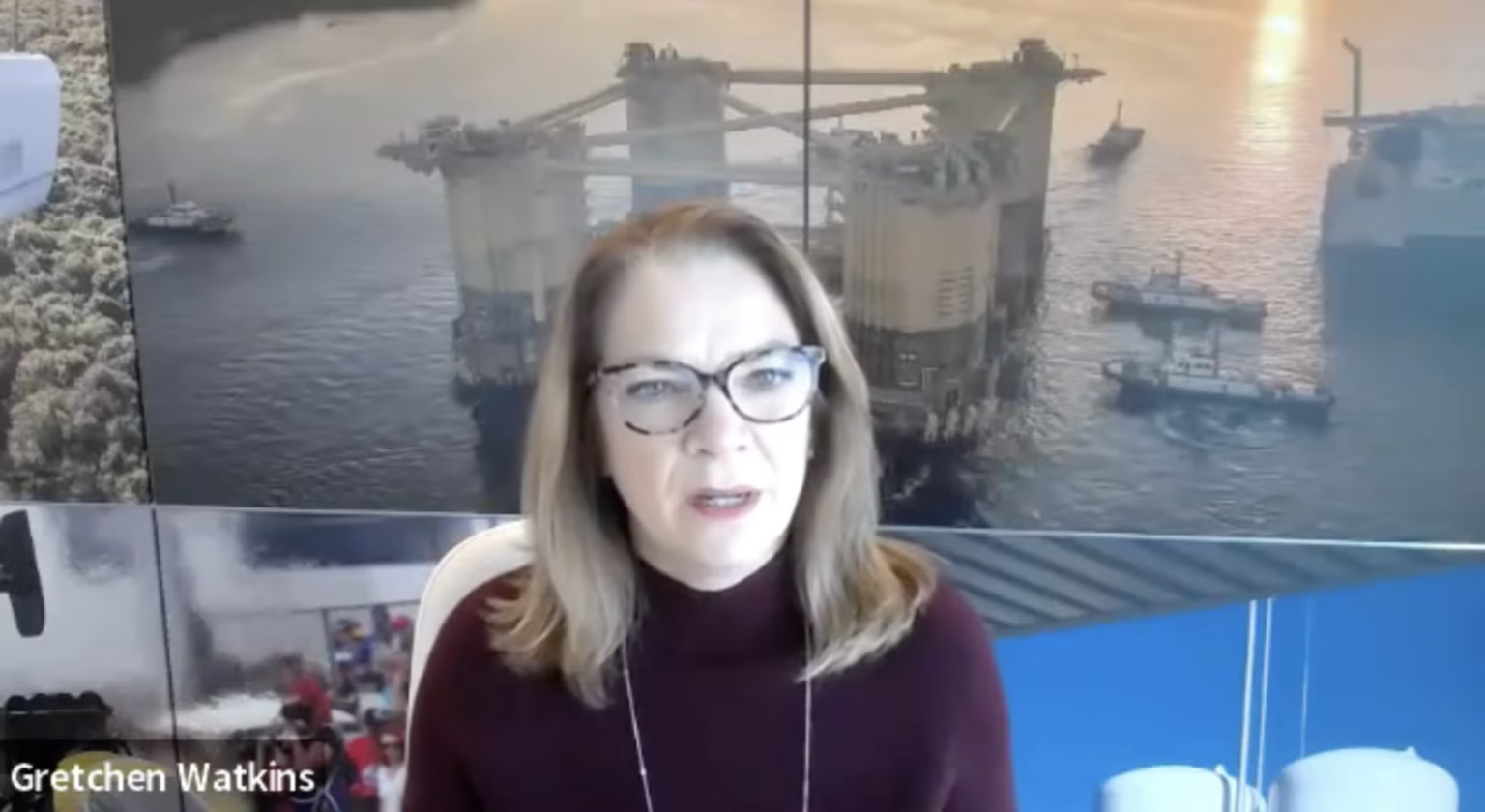
Tax records from 2022 show that the president of the foundation was Gretchen Watkins, the current president of Shell USA. But the foundation itself “does not endorse any organizations” and “giving is a personal decision not directed by the company,” the spokesperson added.
Shell USA president Gretchen Watkins was also president of the foundation, 2022 tax records show. Credit: OurEnergyPolicy.org / YouTube
Shell is a multinational oil and gas producer headquartered in London that last year reported adjusted earnings of $28.25 billion. Its American subsidiary, Shell USA, has for decades operated Shell USA Company Foundation, which makes grants to American non-profits.
Because the foundation itself is a registered non-profit, it must file public returns each year with the IRS, which contain detailed information about the organizations to which it donates. The vast majority of these non-profits have no explicit political focus. They include YMCAs, youth groups, local churches, schools and mainstream charities such as Oxfam and United Way.
But an analysis by the Guardian and DeSmog found at least 21 groups supported by Shell’s foundation that are aggressively opposed to progressive cultural and economic change, including addressing the crisis of global heating.
“They’re all certainly working in the rightwing policy and propaganda space,” said Peter Montgomery, research director at the progressive non-profit organization People for the American Way. “That includes the anti-regulation corporate right and the culture warriors of the religious right.”
Since 2013, the Shell foundation sent $59,264 to the American Family Association, another Project 2025 adviser and an organization designated as a “hate group” by the Southern Poverty Law Center due in part to its long history of aggressive anti-gay activism. In a post from 2022, the conservative Christian organization referred to “the unproven hypothesis of man-made, catastrophic climate change.”
Shell’s foundation contributed $23,321 to the Heritage Foundation, which published the Project 2025 document known as Mandate for Leadership. The conservative thinktank has deep ties to Donald Trump and a long history of attacking the scientific consensus on climate change. Last year, it published a commentary on its website stating that “climate change models are poor predictors of warming.”
Shell’s foundation also donated $58,002 to Alliance Defending Freedom, another Project 2025 adviser. It’s a conservative Christian legal activist group that claims credit for helping overturn Roe v Wade, explaining that its “attorneys and staff were proud to be involved from the very beginning.”
Shell’s foundation also reported donations worth $105,748 to Hillsdale College, a private conservative Christian school in Michigan that’s listed as an advisory board member of Project 2025 and that has hosted prominent climate skeptics.
The American Family Association, the Heritage Foundation, Alliance Defending Freedom and Hillsdale College did not respond to requests for comment.
A Heartland Institute video claims ‘the scientific data continue to show there is no climate crisis.’ Credit: Heartland Institute / YouTube
The Shell USA Foundation also donated to religious right organizations that aren’t directly involved with Project 2025, including $79,874 to Focus on the Family, an anti-abortion group that’s called climate change “an unproven theory.” When reached for comment, Gary Schneeberger, a spokesperson for the organization, wrote: “We consider it a best practice for our ministry and, in fact, a promise to our donors that we never share information about their donations with anyone.”
Another anti-abortion group called Texas Right to Life, which has previously argued that climate change is “arguably, nonexistent”, received $65,103 from the foundation. A spokesperson for the group wrote in an email that “the gifts that came from Shell were matched gifts from its employees.”
Shell’s foundation also sent $8,541 to the Prager University Foundation, which is associated with the rightwing media outlet PragerU. Known for producing conservative videos targeting young people with messages downplaying the climate crisis, its content has been approved for classrooms in several states.
“In the absence of real transparency, one can only speculate on the motives behind these donations,” Bardon said. But the contributions help Shell maintain its place within a broader conservative coalition, he argued. “So if something comes up that bothers me, it’s going to bother you, too, because we’re on the same team,” he said.