Tag: Hezbollah

  • ‘This Maniac Must Be Stopped’: Netanyahu Condemned Over Massive Beirut Bombing

    Spread the love

    Original article by Jessica Corbett republished from Common Dreams under Creative Commons (CC BY-NC-ND 3.0). 
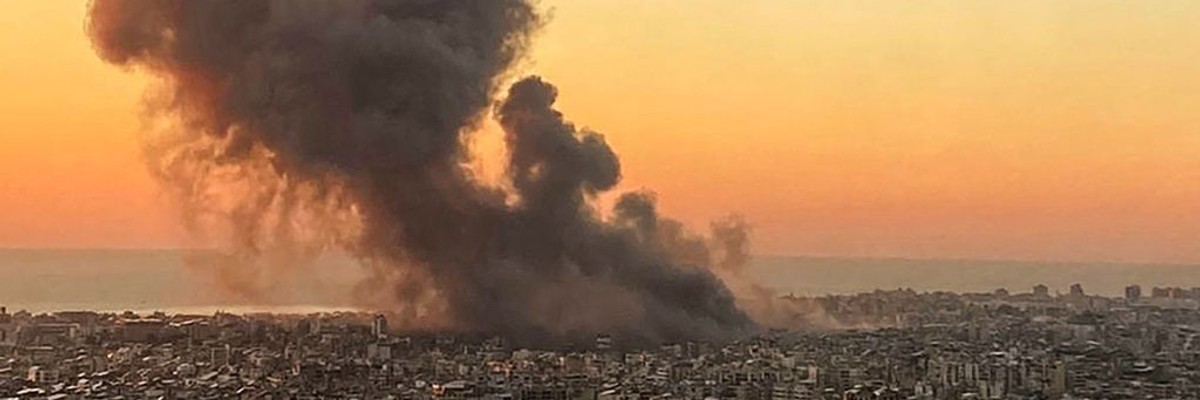
    Smoke rises above Beirut’s southern suburbs during an Israeli strike on Lebanese residential buildings on September 27, 2024. (Photo: AFP via Getty Images)

    While Hezbollah’s leader Hassan Nasrallah reportedly survived the attack on the densely populated area of Lebanon’s capitol, one observer warned that Israel may still “get the regional war it has sought.”

    Israel’s dropping of massive bombs in Beirut on Friday sparked a fresh wave of global condemnation against Israeli Prime Minister Benjamin Netanyahu, with critics accusing him of trying to drag the Middle East into an even bloodier conflict that could engulf the entire region.

    The Israeli attack supposedly targeted Hassan Nasrallah, head of the political and paramilitary group Hezbollah. Multiple media outlets reported that the leader survived, though hundreds of others are feared dead in the “complete carnage” from the bombing that leveled several buildings. While the death toll from Friday is not yet clear, over 700 people have been killed in Israel’s strikes in Lebanon since Monday.

    As The New York Times reported:

    Lebanon’s health minister, Firass Abiad, said that there had been a “complete decimation” of four to six residential buildings as a result of the Israeli strikes. He said that the number of casualties in hospitals was low so far because people were still trapped under the rubble. “They are residential buildings. They were filled with people,” Mr. Abiad said. “Whoever is in those buildings is now under the rubble.”

    Social media and news sites quickly filled with photos and videos of massive plumes of smoke and smoldering rubble.

    Jeanine Hennis-Plasschaert, the United Nations special coordinator for Lebanon, said Friday that she was “deeply alarmed and profoundly worried about the potential civilian impact of tonight’s massive strikes on Beirut’s densely populated southern suburbs. The city is still shaking with fear and panic widespread. All must urgently cease fire.”

    However, the bombing is widely expected to worsen this week’s escalation, which came after nearly a year of the Israel Defense Forces (IDF) trading strikes with Hezbollah over the Israeli assault on the Gaza Strip, which has killed over 41,000 Palestinians.

    “For Israel, it may not matter if Nasrallah was killed. Either way, it believes it’ll get the regional war it has sought,” Trita Parsi, executive vice president of the Quincy Institute for Responsible Statecraft, said of the Friday attack.

    Citing an unnamed Israeli official, NBC News reported that “Israel expects Hezbollah will attempt to mount a major retaliatory attack” in response to Friday’s bombing of the group’s command center.

    As Reuters detailed:

    Israel has struck the Hezbollah-controlled southern suburbs of Beirut, known as Dahiyeh, four times over the last week, killing at least three senior Hezbollah military commanders.

    But Friday’s attack was far more powerful, with multiple blasts shaking windows across the city, recalling Israeli airstrikes during the war it fought with Hezbollah in 2006.

    In a video posted on social media, IDF Spokesperson Rear Adm. Daniel Hagari described the Friday attack as “a precise strike” on what “served as the epicenter of Hezbollah’s terror,” adding that the group’s headquarters “was intentionally built under residential buildings.”

    During Netanyahu’s United Nations General Assembly speech on Friday—which was met with a walkout from several diplomats and other officials—the prime minister said that Hezbollah has stored rockets “in schools, in hospitals, in apartment buildings, and in the private homes of the citizens of Lebanon. They endanger their own people. They put a missile in every kitchen, a rocket in every garage.”

    In response, Middle East expert Assal Rad said, “So he’s claiming there’s no civilian spaces in Lebanon and Israel has a right to destroy all of it.”

    Jason Hickel, who has positions at multiple European universities, also sounded the alarm over those lines from the Israeli leader’s speech.

    Netanyahu is “effectively arguing all homes are a military target,” he said. “This is 100% genocidal and this maniac must be stopped.”

    Hours before the attack in suburban Beirut, the Democracy in Europe Movement 2025 (DiEM25) strongly condemned “Israel’s brutal bombardment of Lebanon, another reckless escalation in the Middle East on behalf of the Benjamin Netanyahu regime that risks further destabilization in an already fragile region.”

    “The Israeli bombardment of Lebanon is the latest dark chapter in a series of disproportionate displays of force. Its ongoing genocide in Palestine over the last year has proven beyond any doubt that its willingness to commit horrific acts knows no bounds,” DiEM25 said. “Rather than seeking a peaceful and just resolution, Israel’s government has consistently chosen the path of militarism, often with international support from the European Union and the United States.”

    “The international community, including the E.U., has a critical role to play in promoting peace rather than enabling violence,” the group added. “Peace and security in the Middle East will not come through bombs and military strength. It will come through diplomacy. We remain committed to working towards that aim and stand in solidarity with the Lebanese people, as well as all others suffering from this violent escalation.”

    Original article by Jessica Corbett republished from Common Dreams under Creative Commons (CC BY-NC-ND 3.0). 

  • Pager and walkie-talkie attacks on Hezbollah look like war crimes – international legal expert

    Spread the love
    EPA-EFE/Wael Hamzeh

    Giacomo Biggio, University of Bristol

    Tensions in the Middle East have reached a new high after thousands of pagers and radios used by members of Hezbollah exploded across various cities in Lebanon and Syria over September 17 and 18. The attacks – which have widely been attributed to Israel, which has not commented – have resulted in at least 30 people killed and more than 3,000 wounded.

    Many analysts and politicians are now speculating that the conflict between Israel and Hezbollah, which has been simmering during the 11-month conflict in Gaza, will spiral into open warfare.

    Far from taking place in a legal vacuum, the attacks are governed by international humanitarian law (IHL). This is the international legal regime that regulates the conduct of hostilities in situations of armed conflict.

    Since the Hamas attacks on October 7 provoked Israel’s ferocious response in Gaza, Israel and Hezbollah have been involved in a series of cross-border hostilities. These qualify as what is called a “non-international armed conflict”, to which IHL applies. This includes the rules set out in, among other instruments, the Geneva conventions.

    In pursuing the objective of protecting civilians in wartime, the Geneva conventions rely on the fundamental principles of “distinction” and “proportionality”.

    What international law says

    The principle of distinction essentially requires belligerents to distinguish at all times between the civilian population and combatants.

    Combatants are lawful targets and can be attacked at all times. But intentionally attacking civilians is prohibited and constitutes a war crime under the Rome statute of the International Criminal Court. To this end, military commanders are under an obligation to do everything feasible to verify that the target of an attack is not a civilian.

    Even assuming that only Hezbollah members were using the radios and pagers at the moment of the attacks, that does not mean that they shall be presumed to be combatants (and, therefore, lawful targets). Under IHL, a combatant is a “member of the armed forces of a party to the conflict”. This comprises “all organized forces, groups and units which are under a command responsible to that party for the conduct of its subordinates”.

    By contrast, whoever is not a member of the armed forces of a party to the conflict is a civilian and subject to the protection of IHL.

    There is no doubt that members of the military wings of Hezbollah are “members of the armed forces”, so they qualify as combatants. But those members of Hezbollah’s political wing who are not combatants should be considered as civilians and accordingly, are protected from attack.

    Civilians may lose protection from attack for such time as they take a direct part in hostilities. This includes conduct like the intentional killing of civilians and carrying out acts which adversely affect the military capacity of a party to an armed conflict – for example, the planning of attacks against Israel.

    The pagers were detonated at 3:30, on September 17 in hundreds of locations in Beirut and other Lebanese cities. Abaca Press / Alamy Stock Photo

    What about the attacks against members of Hezbollah’s military wing?

    In this case, complying with the principle of distinction does not suffice, since the attack must also respect the principle of proportionality. This requires that the expected “collateral damage” (that is, the incidental killing or wounding of civilians) should not be excessive to the “concreted and direct military advantage” anticipated from the attacks.

    Launching an attack with the knowledge that it would cause excessive collateral damage also constitutes a war crime.

    Collateral damage

    In this case, the attacks killed several civilians. These included the nine-year-old daughter of a Hezbollah member, an 11-year-old boy and at least two health workers. Moreover, the attacks injured thousands more, including Iran’s ambassador to Lebanon.

    Although we do not know how many of those killed or injured were civilians, it seems logical that the level of collateral damage to be expected from the attacks would be substantial. After all, the pagers and radios were remotely detonated at the same time, exploding in crowded places such as markets and funerals. In these situations, the likelihood of killing and wounding civilians is extremely high.

    These elements suggest that the expected incidental damage is excessive to the military advantage anticipated from the pager attacks – which, at the time of writing, remains unclear.

    But it’s important to note that what amounts to “excessive” incidental damage is subject to disagreement. On the one hand there are those who, like the International Committee of the Red Cross, believe that extensive incidental damage is always excessive. Others – including the Israeli government – consider that even extensive incidental damage is allowed if the attack results in a high amount of military advantage.

    In my opinion, Israel’s interpretation should be rejected. It turns IHL’s aims of protecting the civilian population on its head and allows for unrestricted warfare.

    My conclusion, based on the available information, appears to be that the pager and walkie-talkie attacks purportedly carried out by Israel against Hezbollah members appear to violate the principles of distinction and proportionality. In other words, they could well amount to war crimes.

    Giacomo Biggio, Lecturer in Law, University of Bristol Law School, University of Bristol

    This article is republished from The Conversation under a Creative Commons license. Read the original article.

  • New wave of Israeli terrorist cyber attacks hit Lebanon

    Spread the love

    Original article by Aseel Saleh republished from peoples dispatch under a Creative Commons Attribution-ShareAlike 4.0 (CC BY-SA) license.

    A person is carried on a stretcher outside the American University of Beirut Medical Center following the pager blasts on Tuesday, September 17, 2024. Photo: Al Manar

    Facing no consequences from the international community on its first series of cyber terrorist attacks in Lebanon, Israel launched a new wave of similar attacks within less than 24 hours

    At least nine people were killed and more than 300 others injured when thousands of wireless devices including walkie-talkies were detonated in different parts of Lebanon on Wednesday, September 18. The new blasts took place, while the information regarding the first day’s cyber terrorist attacks through pagers remained largely unknown and subject to speculation.

    Preliminary media reports stated that the trademark of Taiwan pager manufacturer Gold Apollo was identified on the remains of the pagers, which detonated on Tuesday and that they were model AR-924. In response to the reports, Gold Apollo issued a statement on Wednesday denying that it had manufactured the pagers used by Hezbollah members, clarifying that its logo was only labelled on the devices, which were manufactured by a Hungarian company called BAC through a licensing agreement with the Taiwanese company.

    “According to the cooperation agreement, we authorize BAC to use our brand trademark for product sales in designated regions, but the design and manufacturing of the products are solely the responsibility of BAC,” Gold Apollo said in a statement, while the Hungarian partner BAC has not commented on the incident so far.

    Meanwhile, some of the walkie-talkie devices that exploded on Wednesday, were reportedly identified as Icom model V82s, according to media sources. Nonetheless, Icom has not commented on the tragic blasts yet.

    Although the United States said on Tuesday that it was not aware of the cyber terrorist attacks on Lebanon in advance, CNN published a report on Wednesday unveiling that Israeli officials informed the US about an Israeli plan to carry out an operation in Lebanon on Tuesday without providing it with further details about the planned operation.

    While media outlets have been relying on information provided by anonymous or special sources, as well as analysts to demystify the terrorist attacks that rocked Lebanon on Tuesday and Wednesday, no official statement has been issued on the circumstances of the attacks by Hezbollah yet. However, Hezbollah-run Al Manar news network announced that Hezbollah Secretary General Sayyed Hassan Nasrallah will deliver a speech via Al-Manar television at 17:00 (Beirut time) on Thursday to respond to the new development.

    The United Nations Security Council also announced on Wednesday that it will hold an emergency meeting on Friday afternoon to discuss the recent mass explosions of communication devices across Lebanon. The meeting was scheduled after Algeria submitted a request to the Security Council on Wednesday, amidst the near complete silence of the international community, which was slammed by the Belgian Deputy Prime Minister Petra de Sutter. “Silence is not an option. An international investigation is called for. The bloodshed must end,” Sutter wrote on her platform on X, strongly condemning the “massive attack”, which she described as a “brutal escalation of violence.”

    Izzat al-Rishq, a senior official in the Palestinian Islamic Resistance movement Hamas, also urged the international community to abide by its legal obligations to put an end to Israel’s actions. Al-Rishq described Israel’s cyber terrorist attacks on Lebanon as an assault that violated Lebanon’s land, its leadership, and its people.

    Original article by Aseel Saleh republished from peoples dispatch under a Creative Commons Attribution-ShareAlike 4.0 (CC BY-SA) license.

  • Hezbollah holds Israel responsible for cyber terrorist attack in Lebanon

    Spread the love

    Original article by Aseel Saleh republished from peoples dispatch under a Creative Commons Attribution-ShareAlike 4.0 (CC BY-SA) license.

    Chaos following the explosion of pagers across Lebanon. Photo: Al Manar

    Israel continues to carry out war crimes and breach the sovereignty of countries in the region, while the international community remains unmoved

    The Lebanese Internal Security Forces announced on Tuesday, September 17, that thousands of pagers or wireless communication devices exploded in a number of areas across Lebanon, including in the southern suburb of the Lebanese capital of Beirut. The attack reportedly targeted pagers held by members of the Lebanese resistance movement Hezbollah.

    The explosion of the pagers killed at least nine people, including a child, and injured over 3,000 others. Videos that have circulated online of the explosions, illustrate how many occurred in public places and caused transit accidents, secondary injuries, and general chaos.

    According to media reports, Iranian Ambassador to Lebanon Mojtaba Amani was among the people who sustained injuries in the attacks, and was transported to a hospital to receive treatment. Some casualties were also reported in Syria’s southwestern governorate of Rural Damascus. Mahdi Ammar, son of Ali Ammar, a member of parliament with Hezbollah’s Resistance Loyalty Bloc, was also killed in the attacks.

    Hezbollah movement stated on Tuesday that the pagers, which exploded, were in the possession of a number of workers at various Hezbollah units and institutions, and that the reasons behind their explosion were still unknown. The movement also announced that investigations have been under way to unveil the reasons and the circumstances behind the simultaneous explosions. According to Reuters, the detonated pagers were acquired by Hezbollah in recent months.

    “Hezbollah’s competent agencies are currently conducting a wide-ranging security and scientific investigation to determine the causes of those simultaneous explosions. Likewise, medical and health agencies are treating the wounded and injured at a number of hospitals in various Lebanese regions,” Hezbollah said in a statement. In the statement, the movement urged the Lebanese people “to be aware of the rumors and false as well as misleading information that some parties are spreading in a way that serves the psychological war of the Zionist enemy.”

    Hezbollah issued another statement later on Tuesday holding Israel fully responsible for the attack, which injured thousands including civilians and Hezbollah members. The statement was issued after the movement scrutinized the facts, current available data, and information about the attack. The statement also stressed that the attack will not deter Hezbollah from continuing its support to the Palestinian people. “Our martyrs and wounded are the symbol of our struggle and sacrifices all the way to Al-Quds in triumph of our honorable people in the Gaza Strip and the West Bank and continuous support,” Hezbollah added in the statement, concluding it with a pledge to justly punish Israel for what it described as a sinful aggression.

    The Palestinian Islamic Jihad movement condemned the attack in a statement describing it as a “war crime”. “The treacherous operation carried out by the Zionist entity’s devices through the explosion of dual-use communication equipment is a documented war crime. It inflicted severe damage on a large number of innocent civilians inside their homes with premeditated malice,” Islamic Jihad said in its statement. “Although the enemy’s resort to this option is intended within the framework of psychological and intellectual warfare, it indicates the level of frustration and the narrow options they now have after the blows they have received from multiple fronts supporting the Palestinian people,” Islamic Jihad added.

    The spokesperson of Yemen’s Ansar Allah movement Mohammad Abdul Salam also condemned the attack in a post on his platform on X describing it as a crime and a violation of Lebanese sovereignty. A number of countries also officially condemned the deadly series of explosions in Lebanon vowing to provide necessary medical assistance to the Lebanese people, including Jordan, Iran, and Palestine.

    Meanwhile, the United States denied being aware of the attack. On Tuesday, the US State Department spokesperson Matthew Miller said that the US “was not aware of this operation and was not involved in it”. Miller added that the US “is still gathering information about the explosions in Lebanon”. The unprecedented deadly cyber attacks came after Israeli media outlets recently reported that Israeli Prime Minister Benjamin Netanyahu decided to expand a military operation on the northern front with Lebanon.

    Original article by Aseel Saleh republished from peoples dispatch under a Creative Commons Attribution-ShareAlike 4.0 (CC BY-SA) license.

  • Israel Launches Massive Attack on Lebanon, Heightening Fears of All-Out War

    Spread the love

    Original article by JAKE JOHNSON republished from Common Dreams under Creative Commons (CC BY-NC-ND 3.0).

    Smoke billows from the site of an Israeli airstrike on Zibqin in southern Lebanon on August 25, 2024. 
    (Photo: Kawnat Haju/AFP via Getty Images

    “Looks like Israel is now escalating in Lebanon in a major way in the hopes of kicking off a major war in the north that has thus far been kept to more limited exchanges,” warned one analyst.

    Israel’s military deployed around 100 fighter jets to launch a massive bombing campaign in southern Lebanon on Sunday, endangering tens of thousands of civilians and heightening the chances of an all-out regional war.

    The Israel Defense Forces (IDF) characterized the wave of airstrikes as an effort to preemptively “remove the threat” posed by a purportedly imminent Hezbollah attack, but observers argued the Israeli bombing marked a serious escalation that could further undermine hopes of a cease-fire deal in Gaza.

    “Looks like Israel is now escalating in Lebanon in a major way in the hopes of kicking off a major war in the north that has thus far been kept to more limited exchanges,” wrote political analyst Yousef Munayyer. “Just as negotiations for a cease-fire were reportedly advancing.”

    Hezbollah said Sunday that it had fired hundreds of drones and rockets at Israeli military sites in retaliation for the assassination of one of the group’s senior commanders last month. Hezbollah said the “first phase” of its response was complete and rejected the IDF’s claim that it preempted the group’s retaliatory action.

    The Associated Press reported that “by mid-morning, it appeared that the exchange had ended, with both sides saying they had only aimed at military targets.”

    “At least three people were killed in the strikes on Lebanon,” AP noted, “while there were no reports of casualties in Israel.”

    Israel Katz, the Israeli foreign minister, wrote on social media following the attack on Lebanon that he “sent a direct message to dozens of foreign ministers worldwide, urging them to support Israel against the Iranian axis of evil and its proxies, led by Hezbollah.”

    Sunday’s dangerous back-and-forth, described by one newspaper as the two sides’ biggest exchange of fire since the 2006 war, further intensified concerns that the region is moving toward the precipice of an all-out conflict as Israel’s U.S.-backed assault on the Gaza Strip continues with no end in sight.

    A White House spokesperson said Sunday that U.S. President Joe Biden is “closely monitoring events in Israel and Lebanon.”

    “At his direction, senior U.S. officials have been communicating continuously with their Israeli counterparts,” the spokesperson said. “We will keep supporting Israel’s right to defend itself, and we will keep working for regional stability.”

    One senior U.S. official said Israel did not give the White House advance notice of the Lebanon attack.

    Monica Marks, professor of Middle East politics at New York University Abu Dhabi, wrote that the White House’s claim to be promoting regional stability “lands like a bad joke” given ongoing U.S. support for Israel’s “escalatory acts.”

    “Lives on the ground are at stake. So are [Democratic presidential nominee Kamala] Harris‘ chances and Biden’s legacy,” Marks added. “D.C. is playing Middle East roulette.”

    Israel’s bombardment of Lebanon came after another horrific day in the Gaza Strip, where the IDF killed dozens of Palestinians in southern Gaza. “Among the dead,” according to the AP, “were 11 members of a family, including two children, after an airstrike hit their home in Khan Younis.”

    The atrocities preceded a fresh round of high-level cease-fire talks, negotiations that Israeli Prime Minister Benjamin Netanyahu has repeatedly thwarted with hardline demands.

    The Washington Post reported Saturday that “Israel and Hamas were sending senior-level delegations to Cairo this weekend as U.S., Qatari, and Egyptian mediators prepared for a high-stakes summit they hope will break the deadlock in negotiations for a cease-fire in the Gaza Strip.”

    “Hamas officials arrived in the Egyptian capital Saturday, while Israeli media reported that a team led by the head of Mossad, David Barnea, would travel there Sunday,” the Post added. “The summit, also on Sunday, will include CIA Director William J. Burns, Egyptian intelligence chief Abbas Kamel, and Qatari Prime Minister Mohammed bin Abdulrahman Al Thani.”

    Original article by JAKE JOHNSON republished from Common Dreams under Creative Commons (CC BY-NC-ND 3.0).