RAF Linton-On-Ouse in North Yorkshire, which the Home Office plans to use to detain thousands of asylum seekers in its quest to shut more hotels, June 26, 2026
FORCING people seeking refuge into £10,000 of debt is an “abandonment of principles that should never be negotiable,” campaigners warned today as the government published new plans for its immigration system.
Home Secretary Shabana Mahmood announced the proposal, which would order asylum-seekers to pay the sum to cover living costs while they await a decision on their status.
If they do not pay, Ms Mahmood’s plans would automatically deny refugees settled status in Britain.
Critics immediately slammed the means-tested scheme, saying it would punish people fleeing war, torture and famine.
And it would only raise a “relatively small” amount for the Home Office’s goals of cutting the amount it spends each year on asylum accommodation and support by £4 billion.
The Joint Council for the Welfare of Immigrants (JCWI) condemned the move as “yet another shameless attempt by Labour to inflate the coffers of private companies like Serco, Mears and Clearsprings with multibillion-pound contracts to run asylum accommodation unfit for human habitation.”
JCWI spokesperson Seema Syeda told the Star: “Forcing people seeking safety into debt to pay for it is new depths of cruelty.
“There’s a simple solution: give asylum-seekers the right to rent and the right to work, so they can live in our communities in accommodation they choose — as all human beings deserve to be treated.
Metropolitan Police Commissioner Sir Mark Rowley gives a statement outside Charing Cross police station, London, after a High Court challenge over the Met Police’s use of live facial recognition (LFR) technology was dismissed, April 21, 2026
ANTI-WAR groups have launched a letter campaign for the resignation of Metropolitan Police Commissioner Sir Mark Rowley after “openly lying” about Palestine protesters.
Signed by more than 1,300, the letter to London Mayor Sadiq Khan, Home Secretary Shabana Mahmood, and Mayor’s Office for Policing and Crime chief executive Rena Laigie, warned that “Rowley must go.”
Sir Mark claimed that the pro-Palestine march on May 16, which coincided with a far-right demonstration, posed a threat to the public and that it deliberately marched past synagogues.
Stop the War Coalition and other organisers quickly debunked the statements and demanded corrections.
“On 16 May, Mark Rowley allowed a far-right hate march led by known fascist Stephen Yaxley-Lennon to go to Parliament while barring the Palestine movement from the political centre of London,” the letter reads.
“The Metropolitan Police has failed to act on incidents of Islamophobia and incitement to violence on the far-right demo, while downplaying the size of the Palestine mobilisation.
“Commissioner Rowley’s role as a politically neutral head of the Metropolitan Police has become untenable. We call on Rowley to resign his post immediately.”
Home Secretary Shabana Mahmood during a tour of the Lambeth Central Communications Command Centre, south London, January 22, 2026
CIVIL liberty campaigners pledged to fight plans to roll out facial recognition technology to all police forces across England and Wales.
Overriding concerns, Home Secretary Shabana Mahmood claimed that the technology would cut crime, despite often being entirely inaccurate.
Boosting camera vans from 10 to 50, Ms Mahmood claimed: “New technology has the ability to help us go after criminals and bring more people to justice.
…
Liberty slammed the government for announcing the rollout while supposedly still in the midst of a public consultation.
External relations director Ruth Ehrlich said that “rolling out powerful surveillance tools while a consultation is still under way undermines public trust and shows disregard for our fundamental rights,” adding: “The government must halt the rapid rollout of facial recognition technology, ensure safeguards are in place to protect each of us, and prioritise our rights.”
Be sure not to miss the Black Friday Black comedy at the end ;) X
Orcas discuss Genocide-supporting and complicit Zionists. Donald Trump, Keith Starmer, David Lammy, Rachel Reeves, Angela Rayner and Wes Streeting are acknowledged as evil genocide-complicit and supporting cnuts.Genocide denier and Current UK Prime Minister Keir Starmer is quoted that he supports Zionism without qualification. He also confirms that UK air force support has been essential in Israel’s mass-murdering genocide. Includes URLs https://www.declassifieduk.org/keir-starmers-100-spy-flights-over-gaza-in-support-of-israel/ and https://youtu.be/O74hZCKKdpAKeir Starmer objects to criticism of the IDF. He asks how could anyone object to them starving people to death, forced marches like the Nazis did, bombing Gaza’s hospitals and universities, mass-murdering journalists, healthworkers and starving people queuing for food, killing and raping prisoners and murdering children. He calls for people to stop obstructing his genocide for Israel.
The UK government’s latest proposals on asylum rest on an incorrect premise. In announcing them, home secretary Shabana Mahmood argued that “illegal migration is tearing our country apart”. But asylum-seeking is not illegal migration.
Asylum is a form of protection granted by a country to a non-citizen who faces persecution in their home country. The right to seek asylum is enshrined in international law, and applies irrespective of how the person travelled to the place where they are seeking protection.
Yet the policies being rolled out collapse two distinct categories into a single threat, to be addressed through deterrence and control. In effect, the category of the asylum seeker is equated to that of “illegal migrant”. Both are discussed as “abusing the system”, “flouting the rules” and “undermining communities”.
The underlying implication is that all asylum seekers are “illegal migrants”. Any system that follows will therefore be built on a distortion. Its consequences will fall not on the minority who try to game the system, but on the overwhelming majority who have legitimate claims for protection.
In 2024, 84,200 applications for asylum were made in the UK, relating to 108,100 individuals. More than 36,500 asylum appeals were lodged against negative decisions, with 48% of them allowed. Recent data show that in the months to March 2025, 47% of initial decisions resulted in the applicant being granted refugee status.
The new asylum measures promise faster decisions on asylum applications, tougher thresholds to be granted status, and expanded detention and removals. In continuity with the previous Conservative government, the rhetoric of “restoring control” makes the direction clear: restrict access to protection, harden the conditions for claiming it, and speed up refusals.
Labour is not hiding its reasoning for this approach. The government explicitly argues that firmer control is needed to prevent “darker forces” from coming into power. This is presented not as a concession to the far right, but as a public rationale for tightening the system. The message is clear: these policies are needed to keep politics steady, not because they improve the asylum system.
The issue is not simply that the proposals are harsh, unethical or likely to be ineffective. They represent a deeper shift: redefining protection as a discretionary favour rather than a legal obligation. Control becomes the primary focus, leaving less space for discussing refugee rights, protection and international obligations.
If asylum is framed as illegality, and settlement is reshaped into a privilege that must be endlessly earned, then our understanding of equal membership – the idea that those lawfully in the UK should enjoy stability and a clear path to full inclusion – is fundamentally altered.
A lifetime review
One of the key proposals is to extend the length of time it takes for a refugee to achieve settlement from five to 20 years. Until recently, settlement – the immigration status that allows a non-UK citizen to live, work and study in the UK without time restrictions – was the expected outcome for anyone granted refugee status. It is also a prerequisite for applying for British citizenship.
The new proposals transform settlement into something that must be continually earned. The path has become longer, more conditional and far more easily disrupted.
This aligns closely with other recent announcements on policies relating to migrants more generally. Higher salary thresholds, more enforcement, extended probationary periods and more complex routes to settlement have all been tabled.
These changes would build a structural disadvantage into the migration system. Non-citizens can live, work and contribute, but their belonging remains conditional. They become long-term residents on a form of probation, their status always open to review. This is more than an administrative change. It creates a hierarchy of membership that shapes lives, futures and families.
For a refugee family, this can mean years of uncertainty: parents unable to plan long-term careers or mortgages; partners and children living with the fear that a change in income, a missed renewal deadline or a shift in political priorities could jeopardise their right to remain.
It can also mean delays or barriers to family reunification, with spouses or children abroad left in limbo while the principal applicant waits to demonstrate continuous compliance. In practice, what should be a path to stability becomes a prolonged period of vulnerability, in which everyday life is overshadowed by the possibility of losing one’s status.
Nando Sigona, Professor of International Migration and Forced Displacement and Director of the Institute for Research into International Migration and Superdiversity, University of Birmingham
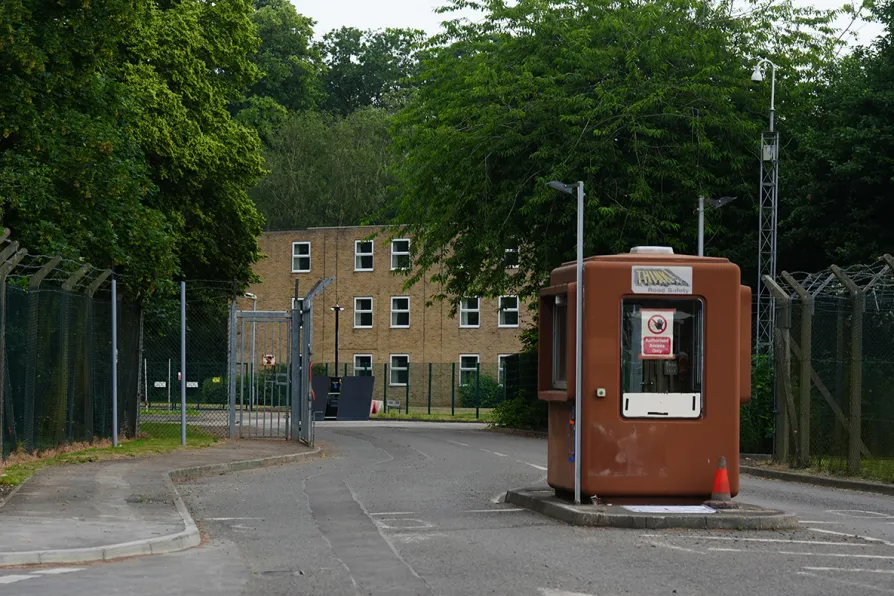
 RAF Linton-On-Ouse in North Yorkshire, which the Home Office plans to use to detain thousands of asylum seekers in its quest to shut more hotels, June 26, 2026