The US Must Stop Arming Israel’s Assault on Hospitals

Spread the love

Original article by KATHY KELLY republished from Common Dreams under Creative Commons (CC BY-NC-ND 3.0).

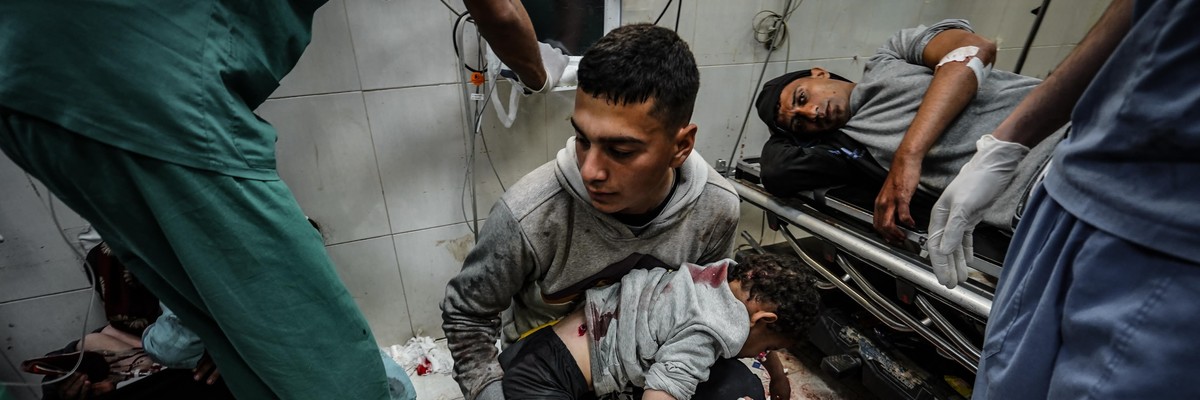
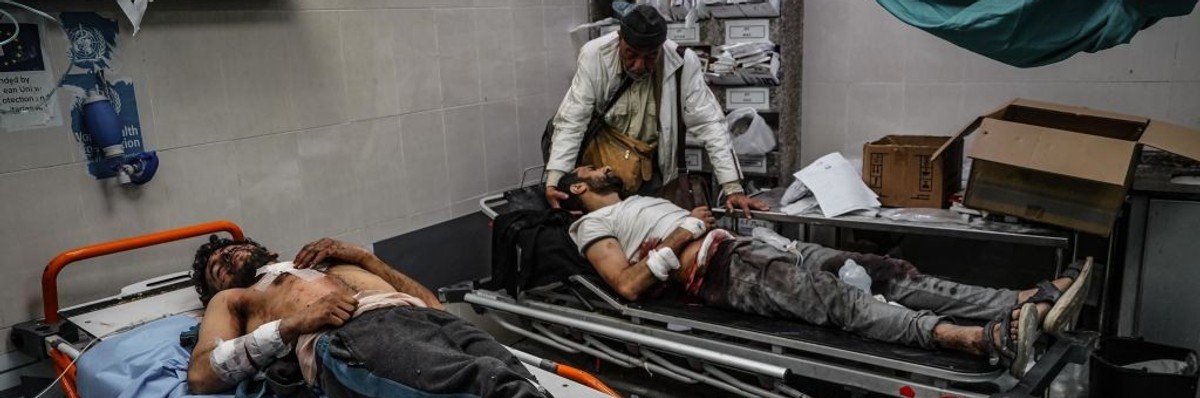
Injured Palestinians, including children, are brought to Nasser Hospital to receive medical treatment following Israeli attacks in Khan Younis, Gaza, on January 22, 2024.  (Photo: Belal Khaled/Anadolu via Getty Images)

If we can’t find the morality to stop, we may find we have created a world in which no one can count on upholding basic human rights.

Many decades ago in Chicago, my favorite of several part-time student jobs was operating the “old-style” telephone switchboard at a small hospital called Forkosh Memorial. The console of coils and plugs included a mirror so operators could keep an eye on the hospital entrance, which on weekends and evenings was also monitored by an elderly, unarmed security guard named Frank. He sat at a classroom style desk near the entrance with a ledger book.

Over the course of four years, on weekends and evenings, “security” at the hospital generally consisted solely of Frank and me. Fortunately, nothing much ever happened. The possibility of an attack, invasion, or raid never occurred to us. The notion of an aerial bombardment was unimaginable, like something out of War of the Worlds or some other sci-fi fantasy.

Now, tragically, hospitals in Gaza and the West Bank have been attacked, invaded, bombed, and destroyed. News of additional Israeli attacks is being reported on a daily basis. Last week, Democracy Nowinterviewed Dr. Yasser Khan, a Canadian ophthalmologist and eye surgeon who recently returned from a humanitarian surgical mission at the European Hospital in Khan Younis in Gaza. Dr. Khan spoke of bombings taking place every few hours resulting in a constant influx of mass casualties. The majority of patients he treated were children from age 2 to 17. He saw horrific eye injuries, shattered faces, shrapnel wounds, abdominal injuries, limbs severed above the bone, and traumas caused by drone-launched laser-guided missiles. Amid the overcrowding and chaos, healthcare workers tended to patients while lacking basic equipment, including anesthesia. Patients lay on the ground in unsterile conditions, vulnerable to infection and disease. Most of them also suffered from severe hunger.

At Forkosh Hospital in the 1970s, I had a mirror to see what was happening behind my back, but everyone on Earth can see, directly, the horror of U.S. support for a genocidal event happening on our watch.

Normally, a child who undergoes an amputation faces as many as 12 additional surgeries. Khan wondered who would do the follow-up care for these children, some of whom have no surviving relatives.

He also noted sniper fire prevented doctors from going to work. “They’ve killed healthcare workers, nurses, paramedics; ambulances have been bombed. This has all been systematic,” Khan explained. “Now there are 10,000 to 15,000 bodies decomposing. It’s the rainy season right now in Gaza, so all the rainwater mixes with the decomposing bodies and that bacteria mixes with the drinking water supply and you get further disease.”

According to Khan, Israeli forces have kidnapped 40 to 45 doctors, specifically targeting specialists and hospital administrators. Three healthcare professional organizations have issued a statement expressing deep concern that the Israeli military has abducted and unlawfully detained Dr. Khaled al-Serr, a surgeon at the Nasser Hospital in Gaza.

On February 19, WHO Director-General Dr. Tedros Adhanom Ghebreyesus described conditions in the Nasser hospital after Israel ordered evacuation of Palestinians from the complex. “There are still more than 180 patients and 15 doctors and nurses inside Nasser,” he said. “The hospital is still experiencing an acute shortage of food, basic medical supplies, and oxygen. There is no tap water and no electricity, except a backup generator maintaining some lifesaving machines.”

Eight years ago, in October of 2015, the United States military destroyed Afghanistan’s Kunduz hospital, run by Médecins sans Frontières (Doctors Without Borders). For more than an hour, a C-130 transport plane repeatedly fired incendiary devices at the hospital’s emergency room and intensive care unit, killing 42 people. Thirty-seven additional people were injured. “Our patients burned in their beds,” read the MSF’s in-depth report. “Our medical staff were decapitated or lost limbs. Others were shot from the air while they fled the burning building.”

The horrific attack outraged war resisters and human rights groups. I remember joining a group of activists in upstate New York who assembled outside a hospital emergency room with a banner proclaiming, “To bomb this site would be a war crime.”

In 2009, on a smaller, yet still horrific scale, I witnessed an Israeli onslaught in Gaza called “Operation Cast Lead.” In the emergency room of the Al Shifa hospital, Dr. Saeed Abuhassan, an orthopedic surgeon, described experiences similar to Khan’s. This surgeon grew up in Chicago, very close to the neighborhood where I lived. I asked him what he would want me to tell our neighbors back home. He listed a litany of horrors, and then he stopped. “No,” he said. “First, you must tell them that U.S. taxpayer money paid for all of these weapons.”

Taxpayer money feeds the bloated, swollen Pentagon budget. U.S. Senators, last week, cowed by AIPAC, decided to send Israel an additional $14.1 billion to boost military spending. Only three Senators voted against the bill.

From PalestineHuwaida Arraf, a Palestinian-American human rights attorney, wrote on X: “The scary part is not that Israel is planning the forcible transfer of the Palestinians it hasn’t slaughtered, but that the so-called ‘civilized world’ is allowing it to happen. The ramifications of this coordinated evil will haunt its collaborators for generations to come.”

At Forkosh Hospital in the 1970s, I had a mirror to see what was happening behind my back, but everyone on Earth can see, directly, the horror of U.S. support for a genocidal event happening on our watch. Gravely distorted versions of what occurred on October 7, cannot—even if believed—justify the scale of the horrors being reported in Gaza and the West Bank each day.

The U.S. government continues enthusiastically to bankroll Israel’s systemic and inhumane destruction of Gaza. U.S. advisers make feeble attempts to suggest Israel should pause or at least try to be more precise in their attacks. In its quest for hegemonic superiority, the United States tears into ever tinier shreds whatever remains of a commitment to human rights, equality, and human dignity.

What kept Forkosh Hospital secure, decades ago, was a social contract that presumed safety for a small hospital serving the local population.

If we can’t find the morality to stop supplying weapons for ongoing Israeli onslaughts against Gaza and its places of healing, we may find we have created a world in which no one can count on upholding basic human rights. We may be creating intergenerational wounds of hatred and sorrow from which there will never, ever be any safe place to heal.

A version of this article first appeared on The Progressive website.

Original article by KATHY KELLY republished from Common Dreams under Creative Commons (CC BY-NC-ND 3.0).

Continue ReadingThe US Must Stop Arming Israel’s Assault on Hospitals

Israeli Assault Leaves Gaza’s Nasser Hospital ‘Not Functional’

Spread the love

Original article by JESSICA CORBETT republished from Common Dreams under Creative Commons (CC BY-NC-ND 3.0). 

Injured Palestinians are brought to Nasser Hospital in Khan Yunis, Gaza on January 22, 2024.  (Photo: Belal Khaled/Anadolu via Getty Images)

The WHO “was not permitted to enter” the facility in recent days, said the agency chief, warning that “the cost of delays will be paid by patients’ lives.”

World Health Organization Director-General Tedros Adhanom Ghebreyesus announced Sunday that the largest hospital in the southern Gaza Strip “is not functional anymore, after a weeklong siege followed by the ongoing raid” by Israeli forces.

After claiming that Hamas was using Nasser Hospital in Khan Younis for “military activity” and some hostages’ bodies may be there, the Israel Defense Forces on Thursday began raiding the facility, where around 10,000 people had sought shelter. Sources there said the IDF bombed “a ward full of patients” and multiple people who were dependent on oxygen have died due to power outages.

Tedros highlighted on Sunday that the WHO team “was not permitted to enter” the facility in recent days “to assess the conditions of the patients and critical medical needs, despite reaching the hospital compound to deliver fuel alongside partners.”

“There are still about 200 patients in the hospital. At least 20 need to be urgently referred to other hospitals to receive healthcare; medical referral is every patient’s right,” he added. “The cost of delays will be paid by patients’ lives. Access to the patients and hospital should be facilitated.”

Later Sunday, the Palestinian Ministry of Health in Gaza said that “150 patients who cannot move are piled inside the rooms and corridors of the old building at Nasser Medical Complex without medical care after the arrest of 70 of the complex’s management and medical staff.”

“The occupation refuses to evacuate patients for treatment in other hospitals, which endangers their lives, including seven intensive care patients, five dialysis patients, [and] three newborns in the nursery, in addition to cases of burns, amputations, quadriplegia, childbirth, and others,” the ministry added.

The IDF said on Telegram that in its operations around the facility, Israeli troops apprehended “hundreds of terrorists and other terror suspects who were hiding in the hospital, some of whom had posed as medical staff,” including alleged participants in the October 7 Hamas-led attack that led to the war.

Noting IDF claims that soldiers aimed to recover the remains of hostages believed to be in the facility, The Washington Postreported that “Israeli forces have not yet found the bodies of any hostages but said on Sunday that they discovered medicine at the hospital bearing the names of Israelis who were abducted by Hamas.”

The Israeli assault on the Hamas-governed enclave has killed nearly 29,000 Palestinians, injured over 68,800 others, devastated civilian infrastructure—including hospitals—and left most of Gaza’s 2.3 million residents displaced, hungry, and at risk of disease. Global experts and critics have accused Israel of genocide, including in a South Africa-led case before the International Court of Justice (ICJ).

In response to IDF orders to leave northern Gaza, most residents are now crammed into the southern part of the strip. According toAl-Jazeera:

Al-Amal Hospital, the only other major medical facility still operational in Khan Younis, continues to be a target of Israeli attacks. The Palestine Red Crescent Society (PRCS) on Sunday said Israeli forces targeted the third floor of the hospital with artillery fire.

The Israeli military has expanded its siege on Khan Younis and its medical facilities as it pushed further south into Rafah on the border with Egypt.

Throughout the week, people around the world including humanitarian and United Nations leaders have pressured Israel to refrain from a full-scale attack on Rafah. The ICJ on Friday echoed U.N. Secretary-General António Guterres’ warning that it “would exponentially increase what is already a humanitarian nightmare with untold regional consequences.”

Original article by JESSICA CORBETT republished from Common Dreams under Creative Commons (CC BY-NC-ND 3.0). 

Continue ReadingIsraeli Assault Leaves Gaza’s Nasser Hospital ‘Not Functional’

IDF Storms Largest Hospital in Southern Gaza and Attacks ‘Ward Full of Patients’

Spread the love

Original article by JAKE JOHNSON republished from Common Dreams under Creative Commons (CC BY-NC-ND 3.0).

Injured Palestinians, including children, are brought to Nasser Hospital to receive medical treatment following Israeli attacks in Khan Younis, Gaza on January 22, 2024.  (Photo: Belal Khaled/Anadolu via Getty Images)

“The situation is escalating every hour and every minute,” said a surgeon at Nasser Hospital in Khan Younis.

Israeli forces on Thursday stormed the largest hospital in southern Gaza, ignoring warnings from United Nations officials, humanitarian groups, and the facility’s administrators that such a raid would put the lives of patients and people sheltering there at dire risk.

The Israel Defense Forces (IDF) reportedly destroyed the southern wall of the Nasser Hospital complex in Khan Younis and started raiding the facility, where around 10,000 people had sought shelter from Israeli airstrikes and ground attacks.

Without providing evidence, Israel has claimed Hamas is using the hospital for “military activities.” Israel also claimed to have intelligence indicating that hostages or their bodies were being held at Nasser.

Ashraf al-Qudra, a spokesman for Gaza’s health ministry, said Thursday that Israel launched a “massive incursion” into the hospital, firing on and wounding people inside and ordering the facility’s staff to move all patients who were unable to flee into a building that’s not adequately equipped, The Associated Press reported.

As of Wednesday afternoon, more than 1,500 displaced people and patients were still inside the Nasser complex, Gaza health officials said in an update on social media.

“Many cannot evacuate, such as those with lower limb amputations, severe burns, or the elderly,” al-Qudra told Al Jazeera.

Others worried that Israeli forces would shoot them if they tried to leave.

“I’m terrified to leave the hospital and get shot,” Hanin Abu Tiba, a 27-year-old English teacher sheltering at the hospital, toldThe New York Times on Wednesday.

The raid began Thursday after Israeli forces reportedly bombed a ward of the hospital that was full of patients. Gaza health officials said the IDF targeted the hospital’s orthopedic department, killing at least one person and injuring “many” more.

The Israeli military, which has encircled Nasser Hospital for weeks, began ordering civilians inside the facility to evacuate on Tuesday.

Citing one of the only remaining journalists inside the facility, The Intercept reported Wednesday that the IDF sent a handcuffed Palestinian man into Nasser to tell people sheltering inside to leave.

An Israeli soldier shot the man, later identified as Jamal Abu Al-Ola, three times in the chest and abdomen as he began walking out of the hospital after delivering the message.

Israeli snipers have also opened fire on people scrambling to flee the hospital as well as medical personnel and patients inside the facility.

Gaza health officials said Wednesday that the situation at Nasser is “catastrophic” and that Israel’s evacuation orders sparked “a state of panic among its residents.”

Dr. Ahmed Moghrabi, a surgeon at Nasser, posted video footage to Instagram that provides a glimpse of the chaos inside the hospital as it comes under Israeli attack.

https://www.instagram.com/reel/C3WPe8lILDa/?utm_source=ig_web_copy_link

Dr. Khaled Alserr, another Nasser surgeon, told AP that seven people injured by Israeli attacks on Thursday were already being treated for existing wounds. Alserr said a doctor was also injured when an Israeli drone “opened fire on the upper stories of the hospital.”

“The situation is escalating every hour and every minute,” he said.

Israel’s raid began hours after Médecins Sans Frontières (MSF), also known as Doctors Without Borders, condemned the evacuation orders and reiterated its call for a permanent cease-fire. MSF said some of its staff members were “still in the building” treating patients “amid near impossible conditions.”

“People have been forced into an impossible situation: stay at Nasser Hospital against the Israeli military’s orders and become a potential target, or exit the compound into an apocalyptic landscape where bombings and evacuation orders are a part of daily life,” Lisa Macheiner, MSF’s project coordinator in Gaza, said in a statement. “Hospitals should be considered as safe places and shouldn’t even be evacuated in the first place.”

In a Nasser update posted to social media Thursday morning, MSF said that “following shelling this morning, our staff reported a chaotic situation, with an undetermined number of people killed and injured.”

“Our medical staff have had to flee the hospital, leaving patients behind,” the group said. “Israeli forces set up a checkpoint to screen people leaving the compound; one of our colleagues was detained at this checkpoint. We call for his safety and the protection of his dignity.”

MSF demanded that the Israeli military “immediately stop this attack, as it endangers medical staff and patients who are still stuck inside the facility.”

This post has been updated with new comments from Médecins Sans Frontières.

Original article by JAKE JOHNSON republished from Common Dreams under Creative Commons (CC BY-NC-ND 3.0).

Continue ReadingIDF Storms Largest Hospital in Southern Gaza and Attacks ‘Ward Full of Patients’

Rule-of-Law Western Style’: Israeli Assassination Squad Kills Three in Jenin Hospital

Spread the love

Original article by JAKE JOHNSON republished from Common Dreams under under Creative Commons (CC BY-NC-ND 3.0). 

Security footage shows Israeli forces disguised as civilians and medical staff during a raid on Ibn Sina hospital in Jenin, a city in the occupied West Bank, on January 30, 2023.  (Photo: Screengrab via CNN)

Ibn Sina hospital’s medical director said the Palestinian men were “executed in cold blood.”

A team of Israeli forces disguised as civilians and medical staff raided Ibn Sina hospital in the occupied West Bank on Tuesday and assassinated three Palestinians, claiming without providing evidence that they were using the facility as a hideout and planning an attack inspired by the Hamas-led October 7 assault.

Journalists on the ground report that there was no apparent attempt to arrest the three individuals, whom the Israeli military identified as Mohammed Jalamneh, Mohammed Ghazawi, and his brother Basel Ghazawi. Ibn Sina’s medical director said the three men were “executed in cold blood.”

Al Jazeera reported that “Hamas confirmed that Jalamneh was one of its members.”

“The Jenin Brigade, which includes a number of Palestinian armed resistance groups, said in a statement that two of the three men were members of Islamic Jihad,” the outlet added.

A hospital spokesperson told The Associated Press that 18-year-old Basel Ghazawi “had been a patient in the hospital since October with partial paralysis.”

Security footage from the hospital shows Israeli forces dressed as civilian women and medical workers moving through a facility hallway and waiting area with assault rifles drawn.

Citing Palestinian officials, AP reported that the Israeli forces “opened fire inside the wards” of the hospital, located in the West Bank city of Jenin.

Palestinian health officials “condemned the raid and called on the international community to pressure Israel’s military to halt such operations in hospitals,” AP added. “A hospital spokesperson said there was no exchange of fire, indicating that it was a targeted killing.”

Hospitals have special protections under international law, but Israel has treated them as legitimate targets for military operations since October 7, endangering wounded patients and medical personnel by raiding and shelling the facilities at will.

Yanis Varoufakis, the former Greek finance minister and co-founder of the Democracy in Europe Movement 2025, sardonically described the Israeli forces’ Jenin hospital raid as “rule-of-law Western style” and rejected the notion that “you can kill anyone you like on a land that you are illegally occupying, brand him/her terrorist, and then vilify as antisemites the ancestors of everyone who questions your right to kill anyone you like on a land that you are illegally occupying.”

Al Jazeera‘s Charles Stratford, reporting from Ramallah, said Tuesday that “the Israeli army often surrounds and in some instances has attacked the three Palestinian hospitals in Jenin during nightly raids on the city.”

“But this is the first time they have entered a civilian medical facility in what seems to have been a well-planned, targeted assassination operation that Palestinian authorities are calling another violation of international law,” said Stratford.

Original article by JAKE JOHNSON republished from Common Dreams under under Creative Commons (CC BY-NC-ND 3.0). 

Continue ReadingRule-of-Law Western Style’: Israeli Assassination Squad Kills Three in Jenin Hospital

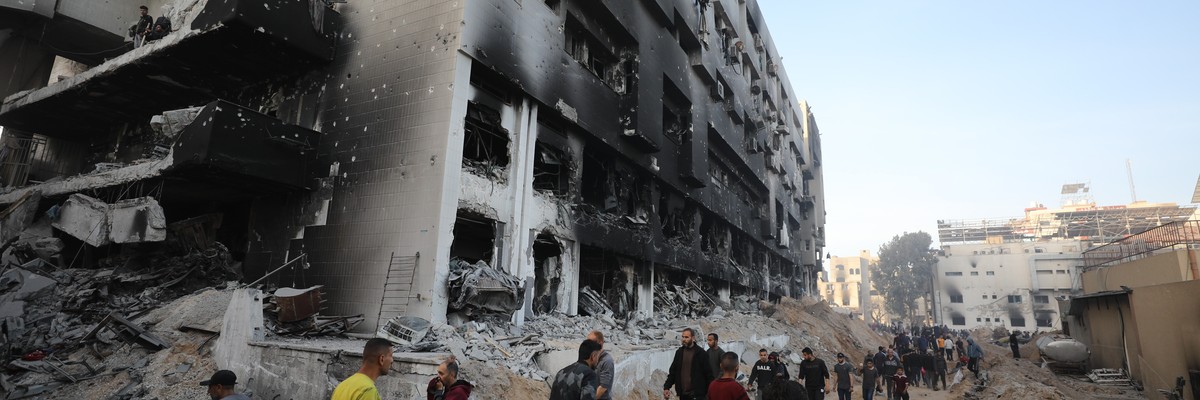
Palestinian and international networks demand Israel release hospital director Dr. Ahmed Muhanna

Spread the love

Original article by Peoples Health Dispatch republished from peoples dispatch under a Creative Commons Attribution-ShareAlike 4.0 (CC BY-SA) license.
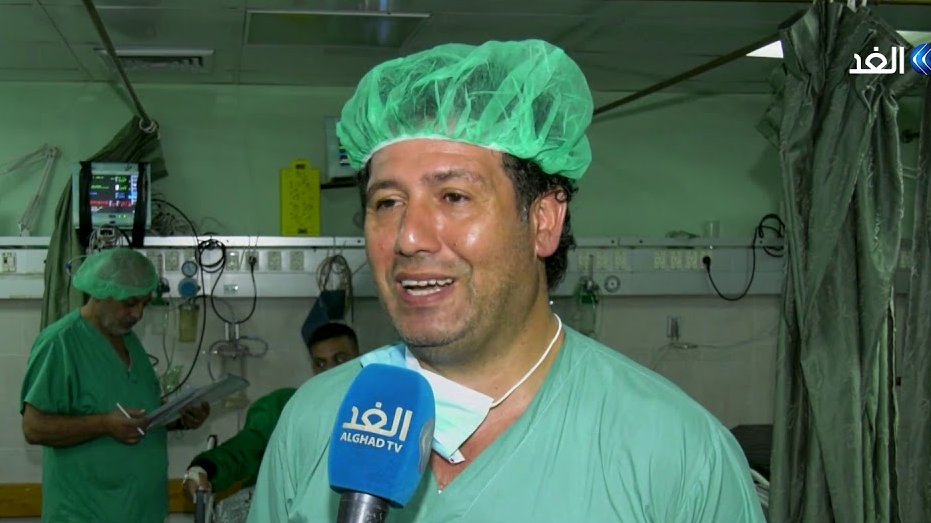
Al Awda Association and the People’s Health Movement launched a campaign for the release of Dr. Ahmed Muhanna, director of Al-Awda Hospital in northern Gaza

Dr. Ahmed Muhanna appeared on numerous international news stations calling for an end to Israel’s attacks on health workers. Photo: Screenshot

Al Awda Health and Community Association and the People’s Health Movement (PHM) have launched a campaign calling for the release of Dr. Ahmed Muhanna, the director of Al Awda’s hospital in the area of Tal Al-Zaatar in Jabalya, northern Gaza. PHM has also called for an end to Israeli attacks on health workers in Palestine, warning that the “deliberate targeting of the healthcare system by Israel is a blatant war crime.”

Dr. Muhanna was detained by Israeli Occupying Forces (IOF) following a raid on Al-Awda Hospital in Jabalya that began on December 17. While other staff members were detained by Israeli soldiers, they were released after several hours of questioning. On the other hand, Dr. Muhanna was not released, and his current status remains unknown.

The director of Al-Awda Hospital in Jabalya became an unofficial spokesperson for health workers in Palestine since Israel started its latest round of attacks on October 7. From the very beginning of the Israeli war on Gaza, Dr. Muhanna kept contact with regional and international organizations, sharing situation reports to illustrate the dire state of hospitals in the Gaza Strip.

Read more: World faces days of “moral decay” as Israel bulldozes hospital grounds, detains more doctors

Along with other members of the staff, Dr. Muhanna was also one of the health workers who refused to abandon the hospital after receiving evacuation orders from the Israeli occupation in the earlier phases of the war. At the time, Dr. Muhanna said the evacuation “is not possible,” given the serious conditions of several patients. “The hospital staff is determined to stay and provide health care to patients,” he asserted at the time.

Shortly before his arrest, Dr. Muhanna sent a new message to Al Awda’s network of contacts, saying: “No one can move in the hospital because of the [Israeli] sniper. The situation in the hospital is terrible. We have 38 patients, some of them lacking medicine. We have no oxygen and only very little fuel for a small generator. We have food for 2 to 3 days tops. The situation is critical.”

Al Awda Association and PHM have called on health workers and activists around the world to denounce Dr. Muhanna’s arrest and apply pressure on their governments to push Israeli authorities to free him. The organizations are also inviting health workers to organize actions in support of Dr. Muhanna and his comrades in the Gaza Strip, making their struggle visible in their workplaces.

People’s Health Dispatch is a fortnightly bulletin published by the People’s Health Movement and Peoples Dispatch. For more articles and subscription to People’s Health Dispatch, click here.

Original article by Peoples Health Dispatch republished from peoples dispatch under a Creative Commons Attribution-ShareAlike 4.0 (CC BY-SA) license.
Continue ReadingPalestinian and international networks demand Israel release hospital director Dr. Ahmed Muhanna