US Abstains as UN Security Council Demands ‘Immediate Cease-Fire’ in Gaza

Spread the love

Original article by BRETT WILKINS republished from Common Dreams under Creative Commons (CC BY-NC-ND 3.0).
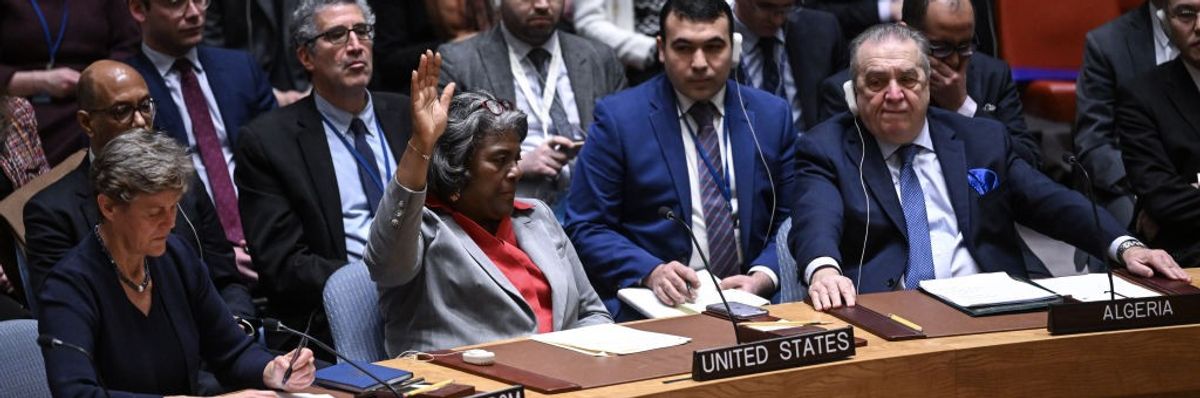
U.S. Ambassador to the United Nations Linda Thomas-Greenfield raises her hand to abstain during a U.N. Security Council vote on a Gaza cease-fire resolution on March 25, 2024 in New York City.  (Photo: Fatih Aktas/Anadolu via Getty Images)

“This resolution must be implemented,” said U.N. Secretary-General António Guterres. “Failure would be unforgivable.”

The U.S. on Monday declined to veto but still abstained from a United Nations Security Council on Monday to adopt a resolution demanding an “immediate cease-fire for the month of Ramadan” in the embattled Gaza Strip, a move that came amid an ongoing Israeli genocide in which more than 114,000 Palestinians have been killed or wounded and hundreds of thousands of others are starving.

The Security Council voted 14-0, with the U.S. abstaining, to approve a resolution for the cessation of hostilities during the Muslim holy month after member states overcame a sticking point over the removal of the word “permanent” from an earlier draft version. Instead, the resolution calls for an “immediate” cease-fire.

The U.S. had vetoed three of the previous four cease-fire resolutions.

“This resolution must be implemented,” U.N. Secretary-General António Guterres said following Monday’s vote. “Failure would be unforgivable.”

As the U.N. News explained:

The resolution is a bare-bones call for a cease-fire during the month of Ramadan, which began on March 11. It also demands the return of about 130 hostages seized in Israel and held in Gaza and emphasizes the urgent need to allow ample lifesaving aid to reach a starving population in the besieged enclave.

The demand to end hostilities has so far eluded the council following the Israeli forces’ invasion of Gaza in October after Hamas attacks left almost 1,200 dead and 240 taken hostage.

Since then, Israel’s daily bombardment alongside its near-total blockade of water, electricity, and lifesaving aid has killed more than 32,000 Palestinians in Gaza, according to the health ministry there, where a recent U.N.-backed report showed an imminent famine unfolding.

Palestinians—especially children—are starving to death in Gaza. Hospitals are under attack, with Israeli forces reportedly executing large numbers of people inside al-Shifa Hospital.

Meanwhile, the approximately 1.5 milllion Palestinians in the southern city of Rafah—most of them refugees forcibly displaced from other parts of Gaza—are bracing for an anticipated ground invasion, which Israeli leaders say will proceed despite a warning from U.S. Vice President Kamala Harris that such an operation would have “consequences.”

Monday’s vote followed intense negotiations over the measure introduced by 10 non-permanent Security Council members—Algeria, Ecuador, Guyana, Japan, Malta, Mozambique, Sierra Leone, Slovenia, South Korea, and Switzerland.

The United States—which, despite growing frustration over genocidal atrocities, still arms Israel—brushed off a threat from far-right Prime Minister Benjamin Netanyahu to cancel a planned visit to Washigton by a high-level Israeli delegation if the U.S. did not veto the resolution.

The Associated Press reported Netanyahu followed through with his threat and canceled the trip.

Human rights defenders welcomed Monday’s vote.

“Israel needs to immediately respond to the U.N. Security Council resolution adopted today by facilitating the delivery of humanitarian aid, ending its starvation of Gaza’s population, and halting unlawful attacks,” Louis Charbonneau, director of Human Rights Watch’s U.N. program, said in a statement.

“Palestinian armed groups should immediately release all civilians held hostage,” he added. “The U.S. and other countries should use their leverage to end atrocities by suspending arms transfers to Israel.”

Original article by BRETT WILKINS republished from Common Dreams under Creative Commons (CC BY-NC-ND 3.0).

Continue ReadingUS Abstains as UN Security Council Demands ‘Immediate Cease-Fire’ in Gaza

UN Chief Invokes Article 99 to Spur Security Council Action on Gaza

Spread the love
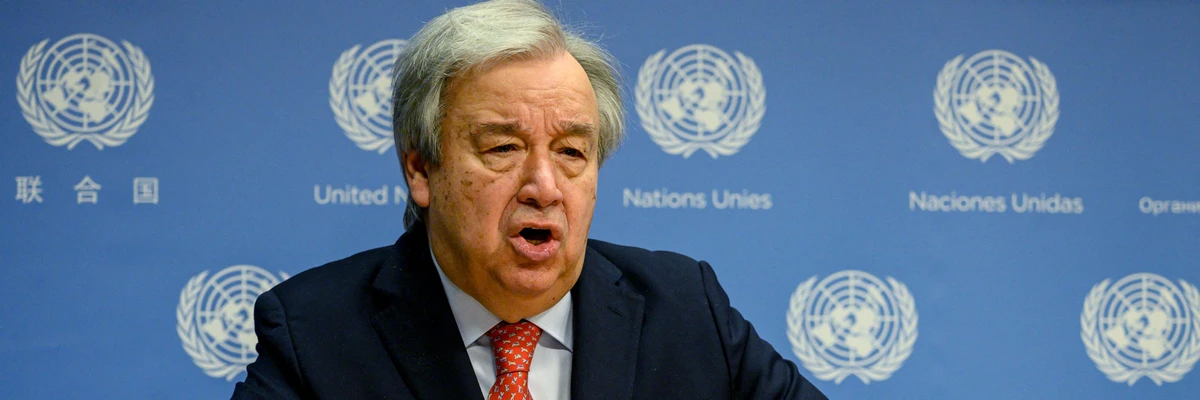
United Nations Secretary-General António Guterres discusses climate change at U.N. headquarters in New York City on July 27, 2023.

“Facing a severe risk of collapse of the humanitarian system in Gaza, I urge the council to help avert a humanitarian catastrophe and appeal for a humanitarian cease-fire to be declared.”

With over 16,000 Palestinians dead just two months into Israel’s war on the Gaza Strip, United Nations Secretary-General António Guterres on Wednesday demanded immediate action by the U.N. Security Council.

For the first time since becoming secretary-general nearly seven years ago, Guterres invoked Article 99, a rarely used section of the U.N. Charter empowering him to bring to the attention of the council “any matter which in his opinion may threaten the maintenance of international peace and security.”

U.N. spokesperson Stéphane Dujarric said that Guterres was invoking Article 99 “given the scale of the loss of human life in Gaza and Israel, in such a short amount of time.”

“I think it’s arguably the most important invocation,” Dujarric told reporters at U.N. headquarters, “in my opinion, the most powerful tool that he has.”

“The international community has a responsibility to use all its influence to prevent further escalation and end this crisis.”

Guterres wrote to José Javier De la Gasca Lopez Domínguez, the Ecuadorian president of the Security Council, that “more than eight weeks of hostilities in Gaza and Israel have created appalling human suffering, physical destruction and collective trauma across Israel and the occupied Palestinian territory.”

The U.N. chief reaffirmed his condemnation of the October 7 Hamas-led attack on Israel—in which around 1,200 people were killed and over 200 others were captured—that led to the war. He called accounts of sexual violence “appalling” and stressed that the remaining hostages “must be immediately and unconditionally released.”

He also emphasized that “civilians throughout Gaza face grave danger,” with the Israeli airstrikes and raids damaging more than half of all homes and displacing about 80% of the 2.3 million residents. Over a million of them have sought shelter at U.N. facilities, “creating overcrowded, undignified, and unhygienic conditions,” while others “find themselves on the street.”

“The healthcare system in Gaza is collapsing,” he noted, pointing out that only 14 of 36 hospitals are operating at all. “I expect public order to completely break down soon due to the desperate conditions, rendering even limited humanitarian assistance impossible. An even worse situation could unfold, including epidemic diseases and increased pressure for mass displacement into neighboring countries.”

Already, conditions in Gaza are making “it impossible for meaningful humanitarian operations to be conducted,” Guterres added. “The capacity of the United Nations and its humanitarian partners has been decimated by supply shortages, lack of fuel, interrupted communications, and growing insecurity.”

“The situation is fast deteriorating into a catastrophe with potentially irreversible implications for Palestinians as a whole and for peace and security in the region. Such an outcome must be avoided at all cost,” the U.N. leader warned. “The international community has a responsibility to use all its influence to prevent further escalation and end this crisis.”

“I urge the members of the Security Council to press to avert a humanitarian catastrophe,” he wrote. “I reiterate my appeal for a humanitarian cease-fire to be declared. This is urgent. The civilian population must be spared from greater harm.”

The United States—a supporter of Israel’s war and one of the U.N. Security Council’s five permanent members—vetoed a mid-October resolution condemning violence against civilians in Israel and Gaza and urging “humanitarian pauses” for aid delivery.

Roughly a month later, the Security Council approved a Gaza resolution that calls on all parties to abide by their obligations under international law and advocates for “urgent and extended humanitarian pauses and corridors.”

Dr. Christos Christou, international president of Médecins Sans Frontières, or Doctors Without Borders, said at the time that “the unacceptably jumbled and sluggish process finally led to the adoption of a text that does not come close to reflecting the severity of the humanitarian catastrophe in Gaza.”

Continue ReadingUN Chief Invokes Article 99 to Spur Security Council Action on Gaza