Tag: House of Lords

  • From aristocracy to ‘assetocracy’ – how wealth has transformed the House of Lords

    Spread the love
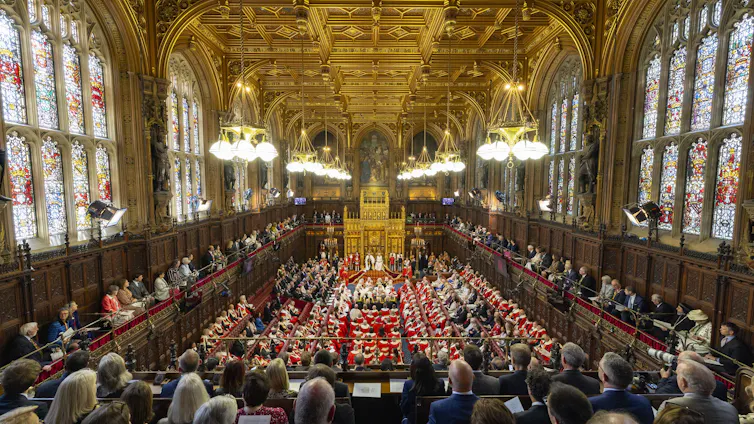
    peers in ermine in the house of lords chamber for the state opening of parliament 2026 with the king and queen.
    The State Opening of Parliament 2026. House of Lords / Roger Harris, CC BY-NC-ND

    Huw Macartney, University of Birmingham

    On April 29, 2026, the remaining hereditary peers left the House of Lords. These 92 individuals were the last vestiges of an era in which the landed aristocracy dominated the UK’s second chamber. In the recent past, as many as 800 aristocrats filled the red benches. Now though, a new financial elite appears to have taken their place.

    Gradually, the dominance of the aristocrats gave way to a more meritocratic order of life peers. In 1999, Tony Blair’s government removed most of the hereditary peers; in 2026, Keir Starmer’s government finished the job. But did removing them really make the House of Lords any less elitist?

    These were some of the issues I sought to explore with a team of graduate researchers at the University of Birmingham. We set about gathering what is, to the best of our knowledge, the largest-ever repository of the financial and political activities of the Lords. Over 18 months, we collected details of all the shareholdings, company directorships, landholdings, rental properties, education, attendance and speeches in the second chamber, as well as voting records for all Lords. These are presented in my new book, The Assetocracy.

    What we uncovered was staggering. More than 260 peers hold multiple, individual shareholdings – stakes in listed companies – worth more than £100,000 apiece. In fact, some Lords held more than 200 individual holdings, each valued in excess of £100,000. Even assuming each asset was only worth £100,000, that would put the combined value of those shareholdings alone at more than £22 million.

    Put simply, this reflects a level of wealth far beyond that of all but the richest people in Britain. In fact, 14 Lords appear in The Sunday Times Rich List of the UK’s wealthiest people, with a combined net worth of £27.8 billion.

    Moreover, half of the House are landlords with rental income. And 250 peers hold one or more paid company directorship. In short, this is an extraordinary concentration of wealth at the heart of Britain’s second chamber.

    The social profile of the Lords is equally revealing. Nearly half of peers were privately educated, compared with just 7% of the wider population. Around one third went to Oxford or Cambridge, compared with just 1% nationally. And 11% attended some of Britain’s most elite schools, where annual fees can now top £60,000.

    Our conclusion? The Lords is not merely wealthy, it is an institution steeped in economic, educational and social privilege. Yet remarkably little is known about the extent of this wealth. Disclosure requirements remain limited, leaving many of the peers’ financial interests hidden from public view.

    And that matters. Membership of the Lords can sit alongside extremely lucrative private-sector careers. Several peers, for example, declared earning between £100,000 and £300,000 a year from company directorships and advisory positions – on top of their parliamentary roles and Lords allowances (a £371 daily rate).

    Aristocrats have gone – but privilege has not

    This is the paradox at the heart of the modern House of Lords. The old aristocracy may be disappearing from the red benches, but wealth and privilege have not disappeared with it. The aristocracy has increasingly given way to what we termed an “assetocracy” – members of the new financial elite whose power rests on property, finance and accumulated asset-based wealth.

    Reforming the second chamber has previously been tied to either removing the aristocratic hereditary peers or (ostensibly) increasing the scope for non-elite appointments. This is primarily done through the House of Lords Appointments Commission and the introduction of crossbenchers, whose appointment does not depend on prime ministerial patronage or political donations.

    Yet while these efforts appeared to be producing a diverse collection of Lords through the early 2000s, the trend was reversed with the arrival of the Conservative governments of the 2010s. Since then, my research shows that the second chamber has seen a striking influx of the new “assetocratic” elite.

    Appointments of peers with shareholdings over £100,000 (by political party)

    My research also reveals a small but clear relationship between wealth and participation in the Lords. Previous accounts have shown that some political donors appear to treat a peerage as a status symbol, playing little part in the day-to-day work of the House. My findings suggest however, that the pattern extends beyond political donors. On average, the wealthiest peers tend to attend less, speak less and contribute less to the work of the House.

    One of the book’s central conclusions is that the rise of the assetocrats in the Lords coincided with a wider transformation of British society. It was a period when wealth inequality grew and asset ownership became an increasingly important source of economic advantage.

    The Lords did not create these changes, nor are its members the only or primary beneficiaries. But my research shows how peers have often sought to narrow the terms of political debate around wealth and redistribution. They have defended a system that privileges asset ownership and particular forms of wealth accumulation.

    For example, Lord Leigh of Hurley, a Conservative peer and businessman, told the House in 2025 that “we need to teach kids that so-called ‘earned income’ is paid, weekly or monthly, without any risk whatever, while ‘unearned income’ is typically generated from an investment, which involves risk to capital and, therefore, deserves greater reward”.

    The research points to three conclusions. The first may seem paradoxical, but the more I researched the Lords, the more convinced I became that – certainly on issues beyond wealth and inequality – it is a remarkable source of expertise that often improves and strengthens legislation. That is why abolishing the Lords would throw away an institution that still performs an important democratic function.

    Second, reform is nonetheless overdue. Prime ministerial patronage should be curtailed; minimum expectations for attendance and participation introduced; transparency over financial affairs should be increased; and outside employment more tightly regulated where it creates conflicts of interest.

    But there is a bigger issue. The transformation of the Lords reflects a much more profound transformation of society. Over the past five decades, the UK has become an economy in which owning property, shares and other assets is an increasingly important route to extraordinary wealth. Removing the last vestiges of the old aristocracy from the Lords will not solve the problem. The deeper challenge is confronting the structural forces that have allowed a new asset-owning elite to take its place.

    This article features references to books that have been included for editorial reasons, and may contain links to bookshop.org. If you click on one of the links and go on to buy something from bookshop.org The Conversation UK may earn a commission.

    Huw Macartney, Associate professor in Political Economy, University of Birmingham

    This article is republished from The Conversation under a Creative Commons license. Read the original article.

    Orcas discuss Donald Trump and the killer apes' concept of democracy. Front Orca warns that Trump is crashing his country's economy and that everything he does he does for the fantastically wealthy.
    Orcas discuss Donald Trump and the killer apes’ concept of democracy. Front Orca warns that Trump is crashing his country’s economy and that everything he does he does for the fantastically wealthy.

  • Giving 16 and 17-year-olds the vote is a long-overdue step towards a stronger, more inclusive democracy say Greens

    Spread the love
    Ellie Chowns, Green Party MP for North Herefordshire. CC image Wikipedia.
    Ellie Chowns, Green Party MP for North Herefordshire. CC image Wikipedia.

    Responding to the government’s announced plans to give votes to 16 and 17 year olds, Green Party MP, Ellie Chowns said: 

    “On this one, Labour have got it right. Giving 16- and 17-year-olds the vote is a long-overdue step towards a stronger, more inclusive democracy. Young people have powerful voices and a vital stake in decisions about their future — it’s only right that they have a say at the ballot box.

    But if Labour are serious about renewing our democracy, this must be just the beginning. We need to go further — that means scrapping the undemocratic House of Lords, and finally delivering proportional representation so that every vote counts.”

  • Protesters disrupted House of Lords to demand unelected chamber is abolished

    Spread the love

    https://morningstaronline.co.uk/article/protesters-disrupted-house-lords-demand-unelected-chamber-abolished

    Screen grab of members of the House of Lords looking up during a protest in the chamber after protesters calling for the abolition of the unelected chamber started shouting, singing and throwing leaflets, March 20, 2025

    PROTESTERS disrupted proceedings in the House of Lords today [yesterday]to demand the abolition of the unelected chamber.

    They threw leaflets, shouted and sang from the public gallery during the demonstration at noon.

    The House was adjourned for a short time as the demonstrators were escorted out.

    Protester Lucy Porter, 50, a primary school teacher from Leeds, said she was “campaigning for a house of the people.”

    On the Lords, she said: “It’s a symbol of everything that’s outdated.

    “We don’t have a functioning democracy in this country.”

    The leaflets, apparently modelled on an album by the Sex Pistols punk band, had written on them: “Never mind the Lords here’s the House of People.”

    On the other side it stated: “Aristocrats and oligarchs: Out. Posties, mums, nurses and neighbours: In.

    “Replace the House of Lords to save the UK.”

    …

    Article continues at https://morningstaronline.co.uk/article/protesters-disrupted-house-lords-demand-unelected-chamber-abolished

  • Government appoints pro-Israel hardliners to the House of Lords

    Spread the love

    https://morningstaronline.co.uk/article/government-appoints-pro-israel-hardliners-house-lords

    King Charles III reading the King’s Speech in the House of Lords Chamber during the State Opening of Parliament in the House of Lords at the Palace of Westminster in London, July 17, 2024

    THE GOVERNMENT faced fresh criticism today after appointing several pro-Israel hardliners to the House of Lords.

    Mike Katz, Luciana Berger, David Evans, Steve McCabe and Phil Wilson – who helped undermine left-wing former Labour leader Jeremy Corbyn with anti-semitism allegations – are among 30 new Labour peers.

    The appointees mostly comprise a string of ex-MPs and Sir Keir Starmer loyalists, including his former chief of staff Sue Gray.

    A Jewish Voice for Labour spokesperson told the Star: “Mike Katz is one of several new peers rewarded for damaging the Labour Party we at JVL supported.

    “These rewards [come] from a government keener on destroying that party than addressing the crises of poverty, oppression, war crimes and racism.”

    Basem Farajallah, of the UK Gaza Community group, said the appointment of Mr Katz showed Labour is “still the same as the Conservatives … ignoring the mass support for the Palestinian cause” in Britain.

    …

    https://morningstaronline.co.uk/article/government-appoints-pro-israel-hardliners-house-lords

    Experiencing issues with this image not appearing. I suspect because it's so critical of Zionist Keir Starmer's support of and complicity in Israel's genocides.
    Genocide denier and Current UK Prime Minister Keir Starmer is quoted that he supports Zionism without qualification. He also confirms that UK air force support has been essential in Israel’s mass-murdering genocide. Includes URLs https://www.declassifieduk.org/keir-starmers-100-spy-flights-over-gaza-in-support-of-israel/ and https://youtu.be/O74hZCKKdpA
    UK Foreign Minister David Lammy confirms that UK government and military are active participants in Israel’s genocides and that the F-35 parts that they suspended from supplying to Israel are instead simply diverted via the United States. He says see https://youtu.be/QILgUHrdWRE
    UK Foreign Minister David Lammy confirms that UK government and military are active participants in Israel’s genocides and that the F-35 parts that they suspended from supplying to Israel are instead simply diverted via the United States. He says see https://youtu.be/QILgUHrdWRE

  • SNP vow to ‘sabotage’ Labour’s ‘watered-down’ House of Lords reforms

    Spread the love

    https://morningstaronline.co.uk/article/snp-vow-sabotage-labours-watered-down-house-lords-reforms

    King Charles III reads the King’s Speech, as Queen Camilla sits beside him during the State Opening of Parliament in the House of Lords, London, July 17, 2024

    THE SNP has vowed to “sabotage” Labour’s “watered-down” House of Lords reforms with a deluge of amendments.

    Labour’s House of Lords (Hereditary Peers) Bill, aiming to exclude the last remaining 92 hereditary peers from the legislature, faces its third reading in the House of Commons today.

    But SNP MP Pete Wishart has tabled amendments ranging from abolishing the institution altogether to making peers’ £342 daily allowance liable for income tax.

    Pointing to the “egregious example” of £18,808 paid to private healthcare tycoon Lord Hameed of Hampstead last year, despite him playing no role and failing to vote even once, Mr Wishart argues that taxing the £20 million paid out in allowances last year could generate over £9m — enough to restore Winter Fuel Payments to more than 22,000 pensioners in Scotland.

    Urging Scottish Labour MPs to “at least” back him on taxing allowances, Mr Wishart commented: “That’s the only viable option for anyone who believes in democracy.

    …

    “The Labour Party has repeatedly broken its promise to abolish the House of Lords for more than a century and, frankly, this embarrassingly limited Bill is 114 years too little, too late.

    “The undemocratic House of Lords is an archaic institution of the kind you’d find in a banana republic and it’s second only in size to the Congress of China costing taxpayers more than £200m a year.

    …

    https://morningstaronline.co.uk/article/snp-vow-sabotage-labours-watered-down-house-lords-reforms