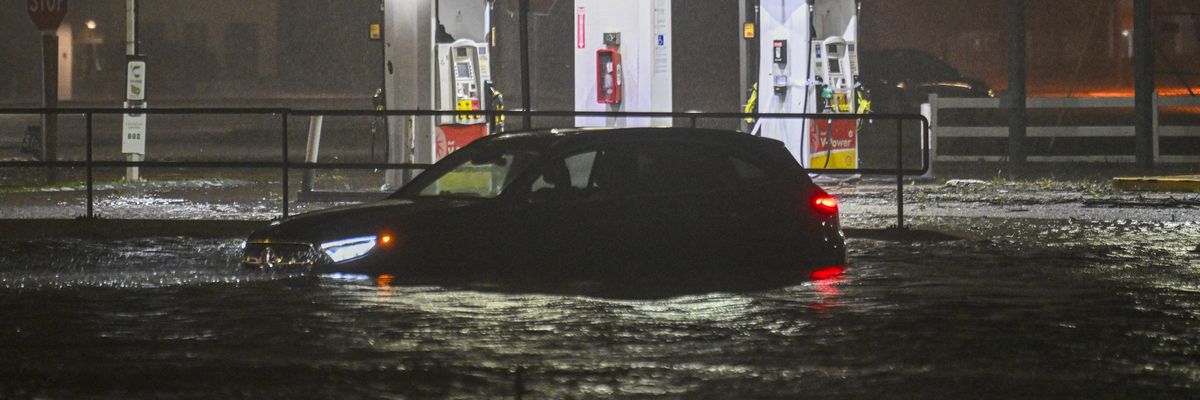
A vehicle is stranded on a water-flooded street after Hurricane Milton made landfall in Brandon, Florida on October 9, 2024. (Photo: Miguel J. Rodriguez Carrillo/AFP via Getty Images)
“If politicians had listened to scientists decades ago, and worked to gradually rein in fossil fuel pollution, the ocean wouldn’t be so boiling hot—and Hurricane Milton wouldn’t have had the fuel to balloon into such a monster storm.”
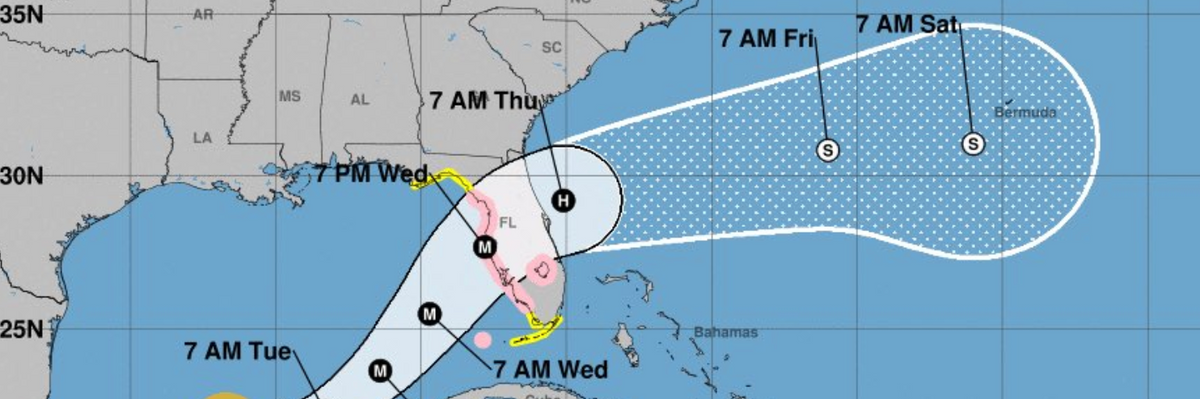
Hurricane Milton made landfall south of Tampa, Florida late Wednesday as a Category 3 storm after rapidly intensifying in the Gulf of Mexico, bringing devastating flooding and powerful winds that destroyed homes and knocked out power for millions.
Several tornadoes triggered by the monstrous storm—which was made stronger by ocean temperatures pushed higher by fossil fuel-driven climate change—killed an unspecified number of residents on Florida’s Atlantic Coast, according to local authorities.
The Associated Press reported that “about 125 homes were destroyed before the hurricane came ashore, many of them mobile homes in communities for senior citizens.”
More than a million Floridians were under evacuation orders as Milton barreled toward the state.
TORNADO IN WELLINGTON: Video a friend sent to me of a confirmed tornado moving through Wellington on Southern Blvd ahead of #HurricaneMilton.
While Milton was downgraded to a Category 2 storm shortly after making landfall and was tracking away from Florida’s East Coast Thursday morning, the National Weather Service warned that “life-threatening storm surge, extreme winds, and flooding rains will continue to occur.”
Video footage posted to social media provided a glimpse of the flooding in downtown Tampa:
Flash flooding in Downtown Tampa from Hurricane Milton 8-14 inches of rainfall pic.twitter.com/jZCaLer77z
Experts characterized Milton, which followed closely on the heels of Helene, as a historically powerful hurricane, pointing to its rapid transformation from a tropical storm into a Category 5 hurricane.
“Milton is the quickest storm on record to rapidly intensify into a Category 5 in the Gulf of Mexico,” according to CBS News meteorologist Nikki Nolan.
Storm surge home inundation Venice Bay, FL along the river from Hurricane Milton pic.twitter.com/ZHQijUbMrY
Ahead of Milton’s arrival in Florida, climate advocates and scientists pointed to the role of the fossil fuel industry and its political allies in misleading the public about the impacts of oil, gas, and coal emissions and obstructing action to confront the threat posed by warming temperatures.
“Things didn’t have to be this way,” Kathy Baughman McLeod, the CEO of Climate Resilience for All, wrote Wednesday. “If politicians had listened to scientists decades ago, and worked to gradually rein in fossil fuel pollution, the ocean wouldn’t be so boiling hot—and Hurricane Milton wouldn’t have had the fuel to balloon into such a monster storm.”
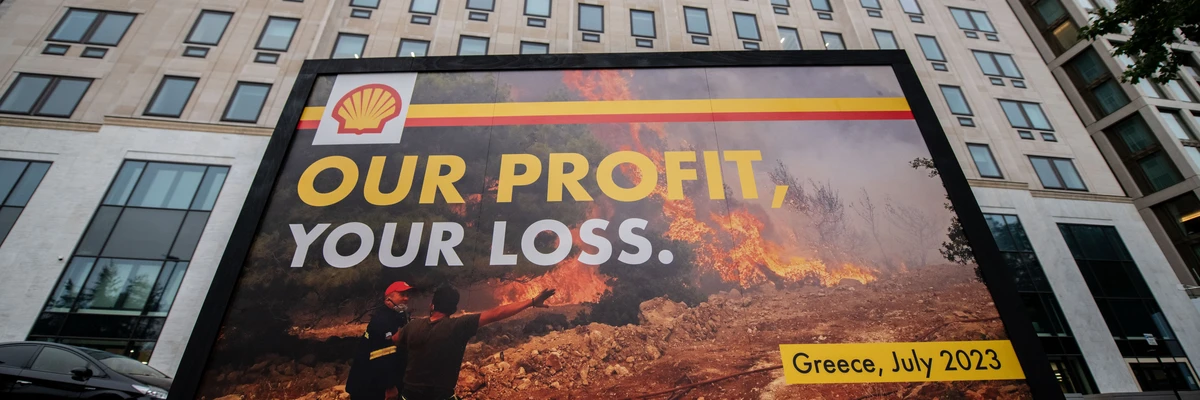
Greenpeace activists display a billboard during a protest outside Shell headquarters on July 27, 2023 in London. (Photo: Handout/Chris J. Ratcliffe for Greenpeace via Getty Images)
“The failure by our political class to deal with this completely solvable issue is staggering and shameful,” wrote one journalist.
As Hurricane Milton’s 145 mile-per-hour winds began closing in on Southwest Florida on Wednesday and people crowded into makeshift shelters across the state, climate advocates and other observers said the life-threatening storm and massive disruption to millions of people’s lives should make Americans “furious” at those who have helped make extreme weather more frequent and dangerous.
As Nathan J. Robinson wrote in Current Affairs, climate scientists and meteorologists have unequivocally told oil companies and policymakers that fossil fuel extraction is causing planetary heating, which has led to higher temperatures in oceans and bodies of water including the Gulf of Mexico, where the rapidly strengthening hurricane formed.
But despite the knowledge that fossil fuel giants like ExxonMobil and Shell had decades ago that drilling for oil and gas would cause “violent weather” and “potentially catastrophic events,” the industry’s profits have only grown as the U.S. has continued to subsidize their pollution-causing activities.
“The failure by our political class to deal with this completely solvable issue is staggering and shameful,” wrote Robinson. “Many of them have children and grandchildren. Presumably they would like their descendants to inherit a world worth living in. And they could make that happen. Unfortunately, it would require challenging the power and profits of some of America’s most influential corporations.”
In the Substack newsletter Heated, Arielle Samuelson explained on Wednesday how fossil fuel extraction and planetary heating “mutated” Hurricane Milton, which stunned weather experts this week as its wind speeds grew at a record-breaking pace, from 60 miles per hour to 180 miles per hour in just 36 hours.
It was the second time in recent weeks that a hurricane in the region has intensified quickly; areas that are expected to take a direct hit from Milton are still overwhelmed by the destruction left by Hurricane Helene.
Hot temperatures in the planets’ oceans and gulfs fuels hurricanes, and as Samuelson noted, scientists say the “extremely hot” Gulf of Mexico “was made far more likely by heat-trapping pollutants from the fossil fuel, agriculture, chemical, and cement industries.”
She continued:
In the past two weeks, ocean temperatures in the Gulf of Mexico were about 30-31° Celsius (86-88°F)—about 1 to 2° Celsius above average. The climate crisis made these extraordinarily high ocean temperatures at least 400 to 800 times more likely over the past two weeks, according to a rapid attribution study from Climate Central.
[…]
The science is also extremely clear that heat-trapping pollution causes sea-level rise and heavier rainfall, both of which make hurricanes more dangerous. Rainfall rates for tropical cyclones are expected to rise with the planet’s temperature, causing deadly flash floods like those found in Asheville, North Carolina. Sea level rise also means that coastal communities, and communities further inland, are more likely to be flooded during a storm.
That’s an objectively scary reality. But we know the primary source of greenhouse gas pollution, scientists note, so we also know how to slow the problem.
The lingering destruction of Helene and the impending landfall of Milton come, noted Fossil Fuel Media director Jamie Henn, weeks after three Democrats in Congress introduced legislation to require fossil fuel companies and oil refiners that do business in the U.S. to pay into a $1 trillion Polluters Pay Climate Fund, with their contributions based on a percentage of their global emissions.
The fund would be used to finance climate adaptation and other efforts to confront the impacts of the climate crisis.
There is a bill in Congress *right now* that would fund FEMA and resiliency efforts by making Big Oil pay for climate damages.
The Polluters Pay Climate Fund Act would provide at least $15 billion to FEMA to "address climate related disasters." https://t.co/cza3eiGZCn
In a press briefing on Wednesday, President Joe Biden noted how the damage done by Helene and the rapidly evolving news about Milton has left overwhelmed Americans vulnerable to misinformation, with some urging them to direct their anger at the White House or the Federal Emergency Management Agency (FEMA).
Republican presidential nominee Donald Trump has made baseless claims that FEMA funds were spent on funding for immigrant shelters, while U.S. Rep. Marjorie Taylor Greene (R-Ga.) wrote on social media that an unnamed “they” can control the weather and suggested the federal government is deliberately keeping emergency aid from people in states controlled by Republicans.
As fossil fuel firms and political leaders march “us toward the tipping points,” wrote Robinson, “many people won’t understand what is happening to them.”
“In a chaotic information environment filled with endless falsehoods, they’ll conclude that the president is manipulating the weather, or FEMA is trying to kill people,” he wrote. “The real story, however, is straightforward: We have a political class that is vastly more committed to sending weapons to war criminals than funding emergency management, and which will not acknowledge the basic facts of the problem (and the known solutions) because some large economic actors benefit in the short run from the destruction of the planet.”
“Truly, it’s revolting,” he added. “What an absolute disgrace our failure to deal with climate change is.”
Candice Fortin, U.S. campaigns manager for 350.org, said that fossil fuel executives and the politicians that support them have “blood on their hands” and called on Biden to unequivocally stand on the side of hurricane victims by declaring a climate emergency.
“This is a climate emergency,” said Fortin. “Every time we repeat that, countless more lives have been lost or upended by the fossil fuel industry. How many more times will it take? We call on President Biden to use his executive power to declare a climate emergency so we can finally protect frontline communities.”
At Newsweek, organizer and attorney Aaron Regunberg wrote that oil companies’ contributions to the climate emergency have been compounded by their vast efforts to spread misinformation and hide their knowledge that fossil fuel extraction was heating the planet.
Exxon CEO Darren Woods, he wrote, pushed for a surge in the company’s extractive activities while “overseeing a substantial portion of the company’s climate deception efforts,” and received $198.9 million for his “climate crimes” from 2015-23, as well as owning Exxon shares worth $371.1 million.
“Regular people are paying the ultimate price for this sociopathic greed,” wrote Regunberg. “The families made homeless, the wives and husbands and parents and children who lost loved ones to Helene—these victims deserve justice no less than victims of street-level crimes, and the companies and corporate executives responsible for their pain and suffering deserve criminal punishment at least as much as, if not far more than, the average street-level offender.”
“Climate victims have paid so much for Big Oil’s reckless conduct,” he added. “It’s time to make the polluters pay.”
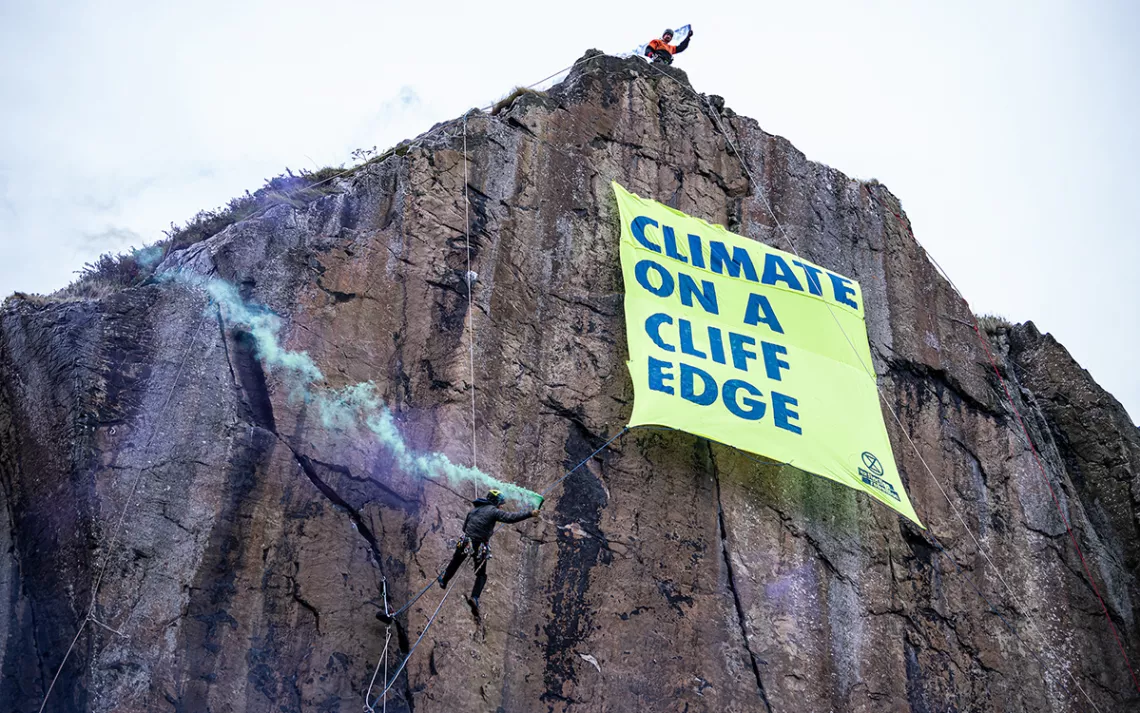
Experienced climbers scale a rock face near the historic Dumbarton castle in Glasgow, releasing a banner that reads “Climate on a Cliff Edge.” One activist, dressed as a globe, symbolically looms near the edge, while another plays the bagpipes on the shores below. | Photo courtesy of Extinction Rebellion and Mark Richards
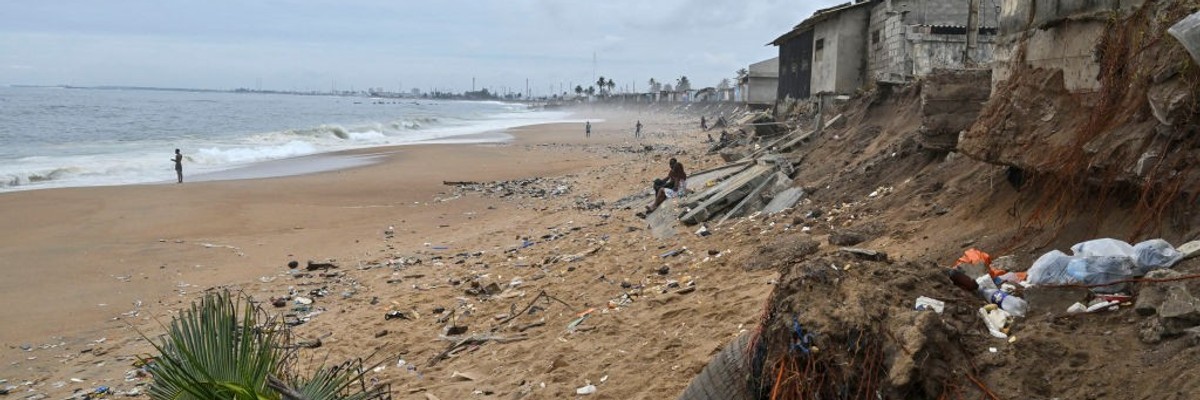
Houses destroyed by the rising sea level are shown at the Port-Bouet beach in Abidjan, Côte d’Ivoire on September 2, 2024. (Photo by Issouf Sanogo/AFP via Getty Images)
“Only by doing much more in this critical decade to bring emissions down and peak temperatures as low as possible, can we effectively limit damages.”
Just over a month away from the next United Nations climate summit, a study out Wednesday warns that heating the planet beyond a key temperature threshold of the Paris agreement—even temporarily—could cause “irreversible impacts.”
The 2015 agreement aims to limit global temperature rise this century to 1.5ºC, relative to preindustrial levels.
“For years, scientists and world leaders have pinned their hopes for the future on a hazy promise—that, even if temperatures soar far above global targets, the planet can eventually be cooled back down,” The Washington Postdetailed Wednesday. “This phenomenon, known as a temperature ‘overshoot,’ has been baked into most climate models and plans for the future.”
“The earlier we can get to net-zero, the lower peak warming will be, and the smaller the risks of irreversible impacts.”
As lead author Carl-Friedrich Schleussner said in a statement, “This paper does away with any notion that overshoot would deliver a similar climate outcome to a future in which we had done more, earlier, to ensure to limit peak warming to 1.5°C.”
“Only by doing much more in this critical decade to bring emissions down and peak temperatures as low as possible, can we effectively limit damages,” stressed Schleussner, an expert from Climate Analytics and the International Institute of Applied Systems Analysis who partnered with 29 other scientists for the study.
The paper, published in the peer-reviewed journal Nature, states that “for a range of climate impacts, there is no expectation of immediate reversibility after an overshoot. This includes changes in the deep ocean, marine biogeochemistry and species abundance, land-based biomes, carbon stocks, and crop yields, but also biodiversity on land. An overshoot will also increase the probability of triggering potential Earth system tipping elements.”
“Sea levels will continue to rise for centuries to millennia even if long-term temperatures decline,” the study adds, projecting that every 100 years of overshoot could lead seas to rise nearly 16 inches by 2300, on top of more than 31 inches without overshoot.
The scientists found that “a similar pattern emerges” for the thawing of permafrost—ground that is frozen for two or more years—and northern peatland warming, which would lead to the release of planet-heating carbon dioxide and methane. They wrote that “the effect of permafrost and peatland emissions on 2300 temperatures increases by 0.02ºC per 100 years of overshoot.”
A paper in @Nature raises concerns about the growing use and acceptance of climate overshoot scenarios, in which warming is allowed to temporarily increase past the Paris 1.5 °C limit. https://t.co/OYaLS2BZo9pic.twitter.com/IM2zR2UdVU
“To hedge and protect against high-risk outcomes, we identify the geophysical need for a preventive carbon dioxide removal capacity of several hundred gigatonnes,” the authors noted. “Yet, technical, economic, and sustainability considerations may limit the realization of carbon dioxide removal deployment at such scales. Therefore, we cannot be confident that temperature decline after overshoot is achievable within the timescales expected today. Only rapid near-term emission reductions are effective in reducing climate risks.”
In other words, as co-author and Climate Analytics research analyst Gaurav Ganti, put it, “there’s no way to rule out the need for large amounts of net negative emissions capabilities, so we really need to minimize our residual emissions.”
“We cannot squander carbon dioxide removal on offsetting emissions we have the ability to avoid,” Ganti added. “Our work reinforces the urgency of governments acting to reduce our emissions now, and not later down the line. The race to net-zero needs to be seen for what it is—a sprint.”
While the paper comes ahead of COP29, the U.N. conference in Azerbaijan next month, co-author Joeri Rogelj looked toward COP30, for which governments that have signed the Paris agreement will present their updated nationally determined contributions (NDCs) to meet the climate deal’s goals.
“Until we get to net-zero, warming will continue. The earlier we can get to net-zero, the lower peak warming will be, and the smaller the risks of irreversible impacts,” said Rogelj, a professor and director of research for the Grantham Institute at Imperial College London. “This underscores the importance of countries submitting ambitious new reduction pledges, or so-called ‘NDCs,’ well ahead of next year’s climate summit in Brazil.”
New study: “blowing past climate goals is more dangerous than it originally seemed”. My sense is that they are right. There are many tipping points in the climate system that might become irreversible except on very long timescales. https://t.co/8gHJpnlEaI
The U.N. said last November that countries’ current emissions plans would put the world on track for 2.9°C of warming by 2100, nearly double the Paris target. Since then, scientists have confirmed that 2023 was the hottest year in human history and warned that 2024 is expected to set a new record.
The study in Nature was published as Hurricane Milton—fueled by hot waters in the Gulf of Mexico—barreled toward Florida and just a day after another group of scientists wrote in BioScience that “we are on the brink of an irreversible climate disaster. This is a global emergency beyond any doubt. Much of the very fabric of life on Earth is imperiled.”
Those experts emphasized that “human-caused carbon dioxide emissions and other greenhouse gases are the primary drivers of climate change. As of 2022, global fossil fuel combustion and industrial processes account for approximately 90% of these emissions, whereas land-use change, primarily deforestation, accounts for approximately 10%.”
Experienced climbers scale a rock face near the historic Dumbarton castle in Glasgow, releasing a banner that reads “Climate on a Cliff Edge.” One activist, dressed as a globe, symbolically looms near the edge, while another plays the bagpipes on the shores below. | Photo courtesy of Extinction Rebellion and Mark Richards
The expected path of Hurricane Milton is seen in a graphic released on October 7, 2024.(Photo: National Hurricane Center)
“The Gulf of Mexico is so warm that the models couldn’t predict how strong Milton has gotten so quickly,” said the Sunrise Movement. “This is a climate emergency.”
“This is not normal,” said climate advocates Monday as they expressed the same shock as weather experts who were reporting on the rapid strengthening of Hurricane Milton, whose winds sped up to 175 miles per hour as Florida residents struggled to recover from last month’s devastating storm, Helene.
Milton was classified as a Category 5 hurricane Monday afternoon—just five hours after it had been designated a Category 2 storm with 100 mile-per-hour winds and 48 hours after it became a tropical storm churning eastward over the Gulf of Mexico.
The winds “explosively” intensified over a matter of hours, according to the National Hurricane Center.
As the hurricane gathered strength, weather analyst Colin McCarthy of U.S. Stormwatch said that “not a single weather model predicted the storm would strengthen this quickly.”
The storm was expected to make landfall on Florida’s Gulf Coast on Wednesday, and Republican Gov. Ron DeSantis—who vehemently denies scientists’ consensus that human-caused climate change is causing more extreme weather—called for widespread evacuations ahead of “life-threatening” hazards.
“If we knew exactly where it’s going to hit, we probably would evacuate fewer people,” DeSantis said Monday morning. “But we don’t know that.”
President Joe Biden declared an emergency in Florida Monday afternoon and ordered federal assistance to the state.
The New York Times reported that Milton could weaken before Wednesday as it makes its way through the Gulf, but that could be accompanied by a widening of the hurricane’s size, threatening a greater portion of the vulnerable state.
“The entire peninsula, the entire west coast, has potential to have major, major impact because of the storm surge,” said DeSantis on Sunday.
Milton is expected to be the second hurricane to hit Florida in two weeks, with parts of the state still reeling from the damage left by Helene.
DeSantis said Monday that emergency workers had picked up 180,000 cubic yards of debris across the state, and said, “There’s still a lot of it.”
The Tampa Bay area, where residents were warned by National Weather Service meteorologist Rick Davis on Monday that Milton could be “the worst hurricane in their lifetime,” was inundated last month with record-high storm surges.
Barrier islands were damaged by Helene, and the destruction of sand dunes has left the area especially exposed to hazards, Davis told The New York Times.
“Just after our latest hurricane, we are extremely vulnerable, especially to surge,” said Davis. “Our ground is extremely saturated from several hurricanes already this year, and we’re going to have river flooding. So people that may be 20 miles inland from the coast won’t get storm surge, but they could get rainfall flooding, river flooding, retention ponds could flood creeks.”
Climatologists have warned that warmer oceans and bodies of water including the Gulf of Mexico are likely to cause more intense hurricane seasons. The Gulf has reached an average surface temperature of nearly 90°F—the hottest it’s been since modern records have been kept, Brian McNoldy, a climate researcher at the University of Miami, toldVox in August.
“The Gulf of Mexico is so warm that the models couldn’t predict how strong Milton has gotten so quickly,” said national climate advocacy group Sunrise Movement.
The Gulf of Mexico is so warm that the models couldn't predict how strong Milton has gotten so quickly.
Officials called on residents to evacuate Monday rather than waiting for the hurricane to get closer to making its expected landfall. More than a dozen school districts in the state announced they were closing ahead of the storm.
But as pro-labor media group More Perfect Union reported, workers on Monday were already sharing stories online of how companies are planning to stay open until at least Tuesday night, making it impossible for people to obey evacuation orders.
One person working in retail management said that “after waiting all weekend to see if the corporate overlords would say we’re closed until further notice, I got notice today that we’re business as usual until Tuesday night… This gives me no time to evacuate or prepare accordingly.”
Hurricane Milton has grown at an astronomical rate into a Category 5 storm.
Workers are already sharing stories of bosses putting them in danger ahead of Milton's landfall.
Workers died during Hurricane Helene because they weren't given time to evacuate. This must stop. pic.twitter.com/HaI4u8LMca
Experienced climbers scale a rock face near the historic Dumbarton castle in Glasgow, releasing a banner that reads “Climate on a Cliff Edge.” One activist, dressed as a globe, symbolically looms near the edge, while another plays the bagpipes on the shores below. | Photo courtesy of Extinction Rebellion and Mark Richards
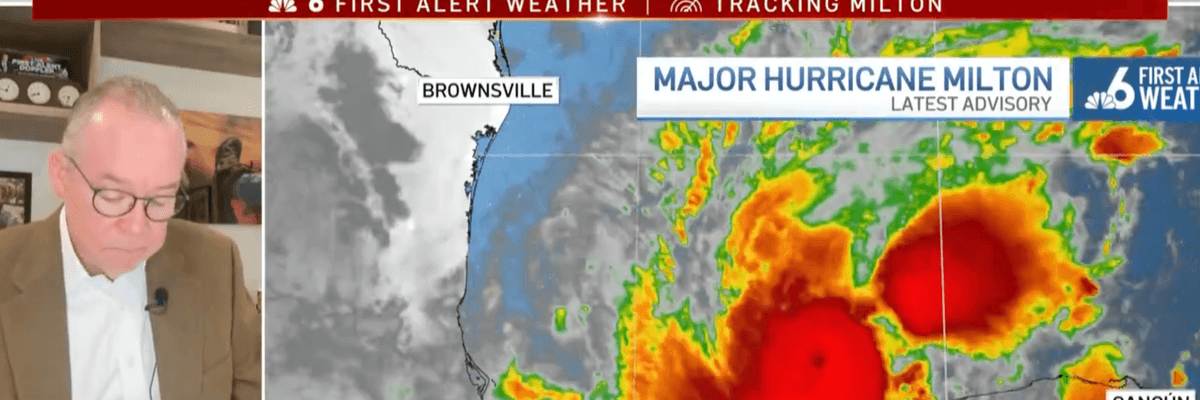
Florida meteorologist John Morales warns residents to evacuate and says the rapid intensifying of Hurricane Milton is due to the climate crisis and planetary heating in a news report on October 7, 2024. (Image: NBC6)
“The warming world has forcibly shifted my manner from calm concern to agitated dismay,” said John Morales. “Now I look at storms differently. And I communicate differently.”
As NBC6 hurricane specialist John Morales in Miami reported on the rapid drop in barometric pressure as Hurricane Milton gained strength in the Gulf of Mexico on Monday, the veteran meteorologist’s voice broke.
“It has dropped 50 millibars in 10 hours,” Morales said, becoming visibly emotional. “I apologize, this is just horrific.”
The storm is expected to make landfall on the west coast of Florida on Wednesday as the state struggles to recover from Hurricane Helene.
Morales spoke as the hurricane’s winds reached 160 miles per hour and climate experts noted that the Gulf of Mexico and Atlantic Ocean’s waters have been abnormally warm.
“The seas are just incredibly, incredibly hot, record hot, as you might imagine,” said Morales. “You know what’s driving that. I don’t need to tell you. Global warming, climate change [are] leading to this and becoming an increasing threat.”
Morales posted the clip on social media later, saying he “debated whether to share” the emotional moment in which he reported on what is likely to be further catastrophic damage to his home state as well as parts of Mexico.
“Frankly, you should be shaken too, and demand climate action now,” said Morales.
A week ago, the meteorologist wrote in the Bulletin of Atomic Scientists that Hurricane Helene, which killed more than 230 people across six states, was “a harbinger of the future.”
“For decades I had felt in control. Not in control of the weather, of course. But in control of the message that, if my audience was prepared and well informed, I could confidently guide them through any weather threat, and we’d all make it through safely,” wrote Morales. “Today as a result of so many compounding climate-driven factors, the warming world has forcibly shifted my manner from calm concern to agitated dismay. Now I look at storms differently. And I communicate differently.”
“No one can hide from the truth,” he added. “Extreme weather events, including hurricanes, are becoming more extreme. I must communicate the growing threats from the climate crisis come hell or high water—pun intended.”
Former U.S. Rep. Debbie Mucarsel-Powell (D-Fla.), who is running for Senate, was among those who applauded Morales’ frank assessment of the crisis facing his state and the country.
“I’ve never seen someone like John Morales get emotional about a storm before. He understands these systems better than most and it should be a warning for all of us to get ready now,” said Mucarsel-Powell. “We MUST have the courage to stand up to climate denialists and take action before it is too late.”
Experienced climbers scale a rock face near the historic Dumbarton castle in Glasgow, releasing a banner that reads “Climate on a Cliff Edge.” One activist, dressed as a globe, symbolically looms near the edge, while another plays the bagpipes on the shores below. | Photo courtesy of Extinction Rebellion and Mark Richards