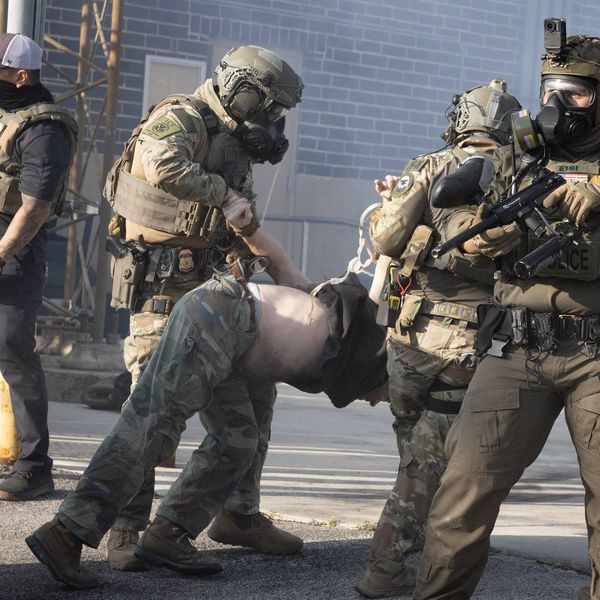
Tag: ice

  • ‘My business was invaded’: UK immigration raids without warrants rise to record high

    Spread the love

    Article by Emiliano Mellino repulished from TBIJ under Creative Commons Attribution-NonCommercial-NoDerivs 3.0 Unported License.

    In brief

    • The Home Office’s immigration team is carrying out more “enforcement visits” than ever, at an average of 60 a day
    • Yet only around a third of these operations, including raids on homes and businesses, resulted in an arrest
    • Warrants were only used in a quarter of raids, down from 40% a decade ago. Experts say this suggests they are fishing expeditions based on weak intelligence

    Customers were sitting down for dinner at Sultanz, an Indian restaurant in a quiet town by the Cornish coast, one Friday last month when two unmarked vans pulled up outside and around 20 immigration officers emerged.

    The town has seen barely any raids but Samsu Ali, the restaurant’s owner, says it felt like his business was being “invaded” that evening. He says: “As soon as they park … everyone runs to the kitchen, front door, back door, everywhere.”

    The officers, from the Home Office’s ICE (immigration, compliance and enforcement) team, had no warrant and entered the premises without explaining the terms of access, says Samsu. Once they were in, they asked every worker for their details, to be checked against a government database. Everyone’s records checked out apart from one: 40-year-old Nanu Mia, who had been packing meals for collection.

    Samsu Ali (right), the owner of Sultanz in Camborne, Cornwall and Nanu Mia (left), who was packing meals when ICE arrived in October. Photo: Maisie Marshall

    Remembering the incident, Nanu says he asked, in broken English, for a translator. Instead, he was offered Google Translate. He gestured with his hands, offering to write down his name, but was ignored.

    Suddenly, he was grabbed, cuffed and marched into a waiting van. Nanu suffers from asthma and when the panic set in, he struggled to breathe. He was in shock, unsure what was happening.

    Samsu knew there had been a mistake: Nanu is allowed to work in the UK as a dependant of his wife, a care worker. So he called Nanu’s sister, who rushed to the restaurant with his ID card.

    This time, when the officers ran his name through the system, his details came up. Nanu was released. But without Samsu’s last-minute intervention, things could have gone differently. In the weeks since, Nanu has developed a habit of looking out the window, worried the officers might return.

    Recommended Articles

    Raids like this are increasingly common in our high streets. The Home Office has said they are necessary to “restore order” to the immigration system. It posts videos showing migrants being detained, invites journalists on ride-alongs and boasts of arresting people in record numbers.

    At the start of the year, home secretary Shabana Mahmood said the government had “surged enforcement activity to the highest level in British history” ensuring “illegal migrants … have nowhere to hide”.

    However, we can reveal that the majority of people bearing the brunt of this crackdown have not breached any immigration laws – in fact, two-thirds of so-called “enforcement visits” resulted in no arrests last year. What’s more, they are increasingly being carried out without warrants, which are now used in just a quarter of raids compared to more than 40% a decade ago.

    Experts say this points to the Home Office carrying out “fishing expeditions” based on weak intelligence and hearsay. The upshot is wasted resources, disrupted businesses and traumatised individuals.

    “Thousands upon thousands of lives are impacted,” says Concepta Cassar, head of policy at Migrant Rights Network. She said she knows of businesses that have been targeted every few months even though nobody has been found to be doing anything wrong.

    The government’s objective isn’t simply to detain people, says Cassar, but to show it has control over an “invented political problem” that scapegoats migrants for societal issues it has failed to address.

    https://flo.uri.sh/visualisation/30773025/embed?auto=1

    Made with Flourish • Create a chart

    Mothin Ali, deputy leader of the Green party, said our findings were “alarming” and called for the government to “end these unjustified raids and protect people’s rights.”

    “People are being humiliated and whole communities terrorised …This is racist harassment dressed up as immigration enforcement,” he says.

    “The falling use of warrants is deeply concerning and raises serious questions about the legality of these operations. Businesses may be intimidated into letting officers in without realising they can refuse. Britain must not import Trump’s ICE playbook.”

    60 raids every day

    Between 2023 and 2025 the number of immigration “enforcement visits” rose by about 40%, to more than 23,500. That’s in excess of 60 per day. The figures include raids on workplaces and homes, as well spot checks in public places: streets, train stations, ports.

    Of the 23,500 carried out last year, more than 15,500 (66%) resulted in no arrests.

    In response to our investigation, the Home Office insisted that enforcement visits were “based on robust intelligence and risk assessments, compliant with policy”.

    While immigration raids are expected to continue to increase, operations by the UK’s ICE teams have received much less scrutiny than their US counterparts.

    To better understand how these operations are conducted and the impact they have on communities, we spoke to workers and businesses, filed freedom of information requests to the Home Office, and presented our findings to experts including a former immigration officer.

    Kevin Barker left the Home Office in 2015 after telling senior staff that the department’s officers were often entering people’s premises illegally. He now helps businesses overturn fines for allegedly employing people who do not have the right to work in the UK. He doesn’t condone people breaching this immigration law but he says the fines are often issued unfairly.

    Officers don’t have formal targets, he explains, but they are encouraged to clock up as many raids as possible and the evidence to justify them doesn’t need to be strong. As a result, many are based on tenuous tip-offs – a fact Barker says is reflected in the declining use of warrants.

    “You’re not allowed to apply for a search warrant if the intelligence you’ve got is old or an anonymous allegation that can’t be corroborated … but it doesn’t stop them from doing the visit,” he said.

    By the government’s own admission, this is a bad use of resources. A 2016 report from the independent chief inspector of borders and immigration (ICIBI) highlighted that about two-thirds of allegations in the Home Office’s management system had come from members of the public. It cited an earlier review stating that this was “not the most efficient way for [immigration enforcement] to direct its activity”.

    https://flo.uri.sh/visualisation/30818129/embed?auto=1

    Made with Flourish • Create a chart

    It’s not hard to see why. As Barker explains, anyone can send an anonymous tip-off – a disgruntled worker or a business competitor. Or just a member of the public who assumes a worker is illegal because of their poor English: “They think they’re doing the right thing, but actually they’re being a bit prejudicial.”

    Recent data we obtained, though, suggests this has only worsened. Last year, 89% of leads on “immigration crime” came from the public or from the Crimestoppers, a charity that collects anonymous tip-offs. Around 2% came from the police.

    The consequences for businesses can be devastating, as Sultanz’s owners have discovered.

    The restaurant was lauded in the local press during the pandemic for giving free food to hospitals and homeless shelters. But since the raid last month, it has seen a stark drop-off in customers, Samsu said.

    Samsu Ali, owner of Sultanz in Camborne, which has faced racist abuse following an immigration raid. Photo: Maisie Marshall

    In a local Facebook group, a question about the incident at the restaurant prompted a number of racist and threatening comments. One person wrote: “People with somewhat darker skin are literally taking over our community and causing a lot of unrest.”

    “Fucking migrants and illegals…All over Camborne and Redruth,” posted another person.

    Someone even wrote: “Attack before we’re attacked” followed by “make them unwelcome”.

    Nobody clarified that all of Sultanz’s staff had the legal right to work in the UK.

    The comments left Samsu struggling to sleep for days. “They don’t understand how much money I spent on this business,” he says. “How much time I have spent in the last six years. How much hard work I did.”

    Small but powerful, we’re taking on the fight for fairness every single day

    MonthlyAnnuallyOne-timeEmail addressPay

    You can cancel anytime

    ‘An element of coercion’

    If officers don’t have enough to secure a warrant, they can rely on other powers to enter the premises. If it’s a licensed shop or restaurant, they can use licensing powers. Or, in most cases – more than 12,000 last year – they can ask for the consent of the tenant, manager or owner.

    When using this power, officers are meant to inform the person of their rights, including the fact that they are free to revoke their consent at any time. But this doesn’t always happen. It didn’t at Sultanz. And as recently as 2024, government inspectors criticised immigration officers for entering premises without consent.

    “There’s an element of coercion here,” says Cassar of the Migrant Rights Network. She says people allow officers to enter their homes or businesses because they do not fully know their rights, that they can ask further questions or that they can question the power under which these raids are being done. In other cases, they might worry that their business could face even greater disruption if they resist.

    “So they’re left in that situation of powerlessness and of fear. And who protects you? Where do you report to? Because these people are the law.”

    In one instance after a business refused to consent to a search, officers found another way to get in. On 5 August this year officers arrived with no warrant to South Motorcycles, a garage in London. Staff refused to let them in, but officers went away, made a phone call and came back with an “assistant director” letter that granted them the power to enter.

    These letters are meant to be reserved for urgent cases where officers do not have time to apply for a warrant. They need to have a strong reason to believe that a specific person who is in breach of certain immigration laws is inside.

    But paperwork we’ve seen suggests the South Motorcycles operation was another fishing expedition. A section of a form handed to the business, which was then crossed out, said they were looking for “no named offenders”.

    Officers did detain two customers who were at the garage and then released them on bail, but did not find anyone working there in breach of immigration law.

    People don’t realise that we have ICE… it’s here

    Concepta Cassar, head of policy at Migrant Rights Network

    Barker told us that, in the case of South Motorcycles, officers had likely entered unlawfully.

    There is a long history of officers misusing this power. In 2014, the ICIBI found officers had used these letters unlawfully to bypass the need for a warrant. Their use was justified in less than a third of cases examined.

    “You’re used to walking into premises and saying… ‘Let us in’. And then all of a sudden somebody challenges you,” Barker said. “Then you’re like, ‘Right, I’ll show you. Let me get my [assistant director] on the phone.’”

    ‘ICE is here’

    While most people might not know what their rights are when ICE officers turn up at their door, anti-raids groups in many cities across the UK are trying to change that, said Griff Ferris, a spokesperson for the Joint Council for the Welfare of Immigrants.

    These groups will often hold workshops or provide information to residents about their rights. They can also go further by filming raids, questioning officers or trying to stop arrests.

    “Every day people are resisting raids in their communities,” Ferris said.

    In recent years residents in London and Glasgow have stopped immigration raids by blocking vans in which people had been detained for several hours. On one occasion protesters blocked a coach that was intended to carry asylum seekers to the controversial Bibby Stockholm barge, where conditions were so poor one resident died by suicide.

    Protesters sit along the road in south London over the planned transfer of asylum seekers to the Bibby Stockholm barge in DorsetThabo Jaiyesimi / SOPA Images / LightRocket via Getty

    Several councils have said they will refuse to hand over data to the Home Office if it will be used for immigration enforcement, and pledged to support residents or businesses affected by raids.

    Meanwhile, both the Conservatives and Reform have floated policies that they say will increase the number of arrests and deportations.

    Reform’s include paying people who make anonymous tips-offs that result in companies getting fined. The Conservatives want to adopt some of the methods used by ICE in the US, where agents have been accused of warrantless arrests, kidnapping and unlawful killings.

    In a debate earlier this year, the Liberal Democrat home affairs spokesperson Max Wilkinson asked Labour’s Mahmood to condemn ICE and to rule out “ICE squads in the streets of Britain”.

    Mahmood dodged the question, saying the UK government had managed to deport record numbers of people without arming officers, as is the case in the US.

    But Cassar said there are already stark parallels: much like its counterpart, the UK’s ICE targets minority and migrant communities with little accountability.

    “They’re not a militarised force yet but we have the same need for community defence and the need to look out for each other,” she said .“People don’t realise that we have ICE. They’re like ‘ICE is coming to the UK’. No, it’s here.”

    If you have faced or witnessed an immigration enforcement operation you think was handled unfairly or unlawfully, please get in touch with our reporter emilianomellino@tbij.com

    This story was updated on Tuesday 10 November 2026 to include a response from the Home Office.

    Reporter: Emiliano Mellino
    Bureau
    Local editor: Gareth Davies
    Editor: Franz Wild
    Production editor: Alex Hess
    Fact checker: Lydia Morrish

    TBIJ has a number of funders, a full list of which can be found here. None of our funders have any influence over editorial decisions or output.

    Article by Emiliano Mellino repulished from TBIJ under Creative Commons Attribution-NonCommercial-NoDerivs 3.0 Unported License.

  • Arctic sea ice decline seemed to be slowing – until two record‑breaking low‑ice winters

    Spread the love
    Arctic sea ice from above
    Hector John Periquin / unsplash, CC BY-SA

    Duo Chan, University of Southampton and Alessandro Silvano, University of Southampton

    Arctic sea ice appeared to be entering a new phase. In the early 2020s, the rapid decline seen over previous decades seemed to ease, leading scientists to ask whether winter sea ice loss had slowed.

    Our new study suggests that conclusion was premature. After two exceptionally low-ice winters in 2025 and 2026, the recent slowdown disappears. The almost 6% drop between 2024 and 2025 was the largest single-year decline on record. The latest observations restore a statistically significant downward trend, showing how a few unusual years can quickly change the overall picture.

    Sea ice is a crucial indicator of climate change in the Arctic. As the planet warms, the Arctic is warming even faster, and satellite observations have shown that sea ice has declined in every month of the year since the late 1970s. The loss is largest at the end of summer, when the Arctic reaches its annual minimum ice cover, but winter sea ice has also been shrinking.

    sea ice
    Arctic Sea Ice near Greenland. Isabelle White, University of Southampton

    However, this decline has not been smooth. In the early 2020s, Arctic sea ice loss appeared to slow across much of the year. This did not mean the ice had recovered to what it was before modern global warming. But compared with the rapid losses seen in earlier decades, the trends seemed weaker, raising an important question: had Arctic sea ice decline begun to slow?

    Exceptional winters

    Our study examines why these two winters changed things. Until 2024, the recent 20-year decline in winter sea ice extent was not statistically significant – meaning the data is consistent with no decline over the past 20 years.

    The record low of ice in 2025, followed by another near-record low in 2026, should rewrite the overall narrative. Using the February–March average, which we use to represent winter sea ice extent, 2025 recorded the largest single-year decline in the satellite record.

    Including these latest observations changes the picture of a weakened decline. Once the 2025 and 2026 winters are included, the 20-year trend in Arctic winter sea ice extent returns to a statistically significant decline. We can now be much more confident that the trend is real, and the decline is still ongoing.

    How Arctic winter sea ice extent has changed since 1980:

    A fall of nearly 6% in one year also raises an obvious question: can Arctic winter sea ice really drop this quickly under current climate conditions? To answer this question, we examined climate model simulations of Arctic climates warmed by a similar amount to today, and asked whether they ever produce a one-year winter sea ice drop as large as the one seen in 2025.

    They do, although only rarely.

    In simulations where the Arctic has warmed by a similar amount to today, about 3°C since 1980, a one-year winter sea ice drop of this size occurs in roughly one out of every 100 simulated years. This suggests that the 2025 drop was unusual, but still physically plausible. It does not require a new explanation. Instead, it is consistent with a warming Arctic in which year-to-year variability can produce abrupt changes. From one winter to the next, the extent of sea ice can decline sharply, remain stable, or even increase.

    So what should we expect in the coming years?

    If warming continues, the same model simulations suggest that winter sea ice is unlikely to rebound to the higher levels seen in the early 2020s. This does not mean every coming winter will set a new record low. Arctic sea ice will continue to fluctuate from year to year. But under continued warming, these recent low-ice winters may mark a shift towards winter ice fluctuating around a lower average level.

    The lesson, at least for winter, is that Arctic sea ice loss has not stopped. The apparent slowdown of the early 2020s looked real at the time, but now looks more like a pause than a lasting change. Short-term variability can temporarily mask decline, but it does not remove the underlying pressure from Arctic warming.

    The open question is whether the same pattern will emerge in summer, which has also shown a recent slowdown in sea ice retreat. So far, the renewed winter decline has not yet translated into an equally clear renewed decline in summer.

    Winter and summer sea ice are connected. Low winter ice may help precondition the ice cover for stronger spring and summer melt. But the connection is not automatic: Arctic sea ice does not simply move in the same direction, in every season, at the same time. Spring weather, clouds, snow cover, winds, ocean heat and ice thickness all affect how much ice survives to the summer minimum.

    Understanding how these factors evolve in a changing climate will be crucial for answering whether, and when, summer sea ice decline re-emerges from its recent slowdown.

    Duo Chan, Lecturer in Climate Sciences, University of Southampton and Alessandro Silvano, NERC Independent Research Fellow in Oceanography, University of Southampton

    This article is republished from The Conversation under a Creative Commons license. Read the original article.

  • How Venezuela poses an “unusual and extraordinary threat” to the US agenda

    Spread the love

    Original article by Celina della Croce republished from peoples dispatch under a Creative Commons Attribution-ShareAlike 4.0 (CC BY-SA) license.

    Las abuelas del Panal (The Grandmothers of the Panal, a commune in Caracas) dance as part of their regular exercise class. Photo: Celina della Croce

    Unlike social democratic projects in the West, Venezuela’s Bolivarian Revolution has set out to fundamentally transform society and build a socialist project rooted in class struggle and run by its people.

    Lee en español aquí

    US President Donald Trump has not shied away from admitting his thirst for Venezuelan oil. On December 16, 2025, in the leadup to the January 3 bombing of Caracas and kidnapping of the country’s president and first lady, Nicolás Maduro and Cilia Flores, he claimed ownership over Venezuela resources, stating that “America will not … allow a hostile regime to take our Oil, Land, or any other Assets, all of which must be returned to the United States, IMMEDIATELY”. In his previous administration, he echoed the same obsession with resource-driven regime change, decrying in June 2023 that “When I left [office], Venezuela was ready to collapse. We would have taken it over. We would have gotten all that oil. It would have been right next door.” Yet Venezuela is not only home to the world’s largest known oil reserve, but also the continent’s largest gold reserves and an ample supply of bauxite, diamonds, iron ore, nickel, and coal … And, not least of all, hope.

    Trouble at home

    Within his own borders, Trump faces heightened civil unrest, with over 100,000 people in Minneapolis alone taking to the streets (roughly a quarter of the city’s population) during a January 23 general strike (an action that has not been seen on this scale for decades) and again during a January 30 nationwide shutdown. Similar uprisings have spread across the country, from Los Angeles to New York, following ICE’s murder of Renée Good and Alex Pretti. This massive outpouring follows a year of discontent and marches decrying Trump’s anti-immigrant, anti-poor policies.

    The escalation of ICE’s tactics under the Trump administration has cost US taxpayers, reaching an all-time high of 85 billion USD in allocated funds (compared to annual spending that has hovered around 10 billion USD or less for the past decade). Much of these funds go to benefit private corporations: for instance, 86% of detainees are held in private, for-profit prisons (whose stocks skyrocketed as a result of Trump’s election and subsequent policies), and the cost of deportation flights, also run by private companies, is astronomically higher than commercial flights (the per-person cost of a deportation flight from El Paso to Guatemala, for example, is USD 4,675—five times higher than a commercial first-class ticket for the same route). At the same time, Trump’s administration has slashed social spending, with a 186-billion USD reduction to Supplemental Nutrition Assistance Program (SNAP) benefits alone (a program that, up to that point, helped 1 in 8 people in the US with the basic provision of food).

    In the United States, and the West in general, there is a deep-seated narrative that this is just the way things are. Perhaps we can tone back the violence – swap out a Donald Trump for a Joe Biden who is more cautious with his tactics and open to mild concessions but no less interested in protecting capitalist profits at all costs. Even key figures in Trump’s own party, from Senators Josh Hawley (R-MO) and Todd Young (R-IN) to Trump’s former Vice President Mike Pence, have sought to distance themselves from his extreme tactics and distaste for liberal democracy (a general audacity that risks backfiring lest it create sufficient dissent and turmoil to provoke a mass uprising and turn to the left). Yet neither party is willing to allow anything further than a meek liberal democracy beholden to the interest of a small but powerful elite, at most with enough provisions to keep the general population at bay.

    Venezuela’s break with the end of history

    The US population, like much of the world, has been told, time and time again, that History has ended. We may be able to eke out higher wages, and certainly demand that the heightened assault on liberal democracy through ICE and the openly fascistic declarations by Donald Trump be brought under control, but anything beyond that is painted as impractical at best, and perilous at worst. Just look at the Soviet Union, we are told – it just doesn’t work. Socialism sounds nice, but look at the suffering in Venezuela and Cuba. You don’t want that, do you?

    Yet this way of understanding the past, present, and future not only seeks to protect the interests of capital, tricking many working-class people into betraying their own interests, but is wildly inaccurate through both omission and outright lies. And it seeks to cover up another extraordinary resource that Venezuela represents: a living example of hope, of unmovable dignity, of the success of a revolution that has not only brought a population out of extreme poverty but has lifted up its confidence and consciousness. In a country under extreme siege by more than 1,000 US-led unilateral coercive measures, there are nonetheless a fraction of the amount of homeless people in the US (where there are roughly 28 vacant homes to every 1 homeless person).

    At the height of the crisis in Venezuela, as Trump ramped up his maximum pressure campaign, 40,000 Venezuelans died in a single year (2017-2018) due to the lack of medicines and healthcare that had previously been provided freely to the population. Even then, the vast majority of Venezuelans have continued to fight to defend not only their right to self-determination, but also to revolution and transformation. What exactly are the Venezuelan people fighting for that the US government tries so hard to cover up? What is the source of resiliency and loyalty to the Bolivarian Revolution, despite the tremendous human cost of US-led efforts to overthrow it? And, what is the “unusual and extraordinary threat” that Venezuela poses to the US – as then President Barack Obama decreed in a 2015 executive order that paved the way for the economic siege?

    The Venezuelan “threat”

    When President Hugo Chávez came to power in 1999, a revolutionary process began that would set out to repay the “social debt” owed to the Venezuelan people, beginning by dedicating 75% of national spending to social investment – funds, importantly, generated by the country’s historically predominant oil sector. Through missions that began the year Chávez was elected, the country elevated its population out of poverty and illiteracy, reaching a 100% literacy rate, with more than three million people learning how to read and write (Mission Robinson); training 6,000 professionals in universities and graduating one million high school students (Mission Sucre); granting nearly 5 million homes to families across the country (Mission Vivienda); building health clinics in 320 of Venezuela’s 355 municipalities (Mission Barrio Adentro); and restoring the eyesight of some 300,000 Venezuelans while providing eye surgery to 1 million (Mission Milagro).

    President Nicolás Maduro has continued this legacy, despite the duress imposed by the US-led unilateral coercive measures imposed in the years following Chávez’s death, ensuring not only that the country’s resources benefit the well-being of the majority, but also that power is given back to the people through a model of direct democracy. Weeks before he was kidnapped, for instance, Maduro convened the Constitutional Congress of the Working Class, the culmination of 22,110 assemblies in workplaces across the country in which delegates debated and made proposals to the president about the future of the country’s labor sector and productive processes, such as strengthening domestic production of machinery components in order to reduce external technological dependency. Aprobada (“approved”), Maduro told delegate María Alejandra Grimán Rondón as she presented him with the conclusions of the congress in front of a packed auditorium; for another proposal, “the method still needs to be refined”, he replied, outlining next steps for further debate. Furthermore, communes (grassroots organizations at the heart of Venezuela’s direct democracy through which communities exercise self-governance) have engaged in quarterly national consults since 2024, with millions voting on the allocation of government funding for thousands of projects that most need attention in their communities, from updating medical equipment in their local health clinics to investing in water filtration supplies to ensure access to potable water.

    Read more: One month after the attack on Venezuela: the resurgence of imperialist “diplomacy”

    Both of these processes are part of a model of direct democracy that, in the 27 years of the Bolivarian Revolution, has held 31 elections, carried out constitutional reform, and created structures for everyday people to make direct decisions about the path of the country. In short, while the accomplishments of the revolution are far too numerous to list here, at their core is a people who have reclaimed their dignity, taken control of their future, and made the irreversible decision to stand upright.

     Fruto Vivas Recycling School, Venezuela
    Members of the Fruto Vivas Recycling School (Escuela de Reciclaje Fruto Vivas) in Barcelona, Anzoátegui, assemble a playground with materials they produced from recycled plastic. Members of the school collect the plastic, sort it, melt it, and then mold it into the pieces required to build a given product based on the needs of the community as well as other paid contracts which generate funds to continue the school’s work. Photo: Celina della Croce

    Unlike social democratic projects in the West, Venezuela’s Bolivarian Revolution has set out to fundamentally transform society and build a socialist project rooted in class struggle and run by its people. That means that the social advances are also tied to a process of raising consciousness among the population, whereby people become the protagonists of their own struggle in a process that ultimately seeks to give them the power and tools to run the country, replacing the bourgeois state with a communal one. In this system, decisions are made by the population which is organized into communes and various social and political movements across the country. Through these processes, people learn how to run productive processes, from coffee to construction materials, and be effective owners of their own means of production; how to engage in popular decision-making processes across thousands of households; run communications teams; carry out education programs; identify, prioritize, and fix issues in their communities; and other elements that are necessary for a productive society that prioritizes the well-being of its people. All of this is done in line with core principals such as protecting the planet (with some communes collecting recyclable plastics and turning them into playgrounds, benches and chairs for the elderly and schoolchildren, and other needs expressed by the community) and centering the leadership and rights of women and marginalized sectors.

    What does the future hold for the nobodies?

    This dynamic process is a continuation of the path set out by Chávez, one that called upon the “nobodies” to be the makers of their own destiny. These “nobodies” (today the protagonists of one of the world’s most resilient and equitable democracies) have shown, time and time again, that they will not sacrifice their dignity nor sovereignty at any cost, no matter how severe the threat. This example is no less valuable a resource than the country’s oil, nor any less of a threat to the Trump regime and US agenda at large. The example set by the Bolivarian Revolution and its people creates a fissure in the narrative that the US (and the world) population must make the best of what we have, go to work every day with our heads down and spirits crushed, and forfeit our dreams of a better world. It opens a window for the nobodies of the world (and especially of the US) to see that on the other side of events like the mass uprisings sweeping the country, they, too, could live in a society where the wealth that they themselves generate is reinvested into the common good rather than paying for bombs and lining the pockets of the few.

    Read more: Venezuela and Iran: oil and survival

    Celina della Croce is a writer, editor, and the publications director of Tricontinental: Institute for Social Research. She has been an organizer and leader in internationalist, anti-imperialist, and working-class struggles in the United States for over a decade.

    This article was produced by Globetrotter.

    Original article by Celina della Croce republished from peoples dispatch under a Creative Commons Attribution-ShareAlike 4.0 (CC BY-SA) license.

    Donald Fuhrump says that Amerikkka doesn't bother with crimes or charges anymore, not being 100% Amerikkkan and opposing his real estate intentions is enough.
    Donald Fuhrump says that Amerikkka doesn’t bother with crimes or charges anymore, not being 100% Amerikkkan and opposing his real estate intentions is enough.
    Elon Musk urges you to be a Fascist like him, says that you can ignore facts and reality then.
    Elon Musk urges you to be a Fascist like him, says that you can ignore facts and reality then.
  • Protests mushroom as ‘drawdown’ of attacks fails to materialize

    Spread the love

    Original article by John Wojcik republished from People’s World under http://creativecommons.org/licenses/by-nc-nd/3.0/us/

    People gather for a protest against ICE outside the Bishop Henry Whipple Federal Building, Friday, Jan. 30, 2026, in Minneapolis.| Adam Gray/AP

    MINNEAPOLIS—Determination to resist the continuing assault on democracy by the Trump administration is reflected in demonstrations breaking out here and from coast to coast. There are boycotts being organized by teachers and students in schools, customers at shopping plazas, and workers on the job in Minnesota by people angry about the administration’s backing off on claims that it was going to draw down its attacks on immigrants and their supporters.

    Early in the morning on Jan. 30, people were already gathering at the Federal Building.

    The repression was intensified Thursday with the arrest and jailing of journalists covering the protests. The assault on freedom of the press involved the arrest and jailing of Don Lemon, a longtime CNN anchor, as he covered a protest by dozens of anti-ICE demonstrators in a church in St. Paul, Minn. The pastor of that church admits having worked with ICE.

    One of the major charges against Lemon, according to a DHS spokesman, is that he obstructed the right of people to worship as they please. His lawyers note he was covering, not participating in the protests.

    Independent journalist Georgia Fort, who was filming the protest, was also arrested. According to the NewsGuild, she was seized at her home at 9 a.m. Friday morning, and at press time, the union had not received any additional information. Fort is a member of the National Association of Black Journalists (NABJ), as is Lemon. A NABJ spokesperson said they would forward any additional statements to People’s World as soon as they become available.

    Caroline Hendrie, Executive Director of the Society of Professional Journalists (SPJ), told People’s World, regarding the arrest of Lemon: “The arrest was outrageous; all Lemon was doing was his job, covering a preacher who has been exposed as an ICE informant.”

    Jon Schleuss, president of the NewsGuild, told People’s World: “It’s absolutely outrageous for any administration, especially the Trump administration, to arrest any journalist. Sadly, this administration has made it their priority by arresting and shooting journalists with rubber bullets. It’s awful.”

    Attorney General Pam Bondi announced that she personally ordered the arrests. Since the pastor is working with ICE, it is expected that the Department of Justice will come up with a plethora of false charges against the journalists, including that they violated free speech and freedom of religion.  

    CNN, where Lemon worked until 2023, came out in his defense. “The FBI’s arrest of our former CNN colleague Don Lemon raises profoundly concerning questions about press freedom and the First Amendment,” the network said.

    “The Department of Justice already failed twice to get an arrest warrant for Don and several other journalists in Minnesota, where a chief judge of the Minnesota Federal District Court found there was ‘no evidence’ that there was any criminal behavior involved in their work.

    “The First Amendment in the United States protects journalists who bear witness to news and events as they unfold, ensuring they can report freely in the public interest, and the DOJ’s attempts to violate those rights is unacceptable. We will be following this case closely.”

    The DOJ is claiming that Lemon tried to deprive worshippers in the church led by a pro-ICE pastor of their right to worship as they please. “If you interfere with the right of people to worship as they please, we are coming for you,” Bondi said Friday morning.

    If these were normal times, it’s the type of claim that most courts, like the court that rejected earlier charges against Lemon, would dismiss. Nevertheless, the arrests, if nothing else, are designed to intimidate the press, along with anyone else who in any way challenges what the administration is doing.

    The arrests and jailing of the journalists add to the growing list of people the Trump administration is investigating. The list includes the wife of Renee Good, killed by ICE agents in Minneapolis; Alex Pretti, who was killed there; and a variety of lawmakers, including the governor of Minnesota and the mayor of Minneapolis. Missing from the list of people investigated are the ICE agents who have shot and killed people.

    Trump’s hand-picked judges are making it easier for the Department of Justice and the rest of his administration to continue and intensify their attacks on immigrants and their supporters, including now the arrests of journalists.

    They step in almost every time that the original trial level judges hearing cases issue rulings that restrain Trump’s out-of-control agents, including ICE and the FBI. As soon as the cases reach a Trump-appointed higher-level judge, the lower rulings are overturned.

    There was a recent positive ruling by a trial judge that put restrictions on how agents can respond to people protesting Operation Metro Surge in Minnesota. Had those restrictions been followed in Minneapolis, Pretti would not have been killed.

    The administration has since scored a victory when a three-judge federal panel indefinitely paused those restrictions. Trump says he has unlimited, unreviewable authority when it comes to matters of immigration.

    As part of the administration’s move to defuse anger over their immigration policies, DHS Secretary Kritsi Noem seemed to modify her initial remarks on the killing of Pretti, saying that her statements were based on “the best information we had at the time.”

    Shortly afterward, however, Trump went back to his hard line and, on a social media post, said Pretti was a “professional agitator, perhaps an insurrectionist.”

    Original article by John Wojcik republished from People’s World under http://creativecommons.org/licenses/by-nc-nd/3.0/us/

    Donald Fuhrump says that Amerikkka doesn't bother with crimes or charges anymore, not being 100% Amerikkkan and opposing his real estate intentions is enough.
    Donald Fuhrump says that Amerikkka doesn’t bother with crimes or charges anymore, not being 100% Amerikkkan and opposing his real estate intentions is enough.
    Elon Musk urges you to be a Fascist like him, says that you can ignore facts and reality then.
    Elon Musk urges you to be a Fascist like him, says that you can ignore facts and reality then.
    Orcas discuss how Trump was re-elected and him being an obviously insane, xenophobic Fascist.
    Orcas discuss how Trump was re-elected and him being an obviously insane, xenophobic Fascist.

  • A ‘Terrifying Line Is Being Crossed,’ Warns Minneapolis Mayor as More ICE Horror Stories Emerge

    Spread the love

    Original article by Brad Reed republished from Common Dreams under Creative Commons (CC BY-NC-ND 3.0).

    Demonstrators march through downtown in protest of ICE operations in Minneapolis, Minnesota, US, on January 30, 2026.
     (Photo by Madison Thorn/Anadolu via Getty Images)

    In an interview with the New York Times, Minneapolis Mayor Jacob Frey described “marauding gangs of guys just walking down the street indiscriminately picking people up.”

    Minneapolis Mayor Jacob Frey is warning that the Trump administration has crossed a “terrifying line” with its use of federal immigration enforcement agents to brutalize and abduct people in his city.

    In an interview with the New York Times published Saturday, Frey described operations that have taken place in his city as “marauding gangs of guys just walking down the street indiscriminately picking people up,” likening it to a military “invasion.”

    RECOMMENDED…

    Protesters Denounce ICE Outside Chicago-Area Facility

    ‘Reign of Terror’: ICE Builds Appalling Record of Killings, Beatings, Kidnappings, and More

    Tensions intensify during an anti-ICE protest

    ‘Get ICE Out!’ Protests Intensify After Another Shooting by Federal Agent in Minneapolis

    During the interview, Frey was asked what he made of Attorney General Pam Bondi’s recent offer to withdraw immigration enforcement forces from his city if Minnesota handed over its voter registration records to the federal government.

    “That is wildly unconstitutional,” Frey replied. “We should all be standing up and saying that’s not OK. Literally, listen to what they’re saying. Active threats like, Turn over the voter rolls or else, or we will continue to do what we’re doing. That’s something you can do in America now.”

    Frey was also asked about Minnesota Gov. Tim Walz’s comments from earlier in the week where he likened the administration’s invasion of Minneapolis to the first battle that took place during the US Civil War in Fort Sumter.

    “I don’t think he’s saying that the Civil War is going to happen,” said Frey. “I think what he’s saying is that a significant and terrifying line is being crossed. And I would agree with that.”

    As Frey issued warnings about the federal government’s actions in Minneapolis, more horror stories have emerged involving US Immigration and Customs Enforcement (ICE) agents in Minnesota.

    The Associated Press reported on Saturday that staff at the Hennepin County Medical Center in Minneapolis have been raising red flags over ICE agents’ claims about Alberto Castañeda Mondragón, a Mexican immigrant whom they treated after he suffered a shattered skull earlier this month.

    ICE agents who brought Castañeda Mondragón to the hospital told staffers that he had injured himself after he “purposefully ran headfirst into a brick wall” while trying to escape their custody.

    Nurses who treated Castañeda Mondragón, however, said that there is no way that running headfirst into a wall could produce the sheer number of skull fractures he suffered, let alone the internal bleeding found throughout his brain.

    “It was laughable, if there was something to laugh about,” one nurse at the hospital told the Associated Press. “There was no way this person ran headfirst into a wall.”

    According to a Saturday report in the New York Times, concern over ICE’s brutality has grown to such an extent that many Minnesota residents, including both documented immigrants and US citizens, have started wearing passports around their necks to avoid being potentially targeted.

    Joua Tsu Thao, a 75-year-old US citizen who came to the country after aiding the American military during the Vietnam War, said the aggressive actions of immigration officers have left him with little choice but to display his passport whenever he walks outside his house.

    “We need to be ready before they point a gun to us,” Thao explained to the Times.

    CNN on Friday reported that ICE has been rounding up refugees living in Minnesota who were allowed to enter the US after undergoing “a rigorous, years-long vetting process,” and sending them to a facility in Texas where they are being prepared for deportation.

    Lawyers representing the abducted refugees told CNN that their clients have been “forced to recount painful asylum claims with limited or no contact with family members or attorneys.”

    Some of the refugees taken to Texas have been released from custody. But instead of being flown back home, they were released in Texas “without money, identification, or phones,” CNN reported.

    Laurie Ball Cooper, vice president for US legal programs at the International Refugee Assistance Project, told CNN that government agents abducting refugees who had previously been allowed into the US is part of “a campaign of terror” that “is designed to scare people.”

    Original article by Brad Reed republished from Common Dreams under Creative Commons (CC BY-NC-ND 3.0).

    Elon Musk urges you to be a Fascist like him, says that you can ignore facts and reality then.
    Elon Musk urges you to be a Fascist like him, says that you can ignore facts and reality then.
    Donald Fuhrump says that Amerikkka doesn't bother with crimes or charges anymore, not being 100% Amerikkkan and opposing his real estate intentions is enough.
    Donald Fuhrump says that Amerikkka doesn’t bother with crimes or charges anymore, not being 100% Amerikkkan and opposing his real estate intentions is enough.
    Orcas discuss how Trump was re-elected and him being an obviously insane, xenophobic Fascist.
    Orcas discuss how Trump was re-elected and him being an obviously insane, xenophobic Fascist.