Sevim Dağdelen: the double standards of the West are on full display at the ICJ

Spread the love

Original article by Sevim Dağdelen republished from peoples dispatch under a Creative Commons Attribution-ShareAlike 4.0 (CC BY-SA) license.
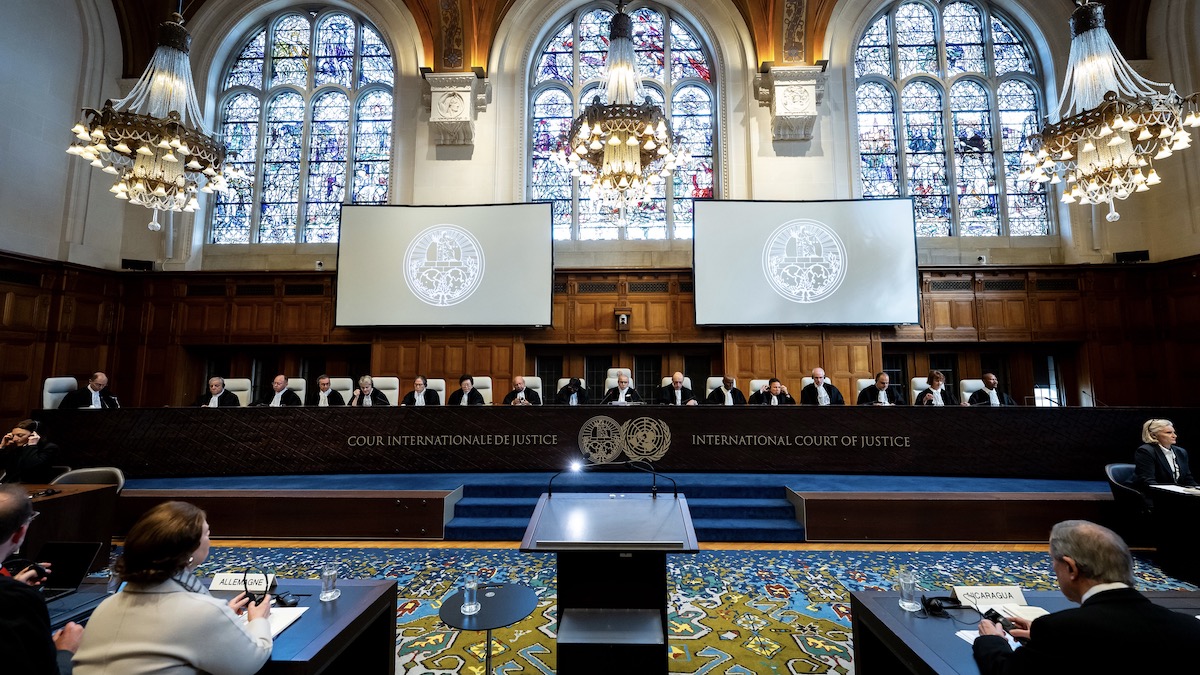
Public ICJ hearing on Nicaragua’s case against Germany. Photo: ICJ

The German MP writes that the response of Germany to Nicaragua’s charges of aiding and abetting genocide in Gaza has been to downplay its role in supplying arms and question the premise that genocide is already taking place

The German government’s appearance before the International Court of Justice in the proceedings for aiding and abetting genocide and violations of international humanitarian law in Gaza is a lesson in Western double standards. On April 8 and 9, Germany sat in the dock in The Hague after Nicaragua filed a case at the highest UN judicial body.

The 43-page document accuses Germany of failing to fulfill its obligations under the Genocide Convention to prevent genocide. Essentially, Germany is accused of aiding and abetting genocide and violating international humanitarian law with its political, financial, and military support for Israel as well as by ceasing to fund the United Nations Relief and Works Agency for Palestine Refugees (UNRWA). In view of the urgency of the situation, Nicaragua requested five interim measures to prevent the facilitation of genocide. These include the demand that Germany stop supplying arms to Israel and resume payments to UNRWA to ensure sufficient humanitarian aid for the Palestinian population.

Does arming a state committing genocide make you an accomplice?

The arguments put forward by the German government in its defense were unconvincing. With a flood of PowerPoint slides, the German representation initially tried to play down the significance of Germany’s arms deliveries to Israel. It argued that the majority of the arms export licenses issued after October 7 were for so-called “other military equipment” (“sonstige Rüstungsgüter”) and only a relatively small proportion for so-called “weapons of war” (“Kriegswaffen”). This was an attempt to deceive the court and the public. For what the German defense failed to mention was the fact that this invented distinction between “other military equipment” and “weapons of war” is a specific feature of German arms export control. Contrary to what the terminology suggests, the category of “other military equipment” can also include weapons that can be used for warfare.

Germany is Israel’s second largest arms supplier after the USA. According to data from the Stockholm International Peace Research Institute (SIPRI), German weapons have accounted for 30% of Israeli arms imports in the last five years. Licenses for new arms exports also increased in 2023. In total, the German government approved the export of weapons to Israel worth EUR 326.5 million – a tenfold increase compared to the previous year. These licenses, most of which were issued after October 7, 2023, include war weapons worth 20 million euros. While the German government tried to justify the approval of 500,000 rounds of ammunition for machine guns with the difficult-to-verify claim that they had been supplied for training purposes, it could not deny the possible use of the approved 3,000 portable anti-tank weapons in war.
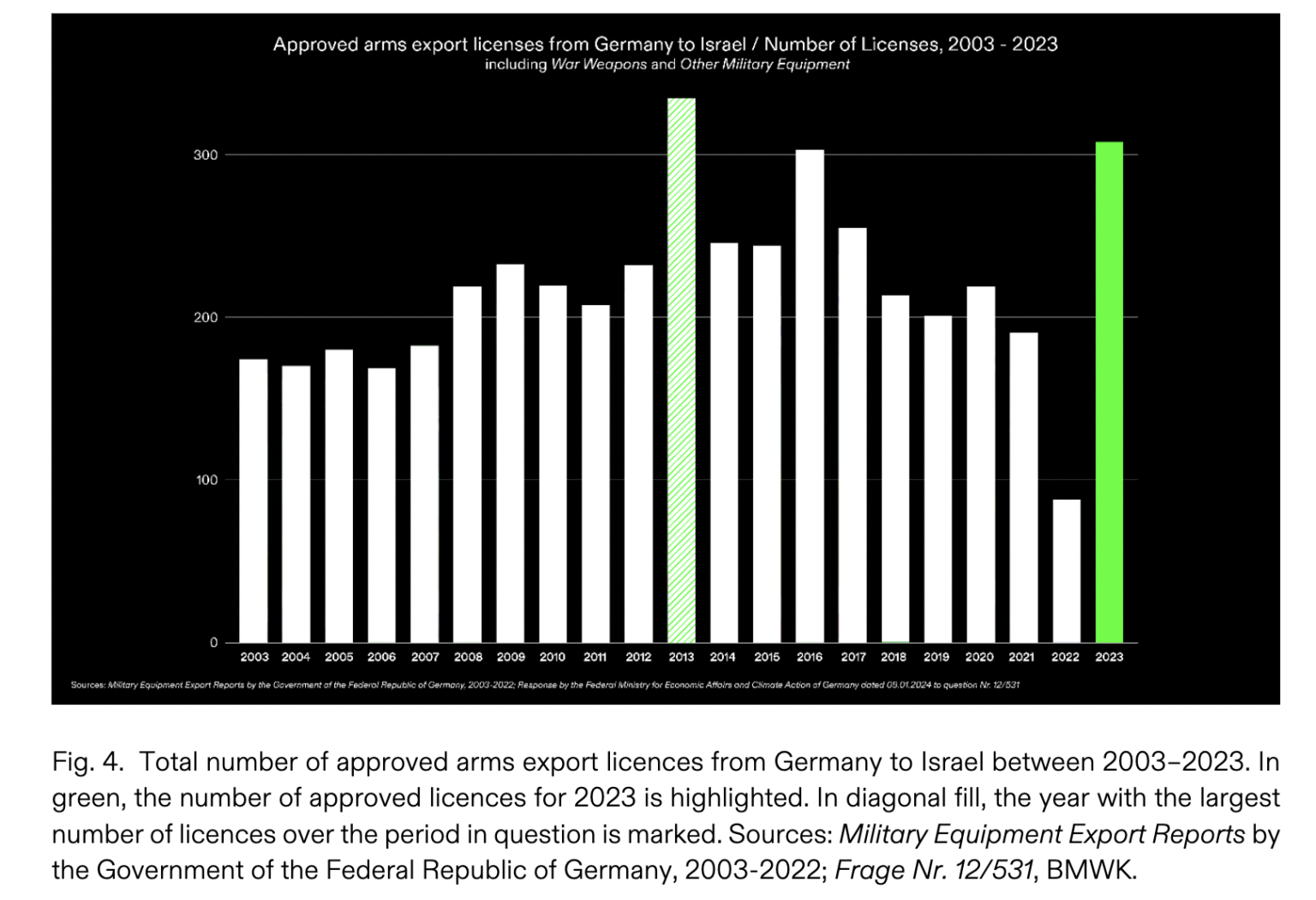
Instead, the German government attempted to justify this by arguing that these and the majority of other export licenses had been issued in October 2023, before the war and the humanitarian catastrophe in Gaza had come to a head. This argument ignores the fact that it must have been clear to the world public – and therefore also to the German government – just a few days after October 7 that the partially far-right Israeli government under Prime Minister Netanyahu would use the horrific attack by Hamas as an opportunity to wage a ruthless war against the Palestinian civilian population, committing numerous war crimes that go far beyond any right to self-defense.

It’s not genocide, yet

It was striking that the German government did not even attempt to dispute Nicaragua’s presentation of facts about the extensive violations of international humanitarian law by Israel. Apparently, it also realized that the terrible humanitarian catastrophe caused by Israel’s war, which has killed more than 33,000 people, including more than 13,000 children, can hardly be denied.

The German defense therefore focused on the formalistic argument that the existence of genocide had not yet been established and that Germany could therefore not be found guilty of aiding and abetting genocide. In doing so, however, the German government fails to recognize the central obligation under international law that arises from the Genocide Convention – namely to prevent genocide. This is all the more significant as the ICJ issued protection orders in the case of South Africa against Israel in order to prevent the danger of genocide, which the court considered plausible. Even Israel’s blatant disregard of these orders to protect the Palestinian civilian population has not led to the German government abandoning its unconditional support for Israel.

This shows the absurdity and hypocrisy of the actions of the German government as well as the governments of numerous other NATO states: On the one hand, they ignore all the findings of the most important bodies of the United Nations about Israel’s most serious war crimes and the danger of genocide and, regardless of this, continue to provide unconditional support for Israel’s war. On the other hand, the German government and other Western donor states decided to stop funding UNRWA solely on the basis of unverifiable insinuations by the Israeli government about the alleged involvement of individual UNRWA employees in the Hamas attack on October 7, 2023. The requirements for subjecting 2.2 million people in the Gaza Strip, who depend on UNRWA aid for their daily survival, to collective punishment are apparently lower than for stopping the supply of weapons that could be used to commit genocide. This can hardly be surpassed in terms of cynicism.

Against this backdrop, the German government’s attempt to defend itself before the ICJ by claiming that it had warned Israel of a military offensive on Rafah is hardly credible. In this sense, the German Foreign Minister Annalena Baerbock boasted to the German Parliament just a few days ago that she had already traveled to the region seven times and called on the Israeli government to respect the humanitarian needs of the Palestinian civilian population.

I asked the Federal Foreign Minister in the plenary session of the German Bundestag whether the Federal Government would consequently now declare a ceasefire on Israel, as the UN Human Rights Council recently called for in a resolution, due to Israel’s blatant disregard for these calls and in view of the announcement of a ground offensive in Rafah and the bloodbath to be expected as a result. The German government representative’s verbose answer can be summarized in one word: No.

Like the Foreign Minister, the German legal representation in The Hague gave the impression that the German raison d’état of unconditionally defending Israel was above international law. Threats from Berlin against the most important judicial body of the United Nations that it would no longer be credible if it ruled against Germany fit into this picture. If the German government only accepts international law when it appears to be advantageous for its own government action, it has finally reached the level of the leading NATO member, the US, which has long understood international law only as an instrument of interest-driven politics.

Regardless of how the court decides, Germany and the West must finally fulfill their obligation to prevent genocide and war crimes in order to lend weight to the demand for an immediate ceasefire in Gaza. The consequences of Western double standards, which seem to have reached a temporary climax in the Gaza war, are fatal. Not only does it lead to the West losing its last remnants of credibility in the eyes of the world. Above all, it promotes the erosion of international law, diplomacy and the United Nations as civilizational achievements for the protection of human life and the preservation of peace.

Sevim Dağdelen is a member of the German Bundestag and foreign policy spokesperson for the group “Alliance Sahra Wagenknecht”. She was the only parliamentary observer at the hearings in Nicaragua’s lawsuit against Germany before the ICJ.

Original article by Sevim Dağdelen republished from peoples dispatch under a Creative Commons Attribution-ShareAlike 4.0 (CC BY-SA) license.
Continue ReadingSevim Dağdelen: the double standards of the West are on full display at the ICJ

Sadiq Khan calls for immediate halt on British arms exports to Israel

Spread the love

https://leftfootforward.org/2024/04/sadiq-khan-calls-for-immediate-halt-on-british-arms-exports-to-israel/

Speaking to PoliticsJOE, Khan said that we should be “holding the Israeli government to account” over its actions in Gaza.

The Mayor of London has called for an immediate halt on British arms exports to Israel.

Sadiq Khan’s intervention comes after more than three former supreme court justices, including the court’s former president Lady Hale, were among more than 600 lawyers, academics and retired senior judges who warned that the UK government is breaching international law by continuing to arm Israel.

The signatories have warned that the present situation in Gaza is “catastrophic” and that given the international court of justice (ICJ) finding that there is a plausible risk of genocide being committed, the UK is legally obliged to act to prevent it.

Speaking to PoliticsJOE, Khan said that we should be “holding the Israeli government to account” over its actions in Gaza.

His comments come after seven international aid workers, including three British citizens, were killed by an Israeli airstrike in Gaza on Monday. John Chapman, 57, James Henderson, 33, and James Kirby, 47, were among the seven World Central Kitchen (WCK) workers killed in Monday’s strike.

https://leftfootforward.org/2024/04/sadiq-khan-calls-for-immediate-halt-on-british-arms-exports-to-israel/

Continue ReadingSadiq Khan calls for immediate halt on British arms exports to Israel

ICJ expands urgent measures in genocide case against Israel as famine “sets in” in Gaza

Spread the love

Original article by Tanupriya Singh republished from peoples dispatch under a Creative Commons Attribution-ShareAlike 4.0 (CC BY-SA) license.
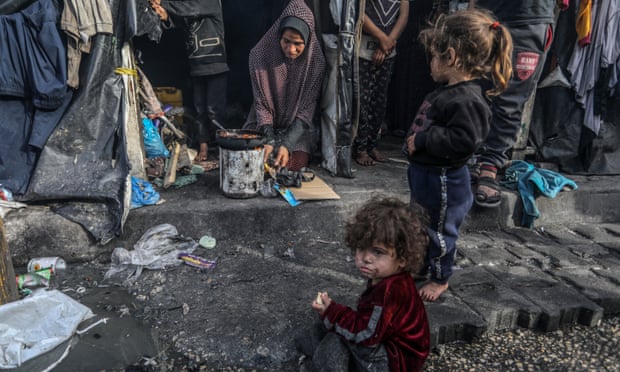
Photo: WHO via UN NEWS

The Court has issued orders for Israel to “ensure” the “unhindered provision” of humanitarian aid, as 31 people have been killed due to deliberate starvation in Gaza

Noting that the “catastrophic living conditions of the Palestinians in the Gaza Strip have deteriorated further,” the International Court of Justice (ICJ) has ordered Israel to take additional measures, including “unhindered provision” of basic necessities and humanitarian assistance, as the Occupation continues its genocidal war for the sixth month. 

The ruling was issued on March 28 in response to a request by South Africa calling on the Court to take further action “in light of the new facts and changes in the situation in Gaza— particularly the situation of widespread starvation”. 

According to the latest Integrated Food Security Phase Classification (IPC) analysis, both North Gaza and Gaza Governorates are “classified in IPC Phase 5 (Famine) with reasonable evidence, with 70% of the population in IPC Phase 5 (Catastrophe).”

On March 24, the head of the UN Relief and Works Agency (UNRWA) stated that Israel had informed the UN that it would no longer approve the agency’s food convoys to north Gaza. Only 11 aid convoys of the World Food Programme have reached the area since the start of 2024. 

In January, Israel accused UNRWA, without any concrete evidence, of employing over 450 “military operatives”. Israel’s allies in the west immediately began suspending funding for the agency, even as it has been revealed that Israel had tortured and coerced UNRWA staffers into giving false confessions. 

Meanwhile, the US Congress has now voted to defund UNRWA as part of a USD 1.2 trillion spending bill. The legislation, which simultaneously provides the annual USD 3.8 billion in funding to Israel, will also limit aid to the Palestinian Authority (PA) in the occupied West Bank if the Palestinians initiate or support an investigation by the International Criminal Court (ICC) into Israel’s crimes. 

South Africa’s request was part of the case it brought against Israel in December, accusing it of violating its obligations under the 1948 Convention on the Prevention and Punishment of the Crime of Genocide. Ahead of a full hearing of the case, South Africa had called on the Court to issue interim measures to prevent “severe and irreparable harm” to the Palestinians as Israel continued and escalated its attacks.

On January 26, the Court found that it was plausible that Israel was committing genocide in Gaza and ordered six measures, including for Israel to “take all measures within its powers to prevent the commission of all acts within the scope of the [Genocide] Convention.” 

These acts include killing, causing serious bodily or mental harm, “deliberately inflicting conditions of life calculated to bring about its physical destruction in whole or in part,” and imposing measures intended to prevent births.

As it became immediately clear that Israel had no intentions of obeying these legally binding measures, South Africa approached the ICJ for additional measures in February. However, the Court declined to expand on its order. 

Starvation and massacres escalate 

In a second attempt on March 6, South Africa stated that Gazans are no longer at “immediate risk of death by starvation,” noting that at least 15 children had died of starvation in the week leading up to its submission. 

“These deaths are “man-made, predictable and entirely preventable. It is predicted that they will increase exponentially and not linearly in the absence of a cessation of military activities and a lifting of the blockade,” it had said, adding that Israel had repeatedly used humanitarian aid as a “bargaining chip in negotiations” by creating a “hostile, inoperable environment for aid agencies.” 

The application was submitted days after the “Flour Massacre”neither the first nor the last atrocity of its kind. The massacre “forms part of an escalating pattern of fatal attacks by Israel on the Palestinian people it is deliberately starving, as they seek access to aid,” South Africa stated. 

In its ruling on Thursday, the ICJ observed that “Palestinians in Gaza are no longer facing only a risk of famine… but that famine is setting in, with at least 31 people, including 27 children, having already died of malnutrition and dehydration.” 

Also cited it a statement made by UN human rights chief Volker Türk that the “situation of hunger, starvation and famine is a result of Israel’s extensive restrictions on the entry and distribution of humanitarian aid and commercial goods, displacement of most of the population, as well as he destruction of crucial civilian infrastructure.”

The Court held that “there is no substitute for land routes and entry points from Israel into Gaza to ensure the effective and efficient delivery of food, water, medical and humanitarian assistance; there is an urgent need to increase the capacity and number of open land crossing points into Gaza and to maintain them open…”

The ruling took “note” of “certain declarations of representatives of the UN and the various organizations… according to which the catastrophic humanitarian situation can only be addressed if the military operations in the Gaza Strip are suspended [emphasis added].” 

Also acknowledged is the UN Security Council resolution 2728, which “[d]emand[ed] an immediate ceasefire for the month of Ramadan respected by all parties leading to a lasting sustainable ceasefire.” 

Not only was the Resolution’s text amended to call for a “lasting” instead of a “permanent” ceasefire under US’ threat of veto, the US ultimately went on to absurdly claim that the resolution was non-binding—statements also rejected by the UN and other SC member states. 

It is important to note that the month of Ramadan, and by extension the proposed ceasefire period, is set to end in less than two weeks. 

The Court also noted that since its ruling on January 26, Israel had killed over 6,600 additional people in Gaza and injured another 11,000. Given that the original provisional measures did not address the changes in the situation in Gaza—including the “unprecedented levels of food insecurity” and the increasing risks of epidemics—the ICJ concluded that its original decision had to be modified. 

The ICJ “reaffirmed” its previous provisional measures and has ordered three further measures: a) that Israel must take all measures to ensure “without delay, in full cooperation with the UN, the unhindered provision at scale…of urgently needed basic services and humanitarian assistance” and b) ensure “with immediate effect” that its military does not commit acts that violate the rights of the Palestinian people under the Genocide Convention. 

Israel has been given one month to submit a report to the Court on all measures taken to implement the order. 

In its original application to the Court, South Africa had demanded an order calling on Israel to immediately cease its military operations in and around Gaza. While this measure was not explicitly granted, a ceasefire could be inferred, as South Africa’s foreign minister Naledi Pandor argued, because “without it, the Order would not work,” including the delivery of humanitarian aid. 

Nevertheless, while the ICJ ruling did not order cessation of Israel’s military actions on Thursday, seven judges from the Court’s bench issued separate statements stating that the Court should have explicitly ordered a suspension of Israel’s operations, “including its planned military operation in Rafah,” or at least acknowledging that a ceasefire was necessary for its orders to take effect. 

“It is indeed the very right of existence of the Palestinian population of Gaza that is currently at risk of irreparable prejudice,” said Judge Abdulqawi Ahmed Yusuf. 

Importantly, he stated, “The argument that a State party to the Convention that is involved in a conflict with a non-State actor is not under an obligation to suspend its military operations to prevent genocide or should not be ordered to do so, unless the non-State actor is disarmed, makes no sense whatsoever. It is contrary to the very idea of prevention of genocide and to the objectives of the Convention…”

“All the indicators of genocidal activities are flashing red in Gaza… The provisional measures indicated by the Court are binding. They are not something that a State party to the Convention is free to respect or to ignore according to its own pleasure. They must be implemented,” ICJ Judge Yusuf had said. 

“In the same way that a State party to the Convention has a duty to prevent genocide in its territory whatever may be the nature of the forces or actors opposing it, it has also the obligation to prevent genocide in any territory which such party invades or occupies. This is the case with respect to the situation in Gaza.” 

This was reiterated in the joint opinion of Judges Xue Hanqin, Leonardo Nemer Caldeira Brant, Juan Manuel Gómez Robledo, and Dire Tladi—“Israel’s dominant control over Gaza explains why Israel has the primary responsibility to ensure unhindered and unimpeded access, in particular the land cross access for the delivery of humanitarian assistance… For that purpose, suspension of military operations… appears indispensable.” 

Israel’s “humanitarian camouflage” 

During the hearings on the provisional measures in January, Israel had deployed two key arguments to deny that it was committing genocide in Gaza. One being its supposed facilitation of humanitarian assistance to Gaza, even though it had already been reported at the time that the entire population of Gaza was suffering from “crisis or worse” levels of food insecurity; and it’s supposed adherence to international humanitarian law as a way to justify its mass killings and bombings of critical infrastructure. 

This second tactic was examined in a report published by the UN Special Rapporteur on the occupied Palestinian territories (OPt), Francesca Albanese, on March 25, titled “Anatomy of a Genocide” which concluded that there were “reasonable grounds to believe that the threshold indicating Israel’s commission of genocide is met.”

The report documents three acts of genocide being committed by Israel—killing members of the group, causing serious bodily or mental harm to members of the group, and deliberately inflicting on the group conditions of life calculated to bring about its physical destruction in whole or in part. 

“More broadly, [the context, facts and analysis] indicate that Israel’s actions have been driven by a genocidal logic integral to its settler-colonial project in Palestine.” 

“Punishing their indigeneity and rejection of colonization, Israel construed Palestinians as a ‘security threat’ to justify their oppression and “de-civilianization,” namely the denial of their status as protected civilians.” 

This “de-civilianization,” Albanese argues, has intensified since October 7 through Israel’s use of International Humanitarian Law (IHL) terminology such as human shields, collateral damage, safe zones, and evacuations, which has “transformed an entire national group and its inhabited space into a destroyable target, revealing an eliminationist conduct of hostilities.” 

The report notes that Israel has repeatedly accused Palestinian resistance groups of “deliberately using civilians as human shields” in its wars of aggression on Gaza and the 2018 Great March of Return protests—even as it was later proved that the evidence had been fabricated—to “justify widespread and systematic killing” of Palestinians. 

“Israel [has] transformed Gaza into a “world without civilians” in which “everything from taking shelter in hospitals to fleeing for safety is declared a form of human shielding.”

This strategy has been extended to the infrastructure required to sustain life in Gaza—including hospitals—with Israel systematically attacking medical workers and facilities for being Hamas “command centers” or “headquarters,” “legitimizing the destruction of Gaza’s entire healthcare sector.”

The report also connects this policy of shielding with Israel’s evacuation orders, particularly the one issued on October 13 forcing people to move to south Gaza—“Israel illegally categorized the inhabitants of northern Gaza who had remained (including the sick and wounded) as “human shields” and “accomplices” of terrorism.”

“This policy points to the intention by Israel to ‘transform’ hundreds of thousands of civilians into ‘legitimate’ military targets or collateral casualties through impossible-to-follow evacuation orders.” Not only that, Israel targeted evacuees and residents of designated safe zones—“safe areas were deliberately turned into areas of mass killing.” 

“Israel considers any object that has allegedly been or might be used militarily as a legitimate target, so that entire neighborhoods can be razed or demolished under fictions of legality… Rationalizing patterns of attacks on civilian objects, knowingly killing civilians en masse, has become military strategy premised upon probable war crimes,” Albanese notes. 

Importantly, she also addresses Israel’s use of the notion of “proportionate collateral damage to knowingly shell large numbers of members of the protected group”. The way Israel has gone about this, is by “defining military advantage, in each attack, in relation to the destruction of the whole Hamas organization both politically and militarily.” 

“It is manifestly illegal to declare as a war aim the destruction of the other side’s political capacity (particularly in the context of a 56-year military occupation which deprives the occupied population of its right to self-determination.”

Meanwhile, Ireland has announced that it will intervene in the case, as has the State of Palestine, which stated that despite the Court’s orders, “Israel’s relentless aggression persists… violating Palestinian rights under the Genocide Convention.”

“Equally, many states have failed to honor their erga omnes obligations [obligations owed to the international community as a whole] to adhere to and implement the ICJ’s order, thereby entrenching complicity in these grave acts, including the political and military aiding and abetting of the perpetrators of the genocide.”

Original article by Tanupriya Singh republished from peoples dispatch under a Creative Commons Attribution-ShareAlike 4.0 (CC BY-SA) license.
Continue ReadingICJ expands urgent measures in genocide case against Israel as famine “sets in” in Gaza

‘Famine is setting in’: UN court orders Israel to unblock Gaza food aid

Spread the love

https://www.theguardian.com/world/2024/mar/28/famine-is-setting-in-icj-orders-israel-to-unblock-gaza-food-aid

Palestinian families displaced from their homes make preparations for the iftar dinner in temporary tents in Rafah on Thursday. Photograph: Anadolu/Getty Images

The international court of justice has ordered Israel to allow unimpeded access of food aid into Gaza, where sections of the population are facing imminent starvation, in a significant legal rebuke to Israel’s claim it is not blocking aid deliveries.

A panel of judges at the UN’s top court, which is already considering a complaint from South Africa that Israel is committing genocide in the Palestinian territory, issued the ruling after an emergency measure in January obliging Israel to admit emergency aid.

The judges, who were unanimous in their decision, said Palestinians in Gaza were facing worsening conditions of life, and famine and starvation were spreading. “The court observes that Palestinians in Gaza are no longer facing only a risk of famine … but that famine is setting in,” the judges said.

In its legally binding order, the court told Israel to take “all necessary and effective measures to ensure, without delay, in full cooperation with the United Nations, the unhindered provision at scale by all concerned of urgently needed basic services and humanitarian assistance” including food, water, fuel and medical supplies.

The ICJ also ordered Israel to immediately ensure “that its military does not commit acts which constitute a violation of any of the rights of the Palestinians in Gaza as a protected group under the convention on the prevention and punishment of the crime of genocide, including by preventing, through any action, the delivery of urgently needed humanitarian assistance”.

Israel denies it is committing genocide and says its military campaign is self-defence.

https://www.theguardian.com/world/2024/mar/28/famine-is-setting-in-icj-orders-israel-to-unblock-gaza-food-aid

Continue Reading‘Famine is setting in’: UN court orders Israel to unblock Gaza food aid

‘Enough Is Enough’: Ireland Joins ICJ Genocide Case Against Israel

Spread the love

Original article byBRETT WILKINS republished from Common Dreams under Creative Commons (CC BY-NC-ND 3.0).

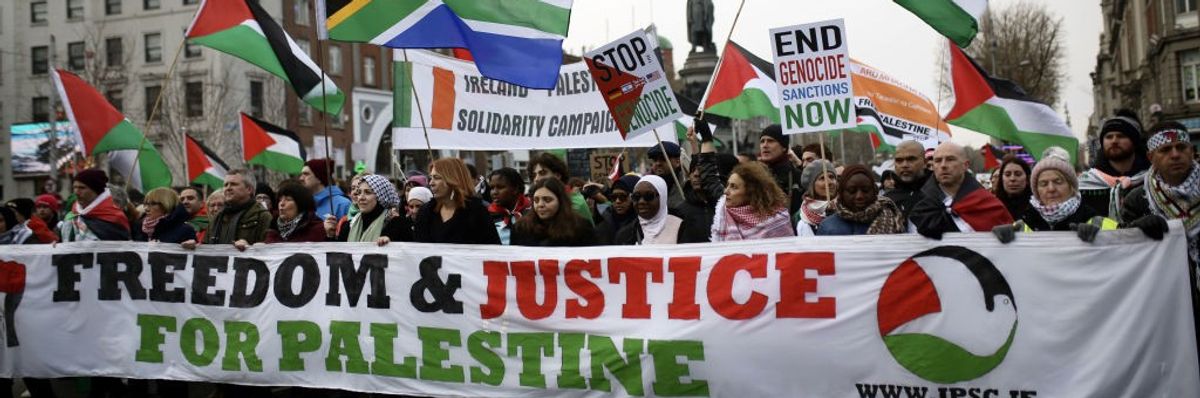
Palestinian and South African flags are seen at a January 13, 2024 protest for Gaza in Dublin, Ireland.  (Photo: Stringer/Andalou via Getty Images)

“What we saw on October 7 in Israel, and what we are seeing in Gaza now, represents the blatant violation of international humanitarian law on a mass scale,” said one top Irish official.

Citing Israel’s “blatant” human rights violations in Gaza, Ireland’s second-highest-ranking official said Wednesday that the country will join the South Africa-led genocide case before the International Court of Justice in The Hague.

Irish Tánaiste Micheál Martin—the equivalent of a deputy prime minister in other parliamentary nations—said that Ireland decided to intervene in the case after analyzing the “legal and policy issues” pertaining to the case under review by the United Nations’ top court.

“It is for the court to determine whether genocide is being committed,” Martin—who also serves as Ireland’s foreign and defense minister—said in a statement. “But I want to be clear in reiterating what I have said many times in the last few months; what we saw on October 7 in Israel, and what we are seeing in Gaza now, represents the blatant violation of international humanitarian law on a mass scale.”

Martin continued:

The taking of hostages. The purposeful withholding of humanitarian assistance to civilians. The targeting of civilians and of civilian infrastructure. The indiscriminate use of explosive weapons in populated areas. The use of civilian objects for military purposes. The collective punishment of an entire population.

The list goes on. It has to stop. The view of the international community is clear. Enough is enough. The U.N. Security Council has demanded an immediate cease-fire, the unconditional release of hostages, and the lifting of all barriers to the provision of humanitarian assistance at scale. The European Council has echoed this call.

South Africa’s case—which is supported by over 30 countries, the Arab League, African Union, and others—incisively details Israel’s conduct in the war, including the killing of tens of thousands of Palestinians, mostly women and children; the wounding of tens of thousands more; the forcible displacement of 90% of the besieged enclave’s 2.3 million people; and the inflicting of conditions leading to widespread starvation and disease. The filing also cited numerous genocidal statements by Israeli officials.

On January 26, the ICJ issued a preliminary ruling that Israel is plausibly committing genocide in Gaza and ordered its government and military to prevent genocidal acts. Palestinian and international human rights defenders say Israel has ignored the order.

A draft report released this week by the U.N.’s Human Rights Council found “reasonable grounds to believe” that Israel is committing genocide in Gaza, a move that came on the same day as the U.N. Security Council passed a resolution demanding an immediate cease-fire in the ongoing war.

“The situation could not be more stark; half the population of Gaza face imminent famine and 100% of the population face acute food insecurity,” said Martin. “As the U.N. secretary-general said as he inspected long lines of blocked relief trucks waiting to enter Gaza during his visit to Rafah at the weekend: ‘It is time to truly flood Gaza with lifesaving aid. The choice is clear: surge or starvation.’ I echo his words today.”

In a St. Partick’s Day White House meeting with U.S. President Joe Biden—a staunch supporter of Israel—Irish Toaiseach (Prime Minister) Leo Varadkar, who announced earlier this month that he would soon step down, said that “the Irish people are deeply troubled about the catastrophe that’s unfolding before our eyes in Gaza.”

“And when I travel the world, leaders often ask me why the Irish have such empathy for the Palestinian people,” he added. “And the answer is simple: We see our history in their eyes—a story of displacement, of dispossession and national identity questioned and denied, forced emigration, discrimination, and now hunger.”

Original article byBRETT WILKINS republished from Common Dreams under Creative Commons (CC BY-NC-ND 3.0).

Continue Reading‘Enough Is Enough’: Ireland Joins ICJ Genocide Case Against Israel