Tag: IDF

  • Group Files New ICC Complaint Over Journalists Killed by Israel in Gaza

    Spread the love

    Original article by BRETT WILKINS republished from Common Dreams under Creative Commons (CC BY-NC-ND 3.0). 
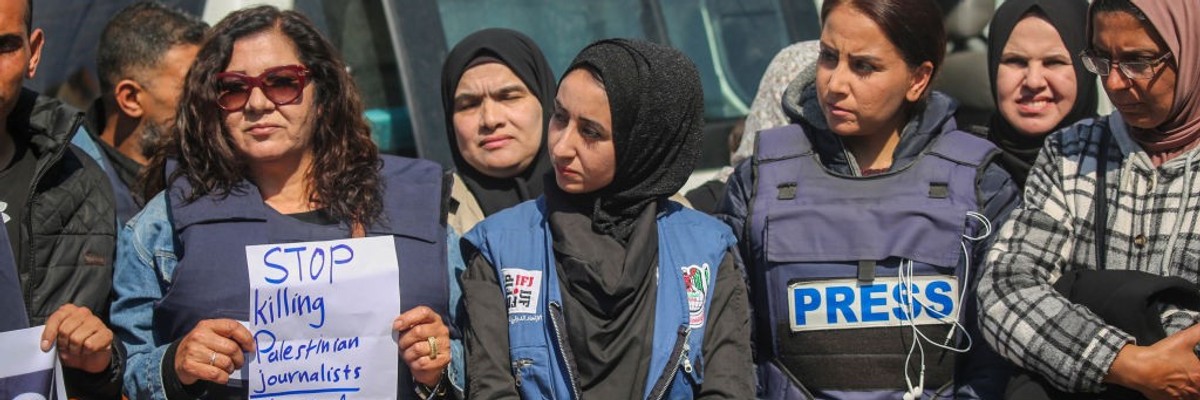
    Palestinian journalists stage a protest to draw attention to Palestinian press killed while covering the war in the Gaza Strip on February 26, 2024 in Rafah.
     (Photo: Ahmad Hasaballah/Getty Images)

    Reporters Without Borders says it has “reasonable grounds for thinking that some of these journalists were deliberately killed and that the others were the victims of deliberate IDF attacks against civilians.”

    The press freedom group Reporters Without Borders announced Monday that it has filed a third complaint at the International Criminal Court alleging “war crimes against journalists in Gaza,” where over 100 media professionals have been killed by Israeli forces since October 7.

    Paris-based Reporters Without Borders (RSF) is asking the ICC to investigate the Israel Defense Forces’ (IDF) killing of eight Palestinian journalists and wounding of another between December 15 and May 20 and, more broadly, the over 100 media workers slain during the course of Israel’s 234-day assault on Gaza.

    RSF said it “has reasonable grounds for thinking that some of these journalists were deliberately killed and that the others were the victims of deliberate IDF attacks against civilians” and accused Israel of “an eradication of the Palestinian media.”

    “Impunity endangers journalists not only in Palestine but also throughout the world,” RSF advocacy and assistance director Antoine Bernard said in a statement. “Those who kill journalists are attacking the public’s right to information, which is even more essential in times of conflict. They must be held accountable, and RSF will continue to work to this end, in solidarity with Gaza’s reporters.”

    Journalists in RSF’s latest complaint include Mustapha Thuraya and Hamza al-Dahdouh, freelancers working for Al Jazeera in Rafah when they were killed by a targeted Israeli drone strike on their vehicle on January 7, and Hazem Rajab, who was injured in the strike.

    According to RSF:

    The complaint also cites the cases of Hadaf News website reporter Ahmed Badir, who was killed by an airstrike at the entrance to Shuhada al-Aqsa Hospital in Deir al-Balah on 10 January; Kan’an News Agency correspondent Yasser Mamdouh, who was killed near Al-Nasser Hospital in Khan Yunis on 11 February; Ayat Khadoura, an independent video blogger killed by an Israeli strike on his home on 20 November shortly after posting a video; Yazan Emad Al-Zwaidi, a cameraman with the Egyptian satellite TV news channel Al Ghad, who was killed on 14 January when an Israeli strike hit the group of civilians he was with in Beit Hanoun; Ahmed Fatima, a journalist with the Al Qahera News TV channel, who was killed during a bombardment in Khan Yunis on 13 November; and Rami Bdeir, a reporter for the Palestinian New Press media outlet, who was killed during an Israeli bombardment in Khan Yunis on 15 December.

    Another advocacy group, the Committee to Protect Journalists, previously condemned what it called an “apparent pattern of targeting journalists and their families,” noting cases in which media workers were killed while wearing press insignia and after being threatened by Israeli officials.

    Monday marked the ninth anniversary of United Nations Security Council Resolution 2222, which concerns the protection of journalists in conflict zones and “emphasizes the responsibility of states to comply with the relevant obligations under international law to end impunity and to prosecute those responsible for serious violations of international humanitarian law.”

    Last month, Francesca Albanese, the U.N. special rapporteur on the occupied Palestinian territories, said: “Killing journalists is a war crime that undermines the most basic human rights. Justice starts with the cessation of injustice.”

    Original article by BRETT WILKINS republished from Common Dreams under Creative Commons (CC BY-NC-ND 3.0). 
  • ‘War Criminals’: IDF Strikes Rafah After Hamas Agrees to Cease-Fire

    Spread the love

    [This article remains relevant despite having been published 2 days ago]

    Original article by JESSICA CORBETT republished from Common Dreams under Creative Commons (CC BY-NC-ND 3.0).

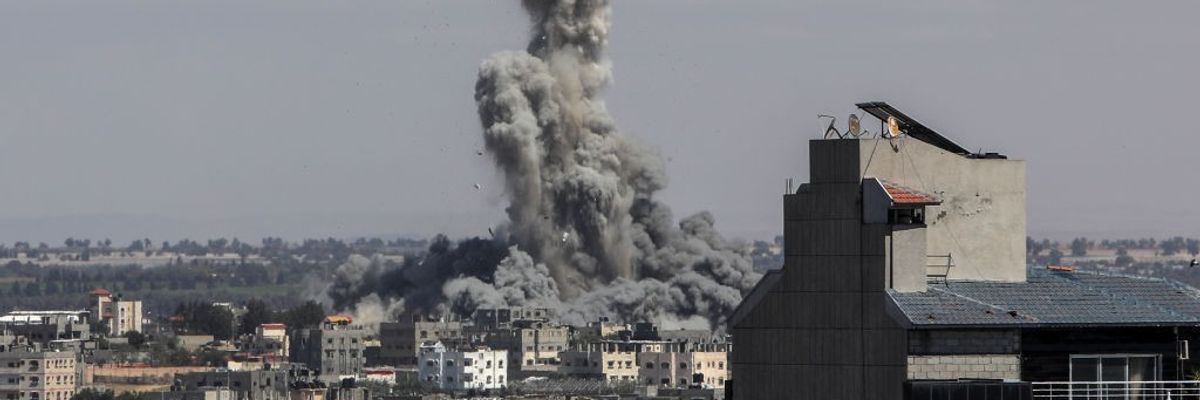
    Smoke rises from buildings after Israeli strikes on Rafah, Gaza on May 6, 2024.  (Photo: Abed Rahim Khatib/Anadolu via Getty Images)

    “Why?” asked Israeli lawmaker Ofer Cassif. “Because killing Palestinians is more important for the Israeli government than saving Israelis.”

    Israel on Monday launched long-awaited strikes on Rafah in the southern Gaza Strip despite Hamas publicly confirming it agreed to a cease-fire and hostage release proposal from Egyptian and Qatari mediators.

    The Israel Defense Forces said on social media that “the IDF is currently conducting targeted strikes against Hamas terror targets in eastern Rafah,” the city to which over a million Palestinians have fled since October 7, when Israel launched a retaliatory war that has already killed at least 34,735 people in Gaza and wounded another 78,108.

    Earlier Monday, the IDF had dropped leaflets directing residents and refugees in that part of Rafah to relocate to a strip along Gaza’s coast, ignoring warnings from the international community and humanitarian groups that a full-scale Israeli attack on the crowded city would further endanger civilians and relief efforts.

    “It is obvious Netanyahu wants this genocidal war to continue indefinitely so that he can remain in power.”

    In addition to sparking outrage around the world, the Israeli government’s Rafah attack and rejection of the Hamas-backed proposal was met with criticism from people across Israel. The Associated Press reported that “thousands of Israelis rallied around the country Monday night calling for an immediate deal to release the hostages still held in the Gaza Strip.”

    Ofer Cassif, a member of the Knesset who was almost expelled by fellow Israeli lawmakers earlier this year for backing South Africa’s ongoing genocide case against Israel at the International Court of Justice (ICJ), again called out his own government.

    “Israeli tanks and infantry enter east Rafah while planes bomb from above, just hours after Hamas’ decision to accept the hostages/prisoners exchange deal,” Cassif said Monday. “Why? Because killing Palestinians is more important for the Israeli government than saving Israelis. War criminals!”

    The office of Israeli Prime Minister Benjamin Netanyahu said Monday that “the War Cabinet unanimously decided this evening Israel will continue its operation in Rafah, in order to apply military pressure on Hamas so as to advance the release of our hostages and achieve the other objectives of the war.”

    Along with the prime minister, Israel’s War Cabinet includes Defense Minister Yoav Gallant and Benny Gantz, former IDF chief of the general staff, along with three observers.

    Netanyahu added that “while the Hamas proposal is far from meeting Israel’s core demands, Israel will dispatch a ranking delegation to Egypt in an effort to maximize the possibility of reaching an agreement on terms acceptable to Israel.”

    Reuters reported that “an Israeli official said the deal was not acceptable to Israel because terms had been ‘softened.’”

    According to the news outlet, the first part of a three-phase plan that Hamas—which has controlled Gaza for nearly two decades—agreed to includes a 42-day pause in fighting, the release of 33 hostages held by the group and some Palestinians in Israeli jails, a partial IDF withdrawal, and free movement in the besieged enclave.

    Phase two would be “another 42-day period that features an agreement to restore a ‘sustainable calm’ to Gaza, language that an official briefed on the talks said Hamas and Israel had agreed in order to take discussion of a ‘permanent cease-fire’ off the table,” Reuters detailed. This phase also includes withdrawing most Israeli troops and Hamas releasing some soldiers and reservists.

    The third phase would involve the exchange of bodies; reconstruction of Gaza overseen by Egypt, Qatar, and the United Nations; and ending the complete blockade on the strip, the outlet added.

    Shortly before Israel’s Monday night strikes on Rafah began, Stéphane Dujarric, a spokesperson for United Nations Secretary-General António Guterres, said that the U.N. chief “reiterates his pressing call to both the government of Israel and the leadership of Hamas to go the extra mile needed to make an agreement come true and stop the present suffering.”

    Expressing concern about the then-imminent Israeli operation in Rafah, the spokesperson said that “we are already seeing movements of people—many of these people are in desperate humanitarian condition and have been repeatedly displaced. They search safety that has been so many times denied. The secretary-general reminds the parties that the protection of civilians is paramount in international humanitarian law.”

    Other U.N. officials have been warning of what an assault on Rafah will mean for the over 1.4 million Palestinians there, among them 600,000 children. So have humanitarian and political leaders, including U.S. Sen. Bernie Sanders (I-Vt.)—who on Monday urged President Joe Biden to stand by his earlier position that attacking the city was a “red line” and “end all offensive military aid to Israel.”

    Council on American-Islamic Relations national executive director Nihad Awad issued a similar call Monday evening, warning that “the Israeli government is hellbent on using American financial, military, and diplomatic support to ethnically cleanse what remains of Gaza and commit another massacre.”

    “President Biden must stand up to Benjamin Netanyahu and take concrete action to end the genocide now,” Awad continued, nodding to the Israeli leader’s legal trouble. The prime minister faces not only potential consequences on a global scale for what the ICJ has deemed a “plausibly” genocidal war on Gaza but also a corruption trial in his own country.

    “It is obvious Netanyahu wants this genocidal war to continue indefinitely so that he can remain in power, avoid jail, and fulfill his racist, far-right Cabinet’s demands for the complete destruction of Gaza and the massacre of its people,” Awad said. “It is long past time for President Biden to end our nation’s complicity in this 21st-century genocide.”

    Biden spoke with Netanyahu by phone ahead of the IDF strikes on Monday and “reiterated his clear position on Rafah,” according to a White House readout. They also discussed the hostage negotiations, humanitarian aid, the Holocaust, and antisemitism.

    Trita Parsi, executive vice president of the Quincy Institute for Responsible Statecraft, also suggested that the Israeli prime minister wants the bloodshed in Gaza to continue for personal reasons.

    “Netanyahu does not want an end to the war because the moment the war ends, his political career ends as well. And his prison sentence will commence,” said Parsi. “Yet, Biden has for seven months deferred to Netanyahu.”

    Original article by JESSICA CORBETT republished from Common Dreams under Creative Commons (CC BY-NC-ND 3.0).

  • ‘Unlawful and Catastrophic’: IDF Begins Forced Evacuation of Rafah

    Spread the love

    Original article by JAKE JOHNSON republished from Common Dreams under Creative Commons (CC BY-NC-ND 3.0). 

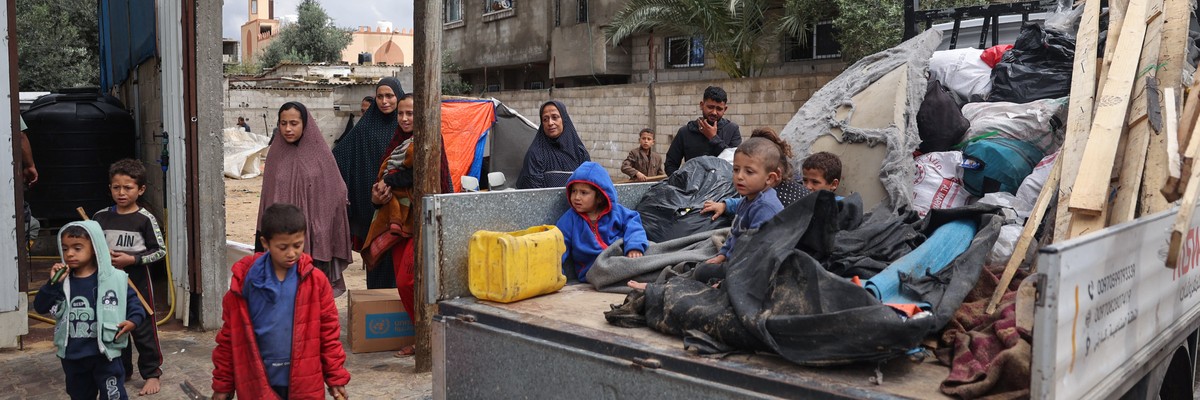
    Displaced Palestinians in Rafah in the southern Gaza Strip gather their belongings following an evacuation order by the Israeli military on May 6, 2024. (Photo: AFP via Getty Images)

    The head of one humanitarian group called the Israeli military’s directives “a serious violation of international law.”

    Israel’s army on Monday ordered roughly 100,000 people living in eastern Rafah to evacuate ahead of an imminent military assault on the area, terrifying families who have been forcibly displaced to the southern Gaza city in recent months and intensifying warnings of a bloodbath.

    The Israel Defense Forces (IDF) dropped leaflets over Rafah ordering some of its 1.4 million residents to move to a strip along Gaza’s coast, a signal that a long-feared ground assault on the overcrowded city is set to begin in the face of vocal opposition from the international community and humanitarian organizations.

    The U.S., Israel’s top arms supplier, has said it would oppose a Rafah assault without a credible plan to evacuate civilians from the city. Humanitarian groups and analysts have said such a plan is impossible because there is no genuinely safe place for Gazans to go. Israeli forces have repeatedly attacked so-called “safe zones” and designated routes Palestinians have used to flee in compliance with past IDF orders.

    “Israel’s military offensive in Rafah could lead to the deadliest phase of this conflict, inflicting horrific suffering on approximately 1.4 million displaced civilians in the area,” said Jan Egeland, secretary-general of the Norwegian Refugee Council. “The relocation orders issued by Israel today to thousands of Gazans, directing them to move to Al-Mawasi, are beyond alarming. The area is already overstretched and devoid of vital services. It lacks the capacity to house the number of people currently seeking refuge in Rafah, with no assurances of safety, proper accommodation, or return once hostilities end for those forced to relocate.”

    “The absence of these fundamental guarantees of safety and return, as required by international humanitarian law, qualifies Israel’s relocation directives as forcible transfer, amounting to a serious violation of international law,” Egeland said. “Any Israeli military operation in Rafah—which has become the largest cluster of displacement camps in the world—will cause potential mass atrocities.”

    “If large-scale military operations start, not only will children be at risk from the violence, but also from chaos and panic, and at a time where their physical and mental states are already weakened.”

    Israel reportedly notified the U.S. of the evacuation orders overnight, and CIA Director William Burns is set to arrive in Israel on Monday to discuss the operation in Rafah, a city along Gaza’s border with Egypt that has become a critical point of entry for humanitarian aid. The new evacuation orders, expected to be just the first round of directives, include Rafah’s largest medical facility.

    The United Nations Relief and Works Agency for Palestine Refugees in the Near East (UNRWA), the main relief agency in Gaza, said in response to the IDF’s orders that it would not leave Rafah.

    “An Israeli offensive in Rafah would mean more civilian suffering and deaths. The consequences would be devastating for 1.4 million people,” the organization wrote in a social media post. “UNRWA is not evacuating: The agency will maintain a presence in Rafah as long as possible and will continue providing lifesaving aid to people.”

    The far-right Israeli government, led by Prime Minister Benjamin Netanyahu, has been threatening a ground invasion of Rafah for months, characterizing the city as Hamas’ last major stronghold. Avichay Adraee, an IDF lieutenant colonel, said Monday that the Israeli military would use “extreme force” in the evacuation areas and warned that “anyone who is close to terrorist organizations puts his life and the life of his family at risk.”

    According to the United Nations Children’s Fund (UNICEF), around 600,000 children are currently sheltering in the city, including many who have been displaced multiple times since Israel’s assault began in October following a Hamas-led attack.

    “More than 200 days of war have taken an unimaginable toll on the lives of children,” Catherine Russell, UNICEF’s executive director, said Monday. “Rafah is now a city of children, who have nowhere safe to go in Gaza. If large-scale military operations start, not only will children be at risk from the violence, but also from chaos and panic, and at a time where their physical and mental states are already weakened.”

    Omar Shakir, Israel and Palestine director at Human Rights Watch, called the IDF’s evacuation push in Rafah “unlawful and catastrophic.”

    “There’s nowhere safe to go in Gaza,” Shakir added. “The international community should act to prevent further atrocities.”

    The IDF began issuing its evacuation orders in Rafah a day after the Netanyahu government voted to shut down Al Jazeera‘s operations in the country, a brazen attack on press freedom.

    “The fact that Israel banned Al Jazeera hours before beginning its assault on Rafah is not a coincidence,” said author and Middle East analyst Assal Rad. “After everything we’ve seen in the last seven months, imagine what they’ll do when they think no one is watching.”

    Original article by JAKE JOHNSON republished from Common Dreams under Creative Commons (CC BY-NC-ND 3.0). 

    Israeli Plan To Evacuate Rafah By Force Sparks Warnings Of ‘Ethnic Cleansing’

  • UN Rights Chief Demands International Probe of Mass Graves Near Gaza Hospitals

    Spread the love

    Original article by JAKE JOHNSON republished from Common Dreams under Creative Commons (CC BY-NC-ND 3.0).

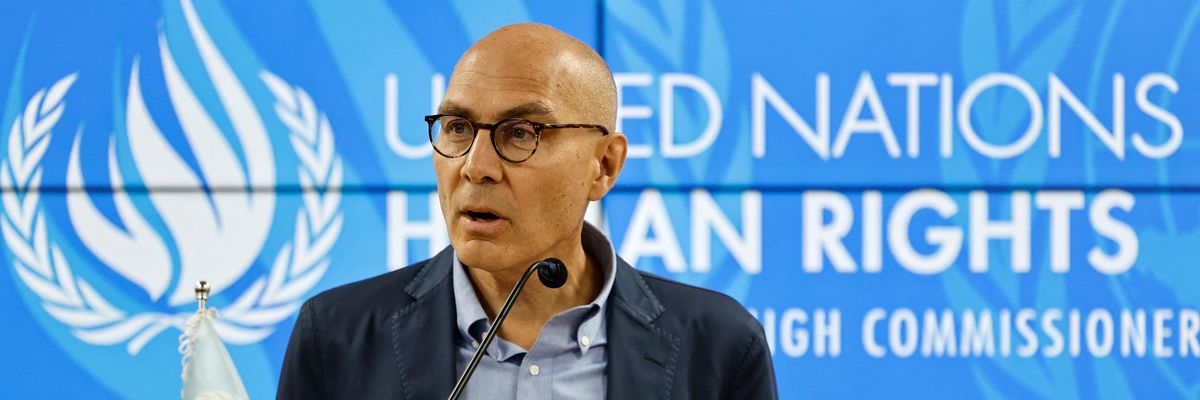
    United Nations High Commissioner for Human Rights Volker Türk speaks during a press conference in Cairo, Egypt on November 8, 2023.
     (Photo: Khaled Desouki/AFP via Getty Images)

    “Hospitals are entitled to very special protection under international humanitarian law,” said Volker Türk, the United Nations high commissioner for human rights.

    The United Nations’ human rights chief on Tuesday called for an international investigation into mass graves discovered at two Gaza hospitals that Israeli forces recently assailed and destroyed, further imperiling the enclave’s barely functioning healthcare system.

    Volker Türk, the U.N. high commissioner for human rights, said in a statement that he was “horrified” by the discovery of mass graves at the Nasser and al-Shifa medical complexes, which the Israel Defense Forces (IDF) reduced to ruins.

    More than 300 bodies were reportedly discovered in the mass grave near the Nasser facility in Khan Younis, Gaza, and eyewitnesses said Israeli soldiers executed civilians during their two-week-long raid of al-Shifa last month.

    Türk demanded an “independent, effective, and transparent” probe into the killings and mass graves, adding that “given the prevailing climate of impunity, this should include international investigators.”

    “Hospitals are entitled to very special protection under international humanitarian law,” he added. “And the intentional killing of civilians, detainees, and others who are hors de combat is a war crime.”

    “Every 10 minutes a child is killed or wounded. They are protected under the laws of war, and yet they are ones who are disproportionately paying the ultimate price.”

    The IDF’s destructive attacks on Nasser and al-Shifa were part of a broader Israeli assault on Gaza’s healthcare system. An analysis released Monday by Save the Children found that the rate of monthly Israeli attacks on healthcare in Gaza since October has exceeded that of any other conflict around the world since 2018.

    The group estimated that Israel has launched an average of 73 attacks per month on healthcare in Gaza—and at least 435 attacks total since October.

    “After six months of unimaginable horror, the healthcare system in Gaza has been brought to its knees,” said Xavier Joubert, Save the Children’s country director in the occupied Palestinian territory. “Healthcare workers are risking their lives daily to give Palestinian children a chance at survival. The constant attacks on healthcare are simply unjustifiable and must stop. Palestinian children must have unimpeded access to services, including healthcare and education.”

    Türk also used his statement Tuesday to condemn Israeli forces’ killing of women and children in airstrikes on the southern Gaza city of Rafah in recent days. The human rights official noted that Gaza doctors rescued a baby from the womb of her mother as the latter succumbed to head injuries from an Israeli strike.

    “The latest images of a premature child taken from the womb of her dying mother, of the adjacent two houses where 15 children and five women were killed—this is beyond warfare,” said Türk. “Every 10 minutes a child is killed or wounded. They are protected under the laws of war, and yet they are ones who are disproportionately paying the ultimate price in this war.”

    Original article by JAKE JOHNSON republished from Common Dreams under Creative Commons (CC BY-NC-ND 3.0).

  • West Bank Pogrom ‘Underscores Urgent Need to Dismantle Apartheid’: Amnesty

    Spread the love

    Original article by BRETT WILKINS republished from Common Dreams under Creative Commons (CC BY-NC-ND 3.0). 
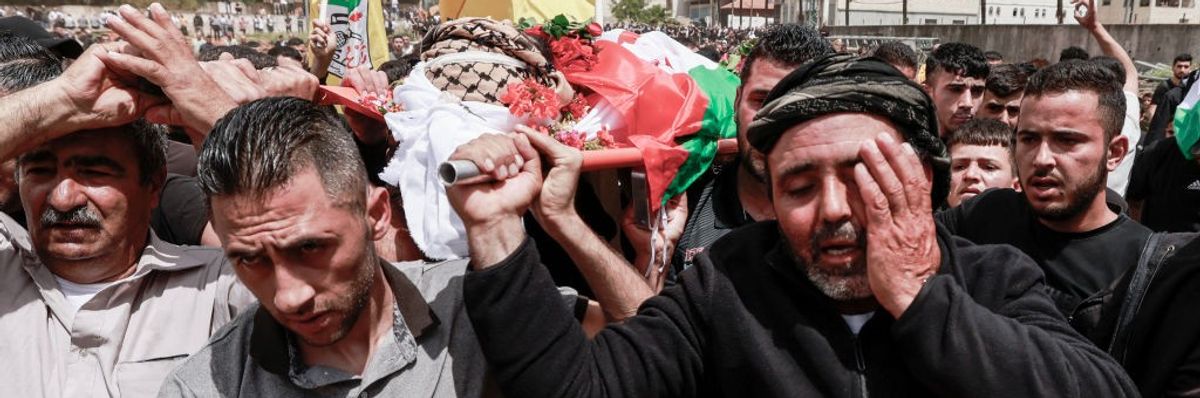
    Mourners carry the body of one of the Palestinian men killed during an Israeli settlers’ attack on the village of Aqraba in the illegally occupied West Bank on April 19, 2024. (Photo: Jaafar Ashtiyeh/AFP via Getty Images)

    “The appalling spike in settler violence against Palestinians in recent days is part of a decadeslong state-backed campaign to dispossess, displace, and oppress Palestinians in the occupied West Bank,” said one Amnesty official.

    Amnesty International said Monday that the ongoing surge in deadly violence by Israeli settlers and soldiers in the West Bank “underscores [the] urgent need to dismantle apartheid” in the illegally occupied Palestinian territories.

    For more than a week now, Israeli settlers have been attacking West Bank Palestinians in towns and villages including Al-Mughayir, Duma, Deir Dibwan, Beitin, and Aqraba, killing at least four people including a child; wounding dozens of others; and destroying homes, vehicles, and other property.

    Israel Defense Forces (IDF) troops have either stood and watched or participated in the settler attacks, which the Israeli human rights group B’Tselem and others are calling a “pogrom.”

    Amnesty said the “alarming spike in violence by Israeli settlers against Palestinians across the occupied West Bank in recent days highlights the urgent need to dismantle illegal settlements, end Israel’s occupation of the occupied Palestinian territories, and its longstanding system of apartheid.

    “The appalling spike in settler violence against Palestinians in recent days is part of a decadeslong state-backed campaign to dispossess, displace, and oppress Palestinians in the occupied West Bank, including East Jerusalem, under Israel’s system of apartheid,” Amnesty Middle East and North Africa regional director Heba Morayef said. “Israeli forces have a track record of enabling settler violence and it is outrageous that once again Israeli forces stood by and in some cases took part in these brutal attacks.”

    “Establishing Israeli settlements in the occupied Palestinian territories flagrantly violates international law and constitutes a war crime,” Morayef added. “Violence is integral to the establishment and expansion of these settlements and to sustaining apartheid. It’s time for the world to recognize this and pressure Israeli authorities to abide by international law by immediately halting settlement expansion and removing all existing settlements.”

    The latest wave of settler violence was sparked by the disappearance of Binyamin Achimair, a 14-year-old Israeli from the illegal settler outpost of Mal’achei Hashalom who went missing on April 12 while herding sheep near the village of Al-Mughayir east of Ramallah. As Israelis searched for Achimair, settlers began attacking Al-Mughayir’s residents and property.

    Achimair’s body was found the following day. Israeli officials said he was killed in a “terrorist attack.” However, no Palestinian resistance group has claimed responsibility for the incident. A 21-year-old Palestinian man was arrested Monday in alleged connection with the boy’s death.

    Late Friday, IDF troops and armored vehicles surrounded the Nur Shams refugee camp east of Tulkarem and besieged the community of more than 6,000 Palestinians during a 50-hour raid in which residents were shot, homes were destroyed, and scores of people were arrested.

    By Saturday, IDF soldiers had killed 14 people in the camp, including at least one child. More than 40 other Palestinians were wounded.

    “I saw one of my relatives, Jihad Zandiq, put his hands in the air to the soldiers but then they shot him anyway from point-blank range and killed him. Half of his skull exploded,” eyewitness Mahmoud Qazmouz told Middle East Eye on Sunday.

    Palestinian officials said Israeli troops attacked first responders attempting to rescue victims, including a volunteer paramedic who was shot in the leg.

    Meanwhile, a funeral was held Sunday for Mohammed Awad Allah Musa, a 50-year-old Palestinian Red Crescent Society volunteer paramedic who was shot dead Saturday by Israeli settler-colonists while trying to reach Palestinians wounded by rampaging settlers in the town of Sa’wiyah south of Nablus.

    The Nur Shams raid and ongoing settler attacks came as the U.S. State Department on Friday announced new sanctions targeting far-right Israeli settler leaders including Ben Zion Gopstein, the founder and head of the Jewish supremacist group Lehava.

    The Biden administration—which backs Israel with billions of dollars in military aid and diplomatic support—is also reportedly considering imposing sanctions on the IDF’s Netzah Yehuda battalion over war crimes committed in the West Bank before the current Israeli war on Gaza, including the January 2022 death of Omar Assad, a 78-year-old Palestinian American man.

    Responding to the prospect of the first-ever U.S. sanctions on his country’s military, far-right Israeli Prime Minister Benjamin Netanyahu said Sunday that “I will fight it with all my strength.”

    According to the Palestinian Health Ministry, at least 485 Palestinians have been killed by Israeli soldiers and settlers in the West Bank since October 7, when Gaza-based militants attacked Israel. More than 1,100 people were killed in the attack—some by responding Israeli forces—and over 240 Israelis and others were kidnapped by Hamas and other militants.

    Israel’s 199-day retaliatory assault on Gaza—which critics including Israelis have called genocidal—has killed at least 34,151 Palestinians, mostly women and children, while wounding over 77,000 others, according to Palestinian and international officials. At least 11,000 Gazans are missing, presumed dead and buried beneath the rubble of the hundreds of thousands of homes and other buildings that have been destroyed or damaged by Israeli bombardment. Around 90% of Gaza’s 2.3 million people have been forcibly displaced, and Israel’s continued obstruction of humanitarian aid delivery has fueled a burgeoning famine in which dozens of people, mostly children, have perished.

    Original article by BRETT WILKINS republished from Common Dreams under Creative Commons (CC BY-NC-ND 3.0).