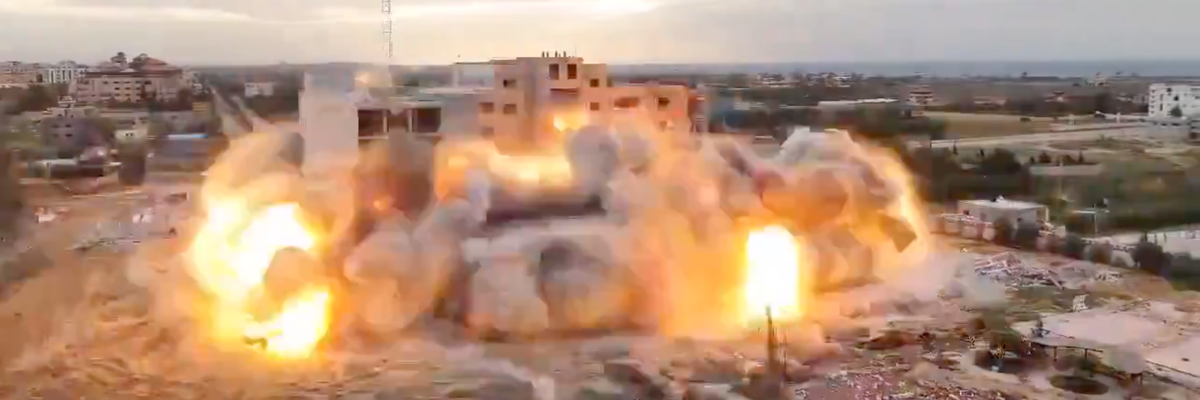
The Israeli military used hundreds of mines to blow up Israa University in Gaza on January 17, 2024. (Photo: Screengrab)
“All the universities in Gaza have been damaged or destroyed,” said one international relations expert.
The Israel Defense Forces’ detonation of more than 300 mines planted at Israa University in Gaza on Wednesday provided the latest evidence that Israel’s objective in its bombardment of the enclave is not self-defense, rights advocates said.
“This is not self-defense,” said Chris Hazzard, an Irish member of the United Kingdom’s Parliament. “This is not counter-insurgency. This is ethnic-cleansing.”
The International Middle East Media Center (IMEMC) called the destruction of Israa University Israel’s latest attempt to carry out a “cultural genocide” along with the slaughter of at least 24,620 people in just over three months—people who Israeli officials have claimed are legitimate military targets despite the fact that roughly half of those killed have been children.
The wiping out of cultural landmarks was included in South Africa’s International Court of Justice case accusing Israel of genocidal acts in Gaza last week, with the complaint noting that “Israel has damaged and destroyed numerous centers of Palestinian learning and culture,” including libraries, one of the world’s oldest Christian monasteries, and the Great Omari Mosque, where an ancient collection of manuscripts was kept before the building was destroyed in an airstrike last month.
“The crime of targeting and destroying archaeological sites should spur the world and UNESCO into action to preserve this great civilizational and cultural heritage,” Gaza’s Ministry of Tourism and Antiquities said after the mosque was bombed.
Now, international relations professor Nicola Perugini of the University of Edinburgh said, “all the universities in Gaza have been damaged or destroyed.”
The Israeli military just blew up the University of Palestine in Gaza City with 315 mines. All the universities in Gaza have been damaged or destroyed. We need a full academic boycott. pic.twitter.com/nNStUTBc9e
On its Facebook page, the university said the IDF had occupied the campus for about 70 days before planting 315 mines and detonating the institution’s main building, its museum, a university hospital, and other buildings.
The IDF occupied Israa University, said administrators, “and used it as a military base for its mechanisms and a center for [the] snatching of isolated civilians in the areas of Rashid, Maghraqa, and Zahraa streets, and temporarily detained [them] to investigate with citizens before moving them.”
Mitchell Plitnick, president of Rethinking Foreign Policy, said the fact that 315 mines were detonated meant that “by definition… it was not a legitimate military target.”
“Israel would have to have full control to plant so many mines,” said Plitnick. “This is a clear example of a war crime and destruction for the fun of it.”
Eight universities in Gaza have now been targeted since the IDF began its bombardment on October 7, according to the IMEMC.
Birzeit University, in the occupied West Bank, condemned the destruction of the school and accused Israel of stealing 3,000 rare artifacts from Israa’s museum.
“Birzeit University reaffirms the fact that this crime is part of the Israeli occupation’s onslaught against the Palestinians,” said the school on social media. “It’s all a part of the Israeli occupation’s goal to make Gaza uninhabitable; a continuation of the genocide being carried out in Gaza Strip.”
The IDF carries out raids to destroy tunnels in Central Gaza, killing dozens. Hamas fires rockets back into Israel. A ground invasion follows aerial bombardments, civilian targets are struck, the number killed climbs into the thousands. This is not a description of the Israel-Hamas war we’re witnessing now, in 2024 – but a near-identical one almost 15 years ago.
In December 2008, the Gaza War (also known as Operation Cast Lead) erupted. On 9 January 2009, the UN Security Council debated a resolution which called for “an immediate, durable and fully respected ceasefire”. The UK voted for it, successfully shifting the US position from opposition to abstention, and the vote was reinforced at the UN General Assembly on January 16. Two days later, Israel declared a unilateral ceasefire, and the war was over. Bold and creative diplomacy by the UK, which whilst they didn’t follow up in a similar vein, nonetheless made a significant difference on the international stage.
Fast forward to today, 100 days since the October 7 Hamas terror atrocities in Israel, and that diplomacy is sorely lacking. In early December, the UK Government committed a grave error by abstaining on a ceasefire motion at the UN Security Council – the lesson of history wasted. It then abstained again a week later in a UN General Assembly vote – making the UK just one of 33 countries to oppose or abstain on the ceasefire motion, while 153 countries voted in favour.
These past 15 years have witnessed five wars – consigning the people of Gaza to ever deteriorating living conditions with barely enough supplies and aid allowed in; the stalemate continues, undermining still further the security of Israel. But with violence spreading through the region into Lebanon, for example, and now the UK and US escalating tensions with their bombing of Yemen, we must make it inconceivable to slip back permanently into endless cycles of violence.
Listening to experts on all sides, there seem to be four key principles that might just start a conversation about how to build the kind of peace which only a fair and lasting political resolution to this crisis can deliver for the people of the region.
Securing a bilateral ceasefire is clearly a critical first principle – ending the current bloodshed and freeing the remaining Israeli hostages is a pre-requisite for peace. As the UN repeatedly states, the bombs and missiles being dropped aren’t just killing people in their tens of thousands; they are also destroying roads, warehouses, hospitals, schools and other so-called safe places.
No wonder so many aid agencies on the ground have gone beyond calling for humanitarian corridors, pauses or safe zones. The size and population density of Gaza mean there is nowhere safe for civilians, and no safe means for aid workers to reach people who urgently need help. The only way to ensure men women and children can escape the bombs is to stop them from being dropped.
The humanitarian case for a ceasefire is overwhelming, but there is a judicial one too – which brings me to the second principle of accountability. Both the Israeli Government and Hamas have responsibilities under international law – above all to minimise civilian casualties, but also only a ceasefire will enable the ICC to conduct investigations into potential war crimes and other human rights violations by both parties, and to establish an Independent Commission of Inquiry.
The UK Government says the right things about adherence to international law, yet very little has changed, and accountability has not been delivered.
Fundamental to this principle is that international law forms the foundations on which all policies must rest both about the conduct of the hostilities and the necessary foundations of a lasting settlement. All parties to this conflict must fulfil the requirements of international law and face the full force of censure and other sanctions if they refuse to do so. The UK’s actions are badly out of step with its legal and moral obligations – it must consistently uphold the international rule of law and make sure Benjamin Netanyahu’s government faces the full consequences of violating international law. Nor should it be involved in any further military action in the region, when this can and will be interpreted as condoning and siding with Israel’s attacks on Gaza.
Thirdly, there has to be dialogue. I understand the rationale behind states refusing to negotiate with terrorist groups. But ensuring lines of communication with Hamas are kept open – along with every back and front channel accessible via the other players in this region, such as Qatar – is the only way to bring the remaining Israeli hostages home to their families and enduring peace.
Clearly the US has the greatest influence over Israel, but the UK can play a critical role too, as the 2009 UN vote demonstrated – our links with Qatar and Egypt should be used to pull every lever possible in support of a consensus on Israel’s right to exist and a Palestinian state. Conversations must happen for peace to be on the table.
It takes courage to start a dialogue – especially when even a shared goal feels unattainable, let alone a peaceful outcome, and murderous regimes like Iran are also involved. But from Northern Ireland and Colombia, talking has secured positive and lasting outcomes. No dialogue is the death of peace. We must believe in it and shake hands for it, as Nurit Cooper, one of the Israeli hostages, so memorably did on her release.
Finally, we must directly confront the complexities that have made peace so elusive to date. My inbox is bursting with different versions of what has brought us to this point – the facts and the feelings. Nuance and debate have been lacking in an era of judgment and condemnation. Those marching for peace are decried as hateful, places of worship are attacked, and our streets have become places where too many people feel afraid.
Laying the groundwork for peace requires acknowledging how people truly feel. A truth and reconciliation process might be one model. Every Palestinian and Israeli has their own story, their own hurt and their own hopes. Here in the UK, this conflict awakens strong feelings too – so we must weigh the impact of our words, as well as the arms we are still supplying to the region, the bombs we are now ourselves dropping on war ravaged Yemen. The UK must stop repeating the same mistakes and instead bring the alternatives to life.
Decades of suffering and Western backed military intervention have acted as potential recruiting sergeant for the likes of Hamas and the Houthis.
Hunger, isolation and hopelessness are among the conditions in which conflicts thrive. So achieving peace demands that the world address these challenges – and only in the context of a settlement that embodies justice, above all the end to occupation.
An ideology cannot be destroyed by guns and bombs. It can only be destroyed by giving people food and medicine, alongside justice and a more hopeful future in which they are treated with dignity – guaranteeing them freedom and a voice.
The eyes of the world may well be on this narrow strip of land right now, but they’ve been largely absent as Gazans have been forced to live in an open prison, systematically stripped of their dignity and freedom, by both the Israeli authorities and by Hamas. We mustn’t let our gaze turn away again.
It’s often said that waging peace is far more difficult than waging war. But we have no choice if we’re to build a safer and more secure world for every child, no matter which side of a border they are born.
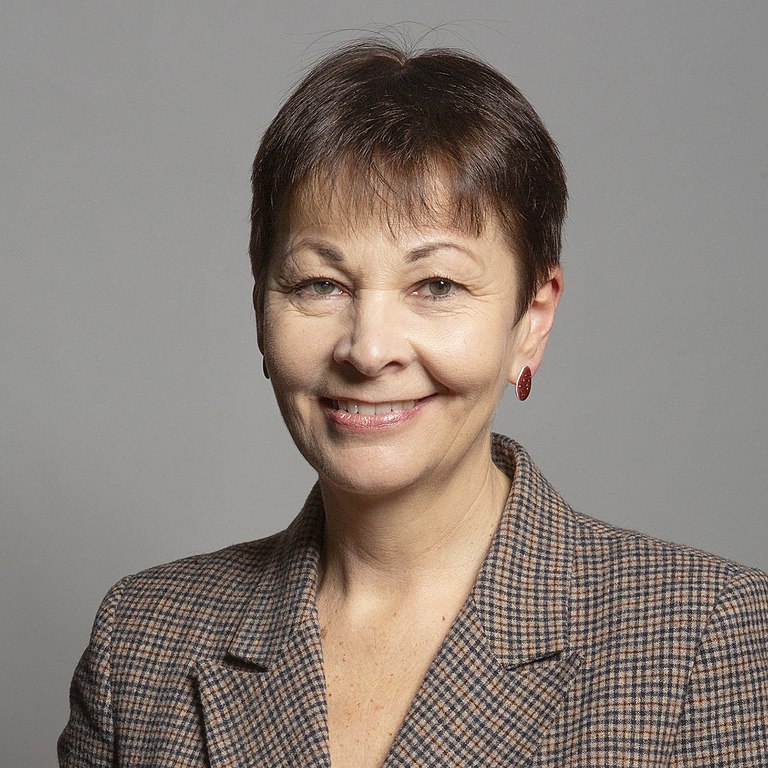
Caroline Lucas Green Party MP for Brighton Pavilion. Official image by David Woolfall Creative Commons Attribution 3.0 Unported license.
Caroline Lucas is the Green Party MP for Brighton Pavilion
I’ve quoted all Caroline Lucas’s article, hope that nobody objects. Authors: It’s likely that you are able to use a Creative Commons licence despite being published by others.
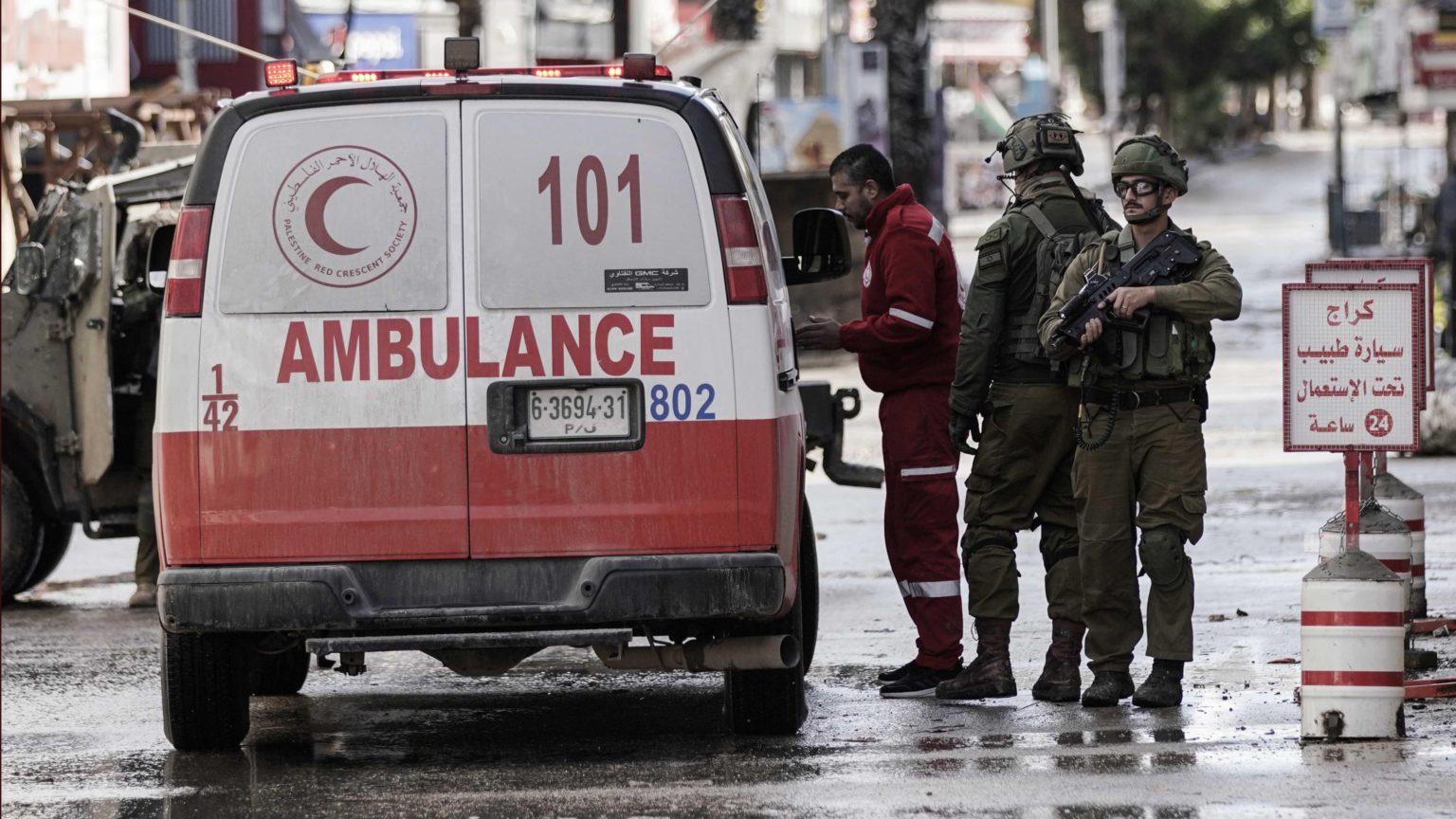
Israeli occupation forces obstructing the work of ambulances in Jenin. (Photo: Mohammad Mansour/WAFA)
Over 500 Palestinians were killed in the West Bank in 2023. Under its undeclared policy of collective punishment, Israel also destroyed a significant amount of civilian infrastructure such as roads, residential buildings, and hospitals in West Bank since October 7
Israel’s war on Gaza has entered its fourth month. It has killed over 23,000 Palestinians in the besieged enclave and injured around 60,000. Nearly 80% of all Gazans have been displaced due to the constant bombings. The amount of destruction and killing in Gaza is horrendous. The offensive has also extended to the West Bank where Palestinians have been facing a form of undeclared collective punishment both before and since the war in Gaza.
Though the West Bank has always faced violent attacks from Israeli occupation, those attacks have increased manifold since the beginning of the war in Gaza. Despite the fact that Hamas does not rule the territory, Israel used the excuse of Operation Al-Aqsa Flood to justify its unprecedented attacks on civilians and their infrastructure there.
Between October 7 and December 31, last year more than 340 Palestinians, including a large number of children, were killed in attacks carried out by both the Israeli forces and illegal settlers.
The Israeli attacks targeted Palestinian civilians, including artists from the famous Freedom Theater, while homes were demolished, hospitals and medical facilities targeted, and roads and other civilian infrastructure uprooted.
At least three Palestinian men were shot and killed by the occupying Israeli forces during the intervening period of Monday evening and Tuesday night in Tulkarm. Video footage of these attacks showed Israeli forces first shooting and killing the men and then running over the bodies of one of them with their military vehicle.
A terrifying scene of an Israeli Jeep running over a young man after shooting him along with two other young men in Tulkarm in the West Bank.
Israeli soldiers prevented paramedics from reaching the young men leaving them to bleed until they died. pic.twitter.com/Udm539Ho0D
Israeli forces reportedly conducted similar night raids in Qalqilya, Nablus, Ramallah, and Bethlehem, among several other places on Tuesday night, arresting scores of people and destroying civic infrastructure.
Israeli occupation is targeting the Palestinians in the West Bank economically as well by refusing to transfer millions of dollars in tax revenue to the Palestinian Authority, leaving it with no money to pay the salaries to its over 140,000 employees. It has also refused to allow around 150,000 workers from the territory to return to their jobs in Israel since October 7.
Deadliest Year since 2005
Israeli forces similarly attacked the Jenin refugee camp a couple of days ago and killed at least 7 Palestinians. They have targeted the camp repeatedly since October 7, killing over 60 Palestinians there and deliberately destroying most of the roads and other civil infrastructure. According to Al-Jazeera, Tulkarm too has been a center of Israeli attacks with at least 60 Palestinians killed since October 7.
In August, the UN had already declared 2023 to be the deadliest year for the West Bank as the number of Palestinians killed in Israeli attacks had crossed 200, more than the previous high of 167 in 2022.
According to the latest data, the total number of Palestinians killed in 2023 has crossed 500 with over 13,000 more injured in the attacks carried out by both illegal settlers as well as Israeli soldiers.
More than 70 of the Palestinians killed in Israeli attacks were children. This is the highest number of the Palestinian children ever killed in the occupied West Bank in a year. Some sources say the death toll among children is even higher.
Settler Violence
According to Israeli human rights organization Yesh Din, 2023 was also the most violent year for the Palestinians in the occupied West Bank in terms of the number of attacks carried out by the illegal settlers. According to it, at least 10 Palestinians were killed in 2023 just in those attacks.
According to the UN Office for the Coordination of Humanitarian Affairs (OCHA), at least 1,225 cases of settler violence were recorded in 2023.
The figure presented by the Palestinian officials for the same is almost double at 2,410. It also claims that the number of Palestinians killed in settler violence in 2023 was 22.
There are around 500,000 Israeli settlers living illegally inside the occupied West Bank. Most of these illegal settlers participate in attacks on nearby Palestinian villages under security cover provided by the Israeli occupation forces.
The settlers attack the villages, burn Palestinian houses, their farms and other properties, and attack people trying to prevent those attacks with the objective of terrorizing people to leave their villages and farms.
Record number of Palestinians detained
More than 11,000 Palestinians were also arrested or detained by Israel in the last year in the occupied West Bank alone, which is almost three times higher than the total number of Palestinians inside Israeli prisons before the beginning of the year.
Some of them were later released after a brief period of detention. Some others were released as part of the prisoner exchange deal between Hamas and Israel. Still the number of Palestinian prisoners inside Israeli jails has jumped from around 4,500 before the beginning of the year to over 7,000 at the end of it.
A joint statement issued by Detainees and Ex-Detainees Affairs Commission, the Palestinian Prisoners Society, Addameer, and others stated that 1,085 of those detained by the Israeli occupation forces from the West Bank in 2023 were children.
As per reports, scores of Palestinian prisoners have been killed inside Israeli jails with large number of them reporting torture and abuse by the prisoner authorities.
Healthcare workers at Al-Awda hospital. Photo: Al-Awda
The number of people infected with contagious diseases in Gaza continues to rise. The latest data from the World Health Organization (WHO) warns that 180,000 people are currently suffering from respiratory infections. Additionally, the UN’s health agency reports that 55,000 people have lice and scabies, 42,000 are experiencing various forms of skin rashes, and 136,000, half of whom are children under 5 years old, have contracted diarrhea.
While these diseases would not be deadly under conditions with a functioning health system and adequate living conditions, in the current situation, they could be life-threatening. “Unless something changes, the world faces the prospect of almost a quarter of Gaza’s 2 million population – close to half a million human beings – dying within a year. These would be largely deaths from preventable health causes and the collapse of the health system,” estimated Devi Sridhar, Chair in Global Public Health at the University of Edinburgh, at the end of 2023.
If a permanent ceasefire does not take immediate effect, though, things are unlikely to change, as reiterated by WHO Director-General Tedros Adhanom Ghebreyesus in a statement. WHO teams, now participating in fairly regular missions on the ground, are sending reports about overcrowding in Gaza’s hospitals and shelters. According to the Palestinian Ministry of Health, on January 4, only 9 out of 36 hospitals were partially functioning in the Strip, resulting in an average bed occupancy of 351% and 261% occupancy in intensive care units.
Israel’s attacks on healthcare in Palestine are affecting everyone, especially the most vulnerable. Cancer and dialysis patients cannot access the specific care they need, and most have not yet been transferred to hospitals abroad as announced. The Ministry of Health estimates that 5,300 patients need to be transferred abroad for treatment, but until January 5, less than 1,000 were moved. This number includes 571 people injured in the attacks and 401 patients who required distinct forms of care, including cancer patients.
Children and pregnant women are also groups most at risk from the attacks and their consequences. Over 5,000 babies were born in Gaza just last month, all requiring adequate care and nutrition. With mothers and families going hungry, it is evident that some of them are also lacking proper food. Among the newborns are about 130 premature babies dependent on incubators, yet most incubators are located in northern Gaza, which, in terms used by the WHO, has become a medical disaster zone.
In addition to going hungry and sleeping in overcrowded tents, newborns and children are also not getting vaccinated. Recounting the experience of a woman who recently gave birth, Nareman, who was “taken from her tent in a temporary camp by horse-drawn carriage to a hospital to give birth to her daughter, before returning to her makeshift home straight after,” the WHO warned that the health system in Gaza is struggling to ensure standard immunization routines. Nareman’s baby is among those who are yet to receive planned vaccines, and she is staying with her sisters and brothers at the camp, who are reportedly in ill health themselves.
The UN Relief and Works Agency for Palestine Refugees in the Near East (UNRWA) has managed to deliver 600,000 key vaccines into Gaza in the period between December 25-29, 2023, and is planning to deliver some 960,000 more together with WHO and UNICEF. Yet, this is no easy feat as Israeli Occupying Forces (IOF) continue to target health infrastructure and health workers. Since the beginning of the attacks on October 7, 326 health workers in Palestine were killed by Israeli attacks, 764 were injured, and 65 were arrested, according to Ministry of Health data.
Many more experienced violence and intimidation by the IOF, including ambulances and partners of the Palestinian Red Crescent Society (PRCS). On January 4, Israeli soldiers attacked a PRCS ambulance. Not long before that, the organization reported attacks targeting the house of Anwar Abu Holi, Director of the Central Gaza Ambulance Center, as well as multiple attacks on the Al-Amal Hospital in Khan Younis.
As shelling in the proximity of the hospital began, Al-Amal offered shelter to approximately 14,000 forcibly displaced people. The attacks, said the PRCS, endangered the lives of thousands. “The displaced persons are living in an atmosphere of horror and panic.”
The attacks that have taken place since the beginning of January killed 7 people, including a days-old baby, injured 11 more, and were reported by the PRCS to be ongoing on January 5, without a meaningful indication they would stop anytime soon.
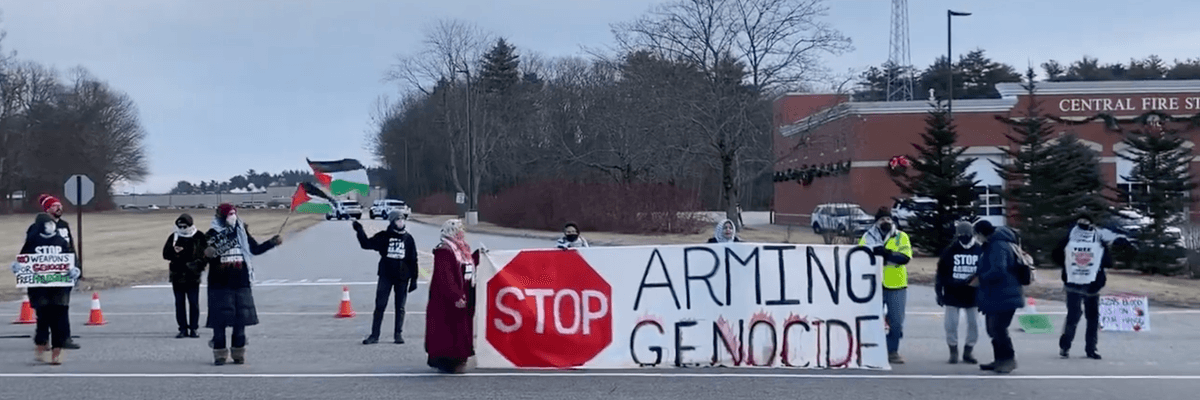
Protesters gathered at a General Dynamics factory in Saco, Maine on January 3, 2024. (Photo: Lisa Savage/X)
“Why do we tolerate this massive bomb factory here in Maine, exploiting the toils of local workers to aid with the intentional mass murder and displacement of innocent children and families in Palestine?”
Defenders of Palestinian rights on Wednesday organized a campout protest at a General Dynamics factory in the city of Saco, Maine to pressure the weapons giant to “stop arming Israel’s genocide in Gaza.”
The demonstrators, led by the Maine Coalition for Palestine, arrived at the roadway leading into the factory before dawn in an effort to prevent workers from entering the facility.
“Genocide in Gaza is currently supported by General Dynamics,” said organizer Lisa Savage of Solon in a statement. “It supplies Israel with the artillery ammunition and bombs used to kill and maim civilians and children in Gaza—which is illegal collective punishment.”
Folks with Maine Coalition for Palestine blocking the entrance this morning to General Dynamics in Saco, which makes the metal bodies of the MK-80 bomb series, the primary weapon type that Israel uses to bomb Gaza. pic.twitter.com/1sLf5eZVYt
Since the Hamas-led attack that set off the war on October 7, the Israel Defense Forces (IDF) have killed more than 22,000 Palestinians in Gaza, injured over 57,000 more, and devastated civilian infrastructure including homes, hospitals, schools, and mosques. A growing number of world leaders and legal scholars have accused Israel of genocide.
General Dynamics—which is headquartered in Virginia but has locations across the United States and around the world—is among a few dozen companies identified in an American Friends Service Committee database as aiding the U.S.-backed Israeli war effort with 155mm caliber artillery shells and the metal bodies of the MK-80 bomb series.
“Since October, more than 5,000 of the 500-lb MK-82 bombs—some made in Saco—have been given to Israel by the U.S.,” said Yusuf Ebrahim, an Iraqi American physician who participated in the protest. “These munitions play a particularly direct role in the ongoing criminal genocide of Palestinians by the IDF, targeting densely populated areas such as the Jabalia refugee camp.”
“Why do we tolerate this massive bomb factory here in Maine, exploiting the toils of local workers to aid with the intentional mass murder and displacement of innocent children and families in Palestine?” Ebrahim continued. “Meanwhile, many local community members suffer from hunger and housing insecurity and cannot afford medical care.”
Members of the Maine Coalition for Palestine include the groups Healthcare Workers for Palestine, the Maine Natural Guard, the Maine Party for Socialism & Liberation, Maine Voices for Palestinian Rights, Portland CONFRONT, and Students for Justice in Palestine from college campuses in the state.
The coalition’s Wednesday action came after a demonstration last month that drew more than 100 protesters to Bath Iron Works, a General Dynamics subsidiary that builds ships for the U.S. military.
The Bangor Daily News reported that Cecil Carey of Skowhegan, a teacher who spoke at the December event, said the group was protesting in Bath because the U.S. government has “got money for war but can’t feed the poor.”
“I do not want my tax dollars going to bomb people in the Middle East,” Carey said. “I want my tax dollars helping my students and their families.”
The United States gives Israel $3.8 billion in annual military aid each year and U.S. President Joe Biden has responded to the Israeli assault on Gaza by asking federal lawmakers for an additional $14.3 billion package that is still under consideration. Since the war began, the Biden administration has also twice bypassed Congress to enable arms sales to Israel.