Article by republished from Common Dreams under Creative Commons (CC BY-NC-ND 3.0).

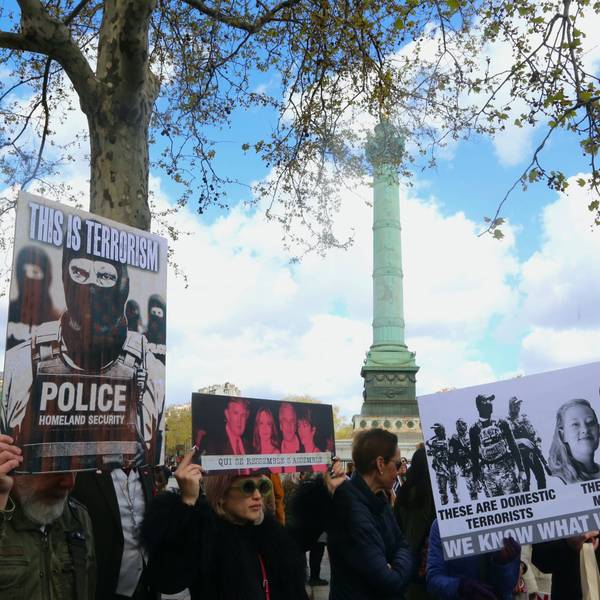
A huge crowd of American expats gathers for the No Kings Movement protest on March 28, 2026 in Place de la Bastille, in Paris, France, displaying signs that label federal agents rather than protesters as “domestic terrorists.” (Photo by Owen Franken Corbis//Getty Images)
National Security Presidential Memorandum-7, which President Donald Trump issued last year, explicitly targets left-wing protesters and beliefs.
Federal prosecutors in Minnesota have struggled to come up with charges that stick as they’ve indicted dozens of people this year for protesting President Donald Trump’s immigration crackdown, and observers suggested Tuesday’s indictments of 15 organizers would likely fail to convince any court. But with a US attorney explicitly citing Trump’s memo threatening to crack down on left-wing protesters, advocates warned the charges were a “major escalation” against First Amendment rights.
US Attorney Daniel Rosen, who was appointed by Trump for the District of Minnesota last year, noted in his announcement of the indictments that Trump issued National Security Presidential Memorandum 7 (NSPM-7) last September and that “Joint Task Force Vanguard,” an investigative group set up “to investigate, prosecute, and disrupt those who engage in political violence and intimidation,” had worked on the case.
NSPM-7, as Common Dreams reported last year, was issued weeks after the assassination of right-wing activist Charlie Kirk and focuses exclusively on left-wing and “anti-fascist” activities, mandating a “national strategy to investigate and disrupt networks, entities, and organizations that foment political violence so that law enforcement can intervene in criminal conspiracies before they result in violent political acts.”
Around the same time, Trump issued an executive order asserting that “antifa,” or the anti-fascist movement, had been designated as a “domestic terrorist organization,” despite the fact that there is no centralized antifa group and that the president does not have the authority to make such a designation.
The president’s directives underpinned the indictment of 15 organizers, including at least one professor and several union leaders and members, who had led direct actions and protests against federal agents during Operation Metro Surge, a crackdown by US Immigration and Customs Enforcement (ICE) and other federal agencies in Minnesota earlier this year.
Rosen said the defendants were members of two Minneapolis-based groups—Direct Action Minnesota and Black Cat Workers Collective—that were associated with “antifa” and were “violently opposed to the enforcement of federal law in our state.”
🚨 Feds point to NSPM-7 as basis for charging 15 anti-ICE protesters in Minnesota, alleging ties to "Antifa".
U.S. Attorney Daniel Rosen: "Last year, President Trump issued National Security Presidential Memorandum 7, which directed the Department of Justice to prioritize… pic.twitter.com/s3uCKCi09V
Twelve of the defendants were arrested on Tuesday, while one had already been in custody on other charges and two had not yet been detained.
The charges include conspiracy to impede or injure a federal officer, solicitation to commit a crime of violence, interstate stalking, assault on a federal officer, and destruction of government property.
But after examining the indictment, David Bier, director of immigration studies at the libertarian Cato Institute, found just one “documented, charged violence by any defendant in the actual indictment against any ICE agent’s person”: A defendant, William Morgan, “approached one of the agents and knocked the agent’s notes out of his hand.”
Bier listed the rest of the overt acts included in the 94-page indictment, which he described as a “cobbled together series of basically unrelated incidents or comments, nearly all of it not criminal with a few minor crimes, effectively all nonviolent acts of civil disobedience.”
The other acts include “attending meetings,” “posting on Facebook and social media about resistance to ICE,” “posting flyers advertising direct actions,” “conducting after-action reviews,” “forming human blockades” at a building used for ICE operations in Minneapolis, and impeding ICE vehicles with sandbags, debris, and vehicles to block roads.
You can read the indictment below. It is a cobbled together series of basically unrelated incidents or comments, nearly all of it not criminal with a few minor crimes, effectively all nonviolent acts of civil disobedience.
At the press conference Tuesday, evidence presented by Rosen included a Facebook post in which one defendant, Cameron Kennedy, said, “We need to become ungovernable.”
Organizers expressed that they were “highly critical of nonviolent peaceful protest,” said Rosen.
“Oh,” said Bier in response on social media.
"Here you will see a social media post that says 'we need to become ungovernable.'" Oh. https://t.co/iQ2DBipBYl
Journalist Ryan Grim of Drop Site News also pointed to a section of the indictment that accuses Isaac Auman Sant of engaging in conduct that “caused, attempted to cause, or would be reasonably expected to cause substantial emotional distress to a person.”
“Actual federal charges in Minnesota for hurting ICE agents’ feelings,” Grim said.
The defendants appeared in the US District Court for the District of Minnesota on Tuesday, where Judge John Docherty said the defendants were being released for the time being and that the conditions for a detention hearing had not been met.
A defendant named Erik Davis, a religious studies professor at Macalester College, told Docherty that according to the indictment, he was being “indicted for holding meetings.”
While the charges were denounced as outrageous by a number of observers, an attorney for one of the defendants, Bruce Nestor, told Democracy Now! that the conspiracy charge “is really an attempt to broaden the net of federal law enforcement and to expand the ability of the federal government to target our movement and to foster repression.”
Federal prosecutors have charged 15 Minnesotans for conspiracy to impede or injure immigration officers in Minneapolis earlier this year during President Trump’s so-called Operation Metro Surge. The indictment has linked the defendants to anti-fascist or "antifa" groups. Trump… pic.twitter.com/5eAI1WmUrI
Adam Federman of Type Investigations said the administration’s strategy for cracking down on those who oppose its political agenda appears to be: “Define a loose coalition of activists opposed to the government’s immigration policies as Antifa, make the case that Antifa is a terrorist organization, and then prosecute them on conspiracy charges. We’re going to see a lot more of this.”
The indictment was announced weeks after federal prosecutors dropped all charges against four protesters who had been accused of interfering with ICE agents at a detention center in the Chicago area.
In March, the Trump administration won its first legal victory in its effort to criminalize groups that organize against its agenda when a federal jury convicted eight people of domestic terrorism because they wore all black to a protest outside ICE’s Prairieland Detention Facility in Alvarado, Texas, where one of the protesters shot and wounded a police officer.
“Prairieland was exhibit A,” said Federman on Tuesday. “My guess is that we will get to the end of the alphabet before this administration runs its course.”
US Rep. Ilhan Omar (D-Minn.) noted that the federal officers who fatally shot two Minneapolis protesters, Renée Good and Alex Pretti, in January have not been criminally charged.
“While the killers of Renée Good and Alex Pretti walk free, the DOJ is busy bringing bogus charges against protesters,” said Omar. “The administration thinks intimidation will make us back down. They keep learning the same lesson: Minnesotans don’t scare easily. We organize for our rights.”
Article by republished from Common Dreams under Creative Commons (CC BY-NC-ND 3.0).

Climate science denier Donald Trump confirms that he knows nothing about democracy and that more liquid gold is being secured according to his policy of global privateering.Orcas discuss Donald Trump and the killer apes’ concept of democracy. Front Orca warns that Trump is crashing his country’s economy and that everything he does he does for the fantastically wealthy.
A huge crowd of American expats gathers for the No Kings Movement protest on March 28, 2026 in Place de la Bastille, in Paris, France, displaying signs that label federal agents rather than protesters as “domestic terrorists.” (Photo by Owen Franken Corbis//Getty Images)
National Security Presidential Memorandum-7, which President Donald Trump issued last year, explicitly targets left-wing protesters and beliefs.
Federal prosecutors in Minnesota have struggled to come up with charges that stick as they’ve indicted dozens of people this year for protesting President Donald Trump’s immigration crackdown, and observers suggested Tuesday’s indictments of 15 organizers would likely fail to convince any court. But with a US attorney explicitly citing Trump’s memo threatening to crack down on left-wing protesters, advocates warned the charges were a “major escalation” against First Amendment rights.
US Attorney Daniel Rosen, who was appointed by Trump for the District of Minnesota last year, noted in his announcement of the indictments that Trump issued National Security Presidential Memorandum 7 (NSPM-7) last September and that “Joint Task Force Vanguard,” an investigative group set up “to investigate, prosecute, and disrupt those who engage in political violence and intimidation,” had worked on the case.
NSPM-7, as Common Dreams reported last year, was issued weeks after the assassination of right-wing activist Charlie Kirk and focuses exclusively on left-wing and “anti-fascist” activities, mandating a “national strategy to investigate and disrupt networks, entities, and organizations that foment political violence so that law enforcement can intervene in criminal conspiracies before they result in violent political acts.”
Around the same time, Trump issued an executive order asserting that “antifa,” or the anti-fascist movement, had been designated as a “domestic terrorist organization,” despite the fact that there is no centralized antifa group and that the president does not have the authority to make such a designation.
The president’s directives underpinned the indictment of 15 organizers, including at least one professor and several union leaders and members, who had led direct actions and protests against federal agents during Operation Metro Surge, a crackdown by US Immigration and Customs Enforcement (ICE) and other federal agencies in Minnesota earlier this year.
Rosen said the defendants were members of two Minneapolis-based groups—Direct Action Minnesota and Black Cat Workers Collective—that were associated with “antifa” and were “violently opposed to the enforcement of federal law in our state.”
🚨 Feds point to NSPM-7 as basis for charging 15 anti-ICE protesters in Minnesota, alleging ties to "Antifa".
U.S. Attorney Daniel Rosen: "Last year, President Trump issued National Security Presidential Memorandum 7, which directed the Department of Justice to prioritize… pic.twitter.com/s3uCKCi09V
Twelve of the defendants were arrested on Tuesday, while one had already been in custody on other charges and two had not yet been detained.
The charges include conspiracy to impede or injure a federal officer, solicitation to commit a crime of violence, interstate stalking, assault on a federal officer, and destruction of government property.
But after examining the indictment, David Bier, director of immigration studies at the libertarian Cato Institute, found just one “documented, charged violence by any defendant in the actual indictment against any ICE agent’s person”: A defendant, William Morgan, “approached one of the agents and knocked the agent’s notes out of his hand.”
Bier listed the rest of the overt acts included in the 94-page indictment, which he described as a “cobbled together series of basically unrelated incidents or comments, nearly all of it not criminal with a few minor crimes, effectively all nonviolent acts of civil disobedience.”
The other acts include “attending meetings,” “posting on Facebook and social media about resistance to ICE,” “posting flyers advertising direct actions,” “conducting after-action reviews,” “forming human blockades” at a building used for ICE operations in Minneapolis, and impeding ICE vehicles with sandbags, debris, and vehicles to block roads.
You can read the indictment below. It is a cobbled together series of basically unrelated incidents or comments, nearly all of it not criminal with a few minor crimes, effectively all nonviolent acts of civil disobedience.
At the press conference Tuesday, evidence presented by Rosen included a Facebook post in which one defendant, Cameron Kennedy, said, “We need to become ungovernable.”
Organizers expressed that they were “highly critical of nonviolent peaceful protest,” said Rosen.
“Oh,” said Bier in response on social media.
"Here you will see a social media post that says 'we need to become ungovernable.'" Oh. https://t.co/iQ2DBipBYl
Journalist Ryan Grim of Drop Site News also pointed to a section of the indictment that accuses Isaac Auman Sant of engaging in conduct that “caused, attempted to cause, or would be reasonably expected to cause substantial emotional distress to a person.”
“Actual federal charges in Minnesota for hurting ICE agents’ feelings,” Grim said.
The defendants appeared in the US District Court for the District of Minnesota on Tuesday, where Judge John Docherty said the defendants were being released for the time being and that the conditions for a detention hearing had not been met.
A defendant named Erik Davis, a religious studies professor at Macalester College, told Docherty that according to the indictment, he was being “indicted for holding meetings.”
While the charges were denounced as outrageous by a number of observers, an attorney for one of the defendants, Bruce Nestor, told Democracy Now! that the conspiracy charge “is really an attempt to broaden the net of federal law enforcement and to expand the ability of the federal government to target our movement and to foster repression.”
Federal prosecutors have charged 15 Minnesotans for conspiracy to impede or injure immigration officers in Minneapolis earlier this year during President Trump’s so-called Operation Metro Surge. The indictment has linked the defendants to anti-fascist or "antifa" groups. Trump… pic.twitter.com/5eAI1WmUrI
Adam Federman of Type Investigations said the administration’s strategy for cracking down on those who oppose its political agenda appears to be: “Define a loose coalition of activists opposed to the government’s immigration policies as Antifa, make the case that Antifa is a terrorist organization, and then prosecute them on conspiracy charges. We’re going to see a lot more of this.”
The indictment was announced weeks after federal prosecutors dropped all charges against four protesters who had been accused of interfering with ICE agents at a detention center in the Chicago area.
In March, the Trump administration won its first legal victory in its effort to criminalize groups that organize against its agenda when a federal jury convicted eight people of domestic terrorism because they wore all black to a protest outside ICE’s Prairieland Detention Facility in Alvarado, Texas, where one of the protesters shot and wounded a police officer.
“Prairieland was exhibit A,” said Federman on Tuesday. “My guess is that we will get to the end of the alphabet before this administration runs its course.”
US Rep. Ilhan Omar (D-Minn.) noted that the federal officers who fatally shot two Minneapolis protesters, Renée Good and Alex Pretti, in January have not been criminally charged.
“While the killers of Renée Good and Alex Pretti walk free, the DOJ is busy bringing bogus charges against protesters,” said Omar. “The administration thinks intimidation will make us back down. They keep learning the same lesson: Minnesotans don’t scare easily. We organize for our rights.”
Orcas discuss Donald Trump and the killer apes’ concept of democracy. Front Orca warns that Trump is crashing his country’s economy and that everything he does he does for the fantastically wealthy.
Protesters and US Immigration and Customs Enforcement agents face off in Minneapolis following the January 13, 2026 fatal shooting of Renee Good. (Photo by Elizabeth Flores/The Minnesota Star Tribune)
“The federal government sent hordes of masked, armed agents to grab people off the street, whisk them away in shackles, and abuse those who sought to bear witness,” Human Rights Watch said of the deadly blitz.
Human Rights Watch on Thursday published a scathing report detailing how President Donald Trump “caused a human rights crisis” in Minnesota by ordering the deadly federal invasion of the Twin Cities in service of the administration’s mass deportation agenda.
HRW called Operation Metro Surge, launched by Trump last December, “an unprecedented deployment of thousands of federal immigration agents and officers to the state of Minnesota,” including members of Immigration and Customs Enforcement (ICE) and Customs and Border Protection (CBP).
“The Trump administration claimed that Operation Metro Surge was designed to keep Americans safe and often stated that it was targeting noncitizens with violent criminal histories,” the report states. “But the operation itself caused significant harm, and nearly two out of three immigrants arrested by ICE during Operation Metro Surge had no prior US criminal history whatsoever.”
At least three people have been killed in connection with the operation. ICE agent Jonathan Ross fatally shot Renée Good, a 37-year-old US citizen, in Minneapolis on January 7. A week later, 36-year-old Nicaraguan detainee Victor Manuel Díaz, who was arrested during the operation, became the third person to die at the notorious East Montana concentration camp in Texas. On January 24, CBP officer Raymundo Gutierrez and Border Patrol agent Jesus Ochoa shot and killed nurse Alex Pretti, 37, also in Minneapolis.
“Federal agents shot a third Minneapolis resident and pulled guns on dozens more,” the report continues. “Agents also violently smashed car windows without justification, physically threw people to the ground who were not resisting arrest, and deployed chemical irritants and flash-bang grenades on dozens of occasions, sometimes at close range and without warning, resulting in injuries, including to journalists.”
Furthermore, federal agents “unlawfully arrested and detained hundreds; engaged in racial profiling, harassment, and surveillance; and terrorized Minnesotans, chilling their rights to freedom of expression and assembly, and impacting their rights to education and health, among others,” HRW said, adding that “residents faced further abuses when they collectively acted to protest, prevent, and stop these violations of their rights.”
The HRW report calls for an immediate end to abusive federal enforcement operations in Minnesota; independent investigations into alleged unlawful killings, racial profiling, arbitrary arrests, excessive force, and other rights violations; and full accountability for officials responsible.
“The federal government sent hordes of masked, armed agents to grab people off the street, whisk them away in shackles, and abuse those who sought to bear witness,” Reagan Williams, HRW’s crisis and conflict researcher, said in a statement. “Minnesotans mobilized to protest, to document abuse, and to provide critical aid to one another. National-level action is needed to ensure accountability, end ongoing abuses, remedy the harm, and prevent another crisis of this scale.”
“Operation Metro Surge put the violent and abusive practices of these agencies on full display,” Williams added. “We have clear proof of how they operate when impunity prevails, and we need to urgently chart a new way forward through accountability and structural reforms that put an end to these abuses.”
A graphic posted to the website for former Border Patrol commander Gregory Bovino’s 2028 presidential exploratory committee on June 4, 2028. (Graphic from Bovino2028.com)
Bovino’s plan to purge the country of one-third of its population has been described as an “ethnic cleansing” proposal. He recently discussed it at a conference with European neo-Nazis.
Fresh off his appearance at a fascist conference in Portugal focused on “remigration,” President Donald Trump’s ex-Border Patrol Commander Gregory Bovino has teased a run for US president in 2028 centered around his fantasy of deporting 100 million people from the United States.
Amid public backlash following the killing of two US citizens by his federal agents in Minneapolis, Bovino was kicked from the helm of Trump’s mass deportation crusade in January and sent into early retirement.
But as he later discussed with The New York Times, he departed with a sense of unfinished business, unfulfilled that he could not exact what was described as a “master plan” to purge a third of the country.
As News Nation reported on Monday, Bovino is not one to give up on dreams easily. The 30-year Border Patrol veteran told the network that he was launching an exploratory committee for a White House run in 2028 and planned to move ahead with a formal campaign “if it all comes together.”
The website for his committee, Bovino2028.com, which features an image of Bovino in his signature SS-style trenchcoat flanked by the phrase “House Bovino. Men Fight Back,” gives a sense of the campaign he seeks to run.
Gregory Bovino being the first 2028 candidate to launch an exploratory committee — with this, um, interesting graphic on his website, no less — was not on my Bingo card. https://t.co/QxLMDwKj4Lpic.twitter.com/I3WQcFFRJK
The website describes a future President Bovino leading the US with a “warrior mindset,” “quelling the foreign hordes that have subsumed our nation’s cities,” and creating a “department of youth masculinity” to turn young men into “warriors for freedom,” and calls for the reestablishment of Elon Musk’s failed Department of Government Efficiency (DOGE).
His website also does not shy away from acknowledging his role in a conference in late May were he appeared alongside representatives of the global far-right. As Charles R. Davis described late last month for The Redoubt:
The “Remigration Summit 2026,” so called, was held May 30 at the Salmanha Residence hotel just south of Porto, Portugal, and its organizers were not subtle.
“Weimar conditions require Weimar solutions,” argues Afonso Gonçalves, chief organizer of the event. He’s the founder of the far-right group Reconquista, so named for the mass expulsion of Muslims from the Iberian Peninsula. That’s who Bovino was photographed standing next to after he landed in Europe.
Martin Sellner, an extremist from Austria, is best known for pushing the “great replacement” conspiracy theory— that Jewish elites are seeking to exterminate the white race via mass migration—that has motivated mass shooters from Pennsylvania to New Zealand.
He was the other man standing next to Bovino.
Other speakers included a Belgian fascist convicted of Holocaust denial and the founder of a Swiss neo-Nazi group called “Junge Tat” who is quite open about his fondness for “National Socialism.”
Bovino is not looking to hide his affiliations with prominent neo-Nazis. The site prominently features a photo of himself with Sellner, who at a previous summit outlined a plan for the forced expulsion of “non-assimilated” citizens of immigrant backgrounds from Germany.
The ex-Border Patrol commander said during the conference that his and Sellner’s ideas “mirror each other.”
Gregory Bovino poses with Martin Sellner in an image posted to his 2028 website.(Photo from Bovino2028.com)
Confirming that he was considering a presidential run on Monday, Bovino wrote on social media: “My one and only priority is deporting the 106 million illegals who are here. That’s it.”
According to May data from the Center for Migration Studies, the number of undocumented immigrants actually in the United States was only about 14.6 million as of 2024, meaning that what Bovino is actually proposing is the mass expulsion of tens of millions of legal immigrants, as well as naturalized and US-born citizens.
David J. Bier, an immigration expert at the libertarian Cato Institute, testified about this plot by Bovino in front of the Senate Budget Committee in March, describing it as a plan for “ethnic cleansing”—and pushing back when one Republican senator dismissed the claim as “hyperbole.”
Cato Institute Immigration Studies Director @David_J_Bier: "They're trying to deport U.S.-born citizens…These are not hyperbolic statements!"
Polls indicate Americans have overwhelmingly turned against Trump’s crusade to round up millions of immigrants, with strong majorities having negative views of his tactics and of Immigration and Customs Enforcement (ICE). In early March, just over a month after Bovino’s tenure ended, a record 50% of Americans said in a YouGov poll that they would support abolishing ICE.
But Bovino said the “grassroots support” he’s seeing indicates that “the polls are completely wrong.”
He said: “If I’m getting this much energy, it’s probably because 90% of the country wants mass deportations, and the media just isn’t asking the right questions.”
While it is difficult to see Bovino achieving mass appeal on the back of an immigration crusade even more extreme than Trump’s, Oliver Willis, a writer for the Daily Kos said it was a sign of where the base of the GOP could be heading.
“The Republican Party has increasingly tied itself to the white supremacist movement through continued support of Trump and the rising influence of figures like conservative podcaster and neo-Nazi Nick Fuentes,” he wrote. “Bovino considering a 2028 presidential bid shows that the party—and the wider conservative movement—isn’t moderating at all.”
Kicking out Palantir, experts warn, may not solve the problems its Federated Data Platform has created.
NHS England’s Federated Data Platform, run primarily by controversial US military contractor Palantir, would give a future UK government the ability to use patients’ healthcare data to unleash unprecedented mass surveillance, experts and technologists have warned openDemocracy.
“We have already seen in the US how Palantir’s reach into so many different areas of government has allowed it to build a system that provides detailed profiles of people to enable ICE raids,” said Duncan McCann of the Good Law Project, referring to how President Donald Trump’s mass deportation programme has used Palantir’s tools. “The exact same thing is being enabled by the integration of Palantir into the UK public sector.”
This risk is only exacerbated by the fact that nearly three years after Palantir was awarded the £330m contract to run the FDP, it remains unclear what patient data it gathers, on what basis and to what end. Despite this, 69% of regional NHS Trusts have already adopted the platform, which provides the health service with a new operating system intended to link up otherwise unconnected databases and disparate software across different NHS services and regions.
This lack of clarity was laid bare this week, when the UK’s cross-party Science, Innovation and Technology Committee urged the government to break the NHS’s contract with Palantir. Its report contained a stark recommendation to the government: reveal “the exact nature of Palantir’s access to identifiable and non-identifiable patient data, on what statutory basis this was authorised, when, and by whom.”
McCann and the Good Law Project are part of an unusually wide coalition demanding the UK cut ties with Palantir, but technologists who have worked closely on the FDP warn that the genie is now out of the bottle; kicking the US giant out of the NHS may not be enough to solve the data privacy problems its Federated Data Platform has created.
“You know you could pull Palantir out,” Tom Bartlett, an NHS technologist who worked on the FDP and has spoken publicly in favour of the project, told openDemocracy. “But the danger remains.”
“You still might get a government that says, ‘We need to have the data from the NHS and the data from the Home Office connected, and we want to use it for the purpose of denying people healthcare or deporting people or whatever’.”
Coalition of Resistance
To understand how deeply Palantir is enmeshed in the UK’s public sector, consider the coalition opposed to it.
NHS data analysts and chief data and analytical officers have spoken out against the FDP. The British Medical Association, a union representing doctors and medical students, has urged GPs to reject it. The Greater Manchester Integrated Care Board, which oversees NHS services for 2.8 million people, has refused to sign up to the platform, claiming outstanding security risks haven’t been addressed, and that it has better technology in-house.
It’s not just the NHS, either. London’s mayor has blocked a £50m Palantir contract with the Metropolitan Police, arguing that it was improperly awarded. The housing ministry replaced a Palantir system to match British hosts with Ukrainian refugees with its own technology. In Coventry, local politicians and unions are protesting the renewal of a £750,000 Palantir contract with the council’s children’s services department. Financial Conduct Authority employees are seeking to orchestrate a cross-union campaign against a 12-week trial contract with Palantir that they fear could expose the UK’s sensitive financial data to US law enforcement authorities.
“Our pilot with Palantir allows the Met for the first time to bring together data it already lawfully holds in one place to identify potential standards, welfare or cultural concerns,” said a spokesperson for The Met over email. “It also allows us to identify early issues so we can act more fairly and consistently, ensuring officers receive support or face appropriate action before problems escalate.” In April, Met officers expressed outrage at the “intrusive” use of Palantir’s technology to assess them for misconduct.
The Financial Conduct Authority’s contract with Palantir involves testing an AI search tool for its data. “The data used in the trial will be fully encrypted and under our control,” wrote a spokesperson for the regulator over email. “No-one is able to access the unencrypted data without our authorisation.”
Coventry City Council did not respond to questions about its Palantir contract.
He co-founded the company with $2 million from the venture capital arm of the CIA in the early 2000s, when the failure to prevent 9/11 was being debated across Washington and Silicon Valley. It was suspected, and would be confirmed by the public report a year later, that the CIA, the FBI, and the National Security Agency had separately held the data required to have foreseen the terror attacks, but had “failed to connect the dots”.
That finding has since been the basis of much of Palantir’s success. It argues that governments, militaries, law enforcement authorities and businesses already have much of the data they need to make decisions, but that it is not readily available in the forms needed.
Palantir, it tells them, is the solution.
“The actual thing that’s difficult is organising all your data together,” Alex Bores, a member of the New York State Assembly and a former Palantir employee turned critic, told The New York Times. “That requires hard work, and there’s no magic to do that yet. The software, plus engineers going on site and doing a lot of that hard work to do the manual hookups, was always going to be the true source of value.”
Databasing the Nation
In the NHS, Palantir’s work involves organising, hooking up, and streamlining vast troves of patient data currently scattered across, by one count, 44,000 healthcare IT systems in 26,000 organisations. “The fragmentation is absolutely massive,” said Bartlett, who helped build the FDP. “There’s all this information, and it’s all sat in different pockets.”
Palantir’s solution has two layers. Bartlett describes one layer as an “operating system” analogous to the software that runs your iPhone, which will allow NHS Trusts and third-party developers to create applications (or what Palantir calls “products”) that allow for efficiency gains. An ambulance crew, for example, could input information about an accident victim to a product that would pass it onto the hospital, so that “the A&E department could prepare, rather than being sort of hit in the face” with information when the ambulance arrives, he said.
Yet, much like how your iPhone decisively locks you into the ecosystem of Apple products, running this system efficiently requires as much of the NHS as possible to sign on to the Palantir system – something experts call “vendor lock-in” – and to draw on a staggering library of data held across the health service.
The FDP’s public documentation reveals that the platform is already in the process of ingesting several hundred databases, covering a vast array of variables that include mental healthcare contact activity, mortality, flu vaccination status, covid vaccination status, emergency services data, race and ethnicity, aggregated data for persons held in secure mental health facilities in adult prisons and immigration removal centres, and much more.
As the cross-party committee of MPs noted in their report last week, there is little clarity around exactly what data will make it into the FDP, and how it will be accessed. The debate around patient data held by GP practices offers a useful illustration.
Back in 2023, the then secretary of state for health and social care, Victoria Atkins, told the House of Commons: “No new data will be collected, and GP data will not be part of the national platform.” However, an NHS FAQ page last updated in April 2026 admits that “some of the data” in the FDP “may have been sourced from GP records”, and GP data lawfully shared with NHS trusts that use the FDP could end up on the platform.
More worryingly, the FDP uses all this data to create detailed profiles of individual patients that it calls the ‘Person Ontology’. To quote from an NHS Data Protection Impact Assessment: “The Person Ontology serves as the single source of the truth for pseudonymised patient level datasets”.
Elsewhere, the document says that “the Person Ontology currently holds activity data for citizens in different care settings”, explaining that the platform assigns individual patients a unique ID that can be cross-referenced across multiple databases.
The NHS says that as the data held in the FDP is pseudonymised, it does not directly identify individuals. But pseudonymisation, as has been pointed out by the Information Commissioner’s Office, the UK’s data protection watchdog, is a reversible process. “Take care not to confuse pseudonymisation with anonymisation,” the ICO warns.
A person’s healthcare data is their “most intimate information,” said a spokesperson and legal officer at Privacy International, a UK-based charity focusing on technology and rights. “We’re talking about the breadth of the data, how personal it is, and the severity of what could be done with it if it were to land in the wrong hands.”
Big Data Means Big Brother
Consolidating so much data brings very real risks of surveillance, say those familiar with the platform, particularly since Palantir also holds contracts with police forces in the UK. In principle, all that’s stopping the Home Office from accessing NHS data are legal safeguards that can be reversed.
Here in the UK, Palantir UK CEO Louis Mosley has said that if Nigel Farage’s Reform comes into power, the company will follow the party’s professed directives to use NHS data to target individuals based on their immigration status.
Such a scenario played out in the US when Trump first became president in 2016, as Bores, the former Palantir employee, told The New York Times.
“Palantir had signed a contract with a department within ICE called HSI, Homeland Security Investigations. During the Obama administration, it was focused on anti-human trafficking, anti-drug trafficking, sometimes counterfeiting,” Bores said. “Then, when Trump comes in in 2017, they try to change the nature of that work. They try to get another part of ICE called ERO, Enforcement and Removal Operations – the part that everyone thinks of as ICE – to get access to the software and to use it for deportations.”
In the US, Palantir already uses data from the Department of Health and Human Services to track people targeted for deportation by ICE. Here in the UK, junior doctor Rhiannon Mihranian Osborne, who is organising against Palantir in the NHS with health justice organisation Medact, described what she said was a disturbing pattern: “Reform’s policy ‘Operation Restoring Justice’ wants to create a powerful immigration surveillance system by mining data from health, police and financial databases. Louis Mosley said his company would comply with this.
“Palantir’s police contracts in the UK include collating highly sensitive information on victims of crime, including sexual orientation and trade union membership. The home secretary says she wants to create a panopticon of state surveillance. The synergy between Palantir and governments who use data to abuse human rights is deeply alarming, and a sign of what could be coming in the UK.”
This is a real risk, conceded Bartlett. “Let’s take [a] Reform government and the immigration question coming in, I do worry about that scenario,” he said – but he questioned whether that means the NHS doesn’t need a Federated Data Platform. “So is the answer to that bad scenario playing out to keep the data in such a bad state that nobody could ever use it at all for good or bad?”
Palantir, NHS England, the Cabinet Office, the Department of Health and Social Care and The Reform Party did not respond to requests for comment.
Critics of the FDP, however, have pushed back against what they see as a narrative that the NHS’s systems are so hopelessly complex and tangled that the only way to solve them is with a mass surveillance tool built by Palantir.
“There’s no magic here,” Sam Smith, a technologist with patient rights organisation medConfidential, said of the FDP. “It’s not like Palantir is doing anything that other people can’t do… They’re just doing the thing because they have the mythos that they can do the thing.”
Andrew Holway, the founder of UK-based medical software startup Darwinist, told the cross-party committee that “the primary barrier to NHS innovation” is mega contracts with companies such as Palantir. These, he said, hold the NHS “hostage, preventing the implementation of modern productivity tools that could save tens of billions of pounds”.
Some in the NHS have also questioned whether the service has tried different approaches that are less intrusive and data-centric. The NHS Greater Manchester Integrated Care Board, for instance, uses its own Analytics and Data Science Platform because it believes it offers better technology and access to better data.
“Public trust isn’t a side issue for the Federated Data Platform,” wrote Matt Hennessey, the chief data and analytics officer at Manchester Integrated Care Board, in a post on LinkedIn. He outlined the “effect that ethical concern, moral unease or perceived opacity has on trust–and, in turn, on participation.”
The platform’s “main problem is that it isn’t clear what it actually is,” he wrote. “Where trust is eroded, people disengage, patients opt out, and clinicians become cautious about involvement.”
Ultimately, as Osborne said, “any NHS data system must be built on public trust, buy-in from staff, and most importantly, protection from abuse by private corporations and governments themselves”.