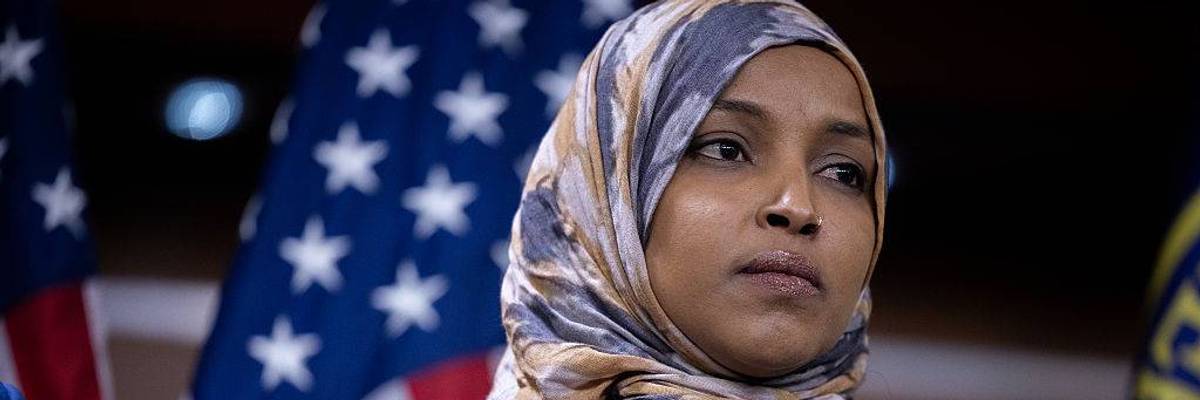
Rep. Ilhan Omar (D-Minn.) is seen at a press conference with other members of the Congressional Progressive Caucus on funding for and efforts to reform the Department of Homeland Security, in Washington, DC on, January 13, 2026.(Photo by Nathan Posner/Anadolu via Getty Images)
Trump and other Republicans have called for Omar to be stripped of her citizenship and deported for years.
Following years of threats from President Donald Trump and other Republicans to deport Rep. Ilhan Omar, the Minnesota congresswoman’s Washington, DC home was raided on Monday morning by agents with the Department of Homeland Security.
The US Department of Justice (DOJ) has confirmed that the raid was carried out as part of a judicially authorized warrant, which it said was part of an ongoing criminal investigation.
Fox News, which first reported news of the raid, said it was part of a probe into the naturalization paperwork filed by Omar’s late father when she became a US citizen in 2000 after immigrating to the US as a refugee from Somalia in 1995.
In September, The New York Post reported that federal investigators were examining whether Omar may have been older than 17 when she obtained citizenship through her father as a minor in 2000. The allegation, which stems partly from a discrepancy in historical records of her birth year, has not been substantiated.
Aaron Reichlin-Melnick, a fellow at the American Immigration Council, argued that the case was “even weaker than it already seems,” since federal immigration law includes a waiver for people who obtain legal status through fraud they were unaware of.
Joyce Vance, who served as the US attorney for the Northern District of Alabama under President Barack Obama, noted that the raid took place just weeks before the November 3 midterms, inside the 60-day window where DOJ typically avoids such dramatic actions.
“To state what’s obvious to prosecutors here, we are within the period before an election where DOJ doesn’t take overt steps in an investigation that might influence its outcome,” she said, adding that it was “another hard norm out the window.”
Omar has not yet commented on the raid as of Monday morning, and the DOJ has not indicated what, if any, specific charges have been filed against her.
BREAKING: Federal agents searched Minnesota Rep. Ilhan Omar's home as part of a criminal investigation, AP sources say. https://t.co/67uyHWqjY9
The search comes after years of demands from Trump and other Republicans for Omar—who has served in the US House of Representatives since 2019—to be deported, imprisoned, or otherwise removed from office.
In a statement Monday morning, Joel Payne, a spokesperson for the progressive advocacy group MoveOn condemned the raid on Omar as a political attack.
“Rep. Omar is a dedicated public servant and a true ally for working families, and Donald Trump has done nothing but use racist tropes and stereotypes to attack her,” he said. “Now, he’s abusing his power to physically intimidate and harass her.”
Last November, Trump remarked that Omar should be thrown out of the country because she is “always complaining” and referenced her religious attire, referring to it as a “swaddling hijab.” In another post that day, he called for the US to “denaturalize migrants who undermine domestic tranquility.”
He also said Rep. Rashida Tlaib (D-Mich.), the only Palestinian American member of Congress, should be “sent back” along with Omar after the two protested his state of the Union address in February.
Trump has often referenced Omar while calling for all Somali immigrants to be deported from the country—even though most are US citizens. Trump has referred to Somalis collectively as “garbage” and said they have “low IQs.”
Last week, Trump called for the people of Minnesota to “fight back” against Somalis living there in a post on Truth Social, which was widely interpreted as an incitement to violence.
In March, Vice President JD Vancesaid on a podcast that the administration believed Omar had “definitely committed immigration fraud against the United States of America” and that he’d discussed with senior Trump adviser Stephen Miller—who is not a federal prosecutor—how to “go after” her.
Beau Tremitiere, counsel and deputy director of impact programs for Protect Democracy, told Common Dreams that “raiding the home of a prominent critic and longtime target of President Trump’s racist attacks on the eve of an election is an obvious attempt to intimidate the opposition.”
“This administration already has a long track record of failed political prosecutions,” he said. “Each new one should both anger and stiffen the spine of those standing up for our democracy.”
Several Republican members of Congress have referenced Omar’s religion and political viewpoints as reasons for her to be stripped of citizenship and deported.
Rep. Randy Fine (R-Fla.), who introduced a resolution to expel Omar from Congress last year, referred to her as a “Muslim terrorist” because of her outspoken criticism of Israel’s genocide in Gaza and said she should not “be a citizen.”
Rep. Brandon Gill (R-Texas) has also called for her deportation, claiming she helped to facilitate the “invasion” of the US after she discussed informing Somali American residents of her district of their constitutional rights should they encounter immigration officers.
In a statement Monday, House Democratic leadership called the raid on Omar’s residence “deeply disturbing” and said it “raises serious questions about the continued corrupt weaponization of the federal government against Donald Trump’s adversaries.”
“For years, Donald Trump and far-right extremists have relentlessly targeted Congresswoman Omar with vile personal attacks and baseless accusations,” they said. “Now, less than 30 days until the midterm election, his violent mass deportation machine has descended upon the home of a duly elected Member of Congress and her family.”
They added that “the American people deserve transparency, and we will deliver full accountability for the rogue abuse of power from the Department of Homeland Security and Department of Justice.”
This article has been updated to include comments from House Democratic leadership and Beau Tremitiere at Protect Democracy.
Climate science denier Donald Trump confirms that he knows nothing about democracy and that more liquid gold is being secured according to his policy of global privateering.Orcas discuss Donald Trump and the killer apes’ concept of democracy. Front Orca warns that Trump is crashing his country’s economy and that everything he does he does for the fantastically wealthy.Orcas discuss rotting brain, front Orca says Sundown Syndrome is a dead givaway and he wishes someone would Lock Him Up
General Secretary of the Communist Party Marxist – Kenya (CPM-K) Booker Ngesa Omole. Photo: BookerBiro/X
Withdrawing from the case, the complainant and the key witness named in the chargesheet has accused the police of fabricating charges and weaponizing the criminal justice system.
The chargesheet against Booker Omole, the general secretary of the Communist Party Marxist – Kenya (CPM-K), began to unravel in the very first pre-trial hearing on March 9. Abducted on February 24 without a warrant by men in plainclothes, tortured in custody, and imprisoned, Omole was released on bail on March 3.
At his pre-trial hearing on Monday, the complainant and the main witness named by the police in the chargesheet submitted an affidavit in the court, saying that he was “unequivocally” withdrawing his “complaint and all statements recorded” pertaining to the case.
Stating that “these proceedings are a weaponization of the criminal justice system aimed at … harassing and intimidating” Omole, he added that the police had fabricated the charges.
“It is clear that the complainant was forced into this by the police,” Omole told Peoples Dispatch. “The Registrar of Firearms Bureau also presented a report to confirm that I am a legally registered owner of the firearm,” he was accused of possessing illegally.
Surviving an assassination attempt
It was the same firearm he had used to survive an assassination attempt last year during the Gen Z protests between June and July, sparked by police brutality amid a worsening cost-of-living crisis under the austerity regime instituted by President William Ruto.
“Many activists suspected of being involved in the protests were being abducted without warrants and tortured,” Omole recalled. “Six gunmen broke into my house. I shot one dead at my bedroom door.”
After a gun fight, “one more was found dead outside on the road, probably from a bullet wound. Others who fled were arrested, but the judicial enquiry never concluded.” The case went dark “because they were intelligence officers,” he maintains.
“It was an ambush.”
“But I did not have this gun with me in the car when I was stopped” on February 24 at a roadblock set up at the bypass to turn to Nairobi on his way back from Isiolo, where he was travelling with a party comrade and a foreign delegate for political work and to raise funds.
“It was an ambush. Some 20 men, without uniforms, surrounded our car and started to grab us. We did not know who they were. So we resisted and fought back,” he recalled. It was only when the public gathered, demanding to know who the men were, that they identified themselves as police.
“The accusation that I threatened to kill them during this scuffle is ridiculous. There were 20 of them – armed – how could I have threatened to kill them?”
They took all three into custody, along with their two cars, and drove them to the apartment the party had rented to host its international delegates. The police named the owner of this apartment, Andrew Amoth, as the main complainant and witness in the chargesheet.
A chargesheet riddled with contradictions
The police maintain they swung into action after Amoth allegedly made a noise complaint against the guests who had rented his apartment. “But his apartment is in Nairobi. I was abducted on my way from Isiolo. How could I be making noise in Isiolo and Nairobi at the same time? When the police write a cooked story,” Omole remarked, “such contradictions appear.”
Upon their arrival at the apartment, the police allege that Omole drew his gun on the landlord. But Omole maintains he was already detained and brought there in police custody. “At no point did … Omole point a firearm at me,” the landlord insisted in his affidavit.
Upon raiding the apartment, the police found 320,000 Kenyan shillings, equivalent to about USD 2,500, which they insisted was a fund to sponsor an insurgency against the government. They then drove Omole to the Mlolongo police station, where, according to Amoth’s affidavit, they tried to extort this amount from Omole.
“A well-known criminal within the police”
The Officer Commanding Station (OCS) at Mlolongo is Peter Mugambi, whom Omole described as “a well-known criminal within the police. He is also a sworn anti-communist, Evangelical Christian.” Omole had already had a run-in with him back when he was the OCS of Bamburi. At the time, “he had accused me of organizing a terrorist cell to overthrow the government.”
Now under his wing again at the Mlolongo police station, the police tortured Omole, dislocating his arm, already injured in the scuffle during his abduction. “They even strangled me”, demanding to know who was financing him for leading the protest outside the US embassy against the abduction of Venezuela’s president, Nicholas Maduro.
“They insisted I must also be a member of a drug cartel,” like Maduro, echoing the allegation the US had concocted before his abduction. Just as this allegation was dropped by the US prosecution when Maduro was produced in a court, the Kenyan police also dropped this from the chargesheet.
They instead claimed to have found narcotics in the apartment. “Contrary to what is stated in the Charge Sheet, I confirm that no narcotics, drugs, or illegal substances were found in the apartment,” its owner and complainant said in his affidavit. “As the lawful owner and occupant of the premises, I find any suggestion to the contrary to be false and did not originate from any evidence recovered from my home.”
The chargesheet was made available to Omole only when he was produced in the Mavoko Law Court in Machakos on February 26, well past the 24 hours since detention as mandated by law. His injured arm was crudely bandaged as he was rushed into the courtroom by more than half a dozen policemen who kept out all his comrades and journalists. Denied bail on the technical grounds that the police had not provided the pre-trial document to the court, Omole was sent to Kitengela Remand Prison.
“A prison within a prison where they send you to break your spirit”
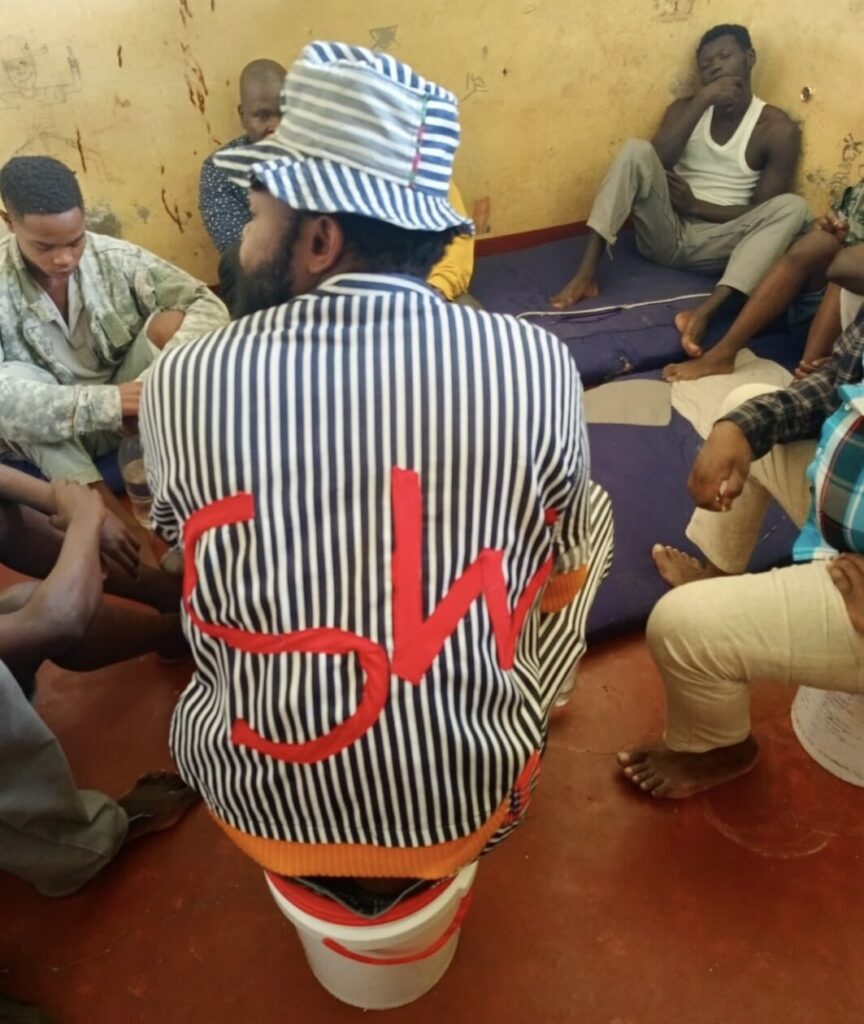
On the night he was brought to this prison, he was held in isolation, in what he estimates to be a 2-by-1 meter cell, where his tall and athletic frame could barely move about. “There is no toilet,” added Omole. “You are given a bucket to defecate in. It is a prison within a prison where they send you to break your spirit.”
The following day, he was transferred to the “capital remand prison”, in a uniform, scrawled with the red letters “SW”, standing for Special Watch, assigned to those deemed dangerous. His inmates here were charged or convicted with the death penalty, carrying crimes like murder, robbery with violence, etc.
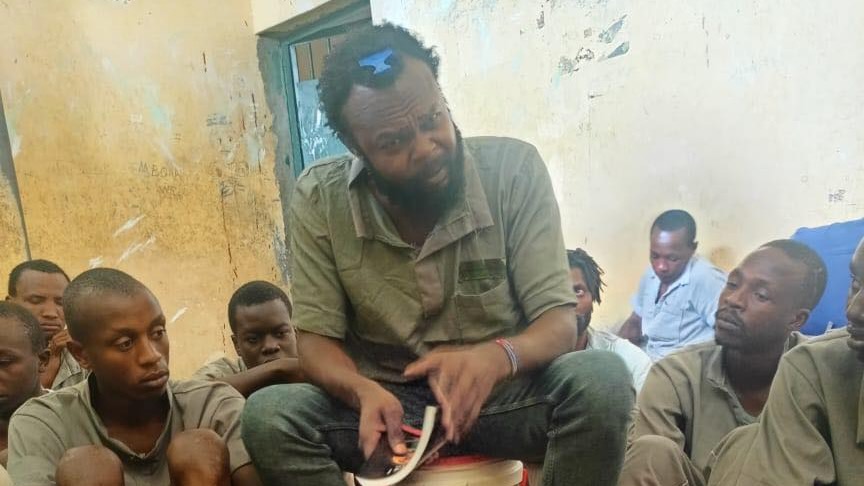
Booker Omole in prison. Photo: CPM-K
“We were about 400” held on a floor consisting of what he estimates to be an 8 by 20 meters hall, with rows of 3 by 4 meter cells on either side – 27 prisoners packed in each. Several human rights reports have also documented the overcrowding in Kenyan prisons, requiring inmates to sleep on their sides, facing the same direction to fit in, “packed close to one another like sardines.”
“If a privileged prisoner who could pay the police was brought in, a cell would be emptied for him,” which would further overcrowd other cells, added Omole. “So inmates spend most of their time in the hall.”
Holding political education sessions for prisoners and wardens
Sitting on the lid over a dustbin in this hall, shuffling between books, Omole can be seen in a video snuck out of prison lecturing the inmates gathered around him about the commonalities between the guerrilla warfare led by Mao in China and the Mau Mau uprising led by Dedan Kimati in Kenya.
“We had three such sessions at night,” he recalled, observing that the prisoners were readily receptive “to our ideas”. All of them were poor and strongly insisted that it was their instincts to survive poverty that got them into crime.
“None of them had any regrets for their crimes,” he said, adding that they only swore that if given a second chance, they would not get caught. “This goes to show that the idea of prison as a place to reform criminals and rehabilitate them back into society is a myth.”
Wealthy criminals, rarely imprisoned, have a relatively comfortable living space and are not crammed in like the rest. They get to “take walks and have a smoke.” Prison authorities, bribed, allow them wholesome meals brought in from outside. The rest, who cannot pay, have to make do with “some soup and corn bread,” perceptible in their bony frames seen in the video. The prisoners were therefore acutely aware of the class contradictions, Omole said.
This, he said, was “already a firm basis to start the discussion about the capitalist system.” The inmates did not need much explanation to grasp why Kimati, who fought for land, remained criminalized as a terrorist for the most part since independence by the “neo-colonial state”, while the representatives of the wealthier classes were hailed as the heroes of Kenya’s freedom struggle.
Outside of this floor where the violent criminals were held, there was also the so-called “prison school”, where inmates gather for sort of group therapy sessions, recollecting “what got them into prison” and reiterating “why they must change. I exploited that platform to deliver an agitational lecture.”
Prison wardens live like prisoners themselves
The junior prison wardens took an interest, initially out of simple curiosity about a political prisoner. As it grew, “I also held a session with them,” Omole said. “They needed a public figure to engage with their issues.” Their condition was little better than the prisoners themselves. Their homes were essentially four walls and a roof made of iron sheets, emanating a chilling cold in winters and blistering heat in summers.
”There are seven gates” between the rows of jails, with two junior prison wardens placed as guards between each. “They are also locked in. They don’t have the keys. If there is a fire outbreak, they can’t escape either. They have to die with the rest of the prisoners. These work conditions,” Omole explained, naturally gravitated them toward the left-wing ideas he was espousing. “We became good friends. They helped us smuggle in political literature.”
But the political literature was later discovered by the higher authorities. “I was handed another 8 hours in the isolation cell.”
In the meantime, the police finally provided the court with the pre-bail hearing document, whereupon he was granted bail on March 3 for an amount of 500,000 Kenyan shillings, more than the 320,000 the police had allegedly tried to extort from him.
The judge also ordered the police to return all the possessions they had seized from Omole and his co-accused. It included “two cars, an iPhone, a laptop, and the 320,000 Kenyan shillings” they found in the apartment. When Omole went with his lawyer to collect them, he said that Mugambi let loose his police to expel him from the station, leading to a scuffle.
Chargesheet unravels
On March 9, the court issued another order to return them. At the pre-trial hearing that day, Amoth, the complainant and main witness, submitted an affidavit to withdraw from the case, while the Registrar of Firearms also confirmed his gun was legally owned.
The Department of Public Prosecution then sought leave to amend the chargesheet, to change the accusation of illegal possession of a firearm to misuse of a firearm. However, Amoth said in his affidavit, “At the time the police arrived, the firearm was secured in a safe in the upper bedroom, and the magazine was separated from it.”
So the charge of misusing a firearm will not hold either, Omole said, adding the chargesheet will likely be dropped as “defective and untenable. If that happens, we will file a case for wrongful detention and prosecution, and demand compensation.”
While confident that the case against him will fall apart, Omole is certain that the “crackdown against our party will only intensify as we grow in strength. The task we face today is to build a revolutionary organization, capable of fighting back.”