Tag: inequality

  • How global inequality hinders climate action

    Spread the love
    Leaders from around the globe are meeting in Davos. Michael Derrer Fuchs/Shutterstock

    Susan Ann Samuel, University of Leeds

    World leaders have gathered for the World Economic Forum annual meeting in Davos, Switzerland. One of their main goals is to align their responses to geopolitical shocks such as floods and wildfires that hamper trade, investment and more.

    The meeting also supposedly aims to find ways to stimulate economic growth to improve living standards, foster a just and inclusive energy transition, achieve security and cooperation amidst conflicts, and accelerate the economic response to an “intelligent age” of AI.

    But, a new report from Oxfam International, published on the first day of the meeting in Davos, highlights how global inequality is more rampant than ever. The report, written by a team of policy campaigners and inequality research advisers outlines how billionaire wealth rose sharply in 2024 worldwide, with the pace of the increase three times faster than in 2023.

    The World Economic Forum lists extreme weather as one of the top global risks. But, as world leaders convene in Davos, the high-profile anti-climate stances of some of them stand in stark opposition to any meaningful progress for climate action.

    The Oxfam report highlights the exploitation involved in creating and sustaining wealth and outlines how, as inequalities deepen, vulnerable communities are disproportionately affected. The most vulnerable – overwhelmingly women, people of colour, Indigenous groups and low-wage workers – are caught in a cycle of insufficient wages, limited services and minimal political influence.

    The report also highlights how wealth inequality is often intertwined with historical processes of extraction — both within countries (for example, through weak labour protections that lowers wages) and between countries (through trade, finance, and resource exploitation).

    The climate connection

    Other research has also shown how inequality is deeply interwoven with climate breakdown. Each crisis exacerbates the other. Historically, the richest nations – and within them, the wealthiest people – have contributed the most to greenhouse gas emissions.

    Meanwhile, lower-income countries that bear little responsibility for global heating suffer the most. These countries, already burdened by debt and systemic inequality, have fewer resources to protect communities from extreme weather, crop failures and infrastructure damage. This makes day-to-day survival a struggle for billions.

    When climate change exacerbates existing inequalities, marginalised communities are denied basic human rights. For instance, droughts reduce crop yields and deplete water sources, so more people — often women and children — have to ration supplies or go without. This directly infringes on their rights to food, safe drinking water and sanitation.

    In these ways, without climate action, the warming planet threatens to widen inequalities by affecting the poorest people most severely. A 2020 World Bank report estimated that an additional 68 to 135 million people could be pushed into poverty by 2030 because of climate change. French researchers identified that climate change also slows down the economic catch-up of poorer countries.

    The reality on the ground is bleak. Floods in Pakistan displaced thousands and affected more than 33 million people in 2023. That’s ten times more than the total population of Los Angeles where, when the recent wildfires struck, 170,000 people had to be evacuated.

    Around the world, climate movements continue. Law suits that demand climate action are transforming governance. High-level negotiations like the UN’s annual climate summit carry on seeking progress, although the processes could be improved to accelerate change.

    What can Davos do? World leaders need to look at how wealth and power can be redistributed (reparations for climate damages is one way to do this) and low-income, climate-vulnerable nations can be better represented in global decision-making.

    Without this kind of change, there’s a risk climate action will perpetuate the same structural imbalances that first enabled environmental exploitation. Only by tackling both climate injustice and economic inequality together can the world prevent further climate disasters and ensure a more equitable future.


    Don’t have time to read about climate change as much as you’d like?
    Get a weekly roundup in your inbox instead. Every Wednesday, The Conversation’s environment editor writes Imagine, a short email that goes a little deeper into just one climate issue. Join the 40,000+ readers who’ve subscribed so far.


    Susan Ann Samuel, PhD Candidate, School of Politics and International Studies, University of Leeds

    This article is republished from The Conversation under a Creative Commons license. Read the original article.
  • Top 10% have more financial wealth than the other 90% combined, new figures show

    Spread the love

    https://morningstaronline.co.uk/article/top-10-have-more-financial-wealth-other-90-combined-new-figures-show

    THE top 10 per cent of Britain’s population has more wealth than the other 90 per cent combined, according to TUC analysis of official Office for National Statistics (ONS) figures released today.

    The huge inequality between rich and poor has widened under 14 years of Tory rule, which saw an “explosion” in insecure work and a decline in living standards.

    Under the Conservatives, real wages grew by just 0.3 per cent a year — compared with 1.5 per cent from 1997 to 2010 under Labour.

    The TUC estimates that the average worker would be £117 a week better off had pay increased since 2010 at the same pace as between 1997 and 2010.

    Pay growth during Conservative-led governments from 2010-2024 was worse than for any other period of government since the 1920s.

    The Tories also oversaw the worst fall in living standards since records began in 1955, the TUC said.

    …

    Continues at https://morningstaronline.co.uk/article/top-10-have-more-financial-wealth-other-90-combined-new-figures-show

  • Expanding Heathrow is incompatible with net zero – here’s the evidence

    Spread the love

    Plane Photography / shutterstock

    Richard Sulley, University of Sheffield

    The UK government is set to back plans for a third runway at Heathrow, the country’s busiest airport, and to expand two other airports near London: Gatwick and Luton. The move is designed to support the government’s “mission” to grow the economy.

    Air transport is notoriously hard to decarbonise. Unlike the energy system, or even road transport, there is no renewable alternative to switch to immediately. If electric or hydrogen planes become reality, it won’t be for many years yet. Therefore it’s not clear this airport expansion can fit within the UK’s legal and arguably moral requirement to cut emissions and remain within its carbon budget.

    It certainly goes against what the government’s official advisory body the Committee on Climate Change (CCC) recommends. The CCC’s 2023 report to parliament stated that: “No airport expansions should proceed until a UK-wide capacity management framework is in place to annually assess and, if required, control sector GHG [greenhouse gas] emissions and non-CO₂ effects.”

    Those non-CO₂ effects of aviation include water vapour, soot and other gases like nitrous oxides and sulfur dioxide, all released directly into the high atmosphere where they help form heat-trapping clouds. Estimates suggest they could triple the greenhouse impact of aviation.

    In 2019, the last year of available data pre-COVID, domestic and international aviation accounted for around 8% of the UK’s total emissions. The non-CO₂ effects makes aviation a larger contributor to climate change than that number suggests.

    The sector itself struggles to build a coherent decarbonisation roadmap based solely on “supply-side” improvements to things like fuel efficiency or, in a recent example from EasyJet, thinner paint. The demand side – taking fewer flights, frequent flyer levies, or restrictions on domestic flights as have been introduced in France – is rarely mentioned.

    Unfortunately aviation is a prime example of the Jevons effect where any improvement in efficiency has been wiped out by increased demand. With a growing global middle class pursuing a higher consumption lifestyle, aviation emissions continue to grow even while other sectors have shows some efforts to reduce their own.

    '3rd runway plane stupid'
    A third runway at Heathrow was first proposed back in the 2000s. This photo is from a 2016 protest. Dinendra Haria / shutterstock

    The UK has mandated that synthetic aviation fuel (SAF), a more sustainable alternative to regular jet fuel, must make up 10% of aviation fuel by 2030. But only 1.2% of aviation fuel is currently SAF and the industry has not published any plans to show it can scale up in time. Indeed, the sector’s own plans for growth will outstrip efforts to decarbonise through synthetic fuel, delivering a neutral effect at best.

    The consumer-facing airport sector has also been accused of greenwash. For instance, Luton Airport recently published adverts making the claim that its own expansion would be stopped if it did not meet stringent environmental targets. However, the Advertising Standards Authority found that consumers would naturally believe that would include air traffic and not just terminal operations (a terminal’s heating or lighting is, of course, largely irrelevant when its core business is as emissions-intensive as flying).

    The difficulty of decarbonising aviation while the sector still grows is exemplified by the government’s recently launched consultation on adopting the Corsia carbon offsetting scheme for international flights and how it might work with existing cap and trade schemes. All of which encourage or excuse excess emissions through a charging mechanism.

    Growing pains

    “Kickstarting economy growth” and “Make Britain a clean energy superpower” are two of the UK government’s six “missions”. However, by expanding airports in support of the former, it risks failing the latter.

    A new report by thinktank the New Economics Foundation shows that airport expansion could balance out all of the emissions saved by the government’s clean power plans by 2050.

    There is evidence that airport expansion can bring some of the economic benefit that government needs. However, another New Economics Foundation report has found that air travel is no longer a catalyst for productivity growth. So the economic benefits of a new runway are really confined to the airport operation itself – projects for engineers and builders, service jobs for people living near Heathrow, and so on.

    Aviation is the privilege of the richer part of society, both globally and within the UK. Figures from Our World in Data shows the richest 50% of the global population produces 90% of the aviation emissions.

    While many more UK residents have experienced flying than in the past, most flights are still taken by a small, wealthy subset of the population, which will typically capture the largest share of any new capacity. Each year, around half of British residents do not fly at all.

    The focus on London airports for the largest scale expansions will shift the balance of the economy further towards south-east England, and increase inequality within the UK economy. And while these plans might bring some of the GDP gains the government is desperate to deliver, all the evidence shows they will be at the expense of its environmental targets.


    Don’t have time to read about climate change as much as you’d like?
    Get a weekly roundup in your inbox instead. Every Wednesday, The Conversation’s environment editor writes Imagine, a short email that goes a little deeper into just one climate issue. Join the 40,000+ readers who’ve subscribed so far.


    Richard Sulley, Senior Research Fellow, Sustainability Policy, University of Sheffield

    This article is republished from The Conversation under a Creative Commons license. Read the original article.

    Orcas comment on killer apes destroying the planet by continuing to burn fossil fuels.
    Orcas comment on killer apes destroying the planet by continuing to burn fossil fuels.
  • Sanders Lays Out Plan to Fight Oligarchy as Wealth of Top Billionaires Passes $10 Trillion

    Spread the love

    Original article by Jake Johnson republished from Common Dreams under Creative Commons (CC BY-NC-ND 3.0). 

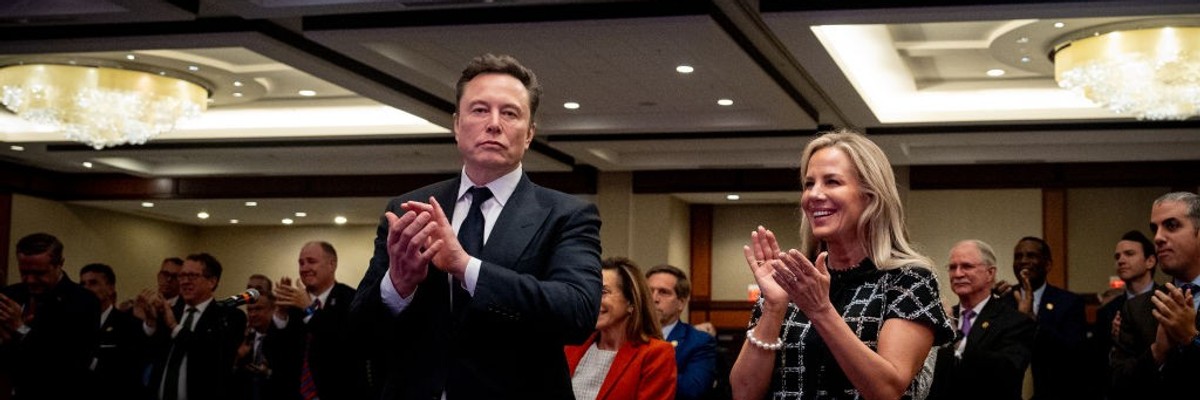
    Elon Musk and the wife of House Speaker Mike Johnson (R-La.) applaud during a House Republican Conference meeting on November 13, 2024 in Washington, D.C. (Photo: Andrew Harnik/Getty Images)

    “If there was ever a moment when progressives needed to communicate our vision to the people of our country, this is that time,” wrote Sen. Bernie Sanders. “Despair is not an option.”

    A Bloomberg analysis of billionaire wealth published Tuesday found that the combined fortunes of the 500 richest people on the planet surpassed $10 trillion this year, a finding that came shortly after U.S. Sen. Bernie Sanders issued an urgent call to action to prevent the emergence of “an oligarchic and authoritarian society.”

    The new analysis notes that the world’s top 500 billionaires “got vastly richer” this year with the help of “an indomitable rally in U.S. technology stocks.”

    Just eight billionaires—Elon Musk, Mark Zuckerberg, Jensen Huang, Larry Ellison, Jeff Bezos, Michael Dell, Larry Page, and Sergey Brin—added more than $600 billion to their collective wealth in 2024 and accounted for 43% of the $1.5 trillion increase in net worth among the world’s 500 richest people, according to Bloomberg.

    “But it was Musk—the so-called ‘first buddy’ of President-elect Donald Trump after unprecedented support for his reelection campaign—who dominated the world’s wealthiest in 2024,” Bloomberg observed, adding that Trump himself also saw his fortune surge to a record high this year, “boosted by the performance of his majority stake in Trump Media & Technology Group Corp.”

    Musk’s use of his enormous fortune to influence the U.S. political system—including via his purchase of one of the world’s largest social media platforms and donations to Trump’s 2024 campaign—amplified existing concerns about the corrosive impact of massive wealth concentration on democracy.

    And wealth inequality in the U.S. could soon get worse, with Trump and the incoming Republican-controlled Congress set to pursue another round of tax cuts for the ultra-rich and large corporations.

    “They do not believe in democracy—the right of ordinary people to control their own futures. They firmly believe that the rich and powerful should determine the future.”

    In an email to supporters on Monday, Sanders (I-Vt.) called the rapid shift toward oligarchy in the U.S. “the defining issue of our time,” warning that billionaires have come to increasingly dominate not only “our economic life, but the information we consume and our politics as well.”

    “A manifestation of the current moment is the rise of Elon Musk, and all that he stands for,” Sanders wrote, pointing to Musk’s outsize influence on the 2024 election and his key role in shaping Trump’s billionaire-dominated Cabinet.

    “But it’s not just Musk. Billionaire owners of two major newspapers overrode their editorial boards’ decisions to endorse Kamala Harris, while many others are kissing Trump’s ring by making large donations to his inauguration committee slush fund,” the senator continued. “They do not believe in democracy—the right of ordinary people to control their own futures. They firmly believe that the rich and powerful should determine the future.”

    Progressives, Sanders wrote, have a “radically different vision,” one that prioritizes “an economic system based on the principles of justice,” “a vibrant democracy based on one person, one vote,” and making “healthcare a human right.”

    “Even though we are not going to succeed in achieving that vision in the immediate future with Trump as president and Republicans controlling Congress, it is important that vision be maintained and we continue to fight for it,” wrote Sanders.

    Since Trump’s victory in the 2024 election, Sanders has focused heavily on the need to organize the working class to combat the threat posed by Musk and other far-right billionaires who have amassed obscene wealth and political power.

    In his email on Monday, the senator said he intends to “travel, organize, hold events, and create content that reaches people where they are” in the coming weeks as part of the “struggle to determine where we go from here.”

    “Will this effort be easy?” asked Sanders. “No, of course it will not. Can it be done? We have no choice. If there was ever a moment when progressives needed to communicate our vision to the people of our country, this is that time. Despair is not an option. We are fighting not only for ourselves. We are fighting for our kids and future generations, and for the well-being of the planet.”

    Original article by Jake Johnson republished from Common Dreams under Creative Commons (CC BY-NC-ND 3.0). 

  • Wealth of World’s Richest Has Doubled Over Past Decade

    Spread the love

    Original article by Julia Conley republished from Common Dreams under Creative Commons (CC BY-NC-ND 3.0). 

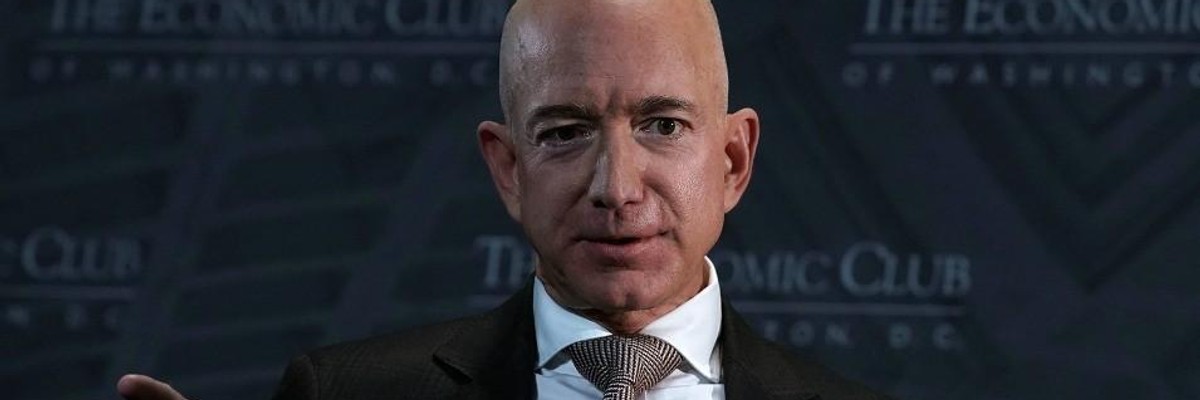
    Amazion founder Jeff Bezos participates in a discussion during a Milestone Celebration dinner September 13, 2018 in Washington, D.C. (Photo: Alex Wong/Getty Images)

    The total wealth of billionaires increased by 121% from 2015-24.

    Driven largely by the accumulation of massive wealth by the richest people in the United States, the Swiss wealth manager UBS said Thursday the assets of billionaires around the world more than doubled over the past decade.

    Between 2015-24, the total wealth of billionaires increased by 121%, from $6.3 trillion to $14 trillion.

    Meanwhile, the MSCI AC World Index of global equities, which measures the performance of more than 3,000 stocks from both developed and emerging markets, rose by 73%.

    The planet’s total gross domestic product is about $105.4 trillion, with a population of just over 8 billion, underscoring the extreme concentration of wealth among the very richest people.

    The number of billionaires rose from 1,757 to 2,682 over the past decade, while the wealthiest people in the world boasted significant gains over just the past year.

    Billionaires’ wealth jumped by about 17% in 2024, with the accumulation of wealth among the richest people in the U.S. offsetting a decline in China.

    U.S. billionaires amassed wealth gains that were 27.6% higher than the previous year, accumulating a total of $5.8 trillion—more than 40% of international billionaire wealth.

    The tax cuts pushed through by President-elect Donald Trump and the Republican Party in 2017 are still in effect in the U.S. Tax policy analysts have found that the law was skewed to the rich, with households in the top 1% of incomes expecting to receive an average tax cut of more than $60,000 in 2025 compared to an average tax cut of less than $500 for people in the bottom 60%.

    As Common Dreams reported this week, the top 12 U.S. billionaires now control $2 trillion. The wealth of the four richest people in the U.S.—Tesla CEO Elon Musk, Amazon founder Jeff Bezos, Oracle co-founder Larry Ellison, and Meta CEO Mark Zuckerberg—has hit $1 trillion.

    “These four men were worth $74 billion 12 short years ago,” said Americans for Tax Fairness. “Tax billionaires.”

    At the G20 Summit last month, world leaders agreed to “engage cooperatively to ensure that ultra-high-net-worth individuals are effectively taxed.”

    Original article by Julia Conley republished from Common Dreams under Creative Commons (CC BY-NC-ND 3.0). 

    Keir Starmer warns against following the https://onaquietday.org blog.
    Keir Starmer warns against following the https://onaquietday.org blog.