Article by Industry insider republished from TBIJ under a Creative Commons Attribution-NonCommercial-NoDerivs 3.0 Unported License.
Our refusal to confront reality could prove catastrophic for homes, communities … and the entire economy
This is the first in our Secret Source series, a regular column from industry whistleblowers.
The world is facing greater risk than ever from extreme weather. We are not prepared – and that could have profound consequences for the global financial system.
I work for a major insurer, assessing the risk posed by natural disasters on properties around the world, from family homes to schools, government offices and multibillion-dollar commercial centres.
In the face of ever more dire and unpredictable climate risks, I am coming under pressure to cut my forecasts for the losses that disasters will cause in order to make insurance more affordable – and get my employer more business. In some instances, the questioning of my numbers and models is justified. But too often it is not being done to produce more accurate predictions, but to artificially lower prices. If this is happening at my firm, which is struggling to compete with rivals’ prices, it’s happening elsewhere.
Our sector is carrying more risk than we realise. The warming global climate has caused more high-intensity storms, rising sea levels, flooding, wildfires and drought.
While the immediate impact of these events is plain to see, the long-term effects will be compounded as insurers withdraw from entire regions, leaving the economy in freefall and people’s day-to-day lives in ruins.
For example, if subsidence – which is made worse by drought – damages a number of homes in your area, insurers may exclude this from your policy. If subsidence then damages or destroys your house, you won’t be covered.
When that happens to an entire community, businesses leave, investment dries up and the local economy tanks. Now imagine that happening in towns all around the country, all at the same time. And subsidence is only one such issue, alongside wildfires, coastal erosion, wind and floods. And that’s just the UK.
As a modeller it is my job to look scientifically at the data and calculate an expected loss from a natural disaster, which in turn affects the price of the premium for a given policy. As my analysis shows higher and more volatile risk, the price rises with it and we lose customers.
Our industry says it holds modellers’ numbers as sacrosanct, but in reality we are coming under pressure to reduce our projected losses. In the most basic terms, we are collectively fudging the numbers and taking on more risk than we should for a lower price than the expected loss demands.
Sometimes I will forecast losses that would normally be seen as much too risky for us to insure but we offer the policies anyway.
This will eventually lead to a sector built on “competitively-priced” contracts that underestimate risk, leaving gaping holes in the safety net that insurance is supposed to provide.
I have respect for underwriters who are just doing their jobs, and I know that no single individual is responsible. My concern lies with the attitude of the industry as a whole towards modellers, actuaries and researchers: there is a sense that we are an inconvenience to the deal-making process rather than an essential part of risk management. We are the failsafe that stops our industry from reckless gambling.
At the largest scale, misquoted insurance can damage insurers, companies, their employees and entire communities. The upshot is that our customers are likely much more exposed to climate-related risks than they realise. People are not budgeting for a major increase in their insurance premiums or planning for their homes becoming uninsurable, but many of them absolutely should be.
If the worst happens, the insurance industry may not have the money to pay every claim when a major disaster hits. That would have profound consequences for the economy as a whole – businesses could go bankrupt, the housing market will seize up. If people can’t pay their mortgages, banks could collapse.
As natural catastrophes continue to become less predictable and more severe, the foundations of our entire economy will only become more fragile. Our customers deserve to know.
Article by Anonymous republished from TBIJ under a Creative Commons Attribution-NonCommercial-NoDerivs 3.0 Unported License.
Elon Musk urges you to be a Fascist like him, says that you can ignore facts and reality then.Donald Trump urges you to ignore facts and reality and be a Climate Science denier like him. He says that he makes millions and millions for destroying the planet, Burn, Baby, Burn and Flood, Baby, Flood.Nigel Farage urges you to ignore facts and reality and be a climate science denier like him and his Deputy Richard Tice. He says that Reform UK has received £Millions and £Millions from the fossil fuel industry to promote climate denial and destroy the planet.
This video is far longer than I like but so important. Are you listening Mr. Burnham?
Donald Trump urges you to be a Climate Science denier like him. He says that he makes millions and millions for destroying the planet, Burn, Baby, Burn and Flood, Baby, Flood.Nigel Farage urges you to ignore facts and reality and be a climate science denier like him and his Deputy Richard Tice. He says that Reform UK has received £Millions and £Millions from the fossil fuel industry to promote climate denial and destroy the planet.Power-mad orange gasbag Donald Trump says Burn, Baby, Burn.
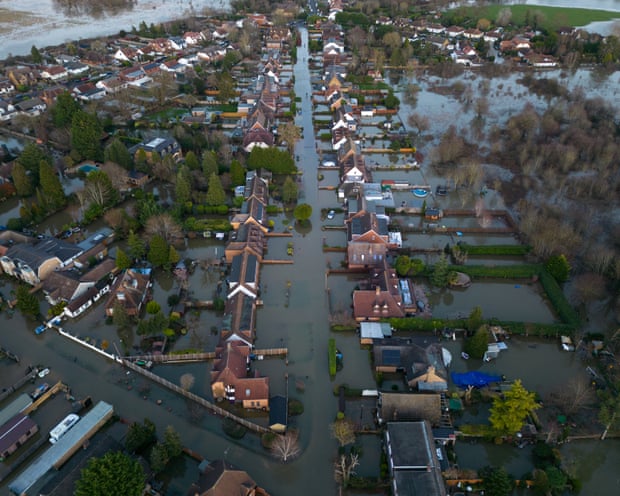
Flood waters surrounding houses in Wraysbury, Berkshire in January 2024. Greater London and Yorkshire and the Humber are two regions at particular risk in the coming years. Photograph: Daniel Leal/AFP/Getty Images
Every constituency projected to be at greater risk, with many areas likely to be uninsurable, Guardian investigation finds
Millions more homes in England, Scotland and Wales face devastating floods, and some towns may have to be abandoned as climate breakdown makes many areas uninsurable, a Guardian investigation has found.
New analysis from the insurance industry, seen by the Guardian, reveals the extent of concern in the sector, with bosses warning that large swathes of housing and commercial property in densely populated areas will be at greater risk.
Separately, experts have said that some towns may need to be abandoned as homes and businesses struggle to get insurance in areas repeatedly battered by storms and rising sea levels.
Densely populated areas including London, Manchester and parts of north-east England, are likely to be worst hit. Experts also say London’s flood defences need to be updated urgently to protect the capital from devastating floods.
…
Orcas comment on killer apes destroying the planet by continuing to burn fossil fuels.Neo-Fascist Climate Science Denier Donald Trump says Burn, Baby, Burn.Nigel Farage urges you to ignore facts and reality and be a climate science denier like him and his Deputy Richard Tice. He says that Reform UK has received £Millions and £Millions from the fossil fuel industry to promote climate denial and destroy the planet.
CounterSpin interview with Derek Seidman on insurance and climate
Janine Jackson interviewed writer/researcher Derek Seidman about insurance and climate for the October 4, 2024, episode of CounterSpin. This is a lightly edited transcript.
Janine Jackson: As we watch images of devastation from Hurricane Helene, it’s hard not to hold—alongside sadness at the obvious loss—anger at the knowledge that things didn’t have to be this way. Steps could have been, still could be taken, to mitigate the impact of climate change, and making weather events more extreme, and steps could be taken that help people recover from the disastrous effects of the choices made.
As our guest explains, another key player in the slow-motion trainwreck that is US climate policy—along with fossil fuel companies and the politicians that abet them—is the insurance industry, whose role is not often talked about.
Derek Seidman is a writer, researcher and historian. He contributes regularly to Truthout and to LittleSis. He joins us now by phone. Welcome to CounterSpin, Derek Seidman.
Home Insurers Cut Natural Disasters From Policies as Climate Risks Grow:
Some of the largest US insurance companies say extreme weather has led them to end certain coverages, exclude natural disaster protections and raise premiums.
I think that drops us right into the heart of the problem you outline in that piece. What’s going on, and why do you call it the insurance industry’s “self-induced crisis”?
DS: Thank you. Well, certainly there is a growing crisis. The insurance industry is pulling back from certain markets and regions and states, because the costs of insuring homes and other properties are becoming too expensive to remain profitable, with the rise of extreme weather. And so we’ve seen a lot of coverage in the past few months over this growing crisis in the insurance industry.
Derek Seidman: “The insurance industry itself is a main actor in driving the rise of extreme weather, through its very close relationship to the fossil fuel industry.”
But one of the critical things that’s left out of this is that the insurance industry itself is a main actor in driving the rise of extreme weather, through its very close relationship to the fossil fuel industry. And in this narrative in the corporate media, the insurance industry on the one hand and extreme weather on the other hand, are often treated like they’re completely separate things, and they’re just sort of coming together, and this “crisis” is being created, and it’s a real problem that the connections aren’t being made there.
So I guess a couple things that should be said, first, are that the insurance industry is the fossil fuel industry, and its operations could not exist without the insurance industry.
We can look at that relationship in two ways. So first, of course, is through insurance. The insurance giants, AIG, Liberty Mutual and so on and so on, they collectively rake in billions of dollars every year in insuring fossil fuel industry infrastructure, whether that’s pipelines or offshore oil rigs or liquified natural gas export terminals. This fossil fuel infrastructure and its continued expansion, this simply could not exist without underwriting by the insurance industry. It would not get its permit approvals, it would just not be able to operate, it couldn’t attract investors and so on. So that’s one way.
Another way is that, and this is something a lot of people might not be aware of, but the insurance industry is an enormous investor in the fossil fuel industry. Basically, one of the ways the insurance industry makes money is it takes the premiums, and it pools a chunk of it and invests those. So it’s a major investor. And the insurance industry, across the board, has tens of billions of dollars invested in the fossil fuel industry.
And this is actually stuff that anybody can go and look up, because some of it’s public. So, for example, the insurance giant AIG, because it’s a big investor, it has to disclose its investments with the SEC. And earlier this year, AIG disclosed that, for example, it had $117 million invested in ExxonMobil, $83 million invested in Chevron, $46 million in Conoco Phillips, and so on and so on.
So, on the one hand, you have this hypocritical cycle where the insurance industry is saying to ordinary homeowners, who are quite desperate, we need to jack up the price on your premiums, or we need to pull away altogether, we can’t insure you anymore—while, on the other hand, it’s driving and enabling and profiting from the very operations, fossil fuel operations, that are causing this extreme weather in the first place, that the insurance industry is then using to justify pulling back from insuring just regular homeowners.
JJ: This is a structural problem, clearly, that you’re pointing to, and you don’t want to be too conspiratorial about it. But these folks do literally have dinner with one another, these insurance executives and the fossil fuel companies. And then I want to add, you complicate it even further by talking about knock-on effects, that include making homes uninsurable. When that happens, well, then, that contributes to this thing where banks and hedge funds buy up homes. So it’s part of an even bigger cycle that folks probably have heard about.
DS: Yeah, absolutely. This whole scenario, it’s horrible, because it impacts homeowners and renters. If you talk to landlords, they say that the rising costs of insurance are their biggest expense, and they are, in part, taking that out on tenants by raising rents, right?
But it also really threatens this global financial stability. I mean, with the rise of extreme weather, and homes becoming more expensive to insure, or even uninsurable, home values can really collapse. And when they collapse, aside from the horrific human drama of all that, banks are reacquiring foreclosed homes that, in turn, are unsellable because of extreme weather, and they can’t be insured.
The big picture of all this is that it leads to banks acquiring a growing amount of risky properties, and it can create a lot of financial instability. And we saw what happened after 2008, as you mentioned, with private equity coming in and scooping up homes. And so, yeah, it creates a lot of systemic financial instability, opens the door for financial predators like private equity and hedge funds to come in.
JJ: And it seems to require an encompassing response, a response that acknowledges the various moving pieces of this. I wonder, finally, is there responsive law or policy, either on the table now or just maybe in our imagination, that would address these concerns?
DS: There are organizers that are definitely starting to do something about it, and there are some members of Congress that are also starting to do something about it.
For this story, I interviewed some really fantastic groups. One of them is Insure Our Future, and this is sort of a broader campaign that is working with different groups around the country, and really demanding that insurers stop insuring new fossil fuel build-out, that they phase out their insurance coverage for existing fossil fuels, for all the reasons that we’ve been talking about today.
At the state level, there’s groups that are doing really important and interesting things. So one of the groups that I interviewed was called Connecticut Citizen Action Group, and they’ve been working hard, in coalition with other groups in Connecticut, to introduce and pass a state bill that would create a climate fund to support residents that are impacted by extreme weather. (Connecticut has seen its fair share of extreme weather.) And this fund would be financed by taxing insurance policies in the state that are connected to fossil fuel projects. So it’s also a disincentive to invest in fossil fuels.
In New York, a coalition of groups and lawmakers just introduced something called the Insure Our Communities bill. And this would ban insurers from underwriting new fossil fuel projects, and it would set up new protections for homeowners that are facing extreme weather disasters.
I spoke to organizers in Freeport, Texas, with a group called Better Brazoria, and these are people that are on the Gulf Coast, really on the front lines. And Better Brazoria is just one of a number of frontline groups along the Gulf Coast that are organizing around the insurance industry, and they’re trying to meet with insurance giants, and say to them, “Look, what you’re doing is, we’re losing our homeowner insurance while you’re insuring these risky LNG plants that are getting hit by hurricanes, and fires are starting,” and trying to make the case to them that this is just not even good business for them.
And then, more recently, you’ve seen Bernie Sanders and others start to hold the insurance industry’s feet to the fire a little more, opening up investigations into their connection to the fossil fuel industry, and how this is creating financial instability.
So I think this is becoming more and more of an issue that people are seeing is a real problem for the financial system, and it’s something that we should absolutely think about when we think about the climate crisis, and the broader infrastructure that’s enabling the fossil fuel industry to exist, and continue its polluting operations that are causing the climate crisis and extreme weather. So I think we’re going to see only more of this going forward.
JJ: All right, then, we’ll end it there for now.
We’ve been speaking with Derek Seidman. You can find his article, “As Florida Floods, Insurance Industry Reaps What It Sowed Backing Fossil Fuels,” on Truthout.org. Thank you so much, Derek Seidman, for joining us this week on CounterSpin.
DS: Thank you.
FAIR’s work is sustained by our generous contributors, who allow us to remain independent. Donate today to be a part of this important mission.

 Why insurers hold the secret to tackling the climate crisis