15 Arab and African countries sound the alarm on the risks of famine in Sudan

Spread the love

Original article by Aseel Saleh republished from peoples dispatch under a Creative Commons Attribution-ShareAlike 4.0 (CC BY-SA) license.
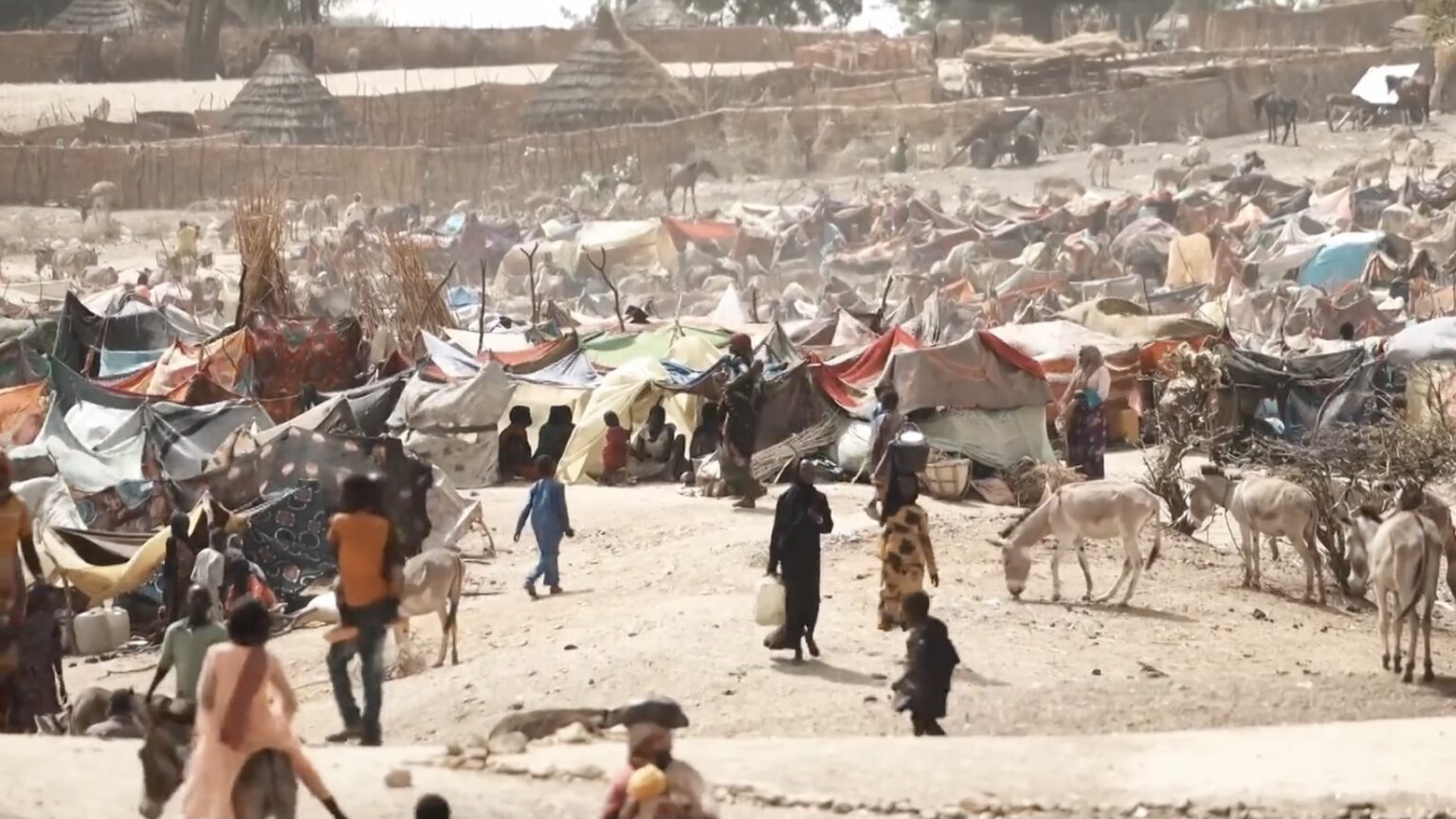
Sudanese refugees in Chad. Over 10 million people have been forcibly displaced in over a year of war in Sudan. Photo: Wikimedia commons

Famine looms in Sudan, forcing people to flee to neighboring countries, while talks between warring parties and a UN envoy are still under way in Geneva

The governments of 15 Arab and African countries issued a statement on Tuesday, July 16, expressing their deep concerns regarding the escalating food security crisis in war-torn Sudan. The countries included the United Arab Emirates, Jordan, Morocco, Mauritania, Chad, Comoros, Guinea-Bissau, Benin, Seychelles, Senegal, Kenya, Sierra Leone, Uganda, Mozambique and Nigeria.

The statement came as a reaction to the Integrated Food Security Phase Classification (IPC) report, which was published on June 27, 2024. “Fourteen months into the conflict, Sudan is facing the worst levels of acute food insecurity ever recorded by the IPC in the country,” the report said, pointing out that more than half of the population in Sudan have experienced severe hunger, which makes Sudan the world’s largest hunger crisis

The number of starving people is estimated at 25.6 million people, with 14 areas at the risk of famine including greater Darfur, Greater Kordofan, Al Jazirah and some hotspots in Sudan’s capital Khartoum. Many starving Sudanese people have been reportedly fleeing Sudan to seek asylum in neighboring countries due to hunger and looming famine. 

The countries who issued the statement expressed their concern about what was set out in the IPC report as a “stark and rapid deterioration” in food security, and its dire impact on the safety and well-being of civilians, including thousands of children, who have suffered from severe acute malnutrition.

According to a Save the Children report published on July 7, due to the war in Sudan 30% of children are acutely malnourished and 20% of the overall population is facing extreme food shortages.

Since the conflict between the Sudanese Armed Forces (SAF) and the Rapid Support Forces (RSF) began in April 2023, the destruction caused by the fighting resulted in a sharp decrease in the agricultural production, and therefore a hike in food prices and food scarcity. The hunger crisis in Sudan has been further deepened by the severe restriction on the movement of food and aid convoys due to the ongoing conflict.

Reiterating the United Nations Security Council’s call from June of 2023, the countries urged all the parties to the conflict to ensure immediate, safe, and unrestricted access to civilian humanitarian aid. They also called on the conflicting parties to adhere to international humanitarian law and to comply with all relevant Security Council resolutions. 

The statement also addressed foreign actors requesting them to stop providing armed or material support to the parties involved in the conflict and to refrain from any action which may ignite the conflict. Furthermore, it called on the international community for immediate and coordinated international response to tackle the urgent needs of the affected Sudanese population. The countries encouraged the international community to scale up the humanitarian assistance it provides, and to support the IPC recommendations for increasing nutrition interventions, restoring productive systems and improving data collection.

While the humanitarian situation in Sudan is constantly deteriorating, talks between a United Nations envoy and delegations from both conflicting parties continue in Geneva this week. The talks started last Thursday, focusing on humanitarian aid and the protection of civilians.

There were a few “promising signs” emerging from Monday’s talks in Geneva, the Representative of the World Health Organization (WHO) in Sudan, Shible Sahbani commented. “Let’s wait for the coming hours and days, and we hope that if we don’t get a ceasefire, at least we can get the protection of civilians and the opening of humanitarian corridors,” he added. 

Original article by Aseel Saleh republished from peoples dispatch under a Creative Commons Attribution-ShareAlike 4.0 (CC BY-SA) license.

Continue Reading15 Arab and African countries sound the alarm on the risks of famine in Sudan

Israel is starving Palestinians to death while the world watches

Spread the love

Original article by Abdul Rahman republished from peoples dispatch under a Creative Commons Attribution-ShareAlike 4.0 (CC BY-SA) license.

Children waiting for food in Gaza. Photo: UNRWA

Israel has deliberately slowed the flow of aid to Gaza with hundreds of trucks stranded on the Egyptian side of the Rafah border at a time when over two dozen Palestinian children have died of malnutrition

UN agencies have repeatedly condemned Israel’s refusal to expedite the process of aid delivery to Gaza which has been under siege by Israel for nearly six months. This is despite repeated calls for urgency in the context of critical humanitarian conditions which are becoming worse with each passing day.

According to the latest alerts issued by the Integrated Food Security Phase Classification (IPC) on March 18, most of northern Gaza would move into the category five indicating the highest stage of food insecurity or catastrophic levels of hunger. The IPC explains that this would mean that Palestinian households would face “an extreme lack of food and extremely critical levels of acute malnutrition.”

The IPC has assessed that the region which continues to face Israeli bombing and ground offensive already faces category four levels of malnutrition with huge gaps between need and actual availability of food.


UNRWA has already confirmed that one in three children in northern Gaza are malnourished. In the last few weeks over 25 children have died due to the same. The situation in other parts of Gaza is approaching similar levels at an alarming speed.

The same day that the IPC released its findings, Philippe Lazzarini, the head of UNRWA, was denied entry to Gaza by Israeli authorities. In a post on X, Lazzarini wrote, “UNRWA has by far the largest presence among all humanitarian organizations in Gaza. My visit today was supposed to coordinate & improve the humanitarian response.”

He added, “This man-made starvation under our watch is a stain on our collective humanity. Too much time was wasted, all land crossings must open now. Famine can be averted with political will.”

The UNRWA head also noted that over 1.1 million people in Gaza facing phase five levels of starvation “is the highest number of people ever recorded as facing catastrophic hunger and is double the number of just three months ago.”

Beth Bechdol, deputy director general of the UN Food and Agricultural Organization (FAO) told Al-Jazeera on Tuesday that, almost half of the total population of Gaza is at the acute level of malnutrition and at the risk of ultimately death.

The United Nations Children Fund (UNICEF) stated on Sunday that thousands of Palestinian children in Gaza are so malnourished that they do not have enough “energy to cry.”

Over 13,000 Palestinian children have been killed in the Israeli war on Gaza which began on October 7. According to different UN agencies, as many children have been injured and now hundreds of thousands are being forced into starvation by Israel.

UNICEF’s Executive Director Catherine Russell had earlier made similar assertions saying that there are “very great bureaucratic challenges” which prevent the humanitarian aid to reach two million Palestinians in Gaza.

Israel has restricted the entry of the aid through land borders using different kinds of excuses, for example presence of scissors in the aid boxes or alleged overcrowding of Palestinians at aid distribution centers among others.

James Elder, UNICEF spokesperson, called the blocking of aid supplies to Gaza “outrageous.” He posted on X showing hundreds of trucks with humanitarian aid stranded at the Rafah border as Israel has not allowed them to enter Gaza.

Adele Khodr, UNICEF’s regional director for the Middle East and North Africa called for the opening of all crossings. “The world’s inaction is shocking as more children succumb to slow death. All border crossing must open now to allow unfettered access to humanitarian aid” Khodr said in the tweet on Tuesday.

Original article by Abdul Rahman republished from peoples dispatch under a Creative Commons Attribution-ShareAlike 4.0 (CC BY-SA) license.

Continue ReadingIsrael is starving Palestinians to death while the world watches