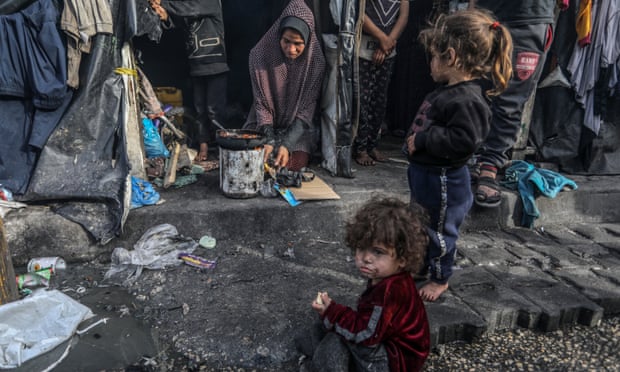
Palestinian families displaced from their homes make preparations for the iftar dinner in temporary tents in Rafah on Thursday. Photograph: Anadolu/Getty Images
The international court of justice has ordered Israel to allow unimpeded access of food aid into Gaza, where sections of the population are facing imminent starvation, in a significant legal rebuke to Israel’s claim it is not blocking aid deliveries.
A panel of judges at the UN’s top court, which is already considering a complaint from South Africa that Israel is committing genocide in the Palestinian territory, issued the ruling after an emergency measure in January obliging Israel to admit emergency aid.
The judges, who were unanimous in their decision, said Palestinians in Gaza were facing worsening conditions of life, and famine and starvation were spreading. “The court observes that Palestinians in Gaza are no longer facing only a risk of famine … but that famine is setting in,” the judges said.
In its legally binding order, the court told Israel to take “all necessary and effective measures to ensure, without delay, in full cooperation with the United Nations, the unhindered provision at scale by all concerned of urgently needed basic services and humanitarian assistance” including food, water, fuel and medical supplies.
The ICJ also ordered Israel to immediately ensure “that its military does not commit acts which constitute a violation of any of the rights of the Palestinians in Gaza as a protected group under the convention on the prevention and punishment of the crime of genocide, including by preventing, through any action, the delivery of urgently needed humanitarian assistance”.
Israel denies it is committing genocide and says its military campaign is self-defence.
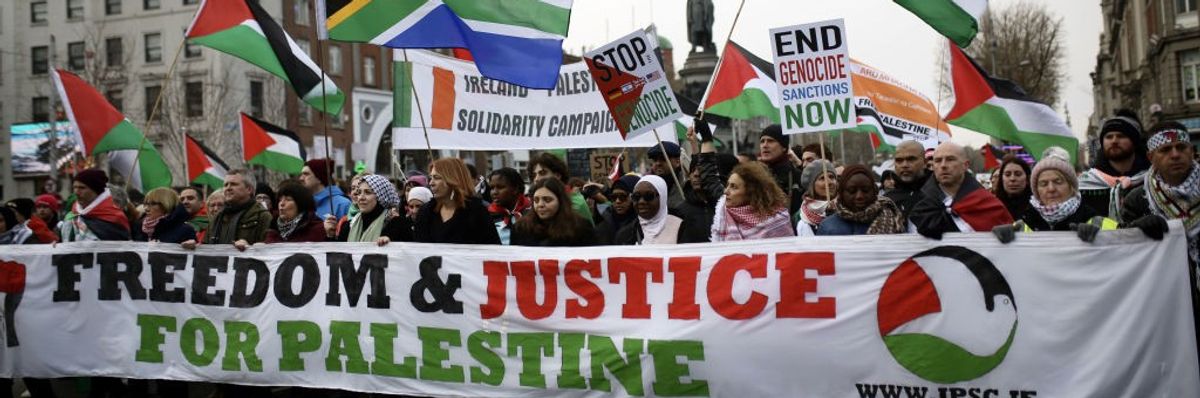
Palestinian and South African flags are seen at a January 13, 2024 protest for Gaza in Dublin, Ireland. (Photo: Stringer/Andalou via Getty Images)
“What we saw on October 7 in Israel, and what we are seeing in Gaza now, represents the blatant violation of international humanitarian law on a mass scale,” said one top Irish official.
Citing Israel’s “blatant” human rights violations in Gaza, Ireland’s second-highest-ranking official said Wednesday that the country will join the South Africa-led genocide case before the International Court of Justice in The Hague.
Irish Tánaiste Micheál Martin—the equivalent of a deputy prime minister in other parliamentary nations—said that Ireland decided to intervene in the case after analyzing the “legal and policy issues” pertaining to the case under review by the United Nations’ top court.
“It is for the court to determine whether genocide is being committed,” Martin—who also serves as Ireland’s foreign and defense minister—said in a statement. “But I want to be clear in reiterating what I have said many times in the last few months; what we saw on October 7 in Israel, and what we are seeing in Gaza now, represents the blatant violation of international humanitarian law on a mass scale.”
Important decision that Ireland will intervene in the South Africa v Israel case at the ICJ
Accountability is the cornerstone of international law & the functioning of the global multilateral system; in respect of all parties to all conflicts, state and non-state actors alike https://t.co/RsOQQu2GpO
The taking of hostages. The purposeful withholding of humanitarian assistance to civilians. The targeting of civilians and of civilian infrastructure. The indiscriminate use of explosive weapons in populated areas. The use of civilian objects for military purposes. The collective punishment of an entire population.
The list goes on. It has to stop. The view of the international community is clear. Enough is enough. The U.N. Security Council has demanded an immediate cease-fire, the unconditional release of hostages, and the lifting of all barriers to the provision of humanitarian assistance at scale. The European Council has echoed this call.
South Africa’s case—which is supported by over 30 countries, the Arab League, African Union, and others—incisively details Israel’s conduct in the war, including the killing of tens of thousands of Palestinians, mostly women and children; the wounding of tens of thousands more; the forcible displacement of 90% of the besieged enclave’s 2.3 million people; and the inflicting of conditions leading to widespread starvation and disease. The filing also cited numerous genocidal statements by Israeli officials.
On January 26, the ICJ issued a preliminary ruling that Israel is plausibly committing genocide in Gaza and ordered its government and military to prevent genocidal acts. Palestinian and international human rights defenders say Israel has ignored the order.
A draft report released this week by the U.N.’s Human Rights Council found “reasonable grounds to believe” that Israel is committing genocide in Gaza, a move that came on the same day as the U.N. Security Council passed a resolution demanding an immediate cease-fire in the ongoing war.
“The situation could not be more stark; half the population of Gaza face imminent famine and 100% of the population face acute food insecurity,” said Martin. “As the U.N. secretary-general said as he inspected long lines of blocked relief trucks waiting to enter Gaza during his visit to Rafah at the weekend: ‘It is time to truly flood Gaza with lifesaving aid. The choice is clear: surge or starvation.’ I echo his words today.”
In a St. Partick’s Day White House meeting with U.S. President Joe Biden—a staunch supporter of Israel—Irish Toaiseach (Prime Minister) Leo Varadkar, who announced earlier this month that he would soon step down, said that “the Irish people are deeply troubled about the catastrophe that’s unfolding before our eyes in Gaza.”
“And when I travel the world, leaders often ask me why the Irish have such empathy for the Palestinian people,” he added. “And the answer is simple: We see our history in their eyes—a story of displacement, of dispossession and national identity questioned and denied, forced emigration, discrimination, and now hunger.”
A wounded person receives treatment at a local hospital in the southern Gaza Strip city of Rafah on March 24, 2024. (Photo: Khaled Omar/Xinhua via Getty Images
U.N. member states must “use their influence” to push Israel to halt its bombardment of Gaza and blocking of humanitarian aid, said the group’s secretary general.
“The time to act to prevent genocide is now,” Amnesty International’s secretary general said Tuesday, a day after the United Nations Human Rights Council released a draft report detailing how the panel found that there are “reasonable grounds to believe” that Israel is already committing genocidal violence in Gaza.
Amnesty’s Agnes Callamard called the 25-page report a “crucial body of work that must serve as a vital call to action to states,” many of which have called for a cease-fire in Gaza for several months.
After the U.N. report found that “the overwhelming nature and scale of Israel’s assault on Gaza… reveal an intent to physically destroy Palestinians as a group,” Callamard said “states must now focus their efforts on making these calls a reality.”
“Third states must apply political pressure on the warring parties to implement the U.N. Security Council resolution adopted yesterday demanding an immediate cease-fire, use their influence to insist that Israel abides by the resolution, including by stopping the shelling and lifting restrictions on humanitarian aid,” said Callamard. “They must impose a comprehensive arms embargo against all parties to the conflict. They must also pressure Hamas and other armed groups to free all civilian hostages.”
“The time to act to prevent genocide is now": #UN Special Rapporteur report on #Gaza provides crucial evidence that must spur international action. Read more below: https://t.co/z8r6FSi7Wl
The U.N. report was released the same day that the U.N Security Council adopted a resolution demanding an immediate, temporary cease-fire for the remainder of the month of Ramadan—the first cease-fire resolution to pass at the council following three that failed due to the U.S. vetoing the measures.
The U.S., which gives Israel $3.8 billion in annual military aid and has continued to provide support throughout the bombardment, abstained from voting on Monday’s resolution and infuriated human rights experts by baselessly claiming the vote was “nonbinding.”
It was irresponsible on the part of the US Ambassador to suggest that a resolution meant to save lives and address massive devastation and suffering can be disregarded. Just plain irresponsible. https://t.co/9VZIGfpJ88
The U.N. report, titled Anatomy of a Genocide, detailed actions Israel has taken since beginning its bombardment of Gaza in October that could violate Article II of the Genocide Convention, including killing members of the group, causing serious bodily or mental harm to members of the group, deliberately inflicting conditions of life calculated to bring about its physical destruction, and imposing measures intended to prevent births.
Along with killing at least 32,414 Palestinians in Gaza—73% of whom have been women and children, and the remaining 27% were not proven to have been Hamas members—Israel has also imposed mass starvation on the population, killing “10 children daily,” according to the report. Israel has detained thousands of Palestinian men and boys in undisclosed locations; injured 70,000 people; forced medical personnel to perform “hazardous health procedures, such as amputations without anesthetics, including on children”; and “destroyed or severely damaged most life-sustaining infrastructure.”
Callamard noted on Tuesday that the report came two months after the International Court of Justice (ICJ) announced an interim ruling that Israel is “plausibly” committing a genocide in Gaza and ordered the country to take action to prevent genocidal violence by its forces.
“In that time, the situation in Gaza has grown exponentially worse, with thousands more Palestinians killed and Israel continuing to refuse to comply with the ICJ ruling to ensure provision of sufficient humanitarian aid to Palestinians as human-made famine edges closer each day and more people starve to death,” said Callamard.
The secretary general echoed a call in the report, which was compiled by Francesca Albanese, special rapporteur on human rights in the occupied Palestinian territories, for the full funding of the U.N. Relief and Works Agency for Palestine Refugees in the Near East (UNRWA).
Israel said Sunday it will no longer permit UNRWA aid trucks to deliver humanitarian relief in northern Gaza, where one-third of children under age 2 are now suffering from acute malnutrition. The U.S. officially suspended UNRWA funding through March 2025 on Monday after President Joe Biden signed a new spending package into law.
The U.S. led several countries in cutting funding to the agency in January after Israel claimed 12 of UNRWA’s 13,000 employees in Gaza had been involved in the Hamas-led attack on southern Israel in October. Countries including Finland, Canada, and Australia have since reinstated funding.
Callamard also called on all states, particularly powerful Western countries that are allied with Israel, including the U.S., to support international authorities as they try to hold Israeli officials to account for the mass killing and starving of civilians in Gaza. Israel has refused to allow U.N. experts and other independent human rights monitors access to Gaza.
“Helping to prevent genocide also means supporting accountability efforts including the ongoing investigation by the Office of the Prosecutor of the International Criminal Court and exercising universal jurisdiction to bring those suspected of crimes under international law to justice,” said Callamard.
The secretary general noted that momentum has grown in recent days around international calls for a cease-fire, but said a desperately needed halt in fighting requires a concerted push by influential states to become a reality.
“An enduring cease-fire,” said Callamard, “remains the best way to enforce the ICJ’s provisional measures to prevent genocide and further crimes and civilian suffering.”
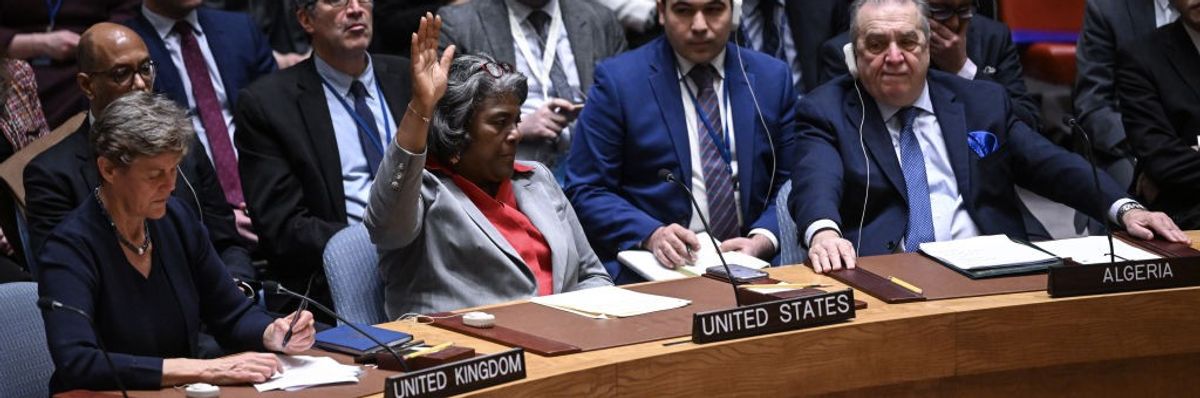
US Ambassador to the United Nations Linda Thomas-Greenfield raises her hand during the UN Security Council meeting which adopted a resolution demanding an immediate cease-fire in Gaza Strip for the month of Ramada on March 25, 2024. As many as 14 countries voted in favor of the resolution, presented by 10 elected members of the Council, while the US abstained from voting. (Photo by Fatih Aktas/Anadolu via Getty Images
Despite weaknesses and false U.S. claims that the resolution is nonbinding, it demands an end to the bombing and a massive influx of humanitarian aid. And that means the possibility of saving lives.
Five and half months into Israel’s genocidal assault on Gaza with more than 32,000 Palestinians already killed, six weeks after the International Court of Justice found Israel plausibly committing genocide and ordered it to stop, and after four earlier tries, the UN Security Council on Monday finally passed a resolution submitted by all ten elected members aiming to stop the slaughter. The resolution has lots of weaknesses and shows the effects of U.S. pressure—but it demands an end to the bombing and a massive influx of food and medicine. And that means the possibility of saving lives.
The resolution demanded an immediate ceasefire leading to a lasting and sustainable ceasefire, the release of all hostages, and compliance with international law in treatment of all those detained. The Council also demanded “the lifting of all barriers to the provision of humanitarian assistance at scale,” reminding the world of the need for massive expansion of that aid and for protection of Palestinian civilians across the entire Gaza Strip.
The resolution’s passage was uncertain until the very last moment. An hour before the vote, U.S. diplomats won a final concession—replacing the original demand for a “permanent” ceasefire” to the squishier, less clear “lasting.” And there are significant other weaknesses in the resolution.
When U.S. Ambassador Linda Thomas-Greenfield claimed that the Council vote was “nonbinding,” she was setting the stage for the U.S. government to violate the UN Charter by refusing to be bound by the resolution’s terms.
The most important flaw in the Council’s text is that it calls for a ceasefire only “for the month of Ramadan.” This most important of Muslim holidays began on March 11, so the demand for a ceasefire is only for about two weeks. And while it does demand that the immediate halt lead to a lasting ceasefire, two weeks is still a much too-short time.
Other problems reflect deliberate obfuscation of language. The demand that all parties treat “all persons they detain” in compliance with international law clearly refers to the thousands of Palestinian detainees Israel is holding, many in administration detention without even the pretense of legitimate legal procedures, whom international law requires to be immediately released. Their detention violates a host of those laws, but by not naming them directly, diplomatic wrangling always threatens to deny them their rights.
And in the paragraph focusing on the catastrophic humanitarian situation across Gaza, the Council’s demand for “lifting all barriers to provision of humanitarian aid at scale” should be a clear and straightforward message to Israel that it must open the gates, end its rejection of goods on the spurious grounds of potential “dual use,” replace its deliberately complex and time-consuming inspection processes and more. But that reference to “lifting all barriers” is hidden in a long sentence within a reference to an earlier resolution. The first part of the sentence merely “emphasizes” the need for more humanitarian aid and protection for Palestinian civilians. And in UN diplo-speak, especially in the Security Council that actually has the right to enforce its resolutions, “emphasizing” something ain’t even close to “demanding” that it happen.
Israel was still not pleased, of course. Prime Minister Benjamin Netanyahu immediately announced his delegation, expected in Washington tomorrow to discuss Tel Aviv’s planned escalation against Rafah, will stay home instead.
But even if the resolution is not all it should be, its passage (14 in favor, the U.S. abstained) still represents a powerful global rejection of the U.S.-backed Israeli assault against Palestinians in Gaza, and an important expression of support for the South African-led intervention at the International Court of Justice designed to prevent or stop Israeli genocide and to hold Israel accountable for its crimes. Importantly, and despite U.S. Ambassador Linda Thomas-Greenfield’s false claim following the vote, all decisions of the Council, as stated in Article 25 of the UN Charter, are binding on Member States.
That puts a big obligation on the U.S. and global movements for ceasefire, massive escalation of humanitarian aid, and resumption of funding UNRWA. Left to its own devices, the Council will almost never move to enforce its own decisions. That responsibility, that obligation, lies with our movements—and, in the UN context, with the General Assembly. The legacy of the South Africa anti-apartheid movement, especially through the 1970s and 80s, and into the early 1990s, shows that model. The U.S. and Britain over and over again vetoed resolutions in the Security Council for sanctions against apartheid South Africa. Over and over again the General Assembly passed the resolutions—for banking, trade, and other sanctions, for arms embargoes and much more. Eventually, public pressure against Washington and London forced a pull-back, and eventually, reluctantly and grudgingly, those governments gave in, stopped vetoing the Council resolutions and started abiding by the calls of the Assembly. It all played a huge role in ending South African apartheid.
Left to its own devices, the Council will almost never move to enforce its own decisions. That responsibility, that obligation, lies with our movements—and, in the UN context, with the General Assembly.
When U.S. Ambassador Linda Thomas-Greenfield claimed that the Council vote was “nonbinding,” she was setting the stage for the U.S. government to violate the UN Charter by refusing to be bound by the resolution’s terms. But enforcement of Council decisions can take shape in many forms—protest movements around the world can demand their governments move to pressure Israel to abide by the Council’s demands. The General Assembly can urge Member States to impose some of those same sanctions it used so successfully against apartheid South Africa. Maybe the Assembly and global movements together can escalate the call urging boycotts of Israeli products, divestment from companies profiting from Israel’s occupation or apartheid, and sanctions on banking transactions or trade, and the imposition of arms embargoes.
First things, of course, an immediate ceasefire, release of hostages and Palestinian detainees, and a flood of emergency humanitarian aid. Then maybe, just maybe, we’ll see this Security Council resolution lead to the United Nations joining the global BDS movement. It’s never too late.
Phyllis Bennis is a fellow of the Institute for Policy Studies and serves on the national board of Jewish Voice for Peace. Her most recent book is the 7th updated edition of “Understanding the Palestinian-Israeli Conflict: A Primer” (2018). Her other books include: “Understanding the US-Iran Crisis: A Primer” (2008) and “Challenging Empire: How People, Governments, and the UN Defy US Power” (2005).
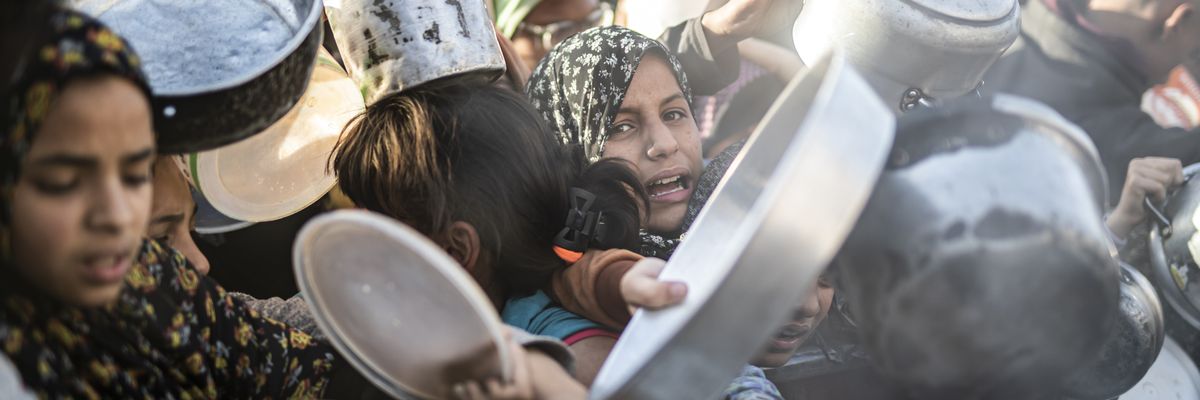
Palestinian children in Rafah, Gaza gather to receive food distributed by aid organizations on March 15, 2024. (Photo: Jehad Alshrafi/Anadolu via Getty Images)
“There is an indisputable, man-made, intentional deprivation of aid that continues to suck the life out of any and all humanitarian operations, including our own,” said one campaigner.
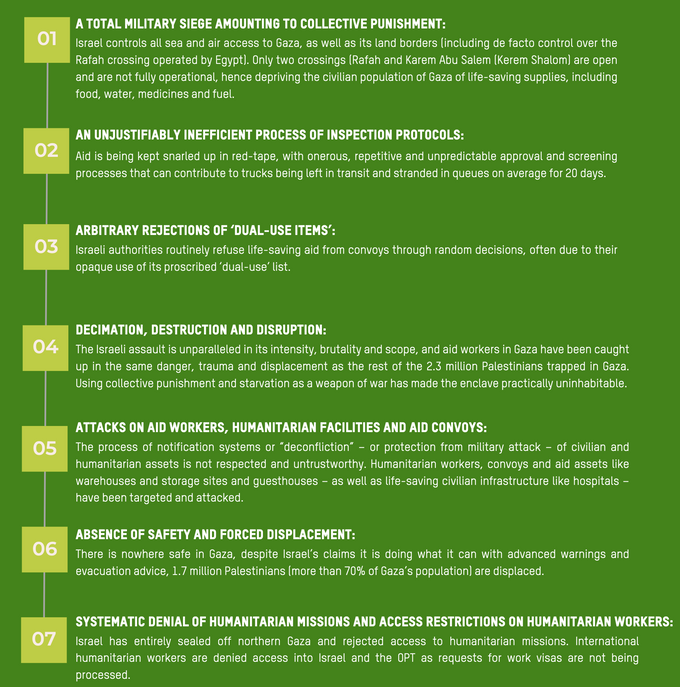
The Israeli government is intentionally restricting the flow of humanitarian aid to the Gaza Strip by subjecting shipments to a prolonged and dysfunctional inspection process, arbitrarily rejecting items, attacking aid convoys, and limiting the number of crossings through which deliveries can pass, Oxfam International said in a report published late Sunday.
The report, titled Inflicting Unprecedented Suffering and Destruction, argues that Israel’s continued obstruction of humanitarian aid is a direct violation of both international humanitarian law (IHL) and a January order from the International Court of Justice (ICJ), which ruled the Israeli government is “plausibly” committing genocide in Gaza and must ensure that assistance reaches desperate Gazans.
Oxfam said Sunday that “humanitarian access in the Gaza Strip has effectively worsened” since the ICJ handed down its interim order nearly two months ago, and conditions on the ground in the Palestinian territory have deteriorated rapidly. New data from the Integrated Food Security Phase Classification (IPC) shows that Gaza’s “entire population” is facing “high levels of acute food insecurity” and 1.1 million people are experiencing “catastrophic” hunger—a figure that one expert called “unprecedented.”
“The ICJ order should have shocked Israeli leaders to change course, but since then conditions in Gaza have actually worsened,” said Sally Abi Khalil, Oxfam’s Middle East and North Africa director. “The fact that other governments have not challenged Israel hard enough, but instead turned to less effective methods like airdrops and maritime corridors is a huge red flag, signaling that Israel continues to deny the full potential of better ways to deliver more aid.”
“Israeli authorities are not only failing to facilitate the international aid effort but are actively hindering it,” Abi Khalil added. “We believe that Israel is failing to take all measures within its power to prevent genocide.”
In its new report, Oxfam outlines seven ways in which the Israeli government is impeding humanitarian aid shipments and exacerbating one of the worst humanitarian catastrophes in modern history:
In February—the first full month after the ICJ’s order—Israel allowed just 2,874 aid trucks to enter the Gaza Strip, a 44% decline compared to the previous month, according to Oxfam.
The group said Israeli authorities “have rejected a warehouse full of international aid including oxygen, incubators, and Oxfam water and sanitation gear, all of which is now stockpiled at Al Arish just 40 kilometers away from the border of 2.3 million desperate Palestinians in Gaza.”
Israel’s military, which is armed by the U.S. and other major countries that are legally obligated to prevent genocide, has also blocked humanitarian staff from entering Gaza, adding “pressure and workload” to already overwhelmed aid efforts, Oxfam said.
Celine Maayeh, advocacy and research officer at Juzoor for Health and Social Development—an Oxfam partner organization—said Sunday that “there’s been an alarming increase in cases of malnutrition among children in the last month, and yet the only food the team is able to find to feed people living in 45 shelters is some vegetables.”
“There is an indisputable, man-made, intentional deprivation of aid that continues to suck the life out of any and all humanitarian operations, including our own,” said Maayeh.
“If a famine is declared, it will already be too late for too many people—children are famine’s first victims and are already dying in Gaza because of malnutrition.”
Oxfam’s findings are consistent with those of other aid organizations and lawmakers who have visited the region in recent weeks.
In January, U.S. Sens. Jeff Merkley (D-Ore.) and Chris Van Hollen (D-Md.) told reporters that they witnessed “miles of backed-up trucks” stuck at border crossings as Gazans nearby struggled to survive, eating grass and drinking contaminated water.
The senators said they saw one warehouse full of items that Israeli authorities rejected in their inspection process, including oxygen cylinders and medical kits used for delivering babies.
Van Hollen said the warehouse was “a testament to the arbitrariness” of Israel’s inspections.
Oxfam argued Sunday that the “only meaningful solution” to Gaza’s intensifying humanitarian emergency is “an immediate, permanent, and unconditional cease-fire.”
“Even the trickle of aid that a humanitarian response could provide under the current circumstances is being further obstructed by Israel’s policies and practices, inflicting suffering on millions of Palestinians who are living under Israeli bombardment without access to food, clean water, and medical care,” the group said.
Xavier Joubert, country director for Save the Children in the occupied Palestinian territory, echoed Oxfam’s call for a cease-fire and warned in response to the new IPC figures that “we have a clear timeframe to stave off famine, and it demands urgency.”
“If a famine is declared, it will already be too late for too many people—children are famine’s first victims and are already dying in Gaza because of malnutrition,” said Joubert. “Every minute counts for them. It should be on the collective conscience of Israeli authorities and the international community that every day without an immediate, definitive cease-fire and unfettered access for and to humanitarian aid is another catastrophic day of starvation and suffering, another step towards famine, and another death knell for Gaza’s children.”