Zita Holbourne addresses a previous TUC Congress at Manchester Central in 2018
ANDY BURNHAM’S government remains complicit in genocide, unions said as TUC passed an historic vote to back the Palestinian-led BDS campaign against Israel today.
Ministers announced new restrictions on trade and weapons exports with illegal settlers in Palestine earlier this month.
Campaigners hailed delegates in Brighton for voting to support the “Palestinian-led boycott, divest and sanctions (BDS) movement” and call on the government to impose “wide-ranging sanctions on Israel until it complies with international law.”
Moving the motion, Artists Union England’s Zita Holbourne said that the government’s recent acceptance of a 2024 International Court of Justice ruling urging Israel not to commit genocide in Gaza “is not enough.”
“Palestinian society, including unions, have reiterated the call for the international community to implement BDS against ongoing crimes of genocide, apartheid and occupation,” she said.
The motion also called on ministers to “commit to freedom of speech and end attempts to censor artists and art organisations expressing solidarity with Palestine” after it emerged on Tuesday that rapper Macklemore was removed from an Ed Sheeran concert for backing the war-torn territory.
Seconding, Unison delegate Margaret McKee said that unions will continue to call on Labour to fully suspend arms trade with Israel and the Britain-Israel trade partnership agreement until “human rights and international law are respected.”
“If the government doesn’t do this, you are still being complicit in the genocide of the Palestinian people,” she said.
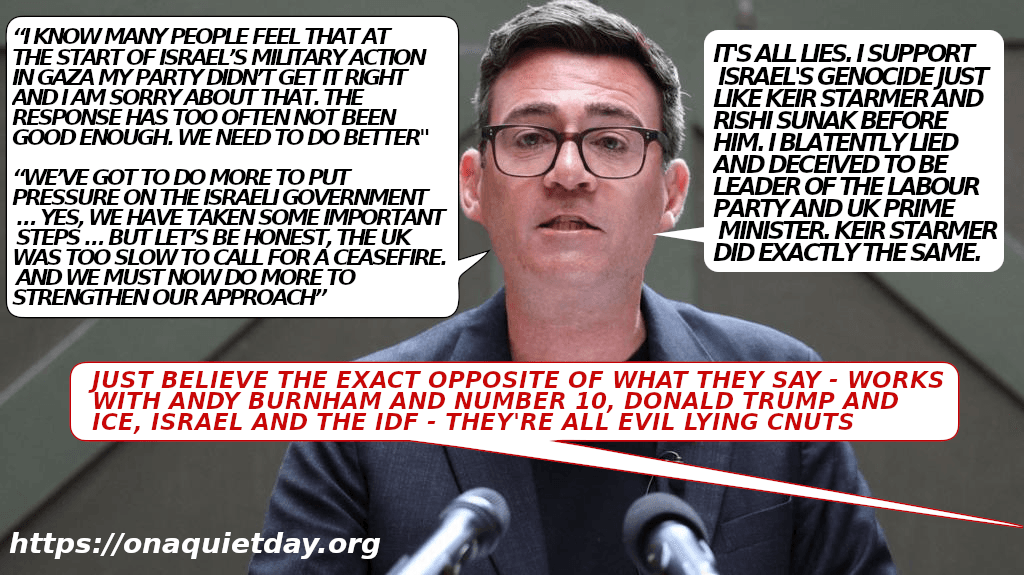
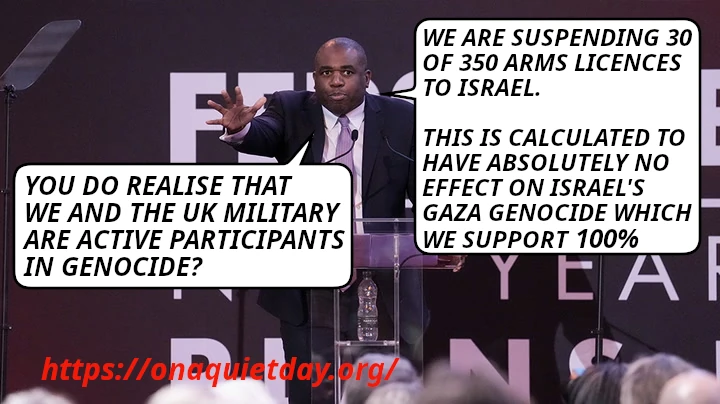
UK Prime Minister Andy Burnham admits to blatently lying and engaging in deception to become leader of the UK Labour Party and Prime Minister.Keir Starmer objects to criticism of the IDF. He asks how could anyone object to them starving people to death, forced marches like the Nazis did, bombing Gaza’s hospitals and universities, mass-murdering journalists, healthworkers and starving people queuing for food, killing and raping prisoners and murdering children. He calls for people to stop obstructing his genocide for Israel. New Labour UK Prime Minister Andy Burnham continues Labour party policy of active support and complicity in Israel’s genocide.Genocide denying [former] UK Foreign Secretary David Lammy says that UK is suspending 30 of 350 arms licences to Israel. He also confirms the UK government’s support for Israel’s Gaza genocide and the UK government and military’s active participation in genocide.
Mobilization in Caracas demanding the return of Nicolás Maduro. Photo: Francisco Trias
The implications of this case extend far beyond Venezuela. The entire process against Nicolás Maduro and Cilia Flores threatens to establish the US court system as one with global and unlimited jurisdiction.
Venezuelan President Nicolás Maduro is not guilty. This is a statement of law and fact, since Maduro has not been convicted of any crime. He has pleaded not guilty to every charge brought against him, and the accusations made by the United States remain precisely that: accusations. Under the presumption of innocence – recognized in the United States Constitution and in Article 14 of the International Covenant on Civil and Political Rights – the burden rests entirely upon the prosecution to prove guilt. It is not Maduro who must prove his innocence, but it is the United States government that must prove his guilt.
On January 3, 2026, United States forces illegally entered Venezuela, attacked targets in and around Caracas, seized President Maduro and his wife and an elected official, Cilia Flores, and transported them to the United States. Two days later, shackled and injured, Maduro appeared before a federal court in Manhattan. “I am innocent. I am not guilty,” he told the court. Both defendants entered pleas of not guilty and are now imprisoned in Brooklyn while awaiting a trial provisionally scheduled for June 2027.
The charges against Maduro
The United States alleges that Maduro participated in conspiracies to import cocaine, possess machine guns and destructive devices, and collaborate with organizations Washington has designated as terrorist groups. These charges developed out of an indictment announced during Donald Trump’s first presidency in March 2020. The case was substantially expanded after Maduro was kidnapped through a fourth superseding indictment. An indictment, however, is not evidence tested before a court. It is a document prepared by prosecutors and approved through a grand-jury proceeding at which the defense is normally neither represented nor permitted to challenge the government’s account.
The prosecution relies heavily upon the idea that Maduro directed the so-called Cartel de los Soles, or Cartel of the Suns. But even organizations deeply hostile to the Venezuelan government acknowledge that this is not a cartel in the conventional sense. The name has long been used as an umbrella expression for disparate Venezuelan officials allegedly involved in criminal activity, long before Maduro entered political life. It does not describe an organization with a demonstrated membership, command structure, headquarters or chain of authority comparable to Mexico’s Sinaloa Cartel. When Washington designated the Cartel de los Soles a foreign terrorist organization in 2025, the Associated Pressnoted that it was “not a cartel per se.”
This matters because the prosecution’s language performs much of its political work. Allegations concerning individual acts of corruption are assembled into the image of a unified organization, the organization is then attributed to the Venezuelan state, and responsibility for everything allegedly done by anyone within that loose network is placed upon Maduro. The indictment must still demonstrate that Maduro knowingly joined the specific conspiracies charged. Political authority over a state in which crimes occur does not by itself establish personal criminal responsibility for those crimes.
Case is dead on arrival
Venezuela is not a major producer of coca leaf or cocaine. The principal cocaine-producing countries remain Colombia, Peru and Bolivia. Venezuela has been used as a transit territory, particularly for cocaine originating in neighboring Colombia. But transit through a country does not prove that its president commands the traffic, and nor does it substantiate the extravagant political image of Venezuela as the central source of the drugs entering the United States. The US Drug Enforcement Administration’s own 2025 threat assessment concentrated overwhelmingly upon Mexican organizations and their supply chains. The global cocaine trade operates primarily through production in the Andean region, maritime export corridors, Central America and Mexico, not through a single organization supposedly commanded from the Venezuelan presidential palace. The International Criminal Court’s investigation into the situation in Venezuela, for example, is an investigation into alleged crimes within its jurisdiction. It is not a conviction of Maduro and has not produced an individual judgment of guilt against him.
The US government is expected to rely upon cooperating witnesses, including former Venezuelan intelligence chief Hugo Carvajal and former general Clíver Alcalá. Both men pleaded guilty to serious offenses in the United States. Their evidence cannot be treated as disinterested truth. Cooperating defendants may hope to obtain sentencing benefits by assisting prosecutors. Their claims must therefore be corroborated and subjected to cross-examination. Until that happens, their statements do not establish Maduro’s guilt. In fact, it is better to see their statements as proof of their own attempt to lighten their sentences and launder their soiled reputations.
The circumstances under which Maduro was brought before the US court create an even deeper problem. Washington did not request extradition through an agreed legal process. It employed military force within another sovereign country without Venezuela’s consent or authorization from the United Nations Security Council. Article 2(4) of the UN Charter prohibits the threat or use of force against the territorial integrity or political independence of a state, subject to narrow exceptions such as self-defence. Arresting a person accused of drug offenses is not one of those exceptions. International-law specialists described the operation as an unlawful use of force, while governments including Brazil, Mexico, and China condemned the violation of Venezuelan sovereignty.
Maduro’s lawyers have argued that the prosecution violates the immunity enjoyed by an incumbent head of state. Venezuela continued to recognize Maduro as its constitutional president when the United States seized him – a fact tacitly recognized by the United States when it calls Delcy Rodriquez the Acting President. Washington cannot necessarily extinguish the international legal status of another country’s head of state merely by withholding diplomatic recognition. The defense has consequently requested dismissal of the indictment on immunity grounds and has separately challenged the narco-terrorism count for lacking an adequate jurisdictional connection to the United States. Oral argument on these questions is scheduled for November 2026.
The case of former Honduran president Juan Orlando Hernández exposes the selectivity of Washington’s supposed war against narco-states. Hernández was a close US ally during his presidency from 2014 to 2022. After leaving office, he was extradited – not abducted through a military invasion – and tried in the same federal district in New York where Maduro is now being prosecuted. In March 2024, a jury convicted Hernández after a three-week trial. Prosecutors presented evidence that he had accepted millions of dollars from traffickers, protected cocaine shipments with the Honduran police and military, and helped move more than 400 tons of cocaine towards the United States. He was sentenced to 45 years in prison. Unlike the claims against Maduro, these allegations were tested through testimony, cross-examination and a jury verdict. Yet on December 1, 2025, President Donald Trump pardoned Hernández and secured his release, claiming that the former president had been treated unfairly.
The contrast could hardly be more revealing. Trump pardoned a former president whose participation in cocaine trafficking had been established in a US courtroom, while threatening and eventually invading Venezuela to seize a president against whom no verdict had been rendered. Hernández belonged to Washington’s political camp; Maduro did not. One was released despite his conviction, while the other was captured despite his legal innocence. This disparity does not by itself disprove the accusations against Maduro, but it demolishes the claim that Washington acted from a consistent concern about narcotics. The determining distinction was political alignment, not the strength of the evidence.
The implications of this case extend far beyond the specific circumstances of Maduro and Cilia Flores or their consequences for Venezuela. Allowing a foreign state to override the jurisdiction of another country’s legal system, pursue an accusation for which there is no evidence, and proceed with a trial that lacks a basis in international law effectively establishes the US court system as one with global and unlimited jurisdiction. The ambivalence of governments around the world toward this case is therefore alarming, as it risks signalling consent and normalizing such gross overreach. This is particularly relevant for Mexico, which is already facing a series of accusations and extradition demands from the United States with clear political implications. The outcome of Maduro’s trial could set an important precedent for how Mexico – and other countries – are treated in similar circumstances.
Nicolás Maduro is not guilty therefore expresses the only defensible conclusion at this stage. He was seized through an act of military force, placed before the courts of the state that had pursued his overthrow for years, and charged based on a politically constructed theory that has yet to survive adversarial examination. He remains innocent unless and until admissible evidence proves otherwise beyond a reasonable doubt. Sovereignty is not an ornament, an indictment is not a verdict, and an accusation issued by a powerful state does not become truth merely because that state possesses the weapons to seize the accused.
Stephanie Weatherbee Brito is the co-coordinator of the International Peoples Assembly (IPA).
Vijay Prashad is an Indian historian and journalist. He is the author of forty books, including Washington Bullets, Red Star Over the Third World, The Darker Nations: A People’s History of the Third World, The Poorer Nations: A Possible History of the Global South, and How the International Monetary Fund Suffocates Africa, written with Grieve Chelwa. He is the executive director ofTricontinental: Institute for Social Research, the chief correspondent for Globetrotter, and the chief editor ofLeftWord Books(New Delhi). He also appeared in the films Shadow World (2016) and Two Meetings (2017).
Climate science denier Donald Trump confirms that he knows nothing about democracy and that more liquid gold is being secured according to his policy of global privateering.Orcas discuss rotting brain, front Orca says Sundown Syndrome is a dead givaway and he wishes someone would Lock Him Up
This work by Middle East Monitor is licensed under a Creative Commons Attribution-NonCommercial-ShareAlike 4.0 International License.
Palestinian citizens of Israel referred to as “48 Arabs,” stage a protest demanding that Israel end its violations in Gaza and the West Bank, in Umm al-Fahm, Israel on August 08, 2026. [Mostafa Alkharouf – Anadolu Agency]
The UK, Italy, France and Germany on Thursday condemned Israel’s decision to publish construction tenders for the E1 settlement project in the occupied West Bank, warning they threaten the chance of a two-state solution, Anadolu reports.
The four governments said the expansion was “unacceptable” and warned that the E1 development would “undermine the prospect of the two-state solution by driving a wedge through the West Bank and harming the territorial contiguity of the Palestinian Territories.”
The governments said the international community had long opposed settlement expansion and repeatedly raised its concerns with Israel — privately and publicly.
“International Law is clear that Israeli settlements in the West Bank are illegal,” they said, adding that the position had been reaffirmed by the UN Security Council.
The four countries also expressed concern about the wider situation in the West Bank, citing “unprecedented levels of violence by settlers against civilians” alongside serious restrictions on the Palestinian economy.
They urged Israel to withdraw the plans immediately and to end its expansion of settlements in the West Bank.
“Not only will they take us further from peace, but they further undermine Israel’s international standing,” they said.
The governments also urged businesses not to bid for construction tenders connected with the project, warning companies to consider the potential “legal and reputational consequences,” including the risk of involvement as “serious breaches of international law.”
The statement reiterated the commitment of the four countries to a “comprehensive, just and lasting peace based on the two-state solution.”
This work by Middle East Monitor is licensed under a Creative Commons Attribution-NonCommercial-ShareAlike 4.0 International License.
Climate science denier Donald Trump confirms that he knows nothing about democracy and that more liquid gold is being secured according to his policy of global privateering.Orcas discuss Donald Trump and the killer apes’ concept of democracy. Front Orca warns that Trump is crashing his country’s economy and that everything he does he does for the fantastically wealthy.
This work by Middle East Monitor is licensed under a Creative Commons Attribution-NonCommercial-ShareAlike 4.0 International License.
Volkswagen plant in Osnabrück, Germany. [Photo/AA]
As Volkswagen explores converting one of its German factories from civilian vehicle production to manufacturing components for an Israeli missile defense system, local peace activists are stepping up efforts to stop the move, Anadolu reports.
The campaign comes amid reports that Volkswagen is in discussions with Israel’s state-owned Rafael Advanced Defense Systems about repurposing its Osnabruck plant after passenger car production ends in 2027.
The site could manufacture components for Israel’s Iron Dome air defense system, including launchers, transport vehicles and power generators, according to the Financial Times. Volkswagen has not confirmed any agreement and says no decision has been made on the plant’s future.
Even without a confirmed agreement, Osnabruck Peace Initiative (OFRI) said it plans to intensify its grassroots campaign to stop the deal, organizing rallies, public events and demonstrations while working with local groups to build support for keeping the factory focused on civilian production.
“We’re working with various coalition partners to build support in the city for the civilian use of the factory, and we’re explaining why we don’t approve of arms production,” OFRI spokesperson Marie Dominique Guyard told Anadolu.
She said the group’s biggest challenge is convincing people that expanding arms production undermines rather than strengthens security.
“We are in favor of peaceful conflict resolution, diplomacy, ending conflicts through diplomacy, and respect for international law – and attracting arms companies to the city is the exact opposite of that,” Guyard said.
She argued that Rafael’s reported involvement makes the proposal particularly controversial.
“Israel is not known for its respect for international law,” she said. “The establishment of an Israeli state-owned company is, in effect, support for Israel’s wars.”
Guyard also criticized reports that public funds could support the project.
A call for worker resistance
Prominent German peace activist Reiner Braun echoed those concerns, calling the reported proposal “criminal.”
“Such a deal must be rejected outright,” he told Anadolu. “Of course, if Volkswagen, an industrial company, manufactures a component for Rafael, it is complicit in the policy of genocide and cannot absolve itself of that responsibility.”
“They know what they are doing, and they do it deliberately because they believe they can make more short-term profits. It is immoral, unethical, and one could actually say it is a criminal deal.”
Braun urged Volkswagen employees to oppose any move toward military production.
”The most important thing is resistance within the plant itself,” he said. “All employees at all Volkswagen plants must raise their voices and say, ‘We do not want to participate in the development of weapons of genocide.’”
He said Germany’s peace movement would continue supporting workers who oppose the reported plans.
Where the talks stand
Volkswagen has not confirmed reports that it is negotiating with Israel’s Rafael Advanced Defence Systems over defense production at its Osnabruck plant.
A company spokesperson previously told Anadolu that Volkswagen is evaluating options for the factory after passenger car production ends in 2027 and remains in discussions with various market participants.
“There are currently no concrete decisions or conclusions regarding the future direction of the site,” the spokesperson said. “The production of weapons by Volkswagen AG remains ruled out for the future, and we do not engage in speculation regarding further plans for the Osnabruck site.”
Since then, media reports have offered conflicting accounts of the future of the proposed deal.
Last month, German newspaper Bild reported that Qatar’s sovereign wealth fund, Volkswagen’s third-largest shareholder with a 17% stake, had blocked management’s proposal to partner with Rafael to manufacture missile components and military vehicles at the Osnabruck plant.
However, German business magazine WirtschaftsWoche later reported that negotiations were continuing despite Qatar’s reported objections.
The magazine said the head of the works council at the Osnabruck plant, which employs about 2,400 people, had urged the German state of Lower Saxony – Volkswagen’s second-largest shareholder – to acquire a majority stake in the factory itself, a move that could allow the Rafael partnership to proceed.
The reported negotiations come as Volkswagen undergoes a broad restructuring program amid mounting competition from Chinese automakers and slower-than-expected growth in the electric vehicle market.
Rafael, meanwhile, has been expanding its European footprint as governments across the continent boost defense spending and procurement following the war in Ukraine.
This work by Middle East Monitor is licensed under a Creative Commons Attribution-NonCommercial-ShareAlike 4.0 International License.
People stage a pro-Palestinian demonstration and call on Labour Party leader Andy Burnham, who is preparing to take office as prime minister, to impose comprehensive sanctions on Israel, in London, United Kingdom on July 18, 2026. [Raşid Necati Aslım – Anadolu Agency
Britain’s new government has rejected calls from 80 MPs and peers to recognise Israel’s genocide in Gaza, impose a full arms embargo and introduce comprehensive sanctions against the occupation state.
The decision has intensified criticism of Prime Minister Andy Burnham and Foreign Secretary Ed Miliband, whose first statements in office raised expectations of a break with the policies of former Prime Minister Keir Starmer but have so far produced little substantive change.
In a cross-party letter led by Labour MP Kim Johnson, members of the House of Commons and House of Lords urged Burnham to recognise the findings of the UN Independent International Commission of Inquiry, which concluded that Israel had committed genocide against Palestinians in Gaza.
I'm one of 80 MPs & Peers calling on the PM to:
– Recognise the UN’s findings on genocide & implement the ICJ ruling in full – Impose sanctions including a full arms embargo – Ban trade that supports Israel’s illegal settlements
The parliamentarians called on the government to “fundamentally change its position” by supporting Palestinian rights and taking steps to prevent further Israeli violations of international law.
They also urged ministers to implement the International Court of Justice’s ruling on Israel’s illegal occupation, impose comprehensive sanctions, introduce a complete arms embargo and prohibit trade in goods and services linked to illegal Israeli settlements in the Occupied Palestinian Territory.
However, the Foreign, Commonwealth and Development Office declined to endorse any of the demands.
The rejection follows criticism of Miliband’s first statement as foreign secretary, in which he referred explicitly to “Russia’s illegal war in Ukraine” but described Israel’s assault on Gaza only as “conflict in the Middle East”.
British governments and senior ministers have repeatedly made legal and political judgements about Russia’s conduct without waiting for a final international court ruling. The UK described Russia’s invasion as illegal from its outset and accused Russian forces of committing war crimes.
In June 2026, the Commission reported that Israeli authorities and forces continued to commit genocide and other atrocity crimes, including through the deliberate targeting of Palestinian children.
The UN findings are part of a much broader body of expert assessments.
Amnesty International concluded in December 2024 that Israel had committed and was continuing to commit genocide against Palestinians in Gaza. Israeli human rights organisation B’Tselem reached the same conclusion in its July 2025 report, Our Genocide. The International Association of Genocide Scholars later declared that Israel’s policies and actions met the legal definition of genocide under the Genocide Convention.
Despite these findings, the British government has maintained that only a court can make a genocide determination.
During a House of Lords debate following the UN Commission’s September 2025 report, ministers insisted that the government would not describe Israel’s actions as genocide until a competent national or international court had ruled on the issue.
Burnham had sought to distance himself from Starmer’s record before entering Downing Street. He acknowledged that Labour “got it wrong” in its initial response to Gaza and admitted that Britain had been too slow to call for a ceasefire.
However, he stopped short of recognising genocide, arguing that the matter should be left to international courts. Green Party deputy leader Mothin Ali accused Burnham of hiding behind the courts when discussing Israel while showing no similar hesitation in condemning Russia.
Ali warned that the duty under the Genocide Convention is to prevent genocide rather than wait until the destruction has been completed and formally adjudicated. Recognising the evidence, he argued, would also raise questions about Britain’s arms exports, surveillance cooperation and wider support for Israel.

 Zita Holbourne addresses a previous TUC Congress at Manchester Central in 2018