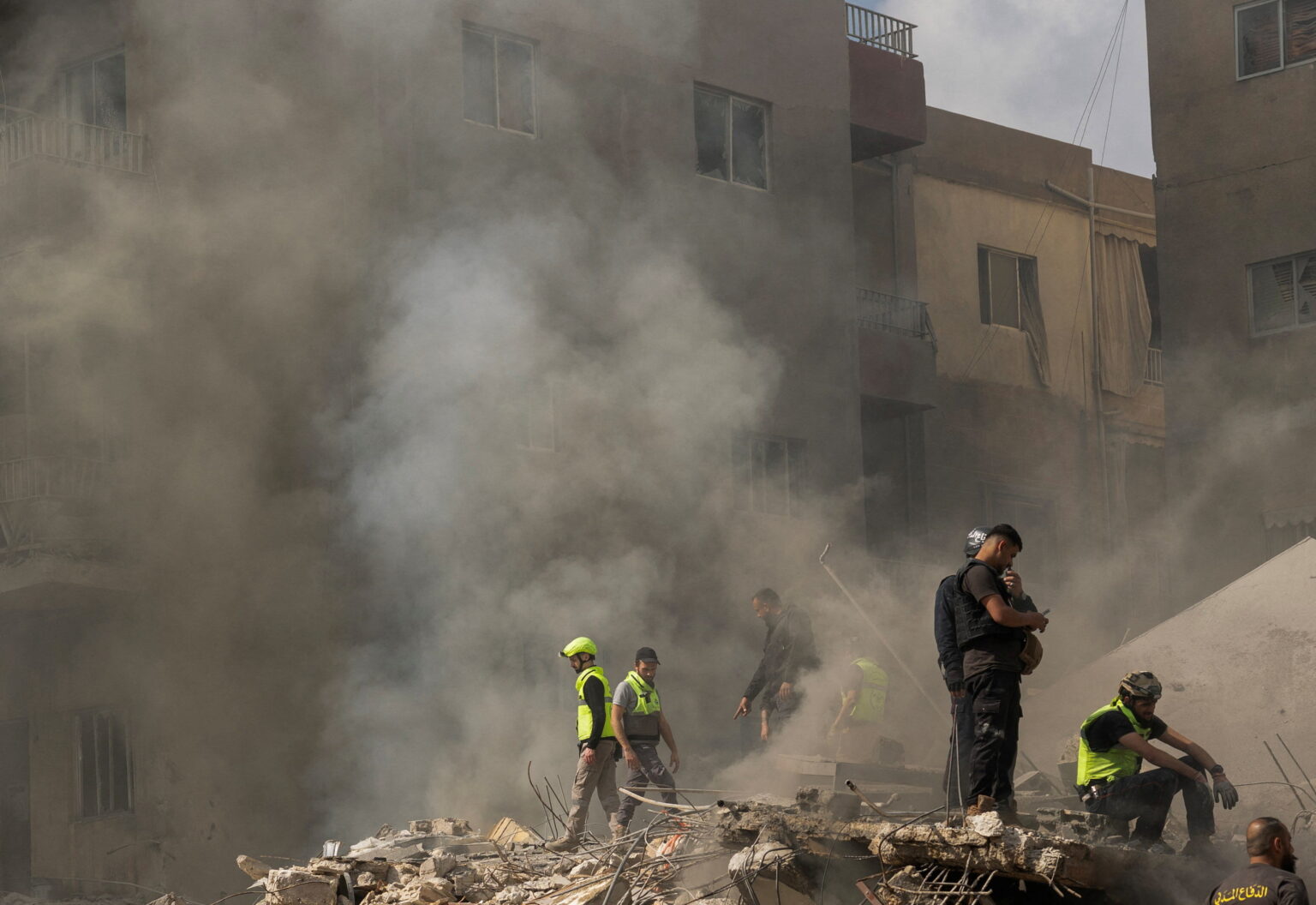
The aircraft was above Baalbek when 18 people were killed there.
The UK flew a drone over Baalbek, Lebanon as Israel massacred 18 people and injured 28 others there on Wednesday, flight data shows.
The flight, first reported on by independent journalist Matt Kennard, left the RAF Akrotiri airbase in Cyprus at 8:22am local time, just hours before Israel’s massive and intense bombardment of civilian areas across Lebanon, which killed at least 303 people, including many children.
The General Atomics Protector RG1 drone circled in the sky near Baalbek for hours, data from AirNav Radar shows. The model is equipped with missiles and bombs and can be used for “surveillance, search and rescue, and armed operations”, according to the RAF’s website.
Prime minister Keir Starmer has repeatedly, and falsely, claimed that the UK’s only involvement in the war in the Middle East since 28 February is defensive.
Wednesday’s drone flight appears to mirror a pattern first seen at the height of Israel’s genocide in Gaza, when Starmer’s government flew numerous surveillance flights over the enclave on behalf of the apartheid state.
Keir Starmer explains that UK is actively supporting Israel’s genocidal expansion and repeats his previous quotation that he supports Zionism “without qualification”. Keir Starmer said “I said it loud and clear – and meant it – that I support Zionism without qualification.” here: https://www.jewishnews.co.uk/keir-starmer-interview-i-will-work-to-eradicate-antisemitism-from-day-one/Keir Starmer objects to criticism of the IDF. He asks how could anyone object to them starving people to death, forced marches like the Nazis did, bombing Gaza’s hospitals and universities, mass-murdering journalists, healthworkers and starving people queuing for food, killing and raping prisoners and murdering children. He calls for people to stop obstructing his genocide for Israel.
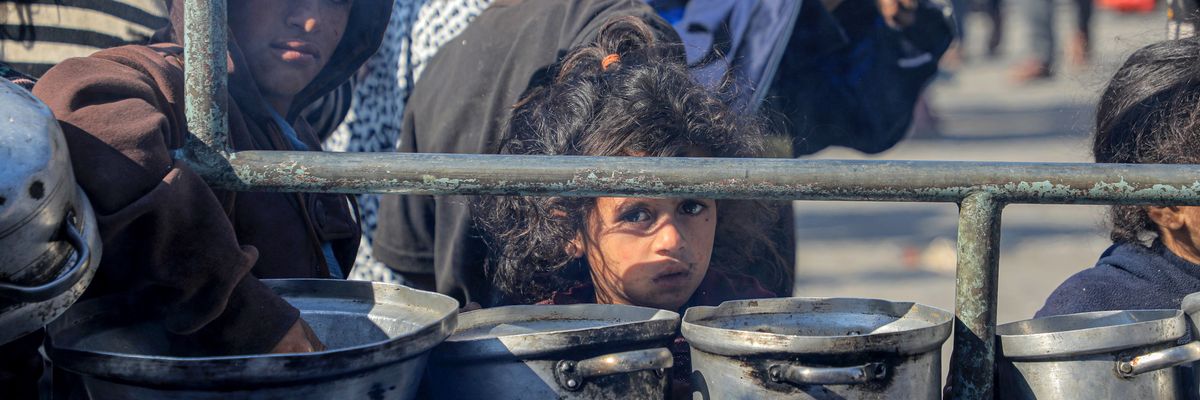
Children wait for food relief in the southern Gaza Strip city of Rafah on December 31, 2023. (Photo: Rizek Abdeljawad/Xinhua via Getty Images)
“If current conditions persist,” said Israeli group B’Tselem, “there is significant risk that famine will be declared throughout the entire Gaza Strip within six months.”
The Israeli government “can, if it chooses to,” save more than 2 million people who are starving in Gaza by ending its blockade on aid, an Israel-based human rights group emphasized in a report on Monday, condemning the country for continuing to allow just a fraction of the food needed in the enclave through border crossings as it relentlessly bombs civilian targets.
“Everyone in Gaza is going hungry,” said B’Tselem in the dispatch, bluntly titled, “Israel Is Starving Gaza.”
The organization pointed to a recent analysis by the Integrated Food Security Phase Classification Famine Review Committee from late last month, which found that about 93% of Gaza’s over 2 million people were suffering from “acute food insecurity” at Phase 3, while more than 15%—378,000 people—were already at the most dire classification, Phase 5, with “extreme food shortages, hunger, and exhaustion.”
By February 7, the entire population of Gaza is expected to reach Phase 3, and “if current conditions persist,” said B’Tselem, “there is significant risk that famine will be declared throughout the entire Gaza Strip within six months.”
“Such a declaration is made when 20% of households read Phase 5, when 30% of children suffer from extreme malnutrition, and when two adults or four children out of 10,000 die of hunger every day,” said the group.
Before Israel began its U.S.-backed bombardment of Gaza in retaliation for Hamas’ October 7 attack, about 80% of Gaza residents relied on humanitarian aid to survive.
Israel’s destruction of cultivated fields, bakeries, food warehouses, and factories has meant that residents now wholly depend on food supplies from outside Gaza.
That aid is still available, B’Tselem stressed, but cannot reach people because “Israel is deliberately denying the entry of enough food to meet the population’s needs.”
About 500 aid trucks entered Gaza daily before the assault began, but only about 120 trucks are allowed through just two crossings—Rafah and Kerem Shalom—on a daily basis.
The Rafah crossing is a designed for passenger vehicles rather than “massive commercial transports,” and the recent opening of the Kerem Shalom crossing was “merely a token addition that has failed to alleviate the hardship,” said B’Tselem.
“The little food that does get in is very difficult to distribute due to constant bombings, destroyed roads, frequent communications blackouts, and shelters overflowing with hundreds of thousands of [internally displaced people] crowding into smaller and smaller areas,” said the group.
Israel’s continued blockade has resulted in “children begging for food, people waiting in long lines for paltry handouts, and hungry residents charging at aid trucks,” B’Tselem added. “The horror is growing by the minute, and the danger of famine is real.”
With meaningful, unhindered & unconditional humanitarian assistance + commercial flow, the looming famine can still be reversed & prevented. https://t.co/en8VMW1117
Martin Griffiths, undersecretary-general for humanitarian affairs and emergency relief coordinator at the United Nations, said late last week that Israel’s air and ground assault on Gaza has rendered the enclave “uninhabitable.”
“A public health disaster is unfolding,” said Griffiths. “Infectious diseases are spreading in overcrowded shelters as sewers spill over. Some 180 Palestinian women are giving birth daily amidst this chaos. People are facing the highest levels of food insecurity ever recorded. Famine is around the corner.”
“For children in particular, the past 12 weeks have been traumatic: No food. No water. No school,” he added. “Nothing but the terrifying sounds of war, day in and day out.”
Last month, Human Rights Watch accused Israel of using starvation as a “method of warfare”—a war crime according to international humanitarian law.
“Changing this policy is not just a moral obligation,” said B’Tselem. “Allowing food into the Gaza Strip is not an act of kindness but a positive obligation under international humanitarian law: Starvation as a method of warfare is prohibited, and when a civilian population lacks what it needs to survive, parties to the conflict have a positive obligation to allow rapid and unimpeded passage of humanitarian aid—including food.”
“These two rules are considered customary law,” added the group, “and violating them constitutes a war crime under the Rome Statute of the International Criminal Court.”