Fire and plumes of smoke rises after a drone struck a fuel tank forcing the temporary suspension of flights near Dubai International Airport, in United Arab Emirates, early March 16, 2026
FEARS of a global energy crisis rose today as the war in the Middle East raged on.
The United States and Israel continued their illegal and unprovoked war on Iran as they bombarded the Iranian capital Tehran and Israel maintained its assault on Lebanon.
An Iranian drone strike temporarily shut Dubai’s airport, a crucial global travel hub, underscoring the threats to the world economy.
The war, which began on February 28, has seen Iran hit back by attacking Israel and US bases in the region, and Gulf Arab countries’ energy infrastructure.
The Iranians have also closed the Strait of Hormuz through which a fifth of the world’s oil is transported. That has dramatically increased the price of oil and put pressure on Washington to do something to ease the pain for consumers.
Brent crude, the international standard, remained more than $100 (£75) a barrel on Monday.
US President Donald Trump said that he has sent a demand to seven countries to send warships to keep the Strait of Hormuz open.
The US president said on Sunday that he wanted these other nations to help police the strait to make it safe for shipping, with his party increasingly concerned that rising prices for US consumers will hurt the Republicans in November’s mid-term elections.
Donald Trump calls for help from NATO allies in securing the Straight of Hormuz despite saying only 9 days ago that they don’t need people to join wars after they’ve already won.Donald Trump sings and dances, says that it’s fun to kill everyone …Climate science denier Donald Trump confirms that he knows nothing about democracy and that more liquid gold is being secured according to his policy of global privateering.
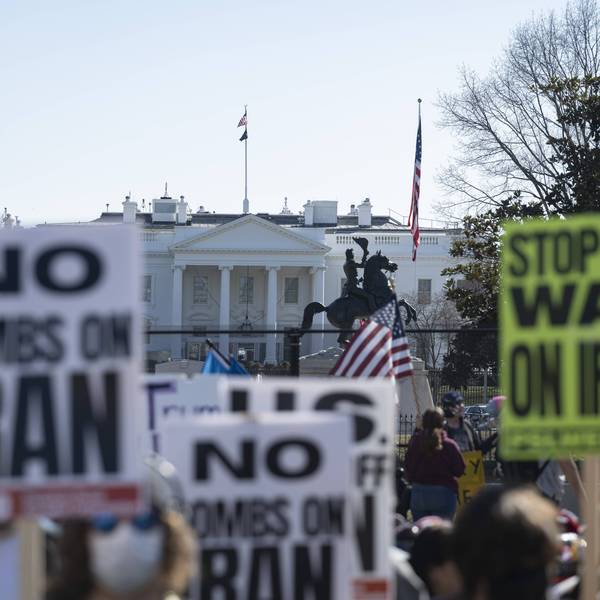
Protesters take part in a demonstration against the visit of Israeli Prime Minister Benjamin Netanyahu at Lafayette Square near the White House in Washington, DC, on September 29, 2025. (Photo by Mehmet Eser/Middle East Images/AFP via Getty Images)
A new survey shows just 32% of US voters view Israel positively—down from 47% in 2023.
Support for Israel has dropped across the board among US voters over the last three years, with particularly steep declines among Democrats and independents, according to a poll commissioned by NBC News.
Overall, the poll conducted by Hart Research Associates and Public Opinion Strategies found that 32% of registered US voters view Israel positively, while 39% see the country in a negative light. This is a drastic shift from 2023, when the same poll found that 47% of US voters viewed Israel positively, versus just 24% who viewed it negatively.
Democratic voters have been leading the shift away from Israel, as the percentage of Democrats who view Israel positively has fallen from 34% in 2024 to 13% in 2026, while negative views of the country have spiked from 35% to 57% over the last three years.
The shift among independent voters has been almost as dramatic, as just 21% of independents said they now have a positive view of Israel, compared to 40% of independents who viewed Israel positively in 2023. This has similarly correlated with a dramatic spike in negative views of Israel, with 48% of independents rating the country negatively, versus 22% who rated it negatively in 2023.
Republicans overall remained much more supportive of Israel than Democrats and independents, but the poll still showed that GOP support for Israel fell by nine percentage points over the last three years.
Democratic pollster Jeff Horwitt told NBC News that the shift in opinion against Israel was a direct result of its assault on Gaza that has killed at least 70,000 Palestinian civilians.
“Israel may have had major military success in its war against Hamas,” Horwitt said, “but its actions have badly damaged its standing among the American people.”
A poll released by Gallup in February found that, for the first time ever, US voters said they were more sympathetic to Palestinians than to Israelis, just one year after finding that Americans expressed more sympathy toward Israelis than Palestinians by a margin of 13 percentage points.
Israel’s unpopularity among Democratic primary voters has led to candidates trying to distance themselves from groups such as the American-Israel Public Affairs Committee (AIPAC), which is spending big in primaries to defeat Democrats who have been critical of the Israeli government.
As reported by CNN on Sunday, even Democrats running as supporters of Israel have taken pains to not be associated with AIPAC, which has become especially toxic among Democratic primary voters.
“From Minnesota to Mississippi, operatives involved in races told CNN candidates are constantly facing questions about the group on the trail,” the network noted. “Incumbents tell CNN they expect it to come up regularly at town halls. And online, detractors constantly pounce on politicians’ comments they perceive as sympathetic to Israel as evidence of being coopted by AIPAC.”
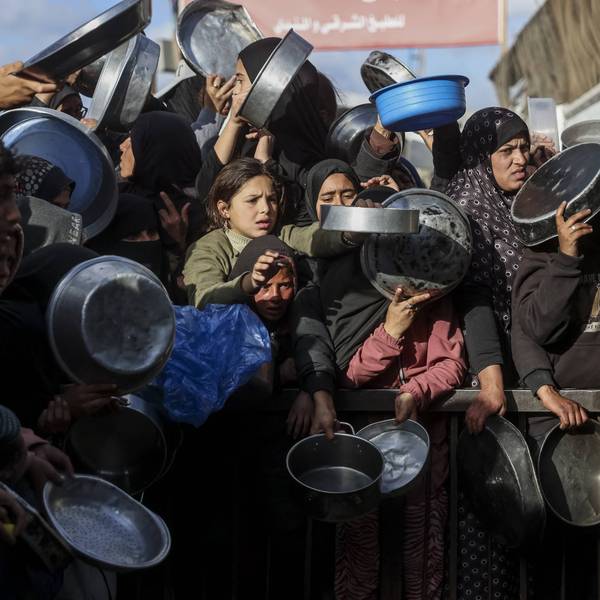
Genocide denier and Current UK Prime Minister Keir Starmer is quoted that he supports Zionism without qualification. He also confirms that UK air force support has been essential in Israel’s mass-murdering genocide. Includes URLs https://www.declassifieduk.org/keir-starmers-100-spy-flights-over-gaza-in-support-of-israel/ and https://youtu.be/O74hZCKKdpAKeir Starmer objects to criticism of the IDF. He asks how could anyone object to them starving people to death, forced marches like the Nazis did, bombing Gaza’s hospitals and universities, mass-murdering journalists, healthworkers and starving people queuing for food, killing and raping prisoners and murdering children. He calls for people to stop obstructing his genocide for Israel.Orcas discuss Genocide-supporting and complicit Zionists. Donald Trump, Keith Starmer, David Lammy, Rachel Reeves, Angela Rayner and Wes Streeting are acknowledged as evil genocide-complicit and supporting cnuts.
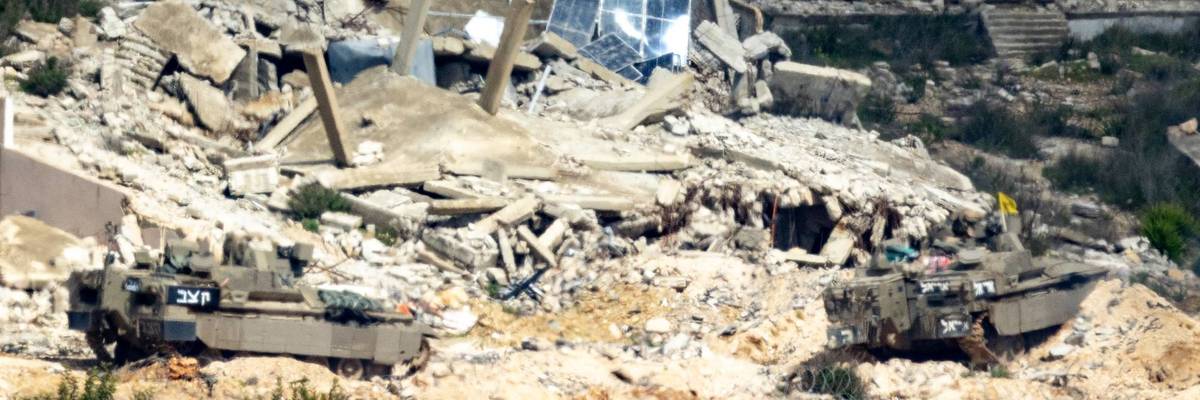
Israeli army vehicles maneuver across the border inside a destroyed Lebanese village as seen from the Upper Galilee in northern Israel on March 16, 2026. (Photo by Odd Andersen/AFP via Getty Images)
“There is no clear exit strategy for this war. While in theory Israel is trying to coerce Lebanon into disarming Hezbollah, it is unlikely that can happen,” said one analyst.
More than 800,000 Lebanese people who have been forced from their homes in southern Lebanon in the last two weeks have little hope of returning soon as the Israeli government on Monday announced its military had begun “limited and targeted ground operations” in and around the strategic southern town of Khiam, a stronghold of Hezbollah.
The ground attacks represent a significant expansion of the Israel Defense Forces’ ground operations. On March 2, when Hezbollah fired rockets into Israel in retaliation for the US and Israel’s killing of Iran’s supreme leader, Ayatollah Ali Khamenei, Israel began sending troops into Lebanon to bolster the presence the IDF has had there in five areas since a 2024 ceasefire.
Until now, ground forces have conducted “limited incursions,” Axios reported.
Israel has also launched airstrikes in Lebanon, killing at least 850 people—including 107 children and 66 women—since it was joined by the US late last month in abruptly ending diplomatic negotiations and attacking Iran.
The Times of Israel reported that the IDF carried out “massive airstrikes and artillery shelling ‘to remove threats’” over the weekend before the 91st “Galilee” Regional Division began raiding the eastern section of southern Lebanon in attacks that the military said killed several Hezbollah operatives.
Israel conducted raids on towns including Burj Qalawiya, Sultyaniya, Chaqra, Qantara, and as-Sawana on Monday, according to Al Jazeera Arabic, with the military saying the 91st Division had “begun limited and targeted ground operations against key Hezbollah strongholds in southern Lebanon.”
A major target of the ramped up ground attacks was Khiam, a Hezbollah stronghold that lies at a strategic junction of roads leading to the eastern and western sections of southern Lebanon.
“What Israel has been trying to do is really cut the supply lines and the difficult capabilities of Hezbollah, so it’s unable to bring in more weapons and fighters to areas south of the Litani River,” reported Zeina Khodr of Al Jazeera.
Israeli Defense Minister Israel Katz said that due to what the IDF claimed will be “limited and targeted ground operations,” close to a million people who have fled their homes in southern Lebanon “will not return to their homes south of the Litani River until the security of the residents of [northern Israel] is guaranteed.”
While claiming the operation in southern Lebanon will be “limited,” Katz also said the operation is intended to resemble Israel’s assault on Gaza, which has continued despite a ceasefire that was reached last October, has killed more than 75,000 Palestinians, and has been called a genocide by leading human rights groups and scholars.
Dozens of healthcareworkers have been killed in Israeli strikes since the IDF began attacking Lebanon earlier this month; in Gaza, more than 1,500 doctors, nurses, and medics have been killed in October 2023. One attack that killed two paramedics this week in the southern village of Kfarsir was reportedly a “double-tap” strike in which first responders were killed when they arrived to help victims of an initial strike on a building.
The charity group Save the Children on Monday described children “clutching beloved pets and toys as they flee their homes in Lebanon due to the escalating conflict,” and said nearly 300,000 children are among those who have been forcibly displaced.
More than 130,000 people are sheltering in overcrowded schools that have been repurposed as refugee shelters, said the group, and families have had to leave their homes without time to gather crucial documents, clothes, or medications.
“Many families were forced to flee in the middle of the night with nothing, and children miss their homes, their villages, their friends, and their schools,” said Nora Ingdal, country director for Save the Children Lebanon. “I met a child who told me, ‘I’m not able to play here and I just want to go back to my village as soon as possible.’ One child I met clutched his blue toy car, as it was the only thing he had managed to bring from home.”
“Hostilities must end and children must be protected at all costs,” said Ingdal. “We know children are always the most impacted in any conflict, and the psychological impacts last long after any conflict ends.”
The IDF is reportedly calling up 450,000 reservists to carry out the ground invasion, and the Israeli newspaper Yedioth Ahronoth reported that a senior Northern Command official told reservists in a briefing that the operation could continue “until Shavuot,” a Jewish holiday falling between May 21-23.
“We will stay as long as necessary,” the official said.
Lebanese security sources told Reuters Monday that the IDF had effectively taken control of Khiam and were advancing west toward the Litani River, which could cut off parts of southern Lebanon from the rest of the country.
Katz has also threatened to seize territory in the southern area in an effort to uproot Hezbollah.
Geopolitical analyst Shaiel Ben-Ephraim said Israel appears to be using “coercive diplomacy” and expressing a willingness to hold direct talks with Lebanon in the coming days.
“Israel is applying the Daheyia Doctrine, which uses overwhelming, disproportionate force against civilian infrastructure in areas controlled by Hezbollah to deter future attacks,” said Ben-Ephraim. “However, they plan to use this increasingly against Lebanese infrastructure to coerce Lebanon into a deal.”
The large scale Israeli invasion of Lebanon has begun. , This invasion is significantly larger in terms of manpower and organization than the 2006 Lebanon War. It is the largest since 1982. Here is what we know so far:
1) Divisions 162 and 98 are expected to join the fighting,…
“There is no clear exit strategy for this war. While in theory Israel is trying to coerce Lebanon into disarming Hezbollah, it is unlikely that can happen,” he said.
US Sen. Chris Murphy (D-Conn.) emphasized that the expanded ground operation in Lebanon is one of several crises unfolding as a result of President Donald Trump’s decision to launch attacks against Iran with Israel.
“A broader, regional war is breaking out,” said Murphy. “Trump has no endgame. Iran and its proxies can create chaos indefinitely.”
“All of this was totally foreseeable,” he added. “Frankly, it’s why previous presidents weren’t so stupid to start a war like this. Trump has lost control of the war. His best course now is to cut his losses and end it. That’s the only way to prevent an even bigger disaster.”
Genocide denier and Current UK Prime Minister Keir Starmer is quoted that he supports Zionism without qualification. He also confirms that UK air force support has been essential in Israel’s mass-murdering genocide. Includes URLs https://www.declassifieduk.org/keir-starmers-100-spy-flights-over-gaza-in-support-of-israel/ and https://youtu.be/O74hZCKKdpAKeir Starmer objects to criticism of the IDF. He asks how could anyone object to them starving people to death, forced marches like the Nazis did, bombing Gaza’s hospitals and universities, mass-murdering journalists, healthworkers and starving people queuing for food, killing and raping prisoners and murdering children. He calls for people to stop obstructing his genocide for Israel.Orcas discuss Genocide-supporting and complicit Zionists. Donald Trump, Keith Starmer, David Lammy, Rachel Reeves, Angela Rayner and Wes Streeting are acknowledged as evil genocide-complicit and supporting cnuts.
This work by Middle East Monitor is licensed under a Creative Commons Attribution-NonCommercial-ShareAlike 4.0 International License.
United States President Donald Trump departs the White House en route to Hebron, Kentucky in Washington DC, United States, on March 11, 2026. [Celal Güneş – Anadolu Agency]
President Trump is not only failing to learn from history. He is also failing to learn from what is happening right now.
This was not a small tactical mistake. Trump walked into a war with no exit plan, then realised too late that Iran had set the battlefield for a war of exhaustion, not a quick victory. Washington is now stuck between two costly choices: it cannot pull back because that would look like failure, and it cannot go deeper because that risks a long war with no guaranteed results.
As the war moves into its third week, harder questions are rising inside Washington: what does “victory” even mean; and how can it be achieved while Iran still holds the strongest pressure point in this confrontation: the Strait of Hormuz?
The Strait of Hormuz is Trump’s weak point
Trump’s biggest miscalculation was believing that firepower alone could force Iran to surrender before Iran turned Hormuz into a global pressure tool. Reality is different. Control of the strait is not an American decision. It is an Iranian one.
And the worst part is that disruption does not require a large army in the traditional sense. One incident, one strike (by an Iranian soldier on a small boat, with an RPG on his shoulder), or even a rise in perceived risk can panic markets and push up oil prices, shipping insurance, and transport costs.
That puts Washington in a double trap:
If it declares “mission accomplished” and withdraws while Hormuz is still under threat, it will look like it lost the war economically.
If it escalates to force the strait open, it enters a wider war with higher costs and no clear guarantees.
The Israeli promise that pulled Washington into trouble
A major part of the trap was set before the first strike. The war was built on an Israeli assumption: if Iran’s top leadership is hit, the state will collapse and the public will rise in the streets to bring down the system. This was sold to Trump as a shortcut: one decisive blow, rapid internal collapse, and political change without a long war.
That assumption failed. The system did not collapse, and the streets did not explode as expected. Iran reorganized leadership quickly and blocked any political vacuum that outsiders were counting on. This has also created tension inside the alliance. Washington wants to focus on Iran and Hormuz. Israel pushes to widen the war, including major escalation in Lebanon. That spreads military and political effort and raises the cost.
The Gulf wants a quick win, but the war is not in Trump’s hands
Some Gulf states want a fast end; on Washington and Tel Aviv’s terms; because they see that as the return of stability and manageable energy prices. That creates political pressure on Trump to intensify strikes.
But more strikes do not solve the Hormuz problem. Firepower can destroy targets, but it cannot restore market confidence overnight, and it cannot stop Iran from keeping the strait under constant risk.
Worse still, a prolonged war may open other maritime fronts, such as Bab al-Mandab. That would mean the crisis moves from one chokepoint to another; from one shock to the next.
Conflicting goals: Open Hormuz or SOLVE the nuclear file?
Washington is now trying to achieve two competing goals:
Secure the Strait of Hormuz enough to calm markets. And,
Deal with nuclear materials and enriched uranium stored in complex, fortified sites.
But talk of a “quick solution” to the nuclear issue points to dangerous scenarios: forces on the ground, technical operations, long timelines, and huge risks. This brings Washington back to the same problem: Trump entered expecting a short campaign, then found himself facing a war that demands costs he does not want to pay.
The real exhaustion: Weapons, defenses, and endless involvement
A war is not measured only by how many strikes are launched. It is measured by what is burned each day: air defences, expensive ammunition, and the political room to keep going.
As attacks continue, the key questions become: can Washington sustain this pace? Can its allies absorb the economic and security backlash?
Iran, meanwhile, is betting on time. It does not need to defeat the US militarily. It only needs to keep the war going long enough to turn it into a global burden: higher oil prices, higher inflation, weaker investment, and a political crisis inside Washington that cannot be covered by victory speeches.
Therefore, Trump entered a war with no exit
Trump fell into Iran’s trap because he bet on a quick collapse that never happened, and he tried to “close the file” by force without having the tools to close it. Now he faces a clear dilemma:
He cannot declare victory while Hormuz remains under pressure.
He cannot end the war without concessions, guarantees, or a settlement.
And every new escalation risks wider fronts and deeper economic damage.
This is not a war that will be decided by tough speeches. It will be decided by who can carry the cost longer. Iran, at least so far, is trying to make that cost global, not local, and to show that in this war, economics may be stronger than missiles in deciding when it ends.
The views expressed in this article belong to the author and do not necessarily reflect the editorial policy of Middle East Monitor.
This work by Middle East Monitor is licensed under a Creative Commons Attribution-NonCommercial-ShareAlike 4.0 International License.
Donald Trump sings and dances, says that it’s fun to kill everyone …Climate science denier Donald Trump confirms that he knows nothing about democracy and that more liquid gold is being secured according to his policy of global privateering.Donald Trump explains why he established his Bored of Peace
A fire and plume of smoke rise after, according to authorities. debris from an intercepted Iranian drone struck an oil facility in Fujairah, United Arab Emirates, March 14, 2026
IRAN denied today that it had called on the United States and Israel to cease fire as the war in the Middle East continued to spread death and destruction.
US President Donald Trump claimed on NBC News that Iran had wanted to make a deal to end the US-Israeli assault, but that he had refused to negotiate because “the terms are not good enough yet.”
He did not specify what those terms should be, but he did say that Iran must commit to abandoning its nuclear ambitions, which the two countries were already discussing in high-level talks before the US and Israel launched their surprise attack on February 28.
Iran’s response has been to launch drone and missile strikes on Israel and Persian Gulf states that host US forces or are otherwise allied with Washington, while also blocking ships from sailing through the Strait of Hormuz, halting the follow of fossil fuels and global trade.
At the weekend, Mr Trump called on Britain, France, China and other nations to help reopen the strategic waterway. He claimed today that several countries had committed to do so, but he has yet to name them.
The US president also said that his country’s forces may bomb Kharg Island, where Iran’s most important oil export facilities are located, again “just for fun,” after the US targeted military installations there on Friday.
Iranian Foreign Minister Abbas Araghchi told CBS News: “No, we never asked for a ceasefire and we have never asked even for negotiation. We are ready to defend ourselves as long as it takes.
“There are people being killed only because President Trump wants to have fun.”
Climate science denier Donald Trump confirms that he knows nothing about democracy and that more liquid gold is being secured according to his policy of global privateering.Donald Trump explains why he established his Bored of PeaceElon Musk urges you to be a Fascist like him, says that you can ignore facts and reality then.

 Fire and plumes of smoke rises after a drone struck a fuel tank forcing the temporary suspension of flights near Dubai International Airport, in United Arab Emirates, early March 16, 2026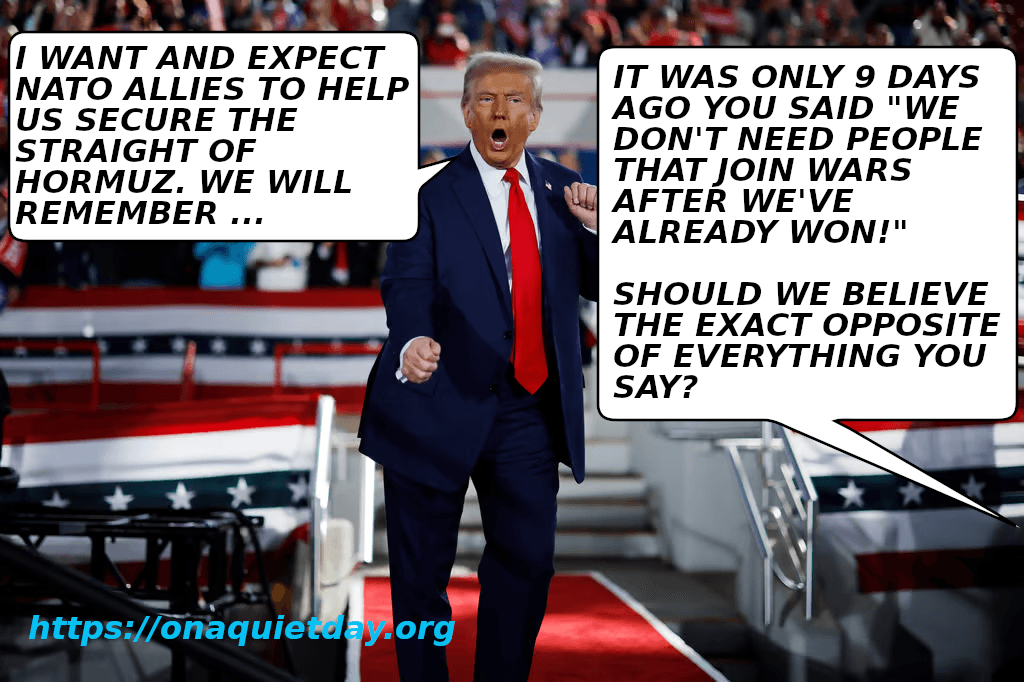






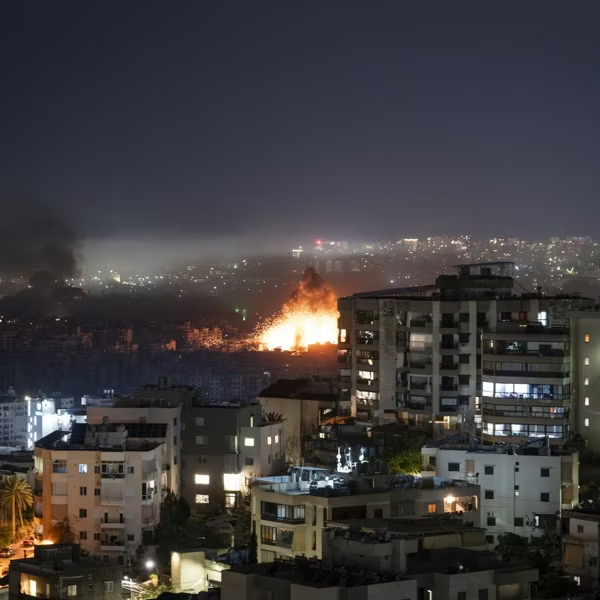



 A fire and plume of smoke rise after, according to authorities. debris from an intercepted Iranian drone struck an oil facility in Fujairah, United Arab Emirates, March 14, 2026