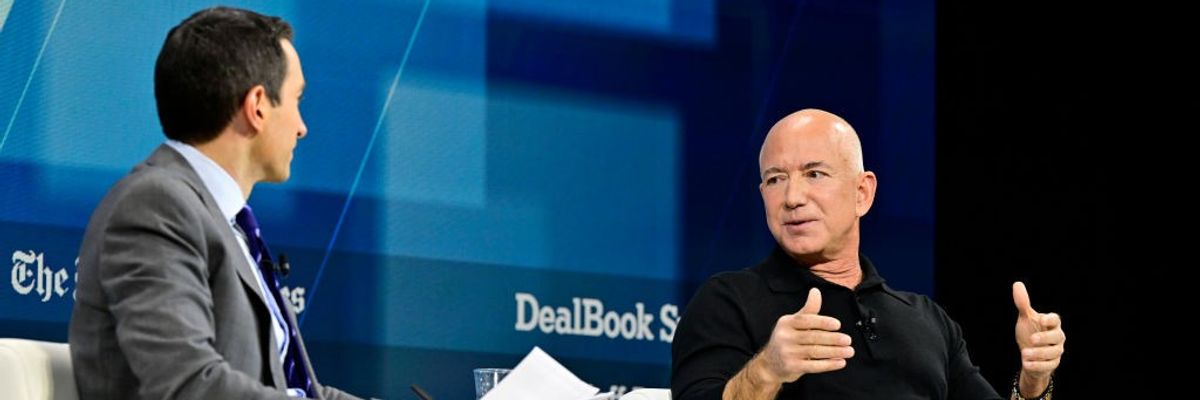
Journalist Andrew Ross Sorkin speaks with billionaire businessman Jeff Bezos during The New York Times Dealbook Summit on December 4, 2024 in New York City. (Photo: Eugene Gologursky/Getty Images for The New York Times)
“Shockingly another one of the richest guys on Earth wants to defund our government and scrap regulations.”
Billionaire Amazon founder Jeff Bezos on Wednesday expressed his optimism about U.S. President-elect Donald Trump’s next term and suggested he would “help” the Republican gut regulations.
“If we’re talking about Trump, I think it’s very interesting, I’m actually very optimistic this time around… I’m very hopeful about this—he seems to have a lot of energy around reducing regulation,” Bezos told The New York Times‘ Andrew Ross Sorkin during the newspaper’s DealBook Summit.
“And my point of view, if I can help him do that, I’m gonna help him, because we do have too much regulation in this country. This country is so set up to grow,” he continued, suggesting that regulatory cuts would solve the nation’s economic problems.
After complaining about the burden of regulations, Bezos added, “I’m very optimistic that President Trump is serious about this regulatory agenda and I think he has a good chance of succeeding.”
The comments came during a discussion about Bezos’ ownership of The Washington Post, which also addressed the billionaire’s recent controversial decisions to block the newspaper’s drafted endorsement of Democratic Vice President Kamala Harris and have it stop endorsing presidential candidates.
Bezos said Wednesday that he is “very proud” of the move, that the Post “is going to continue to cover all presidents very aggressively,” and the decision did not result from fears about Trump targeting his companies.
As Inc. reported Thursday: “Trump had railed against Bezos and his companies, including Amazon and The Washington Post, during his first term. In 2019, Amazon argued in a court case that Trump’s bias against the company harmed its chances of winning a $10 billion Pentagon contract. The Biden administration later pursued a contract with both Amazon and Microsoft.”
Bezos owns Blue Origin, an aerospace company and a competitor to Elon Musk’s SpaceX. Musk—the world’s richest person, followed by Bezos, according to the Bloomberg and Forbes trackers—has been appointed to lead Trump’s forthcoming Department of Government Efficiency (DOGE) with fellow billionaire Vivek Ramaswamy.
Bezos’ remarks at the Times summit led Fortune‘s Brooke Seipel to suggest that he may be the next billionaire to join DOGE.
Musk and Ramaswamy headed to Capitol Hill on Thursday to speak with GOP lawmakers about their plans for the government.
“Despite its name, the Department of Government Efficiency is neither a department nor part of the government, which frees Musk and Ramaswamy from having to go through the typical ethics and background checks required for federal employment,” The Associated Press noted. “They said they will not be paid for their work.”
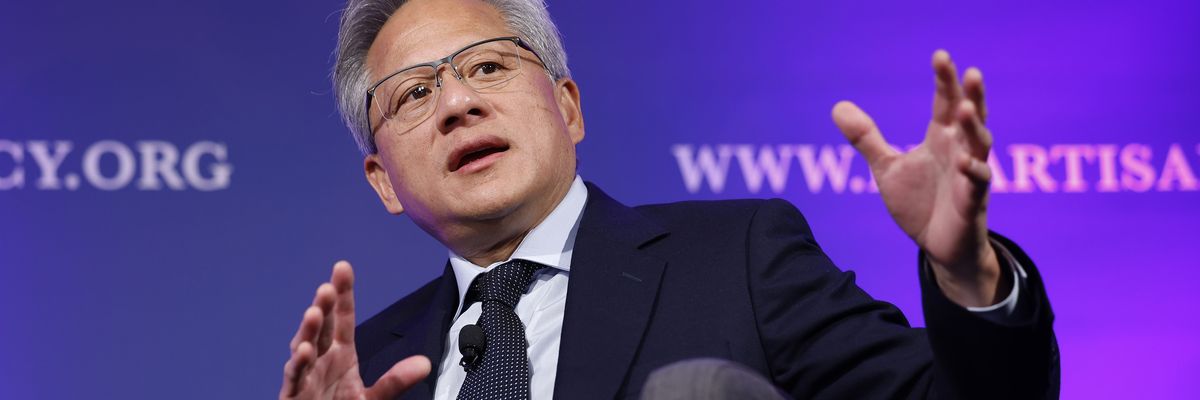
Jensen Huang of Nvidia speaks about the future of artificial intelligence and its effect on energy consumption and production at the Bipartisan Policy Center on September 27, 2024 in Washington, DC. (Photo by Chip Somodevilla/Getty Images)
“The oligarchic dozen is richer than ever, and they are endowed with extreme material power that can be used to pursue narrow political interests at the expense of democratic majorities,” according to the author of a new analysis.
Just 12 U.S. billionaires now have a collective net worth of over $2 trillion—a figure that amounts to a little less than a third of total federal spending in 2023—according to an analysis out Tuesday from Inequality.org, a project of the Institute for Policy Studies (IPS).
The $2 trillion number is also twice the amount of wealth that the top 12 US billionaires held in 2020, according to researchers at IPS, a progressive organization.
The full list of 12 billionaires includes Jeff Bezos, Bill Gates, Mark Zuckerberg, Warren Buffett, Elon Musk, Steve Ballmer, Larry Ellison, Larry Page, Sergey Brin, Jim Walton, Rob Walton, and Jensen Huang.
“This is an unsettling new milestone for wealth concentration in the United States. The oligarchic dozen is richer than ever, and they are endowed with extreme material power that can be used to pursue narrow political interests at the expense of democratic majorities,” wrote the author of the analysis, Omar Ocampo, a researcher at IPS.
New to the “oligarchic dozen” is Jensen Huang, the co-founder and CEO of the tech company Nvidia. Nvidia, which became the most valuable publicly traded company this year, has seen its profits jump thanks to the world’s ravenous appetite for the artificial intelligence chips that the firm produces. According to the analysis, Huang’s personal wealth “has skyrocketed from $4.7 billion in 2020 to $122.4 billion—a mind-boggling 2,504 percent increase—over the last four years.”
Each of the billionaires on the list “owns or is a controlling shareholder of a business that is investing billions of dollars in artificial intelligence,” according to Ocampo, which raises concerns about their respective carbon footprints.
Fueling AI is energy intensive, and AI data centers in the U.S. are largely powered by fossil fuels, meaning their proliferation poses a threat to the environment and a transition to a green economy.
Ocampo also discusses the political reach of the billionaires on the list. Elon Musk and Jeff Bezos, who respectively own X and The Washington Post, “have both purchased large media platforms, which has granted them the ability to set the terms of public debate with the hopes of influencing public opinion in their favor.”
Musk specifically has established himself as a major power broker within the GOP. The billionaire spent hundreds of millions helping to re-elect Donald Trump and is now poised to play a major role in the president-elect’s administration, helping oversee a new advisory committee tasked with slashing government spending.
As of early December, Trump had tapped an “unprecedented” total of seven reported billionaires for key positions in his administration, according to a separate piece of analysis by Inequality.org.
“We see the effects of this growing concentration of wealth and economic inequality everywhere—plutocratic influence on our politics, wealth transfers from the bottom to the top, and the acceleration of climate breakdown,” Ocampo wrote on Tuesday.
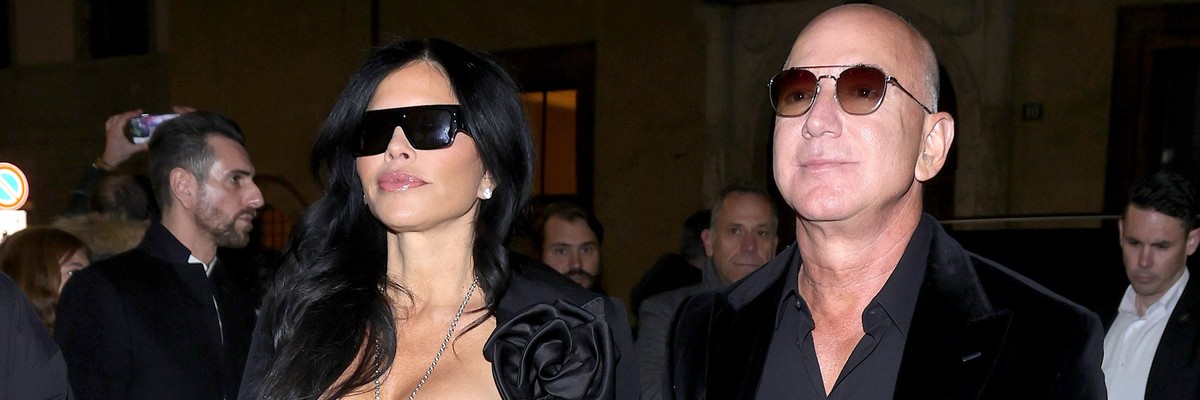
Jeff Bezos and his fiancée Lauren Sánchez arrive at an event in Milan, Italy on January 13, 2024. (Photo: Jacopo Raule/Getty Images)
It’s been a rough few years for most people around the world—but not these folks.
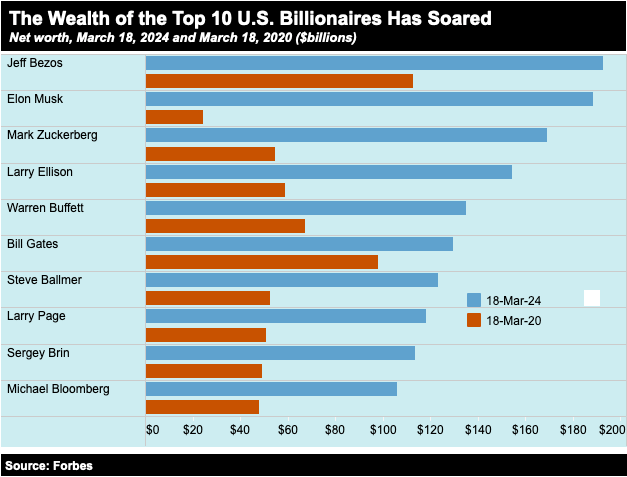
Four years ago, the United States entered the Covid-19 pandemic. Forbes published its 34th annual billionaire survey shortly after with data keyed to March 18, 2020. On that day, the United States had 614 billionaires who owned a combined wealth of $2.947 trillion.
Four years later, on March 18, 2024, the country has 737 billionaires with a combined wealth of $5.529 trillion, an 87.6 percent increase of $2.58 trillion, according to Institute for Policy Studies calculations of Forbes Real Time Billionaire Data. (Thank you, Forbes!)
The last four years have been great for particular billionaires:
On March 18, 2020, Tesla CEO Elon Musk had wealth valued just under $25 billion. By May 2022, his wealth had surged to $255 billion. As of March 18, 2024, Musk is at $188.5 billion, more than a seven-fold increase in four years.
Over four years, Amazon founder Jeff Bezos has seen his wealth increase from $113 billion to 192.8 billion, even after paying out tens of billions in a divorce settlement and donating tens of billions to charity.
Three Walton family members — Jim, Alice, and Rob — are the principal heirs to the Walmart fortune. They saw their combined assets rise from $161.1 billion to $229.6 billion.
In 2020, only one billionaire — Jeff Bezos — had $100 billion or more. Today, the entire top ten are centi-billionaires, bringing their collective wealth to a staggering $1.4 trillion.
The only billionaire on the 2020 top 15 wealthiest Americans list to see their wealth decline in four years was MacKenzie Scott. Four years ago, on March 18, 2020, the ex-wife of Jeff Bezos had a net worth of $36 billion. It has declined to $35.4 billion due to her aggressive giving to charity.
For more details on how America’s billionaires have fared since the onset of the pandemic, check out our updates page.
What can we do about our oligarchy in the United States? President Biden’s blueprint for ones in Russia is a good place to start.
Republished from Common Dreams under Creative Commons (CC BY-NC-ND 3.0) licence. Note by dizzy: There’s a photo of Jeff Bezo’s superyacht at the original article. He’s got a new one now of course requiring an historic bridge to be dismantled in Rotterdam.
12/3/22 ed: I’ve emphasized one paragraph in red typeface. That part is particularly important showing that we do not live in democracy. 13/3/22 The West is imposing it’s model of oligarchs on Russia by imposing sanctions. Western oligarchs control and dictate to Western governments but that’s not the case in Russia.
Tonight I say to the Russian oligarchs and corrupt leaders who have bilked billions of dollars off this violent regime: no more.
The U.S. Department of Justice is assembling a dedicated task force to go after the crimes of Russian oligarchs.
We are joining with our European allies to find and seize your yachts, your luxury apartments, your private jets. We are coming for your ill-begotten gains.
With these words, the president unintentionally laid out a blueprint for responding to the American oligarchs, superpredators who dwarf their Russian counterpoints in wealth and political power.
America’s oligarchs, like their Russian counterparts, have bilked billions—no, make that trillions—from their own regime.
Oligarchs in a Violent Regime
About that “violent regime” business: It’s possible to condemn the violence perpetrated by Russia’s government while at the same time recognizing and condemning of our own. Our direct attacks on Iraq and Afghanistan, among other countries, have been matched by the proxy violence we have funded in nations like Palestine and Syria. Our sanctions have taken countless lives around the world, a form of bloodshed we pretend isn’t warfare.
America’s oligarchs, like their Russian counterparts, have bilked billions—no, make that trillions—from their own regime. Some of their bilking comes directly from its violence, in the form of “defense” contracts to entities like Halliburton, Lockheed Martin, and the Carlyle Group.
A 2014 Princeton political science study showed that government actions nearly always conform to the wishes of wealthy and powerful US elites. “Our central finding was this: Economic elites and interest groups can shape U.S. government policy — but Americans who are less well off have essentially no influence over what their government does,” wrote co-authors Martin Gilens and Benjamin Page.
America’s oligarchical influence extends from healthcare and fossil fuels to the industry of war itself. American companies account for more than half of all arms sales worldwide. The Center for Responsive Politics reports that “in the past two decades, (the arms industry’s) extensive network of lobbyists and donors have directed $285 million in campaign contributions and $2.5 billion in lobbying spending to influence defense policy.”
Arms manufacturers (more commonly known by the Orwellian appellation, “defense industry”) shrewdly concentrate on hiring ex-government officials to advance their agenda and pump up their “ill-begotten gains.” This ensures that their interests are represented by people who know the officials they’re lobbying. Even more importantly, it puts those officials on notice that there is a lucrative future in store for them if they play along. Arms oligarchs have hired more than 200 lobbyists who, in the report’s words, “have worked in the same government that regulates and decides funding for the industry.”
Arms manufacturers played a dominant role under Trump, but are also well-represented in the Biden Administration:
While Biden has touted strict ethics rules that attempt to thwart the influence of lobbyists on the administration, several of his earliest appointees, including Secretary of Defense Lloyd Austin and Secretary of State Antony Blinken consulted for a private equity firmthat emphasized its “access, network and expertise” in the defense industry. Austin also had a seat on the United Technologies and Raytheon board, earning more than $250,000 from the now merged companies.
“Ill-Begotten Gains”
It’s not just the arms industry, of course. Other oligarchs have bilked the people of the United States in more creative ways. Jeff Bezos built his Amazon empire off his ability to sell products online without charging sales tax. This government-granted loophole made him an oligarch, a position he has used to further cement his power and influence. He has purchased the most influential paper in the nation’s capital—an oligarch’s move if there ever was one—while constantly extending his monopolistic power into new markets.
Despite the fact that he already possessed great wealth, Elon Musk has received billions in subsidies and contracts for his automobile and space ventures. Bill Gates parlayed a government contract and some aggressive patent strategies into his own oligarchical status. Insurance executives have bilked billions from the violence of our privatized healthcare system, which takes an estimated 45,000 lives per year.
Money, of course, is only part of an oligarch’s wealth. President Biden also mentioned the property that belongs to Russian oligarchs: “your yachts, your luxury apartments, your private jets. We are coming for your ill-begotten gains.” (He meant “ill-gotten,” but I suppose you could call such malapropisms part of Biden’s charm.)
If a “supertax” were levied against America’s oligarchs by the federal government, it would produce as much as $755 billion in revenue.
Russians own an estimated 7-10 percent of the world’s superyachts, leaving plenty for their American counterparts. Luxury apartments? Check out “New York Condo Sells for Close to $190 Million; Hedge-Fund Billionaire Doubles His Money.” Private jets? Jeffrey Immelt, job outsourcer and financial predator at GE, used to taketwo jetswhen he traveled so that he’d have a spare—and charged it back to GE’s shareholders.
Little Oligarchs, Big Oligarchs
We’re told that the Russians whose yachts have been seized include Alisher Usmanov, whose net worth is $20 billion, and Alexei Mordashov, whose wealth is described as “nearly” $30 billion. Compare that with Elon Musk, who’s worth nearly $300 billion, or Jeff Bezos at $202 billion. These guys are pikers.
Globally, in the US-led world financial order, billionaires have gained $5 trillion in wealth since the pandemic began. Think of our economic leadership as a “global endowment for oligarchy.” Oxfam reports that the ten richest men in the world (yes, they’re all men) own more wealth than the bottom 3.1 billion people (“six times more, in fact”). Oxfam also notes that “if the 10 richest men”—nine of whom live in the US—”lost 99.999% of their combined wealth, they would still be richer than 99% of the world.”
Now that’s oligarchy.
Making a Killing
No industry has taken more advantage of government-granted patent monopolies than Big Pharma. Even when its oligarchs misled the country into an opioid epidemic—one of the largest mass-casualty events in American history—they are able to escape criminal culpability for their actions.
Then came Covid-19. As Forbes reported in January, US billionaires held an estimated $3.5 trillion before the pandemic struck, a figure that reached nearly $5.3 trillion two years later. That’s $1.8 trillion in gains, divided among only twenty oligarchs. Musk led the pack, with Bezos in second place. The billionaires’ list is a cavalcade of monopolists and speculators whose wealth has been fueled by their government’s benign view of their predatory business practices.
Once the pandemic hit, Big Pharma’s oligarchs were able to parlay their political power into exclusive patent rights for Covid-19 vaccines. Moderna made $17.7 billion from its vaccine in 2021 and anticipates making $22 billion this year, from a formula developed with $2.5 billion in funding commitments from the US government. The money from these government-granted profits could vaccinate the entire world, but they’ve been used to enrich shareholders instead. That’s oligarchy.
Restoring the Balance
What can Americans do about their oligarchy? President Biden’s blueprint is a good place to start. A “dedicated task force to go after the crimes of American oligarchs” is an excellent place to start. It could address questions such as:
1. Why have nine American billionaires acquired more than $755 billion during the Covid pandemic, while so many other people struggled?
2. What role did government and central bank policy play in this enrichment?
3. What unethical or illegal actions, if any, were undertaken in amassing this wealth?
4. What effect will these levels of economic inequality have on social justice, political power, social mobility, and the rights of consumers and workers?
5. Is there any reason why this money should not be taxed at 99 or 100 percent?
Item #4 would not be unprecedented. It would revive a proposal from President Franklin D. Roosevelt for a “100 percent war supertax” on extremely high incomes and would echo the 94 percent top tax rate passed during World War II. (The top marginal tax rate stayed above 90 percent for the next two decades.)
We certainly face a World War-level emergency. Oxfam observes that “a 99% windfall tax on the COVID-19 wealth gains of the 10 richest men could pay for enough vaccines to vaccinate the entire world and fill financing gaps in climate measures, universal health and social protection, and efforts to address gender-based violence in over 80 countries, while still leaving these men $8bn better off than they were before the pandemic.”
I don’t hate these oligarchs. I see them.
If a “supertax” were levied against America’s oligarchs by the federal government, it would produce as much as $755 billion in revenue. That’s enough to pay for the original, ten-year “Build Back Better” proposal—twice.
To See, and to Act
It’s striking that the current debate about American democracy ignores its biggest antagonist: the oligarchs who have undermined the political process and drained the nation of its wealth. Restraining the oligarchs would help build true democracy. It would be good politics, too.
“We know from polling that (anti-oligarchical) policies and rhetoric like these are wildly popular,” writes Eleanor Eagan of the Revolving Door Project. “In our deeply divided country, anger at elite impunity and a desire to see it end are among the rare uniting forces that we have left.”
Not that we can expect an anti-oligarchical agenda from this government any time soon. Politicians know that America’s oligarchs, unlike Russia’s, have the ability to crush their careers at any time. But the rest of us are free to speak out and demand an end to oligarchical rule anywhere in the world. Our condemnation of other country’s oligarchs will ring hollow until we do.
Someone once asked me, “Why do you hate billionaires?” The answer is, I don’t. I’ve met a few, and they were always sociable enough (unless you worked for them). I don’t hate these oligarchs. I see them. As we build the anti-oligarchical movement here in the US, Noah Liebman’s handy browser add-on (for Firefox only) helps everyone see them. It replaces the word “billionaire” with “oligarch” on every web page, producing headlines like “Bloomberg’s Oligarch Index,” “Forbes’ Oligarchs 2021,” “Inside the Financial Holdings of Oligarch Betsy DeVos” … you get the idea.
Another headline now reads, “Oligarch investor Bill Ackman says Russia’s attack on Ukraine means World War III has ‘likely already started.’” Maybe it has, or maybe it will start soon. The best way to prevent it is by eliminating all oligarchies, foreign or domestic, and replacing them with genuine democracy.
Our work is licensed under Creative Commons (CC BY-NC-ND 3.0). Feel free to republish and share widely.
Richard (RJ) Eskow is a freelance writer. Much of his work can be found on eskow.substack.com. His weekly program, The Zero Hour, can be found on cable television, radio, Spotify, and podcast media. He is a senior advisor with Social Security Works.
It's getting desperate and urgent. Our climate is getting destroyed, countless species are becoming extinct while politicians cling to the system that is destroying our planet, reproducing and accelerating that senseless destruction.

We have a good idea who they are that are destroying the planet: It's the insane ultra-rich space tourism developers Jeff Bezos, Elon Musk, Richard Branson, it's the same and other insane ultra-rich cnuts with their climate-destroying superyachts, privately-owned islands, private jets and jetset lifestyles, it's the insane petrochemical and coal industries, it's the insane media magnates, it's insane politicians pursuing the destruction of the planet - Boris Johnson and Joe Biden included.

The planet, the people of this planet, it's plants and animals can't afford these absolutely climate-destroying cnuts. We need a clean break so that this world is managed sustainably to survive instead of being run for the benefit of a few super-rich cnuts, much less than 1% really.

May be altered, extended or elaborated

28/2/22 Artic tourism