Tag: killer apes

  • UK aviation emissions to be 50% higher than thought by 2050, government admits

    Spread the love

    Article by Josh Gabbatiss republished from Carbon Brief under a CC license.

    Aerial view of Heathrow airport, London. Credit: Lightworks Media / Alamy Stock Photo

    The UK government has slashed its hopes for electric planes and “sustainable aviation fuels” (SAFs), ahead of giving the green light to a third runway at Heathrow.

    An “ambitious” rollout of new technologies and efficiency upgrades will only cut flight emissions by a quarter over the next two decades, according to forecasts quietly released in June.

    This would leave aviation emissions in 2050 nearly 50% higher than expected under the “jet-zero” strategy, launched by the previous Conservative government in 2022.

    The Labour government has signalled its support for a contentious third runway at Heathrow airport, with a final planning decision expected by 2029.  

    Ministers have justified this expansion by citing the rollout of clean-aviation technologies.

    Yet, the updated forecasts suggest that rising flight numbers and a reduced role for “techno-fixes” will leave aviation emissions stubbornly high in 2050 – the UK’s legal target for net-zero.

    If this is to be compatible with UK climate goals, then these higher emissions from flights in 2050 would need to be taken out of the atmosphere using costly and largely unproven “carbon dioxide removal” technologies – or by planting gigantic new forests.

    Emissions up 

    The previous government’s “jet-zero” strategy committed the UK to a “high ambition” pathway that would have seen aviation emissions peak at 38.2m tonnes of carbon dioxide equivalent (MtCO2e) in 2019 and drop to 19.3MtCO2e in 2050.

    At the time, the Conservative government said this “clear goal” was achievable, alongside airport expansion and rising flight numbers.

    Its strategy relied heavily on the extensive use of early-stage technologies, such as SAFs and battery-powered planes, as well as wider fuel-efficiency improvements.

    In public statements, Labour has broadly continued this approach, backing new airport runways while supporting SAFs as a way to curb aviation emissions.

    However, the government’s latest forecast, quietly published ahead of the formal approval of a new runway at Heathrow, sets far lower expectations for these technologies.

    Its “technology development” pathway, with “ambitious carbon abatement measures”, only sees emissions drop to 28.1MtCO2e in 2050. As the chart below shows, this is around 9MtCO2e higher than the jet-zero strategy’s stated goal – a roughly 50% increase.

    The UK government says UK flight emissions are set to be at least 50% higher than previously thought by 2050. Projected emissions in the UK's new scenarios (dark blue and grey), compared to the jet-zero strategy 'high ambition' scenario (light blue), MtCO2e. By 2050, new technology scenario reaches 28 MtCO2e compared to 19 MtCO2e in jet-zero. Source: UK Department for Transport. - (alt text generated by Google Gemini)

    The shift is down to much lower expectations for SAF uptake, fuel-efficiency improvements and the roll-out of battery-powered planes, as well as lower international carbon prices.

    The government now expects SAFs to make up 30% of aviation fuel by 2050, rather than 50%. It also concedes that SAFs will save less carbon over their lifecycle than previously thought.

    SAFs have faced considerable criticism, due to limited supplies and uncertainty around the extent to which they cut emissions. Even meeting the UK’s relatively modest goal of 22% SAF uptake by 2040 would require enormous – potentially unattainable – volumes of waste products, which are currently the main source of the fuel.

    For its new forecasts, the government commissioned a separate analysis of likely aircraft fuel-efficiency improvements over the next few decades. This analysis, from the Aviation Impact Accelerator, yielded “less optimistic” projections than earlier work.

    Fuel-efficiency improvements have therefore been revised downward from 2% per year in the “jet-zero” strategy to 1.3% in the new “technology development” scenario.

    There is also a reduced role for battery-powered planes, with only some of the smallest zero-emissions aircraft expected to be in use by 2035.

    Crucially, even making the more limited emissions cuts in the new “technology development” pathway would require greater efforts to decarbonise the aviation sector.

    If the UK fails to implement new policies or innovations, while flight numbers continue to rise, then aviation emissions would be even higher in 2050 than they are today. 

    This is illustrated by the pink “current trends” pathway in the chart above, in which emissions increase to 41.1MtCO2e by 2050.

    This is roughly double the amount targeted by the jet-zero strategy and recommended by government climate advisors, the Climate Change Committee (CCC).

    Budget ‘busting’

    The new forecasts all account for the growth of several UK airports, including “planned Heathrow expansion”. Overall, passenger numbers would be at least 50% higher by 2050. 

    In contrast, the CCC and other experts have advised that the rise in passenger numbers may need to be limited, in order to keep emissions down.

    In order to meet the UK’s net-zero target, any aviation emissions that remain in 2050 would need to be offset by planting many thousands of hectares of new forest, or by relying on costly and largely unproven CO2 removal technologies.

    Tim Johnson, director at the Aviation Environment Federation (AEF), says the new forecasts present “a more honest and realistic vision of what’s possible in the next 24 years”. However, he tells Carbon Brief:

    “Less reliance on cleaner technology and fuels reopens the debate about the role and scale of greenhouse gas removals and ways to tackle the projected 50% growth in demand for air travel.”

    AEF calculations, based on government data and shared with Carbon Brief, suggest that emissions from the third runway at Heathrow would initially be relatively modest, reaching 3.5MtCO2e per year in 2050. Its emissions would then be expected to rise significantly beyond the legal 2050 net-zero deadline.

    Previously, the Labour government has explicitly cited SAFs and other new technologies as part of its justification for expanding Heathrow airport.

    Dr Lois Pennington, a research associate at the University of Manchester who has analysed Heathrow’s emissions impact, says the government’s new forecast shows “we are projected to be well over aviation’s share of the carbon budget even before a third runway is considered”. 

    She tells Carbon Brief:

    “For Heathrow, it means expansion can no longer be waved through on the promise of technology, and any approvals will be in the full knowledge that it will bust our legally binding carbon budgets.”

    Article by Josh Gabbatiss republished from Carbon Brief under a CC license.

    Nigel Farage urges you to ignore facts and reality and be a climate science denier like him and his Deputy Richard Tice. He says that Reform UK has received £Millions and £Millions from the fossil fuel industry to promote climate denial and destroy the planet.
    Nigel Farage urges you to ignore facts and reality and be a climate science denier like him and his Deputy Richard Tice. He says that Reform UK has received £Millions and £Millions from the fossil fuel industry to promote climate denial and destroy the planet.
    Donald Trump urges you to ignore facts and reality and be a Climate Science denier like him. He says that he makes millions and millions for destroying the planet, Burn, Baby, Burn and Flood, Baby, Flood.
    Donald Trump urges you to ignore facts and reality and be a Climate Science denier like him. He says that he makes millions and millions for destroying the planet, Burn, Baby, Burn and Flood, Baby, Flood.
    Orcas comment on killer apes destroying the planet by continuing to burn fossil fuels.
    Orcas comment on killer apes destroying the planet by continuing to burn fossil fuels.
  • Trump’s Venezuela: Why seek regime change if you can get regime compliance?

    Spread the love

    Article by Aman Sethi republished from OpenDemocracy under a Creative Commons Attribution-NonCommercial 4.0 International licence.

    A monument in homage to the struggles of the Venezuelan people for the conquest of their oil | by LUIS ROBAYO/AFP/Getty Images

    The Trump administration’s forcible appropriation of a fifth of Venezuela’s oil reserves is worse than the theft of national assets in post-Soviet Russia.

    Nine months after United States special forces abducted Venezuelan President Nicolás Maduro and his wife in an early morning raid, the US claims to have struck a highly unusual deal to take control of about a fifth of Venezuela’s oil reserves, or about 65 billion barrels, over the course of a 100-year lease period.

    The deal, which is structured through the US Department of Defense (which the Trump administration calls the Department of War), has no recent precedent. While the United States has often engineered military and covert regime change in countries around the world to appropriate resources, the Trump administration’s actions in Venezuela recalls the sorts of 20th century US interventions that lead to a series of revolutions in Latin America and also Iran in the 1950s.

    To make sense of this moment, I caught up with Francisco Rodríguez, a Venezuelan economist, a senior research fellow at the Center for Economic and Policy Research, and professor of public and international affairs at the University of Denver. Rodriguez is also the author of four books, including his latest, The Collapse of Venezuela: Scorched-Earth Politics and Economic Decline. 

    The following is an edited excerpt of our interview. You can listen to the whole  interview on our In Solidarity podcast.

    Aman Sethi: I’d like us to start with just getting your reactions to this, this oil deal. Specifically, if you could just talk through what you know so far, what this means, and whether this is how oil deals are normally done in Venezuela.

    Francisco Rodriguez: Okay, a bit of the background. Venezuela had been under oil sanctions from the US between 2019 and this year. And the US after it carried out a military operation to capture Nicolás Maduro, it decided that it was going to try to forge, let’s call it a “cooperative relationship,” with the government of Delcy Rodriguez, who was Maduro’s vice president.

    And what the US has been trying to do is sell the idea of ‘Now we’re gonna help the Venezuelan oil sector recover’. Venezuela is sitting on the world’s largest oil reserves , but it produces just 1% of world oil output. 

    January of this year just a few days after the military operation to take out Maduro, President Trump actually calls a lot of oil industry executives to the White House, says, “I want you to invest in Venezuela.” Many of these executives say, “We’re not so sure.” One of them actually says this country is really uninvestable under current conditions. So he gets a lukewarm reaction. 

    So now we have the announcement of this plan, and this plan — it promises that Venezuela is going to get $100 billion in oil investment. And that’s really important here, because that’s what most experts have said is needed to get Venezuela to produce what it was producing before the sanctions back in 2016 which was around two and a half million barrels. 

    Now it’s producing roughly one [million barrels per day]. It’s increased a bit to 1.2 million. So you want to get that up by 1.5 million barrels. You need 100 billion to do that. That sounds fine. Actually, that sounds great. If I’m Venezuela, and I’m told, “Hey, here’s the $100 billion you can put into your oil industry, and you’ll get more tax revenue. We’ll benefit.” I say, “Where do I sign?” So that part looks good. 

    But then let’s look at it in more detail because President Trump actually says two things almost in the same breath. He says Venezuela’s gonna get $100 billion of investment in the oil sector, but this is not going to cost a dime to US taxpayers. 

    Okay, wait. 

    So the US is not gonna pay for it. Venezuela is broke, so Venezuela is not gonna pay for it. Who is going to pay for it? Well you would think oil companies, large oil companies, right? Chevron, Exxon, Conoco. But they’re not here. They’re nowhere in the deal. No, they don’t wanna be part of this. 

    So where are these 100 billion going to come out of ?

    Here’s where it gets really interesting and really murky. These $100 billion are going to be put out by a Barbados-based company that was created just a few years ago. It’s a company owned by a businessman with not the best reputation in the world. His name is Alejandro Betancourt. He’s best known for getting billions of dollars in no-bid contracts from the Chavez administration to build electrical plants, at least one of which was never completed. And he’s offering to the US a thirty-five percent stake in his company.

    So the US Department of War is going to now own thirty-five percent of that company. And it’s also going to have the right to purchase at cost twenty percent of the company’s output. So that’s the deal.

    The White House yesterday put out a statement saying that Venezuelan barrels of oil are going to start flowing into US reserves as of November. And basically, President Trump had already said that they were going to replenish the US Strategic Petroleum Reserve with oil that was a gift from Venezuela.

    That’s the word that President Trump used.

    So that means that probably as of today you will have Venezuela sending 40,000 barrels of oil to the US at cost. That’s a loss of about $500 million a year for Venezuela. 

    What is Venezuela getting in return? A promise that somebody, someday, is going to come up with $100 billion is going to be willing to lend them to Mr. Betancourt so that he can invest in the oil sector. 

    This deal is all wrong. This is the most impoverished country in Latin America. 

    How legal is this? Like, is this from a Venezuelan perspective, from an international contracts perspective?

    There’s a set of legal objections to it. Now of course the problem is that in developing countries Venezuela ranks 146 out of 146 countries in terms of the rule of law.

    Asking what is legal or not in a country that has no rule of law, this is almost like a theological question, really.

    Because when we think about the law, laws are interpreted by courts, but the courts are controlled by the government. Article 150 of the Venezuelan Constitution says that the National Assembly has to approve the deal.

    The National Assembly is 90% controlled by the government, so they could have taken the deal before the National Assembly. They didn’t. Why didn’t they do it? Because then they’d have to publish the contract, but they don’t want to publish the contract. Nobody wants to publish the contract.

    There’s a set of other problems I could go down out of all of the different laws that have been violated. But one important one is Article 39 of the country’s hydrocarbons law states that you have to assign contracts in the oil sector through public competitive bidding. There was no public competitive bidding here.

    In fact, a government vice-minister recently said, “The thing is that we’re under an economic emergency decree that we declared after the earthquake.” Really? You’re gonna use the earthquake as an excuse to give away 20% of the country’s reserves?

    What does it smell like to you?

    It smells like Trump essentially said, “I wanna do something about gas prices before the midterm and I wanna claim that I’m getting some of this oil from Venezuela. So I want some of that oil from Venezuela to come in and for me to say that I’m putting it into a strategic reserve, and this is bringing down oil prices. I wanna do that before the midterms. Sign me a deal.” 

    I think that’s essentially all there is. But from the standpoint of Venezuela, Venezuela has just given away 20% of its reserves to a company owned by a very shady figure.

    After the invasion of Iraq when you had the occupation there was a public bidding round for the rights to exploit Iraqi oil. This was a competitive bidding process, it was transmitted through public television, so Iraqis could actually see the bidding taking place in real time.

    This process was transparent. This is the complete opposite. This firm is going to get, over the life of the concession, the equivalent of $303 billion.

    That’s the, that, that is what the private firm gets in profits.

    That is what it’s going to get. That is the equivalent of three years of Venezuelan GDP. 65 billion barrels. Venezuela has a huge level of reserves. The Russian privatization program of 1996 was for 20 billion barrels of oil.

    This is more than three times the size. And in Russia, which was a steal, which was horrible, there was a free-for-all. That’s what led to the rise of the Russian oligarchs. They at least had the decency to rig an auction. Here, there was no auction. They didn’t even pretend.

    So this is not going to end up well. If you’re handing over these massive resources to connected political insiders this is not helping create a democracy. This is consolidating a crony capitalist oligarchy. 

    In your book you’ve likened studying the Venezuelan economy to the equivalent of being a rare disease specialist. For all of us outside who honestly don’t know very much about Venezuela, what is your analysis of the regime in power right now? 

    What is the point at which the people just say, “We’re done with this regime,” and they just get swept out?

    We can understand the American motivations. We can understand Delcy Rodriguez is some kind of captive, but what about the entire country that sits below her? How are people taking this?

    That’s a great question. And it forces one to think about how we got here. So Venezuela got here after about a quarter of a century of very deep polarization. Hugo Chávez, who came into power in 1999 was a populist and popular politician.

    And, like many populist politicians, his message was, “Throw the bums out, people are tired of the old politics. You need change. You need to refound the republic.” And that convinced a lot of people. He was able to get a clear electoral mandate. He reformed the constitution.

    He did what many leaders who have at least an authoritarian bent will do in those circumstances, which is say “We really need to change this, give more power to me.” So he really made the Venezuelan presidency all-powerful in that constitutional reform. And that really shaped Venezuelan politics over the next quarter century because you created a winner-take-all political system in which the opposition was completely out of anything.

     So you ended up in this, this politics which was very polarized between the government and the opposition. Now, Chávez did some things that a lot of Venezuelans liked at the time. He was definitely somebody who sought out ways to let very large disadvantaged majorities which had been excluded from Venezuelan social, economic, and political life have a stake.

    He also did a lot of things very badly.

    He got a huge oil boom. He spent a lot of that money. He ran the country into debt. He hired people like Alejandro Betancourt to build electrical plants, some of which were never built. So the country lived through this deep polarization. And then Chávez died, and then he leaves Maduro. Then the economy starts doing poorly. Then he [Maduro] becomes more repressive because the opposition is really going after him. And then the opposition goes to the US, and the US says “Let’s get tough on this, let’s impose sanctions.” 

    They hurt the country’s oil industry. It leads to a huge decline in the country’s oil production. So they, they effectively create an economic catastrophe. So you end up in this trap, which is what in my book I call the trap of economically destructive political conflict. 

    And the whole– the puzzle that I try to explain in my book is, how is it that you get an economy to collapse, to lose seventy-one percent of per capita income? This is the equivalent of three consecutive great depressions without a war. And my answer is that this happens because there’s a moment in which this politics becomes so destructive that both sides are essentially playing scorched earth.

    So you end up having this battle for the country that turns the economy into a political battlefield, and that’s where it collapses. 

    Then all of a sudden Trump decides to send in US forces, captures Maduro, and decides that he’s going to run the country with the people who are there. What we know and what he has said literally is that he’s put a gun to Delcy Rodriguez’s head. We also know that Delcy Rodriguez is complying with everything that Trump is asking for. 

    Is she doing it because she has a gun to her head, or is she doing it because this actually works in her favor and she can stay in power? Probably both.

    I have, well, several questions from this, but, but let’s start with the question of sanctions. It’s possible for many governments to make many bad decisions and to do bad things to the economy.

    But there is a very specific kind of bad thing that happens once sanctions are imposed, right? When you’re cut out of the US financial system, for example, that is a very, very particular form of economic punishment.

    What is your assessment of the role that, that sanctions have actually played here? Because one thing that I’m struggling with is this narrative of “Venezuela let its oil industry completely collapse, and now we’re gonna fix it, and now everything will be fine”. I’m struggling with the dissonance, but maybe I don’t know enough.

    That’s a very interesting question. It’s a very important question. It’s not an easy question to answer because well, you have many factors going on, and definitely there was a lot of mismanagement.

    There were poor economic policies, so you have to disentangle the effects of those poor policies from the effect of sanctions. 

    My estimate is that approximately half of Venezuela’s economic contraction during its collapse period between 2012 and 2020 can be attributed to sanctions.

    So in other words, this is a country that in the absence of sanctions would have gone through a major crisis. It would have seen, by my estimates, GDP decline by thirty-six percent, but not by seventy-one percent. And in fact, that thirty-six percent decline that would have occurred in the absence of sanctions actually puts it in line with other collapses generated by similar episodes of protracted exercise of bad policies particularly in Latin America.

    And all of them have a very similar pattern. You have a commodity-dependent economy. You have a period in which deep imbalances accumulate. You start getting high levels of debt.

    The country starts going into a current account deficit. You start seeing high levels of capital flight, and then you get a decline in the price of the commodity like what you got between 2014 and 2016. And there you get this deep economic crisis. 

    That is what happened in Venezuela between 2012 and 2016, which were the first three years of Maduro in power. In 2017 something different starts happening. And you start seeing that markets are expecting that the Venezuelan economy will begin to recover.

    Because oil prices had fallen from $100 to $30, and then they had recovered to around $50, $60. What history teaches us is that the economy stabilizes and then begins to recover in that situation. That’s not what happened in Venezuela. In Venezuela, the economy continued shrinking at an accelerating rate. And the difference was that was the year in which sanctions began to be imposed.

    So yes, sanctions did deep damage to this economy. These sanctions didn’t come out of the blue. These sanctions were part of a political strategy by the country’s opposition that was reacting to things that Maduro was doing which were very bad and were very evil and very authoritarian, and said, “We need to up the ante here by doing what we can do. We have allies in the US, that can help us start taking Maduro’s control from the country’s purse strings away.” 

    So in 2019, the Trump administration decided to recognize Juan Guaido, an opposition legislator, as Venezuela’s legitimate President. This is something that the US had never done before. The US had never recognized somebody with no de facto control over the territory as the President. And what happened as a result of that was that all of the country’s offshore assets, including all of the assets of PDVSA, the state-owned oil company, were transferred to the management of Guaido or his appointees. What that meant is that the country no longer had access to its funds. These funds were essentially handed over to the opposition. It made it impossible for the government even to carry out the most basic economic policy.

    There’s nothing in politics that is for free, right? So you acquire a commitment when you have an external power like that, that is helping you. And that means that you can’t question what that external power is doing in your country because you essentially live off of them, right? And this, by the way, was literally true. The Venezuelan opposition — the Venezuelan National Assembly elected in 2015, whose term ended in 2020 — had around 80 opposition legislators who were getting paid monthly salaries out of an account in the Federal Reserve. So the US could literally cut the salaries of the opposition politicians if the opposition decided to go against it.

    This is the typical Faustian bargain, right? You say, “I’m willing to do anything if you will help me regain power,” for good reasons.

    But the reality is that these Faustian bargains don’t end well. 

    I’m imagining an Indian opposition leader touring Europe and America and asking for support to become the Prime Minister of India, and they would be, you know, laughed out of the country.

    I understand that the dynamics are different but it does strike me as an unusual theory of power.  In your book, you also talk about the fact that while Venezuela is shown as an exception to kind of ordinary politics, it in many ways is almost like a weather vane that shows you where politics is going.

    But what does this moment in Venezuela tell us if we say Venezuela is, in some ways, the country of the future? What is it telling us now, especially in light of this deal?

    I would love to be wrong but I do think that Venezuela might be initiating a model that the US is probably going to try to imitate in other countries. 

    President Trump actually considers Venezuela a success story, and he’s been trying to produce similar outcomes in Cuba and Iran. And there have been negotiations between Trump administration officials and officials in those countries where they’re proposing this type of deal. The type of deal is you stay in power, the opposition doesn’t come to power but you change completely the way in which you’re doing things, and you follow our orders essentially.

    And I want to emphasize that this isn’t a government that rules the country with US support. This is a government that is carrying out the orders of the US . This is a government that has carried out military operations with US troops and Venezuelan troops in Venezuelan territory. It recognized Israel. And three days after Marco Rubio announced that the US was launching a campaign to dismantle the International Criminal Court, Venezuela says, “We’re leaving the International Criminal Court.” The first Latin American country to do so.

    So this has become the most dependable US ally in the region. And it’s led to this thesis in Washington of, why seek regime change if you can get regime compliance? That’s essentially what they’re trying to do. 

    You were saying this looks like a somewhat of an odd concept coming from India and thinking about it in terms of the dynamics in that region.

    I would say it’s not that foreign in Latin America. But you have to dig a little bit into history to go there. What the US did in Venezuela was actually what the US did in a number of countries at the beginning of the [20th] century including Cuba, Dominican Republic, Haiti, Panama. It basically imposed protectorates in these countries. 

    The Cuban one is interesting because Cuba, the US kind of occupied and took control of after the Spanish-American War. And then what the US did is that it forced the Cubans as a condition for independence to accept into their constitution to grant the US a standing right of intervention.

    So basically, if the US disagreed, if it took exception to any key decisions of the Cuban government, the US had the right to intervene militarily, and the US, in fact, exercised that right four times in the subsequent twenty years from the signing of that amendment, known as the Platt Amendment.

    And one of the problems with that, it’s no coincidence that it was precisely Cuba that saw the political movement that has been most antagonistic to the US emerge. 

    If you study the early 20th century in Cuba what you find is that Cuban politicians were acting very much in the way in which Venezuelan politicians are acting now

     They understood that whoever was in power needed the support of the US. So they became politicians who were adept at lobbying Washington and at building political coalitions between Washington stakeholders to support them. And this means that they were not politicians that built a domestic political base, that were trying to answer the demands of their constituencies. So the protectorate regime, what it does is that it stifles institutional development in a way that basically doesn’t let the institutions of a democracy emerge.

    And of course, if you have an electorate that cannot express its grievances, cannot express its demands through the political system, a big part of that electorate is going to become very angry, and then you end up with something like the Cuban Revolution. I think that is a very distinct risk now.

    It’s a risk that we will enter into a pattern as a result of Washington’s idea that it can run Latin American countries by remote control, that we’re going to enter into a very similar political dynamics, which, in the end, is going to be bad for the region, but it’s also going to be very bad for the US standing in the region.

    Article by Aman Sethi republished from OpenDemocracy under a Creative Commons Attribution-NonCommercial 4.0 International licence.

    Climate science denier Donald Trump confirms that he knows nothing about democracy and that more liquid gold is being secured according to his policy of global privateering.
    Climate science denier Donald Trump confirms that he knows nothing about democracy and that more liquid gold is being secured according to his policy of global privateering.
    Orcas discuss Donald Trump and the killer apes' concept of democracy. Front Orca warns that Trump is crashing his country's economy and that everything he does he does for the fantastically wealthy.
    Orcas discuss Donald Trump and the killer apes’ concept of democracy. Front Orca warns that Trump is crashing his country’s economy and that everything he does he does for the fantastically wealthy.
    Donald Trump urges you to ignore facts and reality and be a Climate Science denier like him. He says that he makes millions and millions for destroying the planet, Burn, Baby, Burn and Flood, Baby, Flood.
    Donald Trump urges you to ignore facts and reality and be a Climate Science denier like him. He says that he makes millions and millions for destroying the planet, Burn, Baby, Burn and Flood, Baby, Flood.

  • New Proposal From Trump SEC ‘Makes Buying Politicians Great Again,’ Watchdog Warns

    Spread the love

    Article by Jake Johnson republished from Common Dreams under under Creative Commons (CC BY-NC-ND 3.0). 
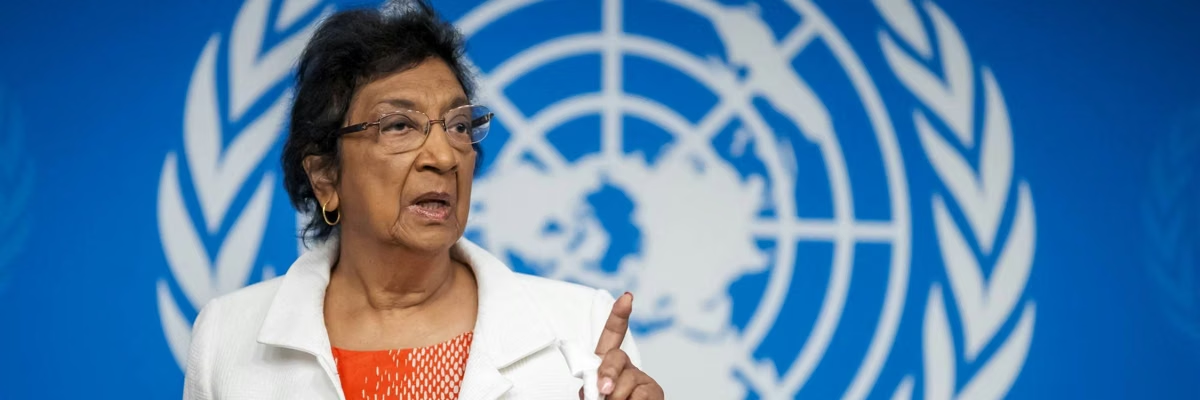
    US President Donald Trump speaks with Securities and Exchange Commission Chairman Paul Atkins during a meeting on August 19, 2026. (Photo by Jim Watson/AFP via Getty Images)

    “Donald Trump and his administration are rigging our markets to work for the wealthy and well-connected while working people pay the price.”

    The US Securities and Exchange Commission on Thursday proposed axing anti-corruption rules designed to prevent investment advisers from using political donations to obtain business from public pension funds.

    Finance industry watchdogs and Democratic lawmakers warned the SEC’s proposal would potentially harm Americans’ retirement accounts and further boost corruption in the federal government, where graft has become increasingly common and overt under the leadership of billionaire President Donald Trump. Better Markets said the SEC’s plan to rescind the agency’s longstanding “pay to-play” regulations “makes buying politicians great again.”

    RECOMMENDED…

    "America is Not for Sale" Rally Against Trump's Crypto Dealings

    Watchdog Finds Trump Crypto Schemes Have Left Investors on the Hook for Over $4 Billion in Losses

    World Liberty Financial

    ‘Brazen Act of Self-Dealing’: Trump Regulator Approves Trump Family Crypto Firm’s Bank Application

    “SEC Chair Paul Atkins has yet to meet a rule he does not want to rescind,” said Benjamin Schiffrin, director of securities policy at Better Markets. “He has the SEC proposing to rescind a rule that prevents so-called ‘pay-to-play’ practices by investment advisers, where advisers make political contributions to government officials in the hopes that those officials will select them for the lucrative assignment of managing public pension funds and other government assets.”

    “Chair Atkins says the SEC is proposing to rescind the rule because it ‘has effectively resulted in the suppression of political speech.’ Not so,” added Schiffrin. “It has resulted in the suppression of corruption. The rule was intended to, and does, ‘combat pay to play arrangements in which advisers are chosen based on their campaign contributions to political officials rather than on merit.’ Chair Atkins apparently believes that such arrangements should be promoted.”

    The SEC’s “pay-to-play” rules, enacted in 2010, barred investment advisers from providing paid services to government clients for at least two years after making a political contribution to an elected official or candidate.

    The Trump SEC’s proposal will face a 60-day public comment period once it is published in the Federal Register.

    The Lever’s Katya Schwenk and Freddy Brewster noted Friday that “after years of relatively weak enforcement, Biden’s SEC brought several charges against investment advisers for violating the pay-to-play rule in 2023 and 2024.” For example, the Biden SEC charged Obra Capital Management for “continuing to provide investment advisory services for compensation from a government entity following a campaign contribution made by an associate to an elected official with influence over selecting investment advisers for the government entity.”

    “Since Trump came to office, the pay-to-play rule has been the subject of lobbying by financial powerhouses that are invested in public pension funds,” Schwenk and Brewster reported. “BlackRock Funds Services Group, LLC, a subsidiary of the world’s largest asset manager BlackRock, Inc., spent more than $1.5 million in 2025 lobbying the SEC, Congress, the White House, and other regulators on the pay-to-play rule, among other matters, disclosures show.”

    Sen. Elizabeth Warren (D-Mass.), the top Democrat on the Senate Banking Committee, said in a statement Thursday that the rules targeted by Trump’s SEC prevent “elected officials from rewarding wealthy campaign donors with lucrative contracts to advise government investments.”

    The proposed rollback, said Warren, represents “another example of how Donald Trump and his administration are rigging our markets to work for the wealthy and well-connected while working people pay the price.”

    Article by Jake Johnson republished from Common Dreams under under Creative Commons (CC BY-NC-ND 3.0). 

    Orcas discuss Donald Trump and the killer apes' concept of democracy. Front Orca warns that Trump is crashing his country's economy and that everything he does he does for the fantastically wealthy.
    Orcas discuss Donald Trump and the killer apes’ concept of democracy. Front Orca warns that Trump is crashing his country’s economy and that everything he does he does for the fantastically wealthy.

  • Germany approves nearly $930M in arms exports to Israel amid Gaza genocide

    Spread the love

    This work by Middle East Monitor is licensed under a Creative Commons Attribution-NonCommercial-ShareAlike 4.0 International License.

    The Israeli and German flags are shown in front of the German parliament building in Berlin. [Photo via Getty Images]

    Germany approved nearly €800 million ($930 million) worth of military equipment exports to Israel in the first half of this year amid its ongoing genocide in the Gaza Strip, local media reported Wednesday.

    The Economy and Energy Ministry disclosed the figure in its response to a parliamentary inquiry by the opposition Left Party, according to German news magazine Der Spiegel.

    Export licenses issued between January and June exceeded four times the total value approved for Israel throughout 2025, the report said.

    The surge came after Chancellor Friedrich Merz’s government lifted partial restrictions on arms exports to Israel on Nov. 24, 2025.

    Merz had suspended exports of weapons that could be used in Gaza on Aug. 8 after Israel decided to expand its military operations in the enclave. The restrictions remained in force for only about three and a half months.

    Large-scale defense projects accounted for most of the sharp increase in approvals.

    Of the €735.8 million in export permits approved during the second quarter, about 67% was linked to a naval project.

    The report highlighted the INS Drakon, an air-independent propulsion submarine built by German shipbuilder ThyssenKrupp Marine Systems (TKMS), which recently left a shipyard in Kiel for Israel.

    READ: Germany should change Israel policy amid growing violence against Palestinians: Ex-envoy

    A further 21% of the licenses covered joint projects involving German and Israeli companies that were deemed to serve the strategic interests of the German armed forces, or Bundeswehr.

    The remaining approvals covered military equipment including small arms, ammunition, explosives and unmanned aerial vehicles.

    Israel’s genocide in Gaza has killed at least 73,470 Palestinians and injured 174,540 others since October 2023, according to the enclave’s Health Ministry. Most of the victims have been women and children, while around 90% of Gaza’s civilian infrastructure has been destroyed.

    Lea Reisner, the Left Party’s spokesperson for international affairs, accused the German government of applying “unlimited double standards.”

    She criticized Berlin for condemning statements targeting Gaza’s civilian population by Israel’s far-right National Security Minister Itamar Ben-Gvir while continuing to expand military support for the country.

    The Left Party renewed its call for an immediate and comprehensive halt to German arms exports to Israel.

    Germany approved €327 million in arms and military equipment exports to Israel in 2023, €161.1 million in 2024 and €260 million in 2025. Its arms sales to Israel had increased tenfold in 2023 from the previous year.

    Berlin has long been one of Israel’s strongest supporters, with German leaders frequently defending that support as a historical responsibility arising from Germany’s Nazi past and the Holocaust.

    READ: Israel receives sixth Drakon submarine for its navy from Germany

    This work by Middle East Monitor is licensed under a Creative Commons Attribution-NonCommercial-ShareAlike 4.0 International License.

    Donald Trump sings and dances, says that it's fun to kill everyone ... unless he gets distracted or falls asleep.
    Donald Trump sings and dances, says that it’s fun to kill everyone … unless he gets distracted or falls asleep.
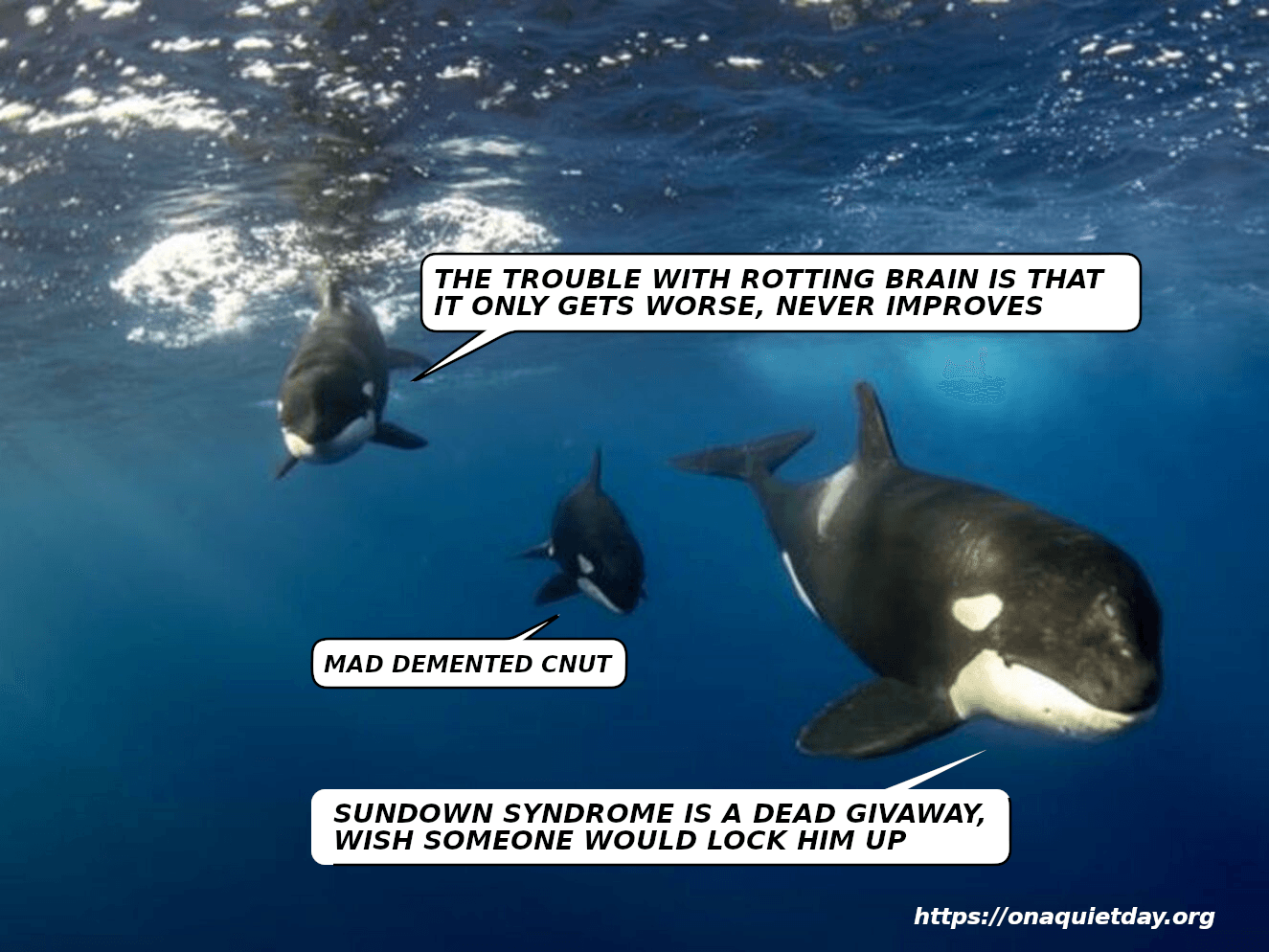
    Orcas discuss rotting brain, front Orca says he wishes someone would lock him up, small Orca speaks bluntly.
    Orcas discuss rotting brain, front Orca says he wishes someone would lock him up, small Orca speaks bluntly.
    Orcas discuss Donald Trump and the killer apes' concept of democracy. Front Orca warns that Trump is crashing his country's economy and that everything he does he does for the fantastically wealthy.
    Orcas discuss Donald Trump and the killer apes’ concept of democracy. Front Orca warns that Trump is crashing his country’s economy and that everything he does he does for the fantastically wealthy.

  • Israel seeks Trump’s backing to ethnically cleanse Palestinians

    Spread the love

    This work by Middle East Monitor is licensed under a Creative Commons Attribution-NonCommercial-ShareAlike 4.0 International License.

    U.S. President Donald Trump meets Israeli Prime Minister Benjamin Netanyahu at White House in Washington DC, United States on July 28, 2026. [Ma’ayan Toaf (GPO)/Handout – Anadolu Agency]

    Israel is seeking backing from President Donald Trump to ethnically cleanse Palestinians from Gaza, as Israeli ministers speak openly about expelling the indigenous, non-Jewish communities from the territories occupied by the apartheid state. Defence Minister Israel Katz said yesterday that the “migration” of more than two million Palestinians out of the territory remains Israel’s preferred outcome.

    Katz made the comments at a conference hosted by the Israeli news site Ynet and the newspaper Yedioth Ahronoth.

    At the conference, Katz insisted, “There is no real solution for Gaza in the end without this migration,” and said Israel was “organised and prepared to get them out – by sea, by air, by every way possible.” He argued that Washington’s backing was essential, since “every country willing to take them in wants American backing.” 

    According to Katz, Trump has “not cancelled” the proposal but has “frozen” it while his administration searches for countries willing to accept Palestinian refugees. Katz also claimed, without offering evidence, that 80 per cent of Gaza’s population wants to leave the territory and is being prevented from doing so by Hamas.

    Trump first floated a US “takeover” of Gaza and the removal of its population in early 2025, before retreating from the idea after Egypt and other Arab states warned it would amount to forced displacement

    The ceasefire agreement he later sponsored, which took effect in October 2025, states explicitly that “no one will be forced to leave Gaza, and those who wish to leave will be free to do so.” Egypt, which borders Gaza, has continued to reject any plan involving the removal of the territory’s population.

    Katz’s remarks, made at a conference days before Israel’s general election, drew criticism in Washington. US Senator Chris Van Hollen said the admission confirmed what critics had long suspected: that Israel’s underlying objective in Gaza is the removal of its population rather than its security. 

    Forcibly transferring a civilian population out of occupied territory is a war crime under the Fourth Geneva Convention and the Rome Statute of the International Criminal Court, which has already issued arrest warrants for Prime Minister Benjamin Netanyahu and Katz’s predecessor, Yoav Gallant, over alleged war crimes in Gaza.

    READ: Israel’s security chiefs revisit Gaza expulsion plan despite global rejection

    Amnesty International, Human Rights Watch and the Israeli human rights group B’Tselem have each concluded in recent years that Israel’s rule over Palestinians, from Gaza to the occupied West Bank, amounts to apartheid, a designation successive Israeli governments have rejected.

    Many view Katz’s comments less as a new position than a public confirmation of Israel’s ultimate goal. Finance Minister Bezalel Smotrich told a settler conference on 26 November 2024 that it was “possible to create a situation where Gaza’s population will be reduced to half its current size in two years” through what he called encouraging “voluntary emigration”, and suggested the same approach could later be applied to the three million Palestinians of the occupied West Bank. 

    National Security Minister Itamar Ben-Gvir has repeatedly called for Palestinians to be “encouraged” to leave Gaza so that Israelis can resettle it, telling a Jerusalem conference on 28 January 2024, “We must encourage them to leave.”

    The rhetoric coincides with Israeli public opinion on the question. A survey published by Haaretz found that 82 per cent of Jewish Israeli respondents supported expelling Gaza’s population. The poll surveyed Jewish Israelis specifically and did not include Israel’s Palestinian citizens, who make up around a fifth of the population.

    Writing in her regular Haaretz column, “Otherwise Occupied”, veteran journalist Amira Hass argued this week that the renewed talk in Washington and Jerusalem of a “two-state solution” functions, in practice, as a smokescreen. While officials and commentators debate Palestinian statehood, she wrote, the Israeli state is doing the practical and political groundwork for expelling Palestinians rather than for negotiating with them. Katz’s comments, made in the days after her column was published, appeared to bear that argument out.

    Human rights organisations, including Amnesty International and B’Tselem, have for more than a year described Israel’s conduct in Gaza as genocide, and have warned that any plan to depopulate the Strip would compound, rather than resolve, the suffering of its population. With Katz now confirming that removal remains official policy pending a green light from Washington, the question facing Palestinians in Gaza is no longer whether such a plan exists, but whether the US president will let it proceed.

    READ: Netanyahu says Israel will not withdraw from Gaza’s ‘Yellow Line,’ plans to expand control

    This work by Middle East Monitor is licensed under a Creative Commons Attribution-NonCommercial-ShareAlike 4.0 International License.

    Donald Trump sings and dances, says that it's fun to kill everyone ... unless he gets distracted or falls asleep.
    Donald Trump sings and dances, says that it’s fun to kill everyone … unless he gets distracted or falls asleep.
    Orcas discuss rotting brain, front Orca says he wishes someone would lock him up, small Orca speaks bluntly.
    Orcas discuss rotting brain, front Orca says he wishes someone would lock him up, small Orca speaks bluntly.
    Orcas discuss Donald Trump and the killer apes' concept of democracy. Front Orca warns that Trump is crashing his country's economy and that everything he does he does for the fantastically wealthy.
    Orcas discuss Donald Trump and the killer apes’ concept of democracy. Front Orca warns that Trump is crashing his country’s economy and that everything he does he does for the fantastically wealthy.