This work by Middle East Monitor is licensed under a Creative Commons Attribution-NonCommercial-ShareAlike 4.0 International License.
Relatives of the Palestinians Ahmed al-Shaer and Basil Qishta, who died as a result of the Israeli attack targeting Khan Yunis, mourn as dead bodies brought to the Nasser Hospital for burial in Khan Yunis, Gaza, Palestine on October 15, 2026. [Abed Rahim Khatib – Anadolu Agency]
A senior UN official warned on Thursday that the situation in the Gaza Strip and the occupied West Bank is dangerously fragile, saying a return to war must be avoided at all costs, Anadolu reports.
Briefing the UN Security Council on Palestine, Ramiz Alakbarov, UN acting special coordinator for the Middle East Peace Process, marked the anniversary of the Oct. 7 events, saying Palestinians and Israelis need a political horizon.
“Palestinians and Israelis deserve more than short-term fixes. They deserve a credible path to peace and finally an end to this conflict,” he said. “The international community must move beyond words and take concrete actions to ensure the future of security and dignity of the people. It is time to return to a genuine peace process.”
Turning to Gaza, Alakbarov noted that one year has passed since a ceasefire was completed. “While some progress has been made, the situation remains extremely fragile,” he said.
He said Israeli military operations have continued, “causing some 1,500 fatalities, including more than 320 children.”
Alakbarov described families in Gaza living in worn-out tents, overcrowded displacement sites and badly damaged buildings, with water and sanitation systems devastated. “Most of Gaza still lives in darkness,” he said.
“People in Gaza must not be forced to endure another winter without safe shelter and basic services,” he stressed.
Highlighting the needs of children, he said, “Emergency assistance alone is not enough. Sustainable recovery and political progress must advance together.”
On the West Bank, including East Jerusalem, Alakbarov said the situation continues to deteriorate amid Israeli military operations, movement restrictions, displacement and Palestinian attacks. He said settler violence persists at “extremely high levels,” with daily attacks on Palestinians.
Describing his assessment as “realistic,” Alakbarov said he felt compelled to raise concerns before the council.
“Today, I feel obliged to sound the alarm. In Gaza, desperation is palpable,” he said.
He warned that frustration among Gaza’s population cannot continue to build indefinitely and described the risk of a return to war as extremely high. “This must be avoided at all costs,” he said.
“The West Bank is also at a boiling point,” he added.
This work by Middle East Monitor is licensed under a Creative Commons Attribution-NonCommercial-ShareAlike 4.0 International License.
Donald Trump sings and dances, says that it’s fun to kill everyone … unless he gets distracted or falls asleep.
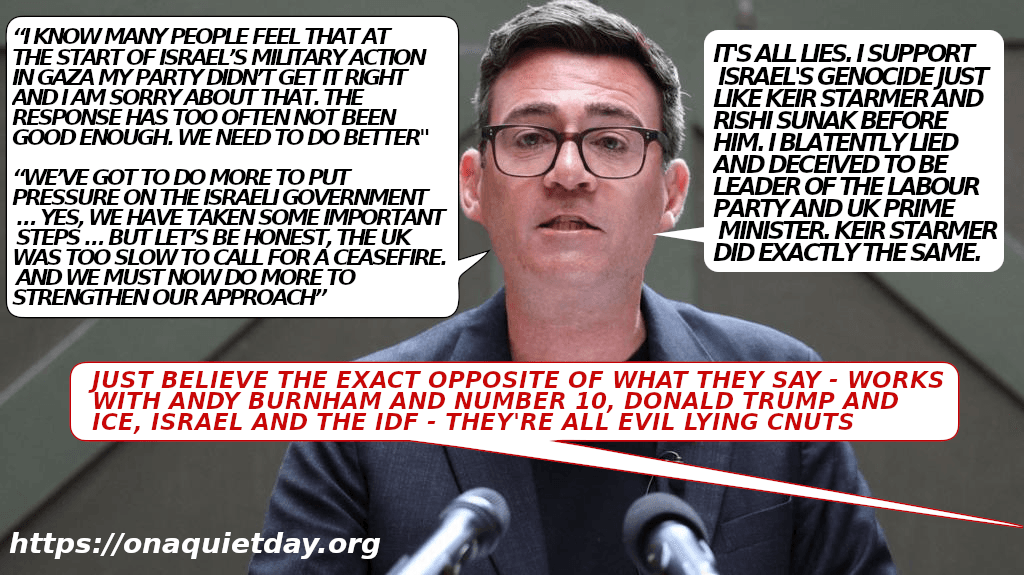
Keir Starmer objects to criticism of the IDF. He asks how could anyone object to them starving people to death, forced marches like the Nazis did, bombing Gaza’s hospitals and universities, mass-murdering journalists, healthworkers and starving people queuing for food, killing and raping prisoners and murdering children. He calls for people to stop obstructing his genocide for Israel. New Labour UK Prime Minister Andy Burnham continues Labour party policy of active support and complicity in Israel’s genocide.UK Prime Minister Andy Burnham admits to blatently lying and engaging in deception to become leader of the UK Labour Party and Prime Minister.Ed Miliband says that he and the Labour Party are full of shit criminalising people holding signs as terrorists despite anything he says.
This work by Middle East Monitor is licensed under a Creative Commons Attribution-NonCommercial-ShareAlike 4.0 International License.
Former U.S. President Barack Obama delivers remarks at a Democracy Forum event held by the Obama Foundation at the Javits Center on November 17, 2022 in New York City, United States [Kyle Mazza – Anadolu Agency]
Former US President Barack Obama has criticized Israel’s handling of the Middle East conflict, warning that military strength cannot guarantee lasting security and that refusing concessions to Palestinians risks undermining its moral standing, Anadolu reports.
The former president made the remarks on Tuesday during a discussion with award-winning writer and journalist Susan McKay at Belfast, northern Ireland, according to the Belfast Telegraph.
Speaking about the Israeli war on Gaza, Obama said the violence should “pain everybody”, describing it as a destructive cycle driven by historical grievances, hardened attitudes and deep divisions.
He acknowledged the long history of persecution faced by Jewish people in Europe. However, he also stressed that Palestinians had suffered injustice through the loss of their land.
“That is undeniable. What is also undeniable is that they took land off people and they were excessive. And those people understandably said: ‘This is injustice and I want my land back,’” he said.
Obama argued that the stronger side carries a greater responsibility to help break the cycle of violence, rather than relying solely on its military and technological superiority.
“If the attitude of Israel is, now that we are the strongest, the most technologically advanced in the region, then our security will depend on us simply doing whatever we need and taking whatever we want, and not making any concessions to anyone,” he said.
“That may work short-term… but you have ceded moral ground if that is the position you take.”
He said the current Israeli government appeared to have adopted that approach and urged it to recognize that millions of Palestinians would remain in the region.
“I would say the current Israeli government appears to have taken that. It is incumbent on them to recognise that 7 million Palestinians are not going anywhere,” Obama said.
“It is not sustainable to press upon them a condition that no-one would accept for themselves.”
Earlier on Tuesday, Obama received an honorary doctorate from Queen’s University Belfast.
Keir Starmer objects to criticism of the IDF. He asks how could anyone object to them starving people to death, forced marches like the Nazis did, bombing Gaza’s hospitals and universities, mass-murdering journalists, healthworkers and starving people queuing for food, killing and raping prisoners and murdering children. He calls for people to stop obstructing his genocide for Israel. New Labour UK Prime Minister Andy Burnham continues Labour party policy of active support and complicity in Israel’s genocide.UK Prime Minister Andy Burnham admits to blatently lying and engaging in deception to become leader of the UK Labour Party and Prime Minister.Ed Miliband says that he and the Labour Party are full of shit criminalising people holding signs as terrorists despite anything he says.
This work by Middle East Monitor is licensed under a Creative Commons Attribution-NonCommercial-ShareAlike 4.0 International License.
U.S. President Donald Trump speaks to press members before boarding Marine One on the South Lawn of the White House in Washington, D.C., on October 5, 2026. [Mehmet Eser – Anadolu Agency]
President Trump has promised that the United States will not attack Iran before the 3rd November midterm elections. That statement sounds like restraint and at the same time also be read as a warning. By tying military restraint to election day, Trump has made the period after the vote more dangerous.
The Iran war is making the election harder for the Republican Party. As of now, prediction markets give Republicans roughly a one-in-ten chance of retaining both chambers of Congress.
An October AP-NORC poll found that 69 per cent of Americans believed the war was not worth fighting, while only 28 per cent approved of Trump’s handling of Iran. For many voters, the war is no longer a distant foreign-policy issue. They feel it through higher fuel prices, inflation, and the fear of another open-ended conflict.
A Republican defeat, however, would not remove Trump’s military power the next morning. He would remain Commander-in-Chief, and the outgoing Congress would remain in office until 3rd January 2027. This leaves a two-month gap between the election and the arrival of a new Congress. During that period, Trump would face less pressure to protect Republican candidates, but Democrats would not yet control the congressional machinery needed to challenge him.
That is the main danger. Americans may vote against the party that owns the war, but their votes would not immediately change who controls military decisions. The election could reject the war politically while leaving Trump free to expand it militarily.
Trump would not need a special executive order or advance approval from Congress to begin a limited operation. Like other presidents before him, he could rely on a broad interpretation of his Commander-in-Chief powers, claim that an attack was needed to protect American personnel or interests, and use forces and funds that Congress had already approved.
Congress would then be responding to a war that was already under way.
The War Powers Resolution offers some restraint, but not enough to prevent the opening attack. It requires the President to report the use of US forces in hostilities within 48 hours and sets a timetable for ending an operation that Congress has not authorised. In practice, this gives Congress a way to contest a campaign after it begins. It does not reliably stop the first missiles from being launched.
A further attack would also face serious questions under international law. Unless Washington could show Security Council authorisation or a genuine case of self-defence, the use of force against Iran would be difficult to justify under the UN Charter. Yet this is another example of the gap between law and action: a strike can take place before courts, international organisations or legislatures are able to respond.
This does not mean that a Democratic victory would be meaningless. Democratic control of both chambers would make a prolonged war harder to sustain.
Congress could investigate the administration, subpoena officials, expose the real military and financial costs, and attach conditions to future funding. It could also demand the withdrawal of US forces and force the White House to defend its war aims in public.
But congressional power has limits. Trump could veto legislation restricting the campaign, and Democrats would need a two-thirds majority in both chambers to override him. The administration could also continue using previously approved funds while Congress debated what to do. The important distinction is simple: a Democratic Congress could make the continuation of war more difficult, but it might not prevent Trump from starting the next phase.
The Pentagon’s preparations make this risk more credible. Recent US reporting indicates that Central Command has been asked to prepare options for renewed operations against Iran. Military planning is not proof that Trump has decided to attack. It does mean that the machinery is being put in place so that he can act quickly if negotiations fail. After election day, the immediate political cost of such action will be lower.
The consequences would be felt far beyond Washington. Iran can retaliate against US forces and partners across the region and can disrupt shipping through the Strait of Hormuz. A new round of attacks could raise energy and insurance costs, expose countries around the Persian Gulf to retaliation and place even more pressure on governments trying to stay outside the conflict. American military superiority may win individual battles, but it has not produced a stable political settlement or removed Iran’s ability to impose regional costs.
The timing also matters for Palestine. Every new escalation with Iran allows Israel to present the region mainly as a security threat and draws diplomatic and media attention away from its actions in Occupied Palestine. A wider US-Iran war would therefore not only deepen regional instability. It would also give Israel more space to avoid pressure over Gaza and the continuing dispossession of Palestinians.
Regional governments should not wait for the American election to solve this crisis. An election can change the political price of war, but it cannot produce peace by itself. Pakistan and Qatar, which are facilitating indirect communication, should use the period before 3 November to press for an immediate and lasting ceasefire. Other regional states should support an agreement that protects navigation through the Strait of Hormuz, prevents further attacks and restores a credible diplomatic path on the nuclear issue.
The real question is therefore not only whether Democrats will win Congress. It is whether diplomacy can produce an agreement before the last electoral restraint on Trump disappears. If it cannot, the period after 3rd November may become more dangerous, not less.
Keir Starmer objects to criticism of the IDF. He asks how could anyone object to them starving people to death, forced marches like the Nazis did, bombing Gaza’s hospitals and universities, mass-murdering journalists, healthworkers and starving people queuing for food, killing and raping prisoners and murdering children. He calls for people to stop obstructing his genocide for Israel. New Labour UK Prime Minister Andy Burnham continues Labour party policy of active support and complicity in Israel’s genocide.UK Prime Minister Andy Burnham admits to blatently lying and engaging in deception to become leader of the UK Labour Party and Prime Minister.Ed Miliband says that he and the Labour Party are full of shit criminalising people holding signs as terrorists despite anything he says.
This work by Middle East Monitor is licensed under a Creative Commons Attribution-NonCommercial-ShareAlike 4.0 International License.
U.S. Ambassador to Israel Mike Huckabee delivers a press statement during his visit to the town of Turmus Ayya, northeast of Ramallah in West Bank, Palestine, on September 5, 2026. [Issam Rimawi – Anadolu Agency]
US Ambassador Mike Huckabee held a secret meeting with an Israeli opposition leader just weeks before this month’s hard-fought Knesset elections, Israel’s public broadcaster reported Thursday.
The broadcaster said Huckabee’s meeting with opposition Yashar party leader Gadi Eisenkot took place in recent days, in the runup to the Oct. 27 elections, and was their first and only meeting. It did not disclose where or when it was held.
Citing a source familiar with details of the previously unreported meeting, the broadcaster said their discussion covered security issues, including tensions in the occupied West Bank and occupier violence, as well as the situation in the Gaza Strip.
Neither the US ambassador nor Eisenkot’s office issued an official announcement about the meeting, while the Yashar party declined to comment, according to the broadcaster.
Meeting with Netanyahu canceled
In a related development, the broadcaster reported that another meeting, scheduled between Huckabee and Israeli Prime Minister Benjamin Netanyahu, was canceled at the last minute.
It quoted an informed source as claiming that Netanyahu was the one who canceled the meeting, without giving the reason. No new date has been set, it added.
The disclosure of the two meetings, one held and one canceled, comes ahead of the Israeli elections scheduled for Oct. 27, amid anticipation over the US position on the electoral contest.
Netanyahu has long touted his relationship with US President Donald Trump, who has repeatedly praised him over the years.
Yet Trump had not announced his support for either Netanyahu or Eisenkot in the upcoming elections.
Traditionally, the US has avoided overt involvement in the internal politics of other countries, but Trump has broken the norm in that area.
A poll published by Israeli Channel 12 on Monday showed the opposition bloc leading Netanyahu’s camp, winning a possible 67 seats in the 120-member Knesset, compared with 49 for the governing coalition. At least 61 seats are required to form a government.
The poll also showed Eisenkot’s Yashar party leading with 23 seats, compared with 20 for Netanyahu’s Likud party.
Asked who would be a better prime minister, 45% favored Eisenkot, compared with 35% for Netanyahu.
Netanyahu has headed the current government since December 2022, leading a coalition widely described as the most right-wing in Israel’s history, as well as drawing international criticism for its actions in Gaza, the West Bank, and elsewhere.
Netanyahu also faces charges of corruption, bribery and breach of trust in three cases.
In addition to the domestic corruption trial, Netanyahu has also been wanted by the International Criminal Court (ICC) since 2024 over war crimes and crimes against humanity committed in the Gaza Strip, where more than 74,000 people have been killed in Israel’s genocidal war since October 2023.
Keir Starmer objects to criticism of the IDF. He asks how could anyone object to them starving people to death, forced marches like the Nazis did, bombing Gaza’s hospitals and universities, mass-murdering journalists, healthworkers and starving people queuing for food, killing and raping prisoners and murdering children. He calls for people to stop obstructing his genocide for Israel. New Labour UK Prime Minister Andy Burnham continues Labour party policy of active support and complicity in Israel’s genocide.UK Prime Minister Andy Burnham admits to blatently lying and engaging in deception to become leader of the UK Labour Party and Prime Minister.Ed Miliband says that he and the Labour Party are full of shit criminalising people holding signs as terrorists despite anything he says.
This work by Middle East Monitor is licensed under a Creative Commons Attribution-NonCommercial-ShareAlike 4.0 International License.
A view of the heavily damaged city infrastructure and destroyed buildings while displaced Palestinians struggle to survive in makeshift tents along the coastline of Gaza City, Gaza, Palestine, on October 07, 2026. [Ali Jadallah – Anadolu Agency]
Nearly a year after the UN Security Council endorsed the Board of Peace to oversee Gaza’s transition, questions over who controls it, and in whose interest, have not gone away. For Anouar El Gharbi, president of the Geneva Centre for Democracy and Human Rights (GCDHR), the problem begins with the Board’s origin. It was not born of an independent international process grounded in the freely expressed will of the Palestinian people, he told MEMO in an interview, but of a political initiative led by the US. That origin, he argues, shapes everything that follows: the scope of the Board’s mandate, the powers it holds and the people it answers to.
The Board emerged from the “Comprehensive Plan to End the Gaza Conflict” advanced by US President Donald Trump. The Security Council endorsed the plan on 17 November 2025 through Resolution 2803, adopted by 13 votes with Russia and China abstaining. The resolution recognised the Board as a transitional administration with international legal personality and authorised a set of operational arrangements on the ground.
El Gharbi rejects any suggestion that this grants the Board permission to place itself above the law. Its work, he insists, “must respect the Palestinian people’s right to self-determination, the prohibition on acquiring territory by force and the obligations of international humanitarian law”.
Asked whether the backing of the Security Council settles the question of legitimacy, he points to the sequence of events in the formation of the board. “Washington designed the initiative and shaped the framework under which the Board operates, and the Council’s endorsement came afterwards.” This, he says, “raises serious questions about the Board’s independence, about how far Palestinians take part in its decisions and about whether there is adequate international oversight to hold it to account”.
El Gharbi draws a clear distinction. A temporary international framework to support reconstruction, humanitarian aid and transitional administration is one thing; a political trusteeship over Gaza is another. The right to self-determination, he says, belongs to Palestinians, and no outside power can exercise it on their behalf.
International law, El Gharbi explains, gives no state or international body an unrestricted right to impose permanent political arrangements on a people under occupation. “Transitional arrangements must stay within their mandate, be subject to effective oversight and must not displace legitimate Palestinian institutions or weaken the ability of Palestinians to exercise their political rights,” he says.
Accountability is a recurring concern. Although Resolution 2803 gives the Board an international legal framework, the Board is not a subsidiary organ of the UN. That, El Gharbi says, makes it crucial to spell out who is responsible for what among the Board, the participating states, the operational bodies and the international institutions involved. Legal personality, he stresses, does not exempt an entity from its obligations under international law, nor does it grant unlimited immunity from the courts.
“The scope of any privileges and immunities must be determined by the relevant legal instruments,” El Gharbi says. “They cannot simply be presumed to extend to every act or every official associated with the transitional arrangements.” He warns that Palestinians would pay the price if this is not resolved. “Excessively broad immunities, inadequate accountability, or decisions about public resources and property taken without proper legal safeguards could seriously endanger the rights of Gaza’s population, including their access to justice and to effective remedies.”
On the role of Palestinians themselves, El Gharbi is unequivocal. The Palestinian people, he says, remain the holders of the right to decide their political future and how their territory is governed. Resolution 2803 does provide for a Palestinian technocratic committee to run day-to-day administration, but in his view meaningful participation must go well beyond administrative tasks. It must shape the decisions that determine Gaza’s governance, its reconstruction and its long-term political future. “Shutting Palestinians out of real decision-making,” he argues, “would undermine the political legitimacy of the whole arrangement and raise serious doubts about whether it is consistent with the right to self-determination.”
Nor, in El Gharbi’s view, does the new arrangement relieve Israel of its responsibilities as the occupying power. “Setting up an international transitional mechanism or a local administrative committee does not, by itself, end Israel’s obligations under international law towards the occupied Palestinian territory,” he says. “The obligations arising from the law of occupation must be judged against the relevant legal criteria and the facts on the ground, and new governance arrangements cannot wipe out existing responsibilities or absolve any party of accountability for violations it has committed.”
El Gharbi also points out that international humanitarian law requires the protection of civilians and the delivery of essential aid. Access to food, medicine, shelter and basic services, he says, must not be made subject to unlawful political conditions that put civilian lives and dignity at risk.
El Gharbi is concerned, too, that continuing violence and obstacles to reconstruction raise questions about the practical effectiveness of the transitional framework, and whether it can protect civilians, support humanitarian recovery and ensure compliance with international law.
This is not, he insists, an argument against international help for Gaza. The danger, he says, is that a mechanism of this kind could reduce the Palestinian question to a humanitarian and security matter and sideline the core legal and political issues of occupation, self-determination and national rights.
“Transitional powers must not become a way of entrenching prolonged external rule over Gaza, or of cementing its separation from the rest of the occupied Palestinian territory,” he stresses. “Resolution 2803 grants only a time-limited authorisation, subject to further action by the Security Council, and this time limit must be respected in practice. It cannot be used to justify open-ended foreign control without the meaningful participation and consent of Palestinians.”
The resolution itself, El Gharbi maintains, must be read and implemented in line with the UN Charter and international law, including peremptory norms and the right of Palestinians to self-determination. It cannot reasonably be treated as a blank cheque for any state or body to decide the permanent political future of Palestinian territory regardless of the rights of its people.
El Gharbi calls for clear and effective international oversight of the Board, greater transparency in how it takes decisions and a precise definition of the powers and responsibilities of everybody involved, and of how each will be held to account. He also urges human rights organisations, legal institutions and independent monitors to scrutinise how the arrangements are carried out, particularly where they affect Palestinian rights, public property, humanitarian access, access to justice and the ability of Palestinians to run their own affairs.
In the end, El Gharbi returns to the point where he began. No political initiative led by the US, he says, can take the place of the freely expressed will of the Palestinian people. A Security Council resolution is not enough on its own to make an international arrangement legitimate; that arrangement must also comply with international law and respect fundamental rights. A lasting peace, he argues, requires three things: respect for international law, the Palestinian people’s right to self-determination and a lawful end to the occupation. Without them, he warns, any transitional arrangement will remain fragile, no matter how many powerful states stand behind it.
Keir Starmer objects to criticism of the IDF. He asks how could anyone object to them starving people to death, forced marches like the Nazis did, bombing Gaza’s hospitals and universities, mass-murdering journalists, healthworkers and starving people queuing for food, killing and raping prisoners and murdering children. He calls for people to stop obstructing his genocide for Israel. New Labour UK Prime Minister Andy Burnham continues Labour party policy of active support and complicity in Israel’s genocide.UK Prime Minister Andy Burnham admits to blatently lying and engaging in deception to become leader of the UK Labour Party and Prime Minister.Ed Miliband says that he and the Labour Party are full of shit criminalising people holding signs as terrorists despite anything he says.