Article by Nandini Naira Archer republished from OpenDemocracy under under a Creative Commons Attribution-NonCommercial 4.0 International licence.
Wael Naouar has been refusing food since 16 August this year. More than five weeks into his hunger strike, supporters say the Palestinian rights activist imprisoned in Tunis, in a semi-conscious state and on the brink of death: Naour, who is Tunisian, has lost more than 20kg, is struggling to breathe, is fainting repeatedly and suffering from hallucinations.
Naouar is not alone, Nabil Channoufi, Ghassan Henchiri and Ghassan Boughdiri — three other activists imprisoned alongside Naouar — have also joined his hunger strike.
Their alleged crime?
Helping organise the 2025 Global Sumud Flotilla, a Palestine solidarity mobilisation in which hundreds of activists from around the world gathered in Tunisia, before setting sail for Gaza in an attempt to break Israel’s illegal siege blockade of the embattled region to provide vital supplies of food and medicine to an embattled population.
The flotilla — which comprised over 40 ships — never made it to Gaza, but succeeded in refocusing the world’s attention on the UN-designated genocide perpetrated on the Palestinian people by the Israeli state.
The story of Naouar’s arrest, his subsequent hunger strike, and the support he and his comrades have received from a wide cross-section of Tunisian society including the Tunisian League for the Defence of Human Rights, the Tunisian General Labour Union and the Tunisian National Bar Association, reveals how the global grassroots movement to demand justice and freedom for Palestinians shows no sign of abating even as many national governments in across the world either chosen silence, or have bowed to pressure from the United States and Israel to crackdown on their own citizens.
Around the world, including here in the UK, citizens urging their governments to take action face torture, arrest, prosecution and lengthy prison sentences.
Earlier this month, Bassem Trifi, president of the Tunisian League for the Defence of Human Rights, visited Naouar in prison with an appeal signed by the Tunisian League for the Defence of Human Rights, the Tunisian General Labour Union and the Tunisian National Bar Association, urging him to stop the hunger strike and preserve his life.
“His health has deteriorated dramatically and his condition is extremely alarming,” Trifi said at the time, adding that Naouar thanked the organisations and activists supporting him but said his hunger strike would continue until “the injustice imposed upon him and his comrades is lifted.”
When Solidarity is a Crime
In Tunisia, the preparations for the 2025 Sumud Flotilla were far from clandestine. Local activists reached out to the relevant Tunisian authorities to seek permission to charter ships and purchase medicines, baby formula and other humanitarian supplies for Gaza, Ghassan Bouazzi, a member of the National Committee for the Defense of the Sumud Flotilla Activists and the Palestinian Cause, told openDemocracy.
The authorities neither approved nor rejected the application, Bouazzi said, and so the organisers proceeded.
In September 2025, hundreds of activists descended on Tunisia to prepare the flotilla, organisers spoke to journalists, held public gatherings and coordinated with police and security officials around Sidi Bou Said port, where the boats assembled.
“The collection of donations, the organisation of the flotilla and, before that, the organisation of a land-based aid convoy… all took place openly and in full view of the Tunisian authorities,” Bouazzi said, adding that the organising headquarters was barely 500 metres from the interior ministry.
The state did more than simply know about the mobilisation, he continued, “The Tunisian state was, in some sense, a party to the flotilla’s departure, and was fully aware of the entire process through which it was organised.”
Ships from the global flotilla began departing for Gaza from Italy and Spain in late August 2025, and were joined by vessels from Greece and Tunisia in early September that year. On the night of September 24, several vessels were attacked by drones and the Israeli crackdown swung into full force.
Back in Tunisia, the mood of the authorities had begun to shift as well.
In January 2026, Naouar and other organisers in Tunis began publicly discussing preparations for a second flotilla. The following month, organisers submitted an application to the authorities, Bouazzi said. This time, permission was denied.
Weeks later, the arrests began.
The authorities claimed those organising Sumud 2025 had committed fraud, falsification of documents and money laundering. Investigators have since scrutinised the detainees’ bank accounts, assets and financial transactions, as well as those of some relatives, according to Bouazzi. He said that, to his knowledge, the investigation had established no unexplained enrichment or links to money-laundering networks thus far.
Seven organisers were initially detained in March. Three have since been released. Naouar, Channoufi, Henchiri and Boughdiri remain in Mornaguia prison.
Within 48 hours of their arrests, supporters established the National Committee for the Defense of the Sumud Flotilla Activists and the Palestinian Cause. Since then, campaigners have organised repeated protests calling for their release.
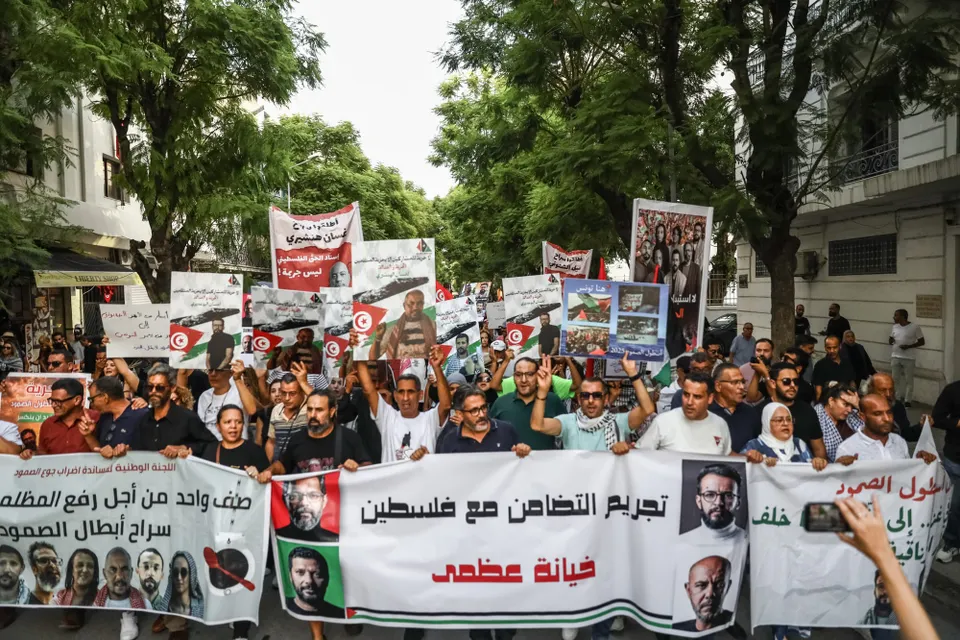
Last week, protesters marched through central Tunis from the headquarters of the Tunisian National Journalists’ Union to Avenue Habib Bourguiba, carrying pictures of the four detainees and calling for an end to the case.
Then some of the protesters were arrested too.
From the following night, police detained people who had participated in the demonstration, some from their homes and others from the street. Lawyers said at least 11 had been arrested, while activists put the number at 13 or more.
A judge subsequently authorised an additional 48 hours of detention for some of those arrested, whose lawyers said they had been questioned about slogans chanted during the protest. Tunisian authorities had not publicly confirmed the arrests at the time of writing.
openDemocracy contacted the Tunisian authorities for comment but had received no response by the time of publication.
Activists such as Bouazzai, have been trying to understand what is driving this recent crackdown.
“The Tunisian authorities regard any independent movement with significant popular support and mobilisation as a threat to their power,” he said, “even when that movement is devoted to supporting the Palestinian people.”
Naouar has a history of political organising beyond Palestine solidarity. He was imprisoned as a student under former dictator Zine El Abidine Ben Ali, later became secretary-general of the General Union of Tunisian Students and, shortly before his arrest this year, publicly criticised President Kais Saied.
Human rights organisations have also raised wider concerns about pressure on Tunisia’s civil society, including the use of financial investigations, lengthy pre-trial detention and prosecutions of activists and NGO workers. Saied’s government has rejected accusations that the judiciary is being used against political opponents and says judicial proceedings are independent.
That tension is particularly striking in Tunisia, where Palestine has historically commanded broad public support and Saied himself has repeatedly expressed support for the Palestinian cause.
Bouazzi argues there is a growing gap between that rhetoric and the state’s treatment of independent organising around Palestine.
He also believes external pressure and the wider geopolitical situation in the region may have played a role in the government’s changing approach, although he did not provide evidence of specific foreign intervention.
For the movement campaigning outside the prison, the immediate demand remains straightforward: the four organisers should be released.
“What we ask of our friends and of supporters of the Palestinian people around the world is to shed light on this injustice,” Bouazzi said. “International attention could create embarrassment and pressure on the Tunisian authorities and help secure the release of our detained comrades.”
Article by Nandini Naira Archer republished from OpenDemocracy under under a Creative Commons Attribution-NonCommercial 4.0 International licence.