This work by Middle East Monitor is licensed under a Creative Commons Attribution-NonCommercial-ShareAlike 4.0 International License.
U.S. President Donald Trump raises his hand to wave goodbye while preparing to board his vehicle during his departure from Aras an Uachtarain on September 12, 2026, in Dublin, Ireland. [Artur Widak – Anadolu Agency]
US President Donald Trump reiterated on Monday that he was “open” to engaging with Iran to end the war launched by the United States and Israel against Iran in February.
“The failing Nation of Iran wants to make a deal, quickly and badly. I will determine whether or not the USA will choose to engage — The concept of which we are open to,” Trump wrote on his Truth Social platform.
Iran’s Revolutionary Guard said on Monday that it had shot down an advanced US MQ-1 drone over the Strait of Hormuz, as diplomatic efforts faced a setback with the postponement of a meeting between Iran and Gulf states.
This work by Middle East Monitor is licensed under a Creative Commons Attribution-NonCommercial-ShareAlike 4.0 International License.
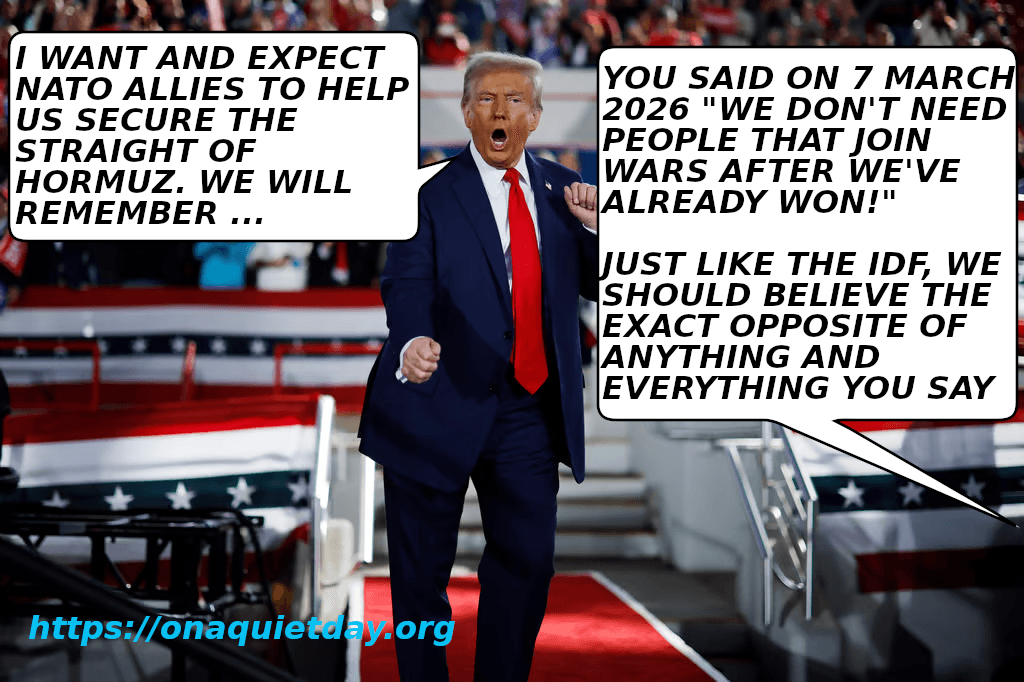
Donald Trump calls for help from NATO allies in securing the Strait of Hormuz despite saying on 7 March 2026 that they don’t need people to join wars after they’ve already won. He’s challenged with the claim that he lies as much as the IDF.
This work by Middle East Monitor is licensed under a Creative Commons Attribution-NonCommercial-ShareAlike 4.0 International License.
Iranian President Masoud Pezeshkian speaks at the Saadabad Cultural and Historical Complex in Tehran, Iran on August 24, 2026. [Iranian Presidency – Anadolu Agency]
Iranian President Masoud Pezeshkian said Friday that he does not support the continuation of war with the US, calling for the country’s resilience to be strengthened for the next phase.
His remarks came during a meeting with heads of Iranian universities, according to the local Mehr News Agency.
Addressing the conflict with Washington, Pezeshkian said, “I am not in favor of continuing the war, but we must strengthen the country’s resilience in the face of upcoming developments.”
Strengthening the country’s resilience requires following a path that does not force Iran to negotiate with the “enemy” from a position of weakness, he said, calling on universities to support the government in this regard.
Economic measures must take into account existing social conditions, the Iranian president said, warning that uncalculated steps would be harmful rather than remedial.
“We must benefit even from the contributions of Generation Z students to solve society’s problems, and ensure their participation in presenting solutions instead of engaging in protests,” he said.
Pezeshkian stressed that, as president, he has no political ties to specific groups, saying he is open to cooperation with all political currents and anyone who contributes to addressing the country’s crises.
The US and Israel launched a war on Iran on Feb. 28, prompting Tehran to fire missiles at Israel and attack US targets and bases in several countries in the region.
Iran also announced the closure of the Strait of Hormuz to navigation, causing widespread disruption to global energy and trade flows.
On June 18, Washington and Tehran reached a memorandum of understanding to end military operations, including guarantees for the passage of commercial ships through the Strait of Hormuz and the launch of negotiations to reach a final agreement within 60 days.
However, the understanding later faltered, and confrontations resumed in July, with the US renewing strikes on targets inside Iran and reimposing a naval blockade on Iranian ports.
This work by Middle East Monitor is licensed under a Creative Commons Attribution-NonCommercial-ShareAlike 4.0 International License.
Donald Trump calls for help from NATO allies in securing the Strait of Hormuz despite saying on 7 March 2026 that they don’t need people to join wars after they’ve already won. He’s challenged with the claim that he lies as much as the IDF.
President Donald Trump attends a meeting at the White House Oval Office in Washington, DC on September 9, 2026. (Photo by White House)
“Even for the notoriously corrupt and lawless Trump, this explicit and desperate attempt to buy votes in the November election is a new low,” said one watchdog leader.
Many Democrats in Congress are on the growing list of critics calling out President Donald Trump for his Wednesday night vow to give US voters $5,000 each if they help Republicans win control of the Senate and House of Representatives—where they already have majorities—in the November midterm elections.
“Nothing says confidence like trying to bribe people for votes,” Congressman Jim McGovern (D-Mass.) quipped Thursday.
Noting the president’s jumbled response to that question, Rep. Don Beyer (D-Va.) said: “I don’t know what this even means, but I do know the reason Trump won’t give a straight answer is that he doesn’t really mean to send these checks to anyone. He has lied about this over and over again, and he’s lying now. Just like he lied when he said he would lower costs.”
Some critics highlighted other cases of Trump pledging to give Americans money, including alleged savings from the actions of his so-called Department of Government Efficiency (DOGE), an effort spearheaded by billionaire Elon Musk.
Congressman Mark Pocan (D-Wis.) said: “So now it’s $5,000 bribes that Trump will never deliver to attempt to make voters forget what they are paying for gas and food. What ever happened to those promised DOGE checks? Americans are not fools, we know he lies daily.”
So after adding trillions of dollars to the national debt, driving it over an unprecedented $40 trillion, Trump now offers everyone a $5,000 political bribe (“the Trump Dividend”) if we elect Republicans to run Congress. So add another $1.3 trillion to the wreckage of this…
Blasting the president as “our pathological liar-in-chief,” Sen. Bernie Sanders (I-Vt.) also pointed to previous instances of Trump promising money, from a 10% cap on credit card interest rates to $2 for a gallon of gasoline.
“The Trump administration is not about helping working families,” the former presidential candidate stressed. “It’s about giving a trillion dollars in tax breaks to the 1% and throwing 15 million Americans off the healthcare they have.”
Sen. Elizabeth Warren (D-Mass.), who has also sought the Democratic Party’s presidential nomination, shared on social media Groundwork Collaborative’s roundup of 15 times Trump has promised a check, dividend, or rebate—and not delivered.
Some Democratic governors also took aim at Trump. California’s Gavin Newsom, who is expected to run for president in 2028, said: “After making you sicker and poorer with his war, Donald Trump now wants to buy your vote with $5,000 in taxpayer-funded blood money. The most corrupt man ever to occupy the Oval Office.”
New York Gov. Kathy Hochul emphasized that “Trump owes New Yorkers $13.5 billion for his illegal tariffs and hasn’t paid up.”
“Now he’s dangling $5,000 checks if Republicans win Congress. A trillion-dollar campaign bribe from a guy who doesn’t pay his bills,” she added. “Fool me once…”
It’s not just elected Democrats ripping Trump’s new pledge. Lisa Gilbert, co-president of the watchdog group Public Citizen, said in a Thursday statement that “even for the notoriously corrupt and lawless Trump, this explicit and desperate attempt to buy votes in the November election is a new low.”
“Trump knows he can’t do this, and yet he’s attempting to bribe voters with the false promise of cash to help his party win an election, which is antithetical to every principle of American democracy,” she continued. “Every Republican at the convention and across the country should loudly and vehemently denounce Trump for proposing this dangerous and transparently illegal scheme. The fact that no one has done that yet is cause for deep alarm about the future of American elections.”
Orcas discuss Donald Trump and the killer apes’ concept of democracy. Front Orca warns that Trump is crashing his country’s economy and that everything he does he does for the fantastically wealthy.Climate science denier Donald Trump confirms that he knows nothing about democracy and that more liquid gold is being secured according to his policy of global privateering.
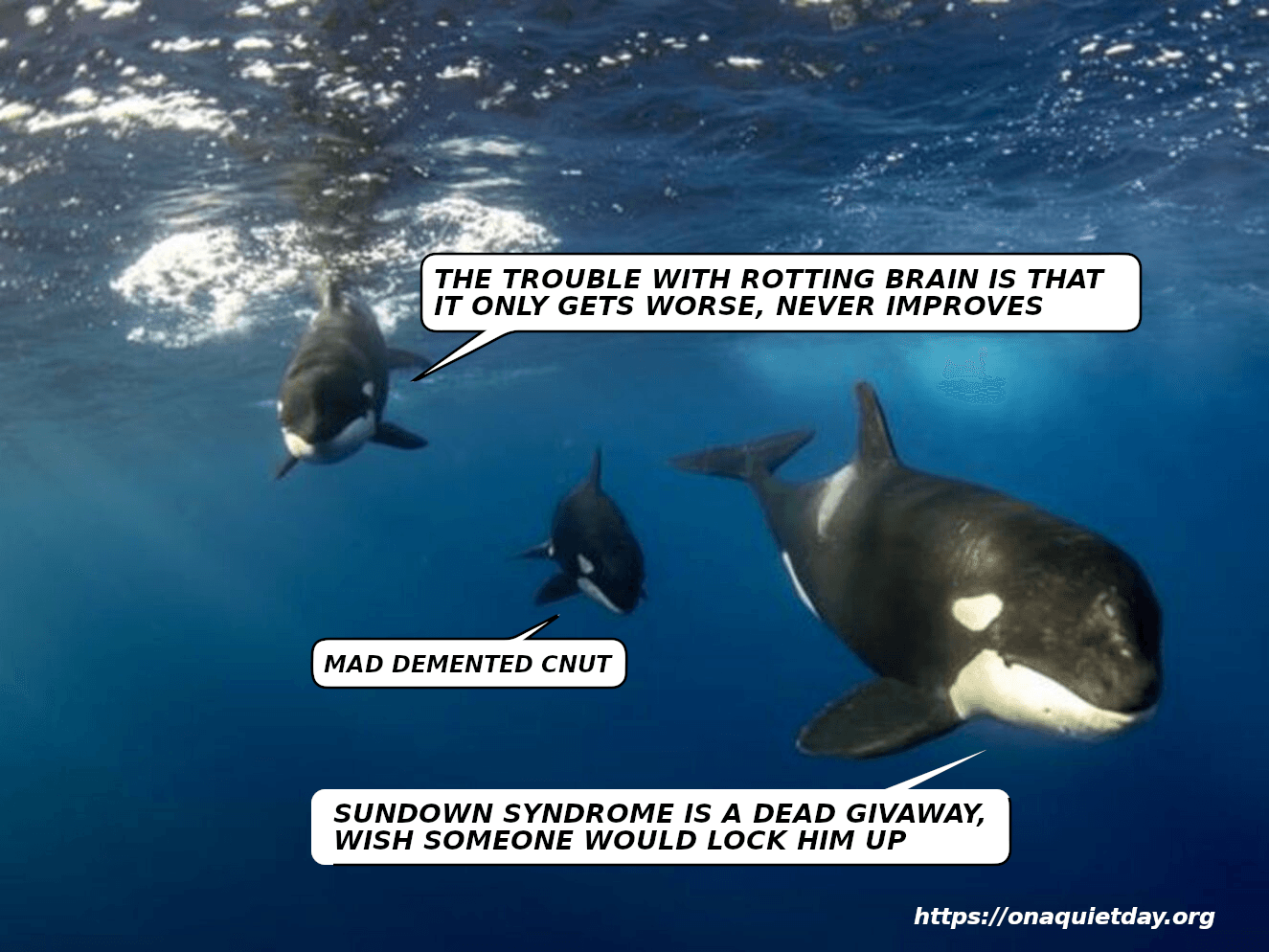
Donald Trump calls for help from NATO allies in securing the Strait of Hormuz despite saying on 7 March 2026 that they don’t need people to join wars after they’ve already won. He’s challenged with the claim that he lies as much as the IDF.Orcas discuss rotting brain, front Orca says Sundown Syndrome is a dead givaway and he wishes someone would Lock Him Up
This work by Middle East Monitor is licensed under a Creative Commons Attribution-NonCommercial-ShareAlike 4.0 International License.
Israeli far-right Finance Minister Bezalel Smotrich displays a map of an area near the settlement of Maale Adumim, a land corridor known as E1, outside Jerusalem in the occupied West Bank, on August 14, 2025. [Photo by MENAHEM KAHANA/AFP via Getty Images]
Far-right Israeli Finance Minister Bezalel Smotrich on Wednesday announced plans for 1,000 new settlement housing units in the northern occupied West Bank, a day after 12 Western countries said they intended to impose trade restrictions on goods from illegal Israeli settlements, Anadolu reports.
Smotrich said on US social media company X that 1,665 dunams (411.5 acres) had been added to the Kida and Havat settlements, allowing for the construction of 1,000 new housing units.
The leader of the Religious Zionism party described the move as “another historic step in the settlement revolution.”
Israel has occupied the West Bank, including East Jerusalem, since 1967. The international community considers Israeli settlements built on occupied Palestinian territory illegal under international law, a position rejected by Tel Aviv.
“After more than 25 years, the Kida and Havat settlements have finally reached the moment when the government is advancing procedures to legalize their status,” Smotrich said.
Kida and Havat were established in 2003 and 2001, respectively. The Israeli government decided to convert them into recognized settlements in December and March, respectively.
The government of Prime Minister Benjamin Netanyahu has touted that since taking office in late 2022, it has approved the establishment of 104 new settlements and established 160 agricultural settlement outposts in the occupied West Bank.
Around 750,000 Israeli occupiers live in 156 settlements and 360 outposts across the occupied West Bank, including occupied East Jerusalem, according to Palestinian figures.
On Tuesday, the UK, Canada, Denmark, Finland, France, Iceland, Ireland, Norway, Poland, Portugal, Spain and Sweden announced plans to impose trade restrictions on goods originating from the Israeli settlements.
This work by Middle East Monitor is licensed under a Creative Commons Attribution-NonCommercial-ShareAlike 4.0 International License.
Orcas discuss rotting brain, front Orca says Sundown Syndrome is a dead givaway and he wishes someone would Lock Him Up
Donald Trump calls for help from NATO allies in securing the Strait of Hormuz despite saying on 7 March 2026 that they don’t need people to join wars after they’ve already won. He’s challenged with the claim that he lies as much as the IDF.Climate science denier Donald Trump confirms that he knows nothing about democracy and that more liquid gold is being secured according to his policy of policy of global privateering.
This work by Middle East Monitor is licensed under a Creative Commons Attribution-NonCommercial-ShareAlike 4.0 International License.
Israeli Prime Minister Benjamin Netanyahu gives a speech in Washington, DC on September 29, 2025. [Will Oliver/EPA/Bloomberg via Getty Images]
The Yedioth Ahronoth newspaper in Israel on Wednesday described the announcement by 12 Western countries, led by Britain, to restrict trade with illegal Israeli settlements in the occupied West Bank as a “diplomatic setback and a significant failure” for Prime Minister Benjamin Netanyahu’s government.
Britain, Canada, Denmark, Finland, France, Iceland, Ireland, Norway, Poland, Portugal, Spain and Sweden announced Tuesday their intention to impose restrictions on trade in goods originating from illegal Israeli settlements.
In a statement, the 12 countries said the Israeli government’s actions in the occupied West Bank undermine the possibility of a two-state solution and urged Israel to immediately halt illegal settlement expansion and violence by occupiers.
Yedioth Ahronoth said that “with the European Union unable for months to reach consensus on sanctions that would ban imports from Israeli settlements, several European countries have begun pursuing restrictions independently, moving the issue from EU-wide diplomacy to national legislatures.”
The absence of an agreement in Brussels led governments supporting the restrictions to conclude that each country would need to enact its own legislation to ban imports from illegal settlements, it said.
The newspaper noted that “the Netherlands has already adopted such measures, although the Dutch order has been challenged in court on claims that it is discriminatory. It is scheduled to take effect Sept. 22.”
“Spain already has legislation in effect, although Israeli exports to the country from the West Bank are limited. Similar legislation is now being discussed in Luxembourg, while Sweden is pursuing its own process,” it added.
Belgium has announced plans for similar action but has not yet enacted legislation, “meaning no restrictions are currently in force there,” said the newspaper.
Yedioth Ahronoth said the growing number of countries supporting restrictions has “caused significant concern in Israel,” not because of the relatively limited volume of trade from illegal settlements, but because officials fear the measures could discourage European importers from altogether purchasing Israeli products.
“Under the new Dutch rules, importers of products originating in settlements could face up to six years in prison,” it added.
Israeli officials and business representatives fear some Dutch companies may choose to avoid Israeli goods entirely rather than verify whether individual products were manufactured inside Israel or in illegal settlements.
They warn that it “could effectively create a quiet, broader boycott.”
“The concern is that importers unwilling to assume the legal risk or administrative burden of establishing where Israeli goods were produced will simply stop purchasing them,” said the newspaper, adding that Israeli officials believe the secondary effects could have serious consequences for the economy as a whole.
The newspaper noted that Europe has long opposed Israeli settlement expansion, “but growing attention to attacks by extremist settlers against Palestinians has given fresh momentum to governments seeking punitive measures.”
Images of Israeli occupiers entering Palestinian villages and reports of violence “have intensified European pressure,” while inflammatory statements by far-right National Security Minister Itamar Ben-Gvir and Finance Minister Bezalel Smotrich “have further fueled criticism,” it said.
“From Israel’s perspective, the failure to effectively address reported incidents of settler violence has created a political boomerang: Extremists in the West Bank are strengthening the case of European governments and activists already opposed to settlements,” it said.
The occupied West Bank has witnessed escalating attacks by occupiers against Palestinians and their property, including incursions into towns and villages, and assaults on residents, vehicles and homes, under the protection of Israeli forces.
Yedioth Ahronoth warned that the potential economic consequences could eventually affect not only occupiers and companies operating in the West Bank, but the Israeli economy as a whole if importers begin viewing all Israeli products as potentially subject to restrictions.
The newspaper said domestic political considerations played a role in Britain’s decision, according to Israeli assessments, as the Labour government faces pressure from elements of its political base; “however, the more consequential development was Britain’s ability to assemble a coalition of 12 countries behind the initiative.”
The timing added another dimension to the controversy because the measures came during Israel’s election campaign.” Some Israeli political figures argue that international pressure on settlements could strengthen Prime Minister Benjamin Netanyahu and his right-wing allies electorally, and British officials had been warned about that possibility,” said the newspaper.
Nevertheless, the newspaper concluded that the decision by Britain and the 11 other Western countries was viewed “not only as a diplomatic setback but as a significant failure by Israel to prevent a coordinated international initiative.”
Palestinians warn that Israel is paving the way for formal annexation of the West Bank through army raids and attacks by occupiers, undermining the possibility of establishing a Palestinian state as stipulated in relevant UN resolutions.
This work by Middle East Monitor is licensed under a Creative Commons Attribution-NonCommercial-ShareAlike 4.0 International License.
Orcas discuss rotting brain, front Orca says Sundown Syndrome is a dead givaway and he wishes someone would Lock Him Up
Donald Trump calls for help from NATO allies in securing the Strait of Hormuz despite saying on 7 March 2026 that they don’t need people to join wars after they’ve already won. He’s challenged with the claim that he lies as much as the IDF.Climate science denier Donald Trump confirms that he knows nothing about democracy and that more liquid gold is being secured according to his policy of policy of global privateering.