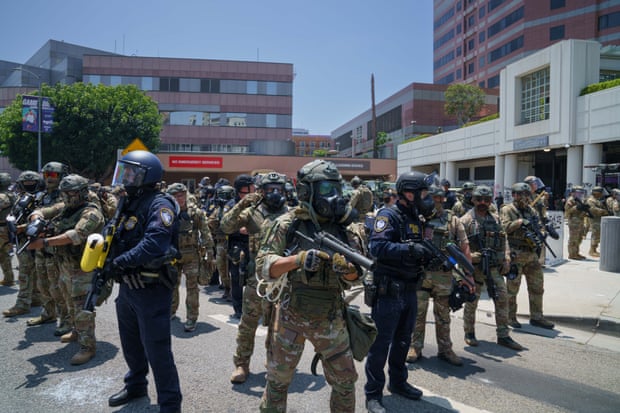
Members of the California national guard and other law enforcement at a protest in Los Angeles on Sunday. Photograph: Daniel Powell/ZUMA Press Wire/Shutterstock
Lawsuit claims administration ‘trampled’ on states sovereignty by bypassing Governor Gavin Newsom
The state of California will file a lawsuit against the Trump administration for “unlawfully” federalizing the state’s national guard and deploying its troops to quell immigration protests, the attorney general Rob Bonta said on Monday.
Previewing the lawsuit, Bonta claimed the Trump administration “trampled” on the states sovereignty by bypassing the governor Gavin Newsom – a move he said was “by definition, illegal” and escalated what began on Friday as scattered protests and erupted into unrest.
“This was not inevitable,” Bonta said of the demonstrations that built over the weekend following immigration raids across Los Angeles, adding: “There was no risk of rebellion, no threat of foreign invasion. No, inability for the federal government to enforce federal laws.”
Elon Musk urges you to be a Fascist like him, says that you can ignore facts and reality then.Neo-Fascist Climate Science Denier Donald Trump says Burn, Baby, Burn.
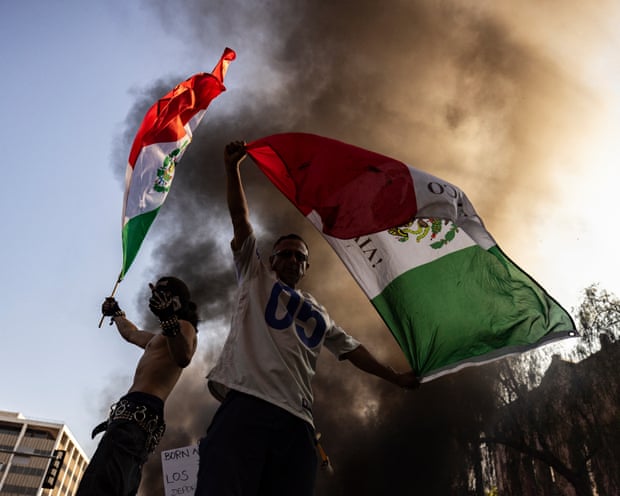
Protesters oppose Trump’s policies in Los Angeles on Sunday. Photograph: Étienne Laurent/AFP/Getty Images
Thousands take to LA streets to protest against Ice raids and president’s deployment of national guard troops
Federal agents clashed with demonstrators in Los Angeles on Sunday as police used teargas and “less-lethal munitions” to disperse massive crowds of people protesting against Donald Trump’s immigration crackdown and his deployment of the California national guard against the will of the state’s elected leaders.
Thousands of Angelenos swamped the streets around city hall, the federal courthouse and a detention center where protesters arrested in days before are being held. They also brought a major freeway to a standstill.
Vocal and boisterous, the crowd for large parts of the day was mostly peaceful. But tensions flared several times. On Sunday afternoon, police used teargas to disperse groups of protesters gathered near the detention center. And in the evening, officers fired round after round of flash-bangs in an attempt to push the protesters back up the freeway off-ramps. Los Angeles police leaders said officers had been shot at with commercial grade fireworks, and had rocks thrown at them.
Trump’s decision to deploy national guard troops into Los Angeles, against the wishes of state and local officials, has sent shockwaves through American politics. California’s governor, Gavin Newsom, and other Democratic governors have sharply criticized the move, describing it as an “alarming abuse of power”. Newsom has called on the administration to rescind the “unlawful” deployment.
“This is a serious breach of state sovereignty – inflaming tensions while pulling resources from where they’re actually needed. Rescind the order. Return control to California,” Newsom said.
Trump ordered the deployment of 2,000 national guard on Saturday night following two days of clashes between demonstrators and US immigration authorities.
The decision marked a stunning escalation in a broad crackdown on immigrants following raids across the country, which have triggered protests.
Elon Musk urges you to be a Fascist like him, says that you can ignore facts and reality then.Neo-Fascist Climate Science Denier Donald Trump says Burn, Baby, Burn.
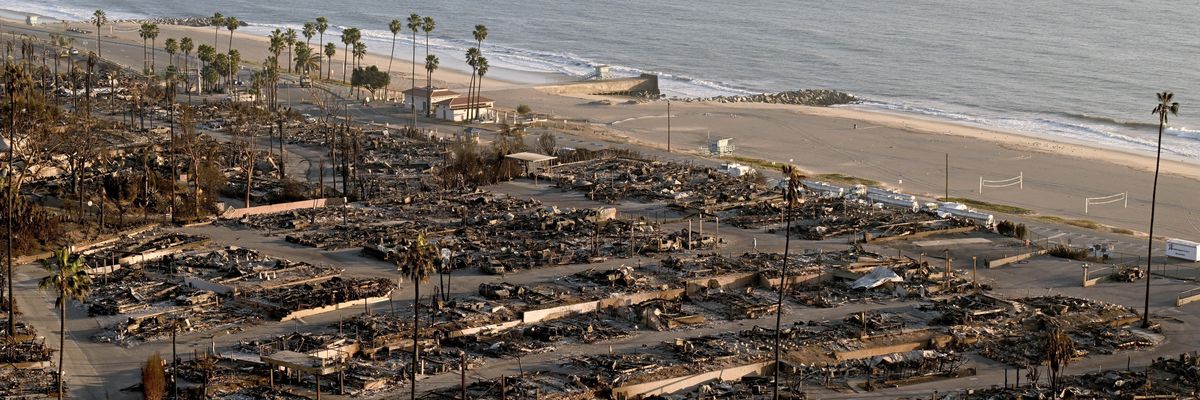
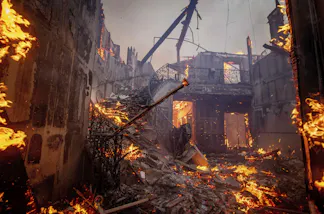
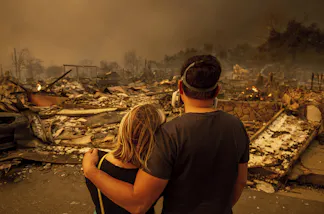
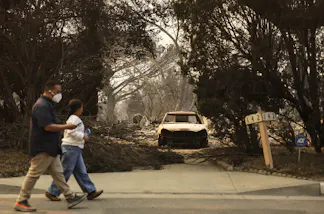
Damaged structures and homes are seen after the Palisades fire in the Pacific Palisades neighborhood of Los Angeles on January 11, 2025. (Photo: Axelle/Bauer-Griffin/GC Images)
“Their philosophy is, if we ignore it, it’s not a problem,” said one meteorologist.
On the heels of the news that higher-than-average temperatures continued globally in April, one of the United States’ top science agencies announced Thursday that it will no longer update a database that tracks climate disasters that cause billions of dollars in damage.
As of Thursday, the Billion Dollar Weather and Climate Disasters database on the National Oceanic and Atmospheric Administration’s (NOAA) website was replaced with a message saying there have been no such events in 2025 through April 8.
That flies in the face of an analysis by the National Centers for Environmental Information, which has maintained the database and said before it was taken down that six to eight billion-dollar climate disasters have happened so far this year, including the wildfires that devastated parts of Los Angeles in January and caused an estimated $150 billion in damage.
The World Weather Attribution said in late January that planetary heating, fueled by greenhouse gas emissions, caused weather conditions in Southern California that made the fires 35% more likely.
Hundreds of people have been laid off from NOAA in recent weeks as the so-called Department of Government Efficiency, led by billionaire tech CEO Elon Musk, has pushed to slash government spending, and those who have lost their jobs include scientists who helped maintain the database.
NOAA spokesperson Kim Doster told The Washington Post that in addition to staff changes, “evolving priorities” were also partially behind the retiring of the database, which will now show disasters that occurred only between 1980-2024.
Between 2020-24, the number of billion-dollar disasters averaged 23 per year, compared to just a few per year in the 1980s.
“This Trump administration move is the dumbest magic trick possible: covering their eyes and pretending the problem will go away if they just stop counting the costs. Households across the country already have to count these costs at their kitchen table as they budget for higher insurance costs and home repairs. Families and retirees dipping into their savings or going bankrupt to recover from wildfires and hurricanes know what disasters cost,” said Carly Fabian, senior insurance policy advocate with Public Citizen’s Climate Program. “Hiding the national tallies will only undermine our ability to prepare and respond to the climate crisis. Deleting the data will exacerbate the devastating delays in acting to slow climate change, and the impacts it is having on property insurance and housing costs.”
NOAA’s “evolving priorities” have also included decommissioning other datasets, including one tracking marine environments and one tracking ocean currents.
Without NOAA’s Billion Dollar Weather and Climate Disasters database, Jeremy Porter, co-founder of the climate risk financial modeling firm First Street, told CNN that “replicating or extending damage trend analyses, especially at regional scales or across hazard types, is nearly impossible without significant funding or institutional access to commercial catastrophe models.”
“What makes this resource uniquely valuable is not just its standardized methodology across decades, but the fact that it draws from proprietary and nonpublic data sources (such as reinsurance loss estimates, localized government reports, and private claims databases) that are otherwise inaccessible to most researchers,” he said.
Chris Gloninger, a meteorologist who resigned from an Iowa news station after receiving threats for his frank, science-based coverage of climate disasters, said the retiring of the database suggests the Trump administration is “okay with spending billions of dollars on disasters.”
Billion dollar disasters are a way to track how our weather is turning more extreme because of #climatechange
— Chris Gloninger, CCM, CBM (@ChrisGloninger) May 8, 2025
“Every dollar that we spend on mitigation or adaptation saves $13 in recovery costs,” said Gloninger. “But their philosophy is, if we ignore it, it’s not a problem.”
Elon Musk urges you to be a Fascist like him, says that you can ignore facts and reality then.Neo-Fascist Climate Science Denier Donald Trump says Burn, Baby, Burn.Orcas discuss how Trump was re-elected and him being an insane, xenophobic Fascist.
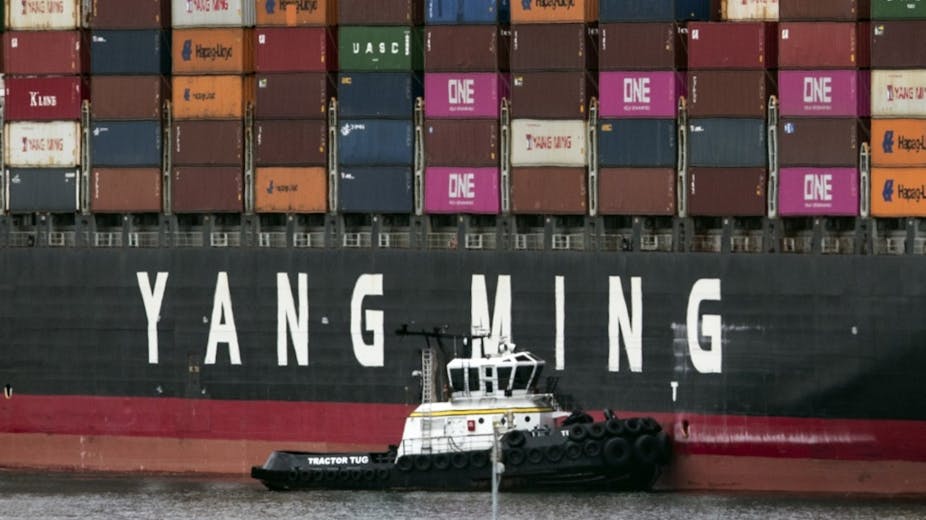
US ports are now starting to see scheduled shipments from China decline as the result of Donald Trump’s 145% tariffs on Chinese goods. The port of Los Angeles, the biggest port for Chinese goods in the US, is predicting scheduled shipments in early May to be about a third lower than the same time last year.
Declining numbers of ships arriving stocked with Chinese imports are likely to affect US supermarket shelves soon, and after warnings from US supermarket bosses, Trump responded by saying trade talks between the US and China were under way in the past few days. But Chinese president Xi Jinping quickly denied talks were happening, suggesting he has no intention of backing away from a fight with the US.
As one of the most powerful leaders in the history of the People’s Republic of China, Xi has fashioned himself as a nationalistic icon. So if China perceives Trump’s tariffs as a bully tactic designed to undermine it, backing down from a confrontation with the US would seriously undermine Xi’s strongman image and rhetoric.
This is something that Trump probably hadn’t considered. At a rally marking his 100 days in office, the US president was still suggesting that China would just back down and “eat the tariffs”.
While tariffs appear to be the primary weapon in the trade war, China might have more tactics to hit back at Trump and the US economy. The question is what might they be?
A few weeks ago it seemed like Washington might punish China’s lack of willingness to negotiate with more tariffs, but now it’s clear that Trump is willing to make a deal and is trying to get China to come to the table. Trump is now implying that US tariffs on China could come down substantially. And US treasury secretary Scott Bessent has called the trade war with China “unsustainable”.
Leveraging agriculture and energy
China has reduced its reliance on US farm imports since the trade war began in Trump’s first presidency. This is bad news for Washington as agriculture is one few sectors in the US that actually has a large trade surplus with China. The 125% retaliatory tariffs will harm the sector’s profitability.
But China’s retaliatory tariffs aren’t the only issue American farmers have to contend with. As the trade war escalates, China has been using bureaucratic hurdles to restrict US agricultural products from entering China and as a potential negotiation tool. For instance, China has delayed the renewals of export license renewals of US pig farmers, and refused to renew licenses of poultry farmers for “health and safety” reasons.
Beijing’s actions might be designed to particularly hit the economy in core Trump supporting states. A major part of Trump and the Republican party’s base lies in “red states”, such as Nebraska, Iowa and Kansas, all have significant farming communities. Focusing on agricultural issues is a tactic that Beijing realises will hit home with Trump voters.
Out of the 444 US counties designated by the United States Department of Agriculture (USDA) as farming-dependent, 77.7% voted for Trump during the 2024 US presidential election. So, any hardship faced by the agriculture sector due to Trump’s own actions is likely to lose him support from a major political base. And with mid-term elections in 2026, Trump has to tread carefully when antagonising Beijing.
Another support base that Beijing might seek to undermine is those involved in the fossil fuel sector. In the past, the US has been a top supplier of natural gas to China.
China has not imported natural gas from the US since early February 2025, and has sought its natural gas from Australia, Indonesia, and Brunei. As the trade war continues, it is unlikely that the US would be able to sell its natural gas to China anytime soon, and this will have an impact on the energy industry – one of Trump’s major political support bases.
Restricting minerals
Another huge problem that the US faces stems from China’s restriction of the export of critical minerals. They include seven rare earth minerals namely samarium, gadolinium, terbium, dysprosium, lutetium, scandium and yttrium. While these are used in the clean energy and automobile sectors, the biggest concern would come from the US defence complex.
The White House probably anticipated export restrictions of critical minerals from China. After all, Beijing had banned the export of critical minerals to Japan in 2010 over a fishing trawler dispute, and stopped exporting “dual-use” metals that can be used to produce civilian and military technology, such as gallium, germanium and tungsten.
What’s next?
For the last few years, China has been trying to overcome an ailing economy that was primarily fuelled by a real-estate crisis. Trump probably expected China to buckle under pressure and come crawling to the negotiation table. After all, the Chinese Communist Party needs to fix its economy fast. The establishment has long relied on delivering economic prosperity to legitimise its rule over China.
Right now the tit-for-tat battle continues. By April 11, US tariffs on China peaked at 145%, while China’s retaliatory tariffs on US goods reached an unprecedented 125%.
Although it is clearly fighting back, China could go even further by selling off US treasuries and increasing US interest rates and thus borrowing cost. But unlike Trump, Xi often plays the long game. After all, Trump’s term as president will be over in less than four years, while Chinese president Xi has no term limits. All the latter has to do is exercise patience, and a friendlier US president might come around.
The fires that have engulfed Los Angeles cap the hottest decade in history.
Each year in the last ten was record-warm, but 2024 was the warmest ever recorded. Last year, Earth was 1.6°C hotter than the temperature average of the late 19th century, which was before widespread fossil fuel burning had significantly altered the climate.
Still, the conflagrations which have so far claimed 25 lives and razed thousands of homes are not inevitable – even on our overheating planet.
“While climate change sets the stage for larger and more intense fires, humans are actively fanning the flames,” says Virginia Iglesias, a climate scientist at the University of Colorado Boulder.
Extreme heat dries out vegetation and the soil. Wildfires ignite more easily, spread faster and burn with greater intensity in these conditions, as parched land is more flammable. In the western US, aridity caused by climate change has helped double the amount of combustible forest since 1984.
Nights are warming faster than days globally, and dusk has brought no reprieve from the fires menacing the residential areas of Pacific Palisades and Altadena. It’s been more than a week since the first spark but firefighters warn several more may pass before the flames are fully contained.
High winds and whiplash
Something is filling the fires with oxygen and spreading their embers to dry brush. The Santa Ana winds that blow down the San Gabriel Mountains between autumn and January lose moisture and gain heat as they rush downslope, and these gusts reached hurricane strength (exceeding 80 miles per hour) at the start of 2025.
“When the wind is blowing like this, there is very little chance of stopping fires,” says Jon Keeley, a plant ecologist at the University of California, Los Angeles.
Gusts have whipped the fire front onward and made containing the blazes difficult. EPA-EFE/Allison Dinner
Santa Ana would cause much less havoc in a more typical wet season, which runs from October to April in California. Ming Pan, a hydrologist who tracks the state’s water supplies, estimates that soil moisture in southern California is in the bottom 2% of historical records for early January.
In other words, the area around LA is about as dry as scientists have ever known it to be at this time of year. Why? Well, southern California has received less than 10% of the rain it would normally get from October onward. But it had the opposite problem last winter.
“Unusually wet winters in both 2022-23 and 2023-24 led to increased vegetation growth, providing more fuel for the fires,” says Doug Specht, a geographer at the University of Westminster.
“This cycle of wet and dry extremes, known as ‘hydroclimate whiplash’, is part of the increasingly intense climate cycles caused by climate change.”
Affluent LA is the most recent arena of climate disaster to capture the world’s attention. Yet it is the poorest 20% of humanity who have felt the sting of whiplashes between drought and downpour most keenly according to Specht.
When unusually heavy rain meets baked ground that cannot easily absorb it, as it did across much of east Africa in spring 2024, flash floods and landslides follow.
‘Perpetually on the brink of catastrophe’
Now we come to the more immediately tractable causes of these fires.
“Fire is a natural process that has shaped ecosystems for over 420 million years,” Iglesias says.
“Indigenous people historically used controlled burns to manage landscapes and reduce fuel buildup. However, a century of fire suppression has allowed vast areas to accumulate dense fuels, priming them for larger and more intense wildfires.”
European colonisation has transformed relationships with the land. Subsequent arrivals to southern California have included invasive plants capable of overrunning native flora and forming dense, uninterrupted fuel beds.
The legacy of these fires may be more invasive plants, and more flammable landscapes. That’s because invasive species are typically better at exploiting extreme weather, their tendrils colonising land disturbed by fire before native species can recover.
The overwhelming majority of wildfires that affect people are also ignited by them, intentionally or otherwise. Lightning has been ruled out for the LA fires so that leaves a wealth of human explanations: arson, unattended campfires, overheating engines or sparks from power lines that utilities have neglected to replace.
“More people now live in and at the edges of wildland areas, and the power grid has expanded with them. That creates more opportunities for fires to start,” Keeley adds.
The Eaton fire which erupted near Altadena on January 7 would have probably burned out in citrus orchards 50 years ago. Today, there is no buffer between homes and the wildland, Keeley says.
Fast-moving wildfires have engulfed residential neighbourhoods with stunning speed. EPA-EFE/Allison Dinner
Whether it was wise to bring flammable homes and cars into this fire-adapted wildland is a debate that should have started nearly a century ago, after the catastrophic Malibu fire in 1930. It didn’t, and late urban historian Mike Davis had a lot to say about why.
“Davis, who died in 2022, painted a vivid, if pessimistic picture of Los Angeles as both a real and imagined city perpetually on the brink of catastrophe,” says Alexander Howard, a senior lecturer in English and writing at the University of Sydney.
“Davis’ Los Angeles is a place where – as he comprehensively details – commercial greed overrides common sense and the social good, where institutional racism marginalises vulnerable communities, and where wilful political inertia ensures history repeats itself with devastating consequences.”
Davis criticised liberal California politicians who greeted each new fire with calls to cut greenhouse gas emissions, but continued to allow real estate developers to “profitably but insanely, [build] in high-fire-risk areas”.
Although motivated by greed, these developers were not alone in their assessment of southern California as a tranquil paradise ripe for luxury housing. LA’s urbanisation occurred “during one of the most unusual episodes of climatic and seismic benignity” according to Davis, who traced natural disasters and climate change back several centuries.
“These spans are too short to serve as reliable proxies for ecological time or to sample the possibilities of future environmental stress,” he writes. “In effect, we think ourselves gods upon the land but we are still really just tourists.”