Demonstrators with a banner reading ‘The Youth Is Angry’ attend a protest under the slogan ‘Gen Z Takes Care of It’ in Berlin, Germany, October 31, 2026
PROTESTS over cuts and the cost of living continue to rock Italy and France. Millions were on the streets across Europe on Saturday.
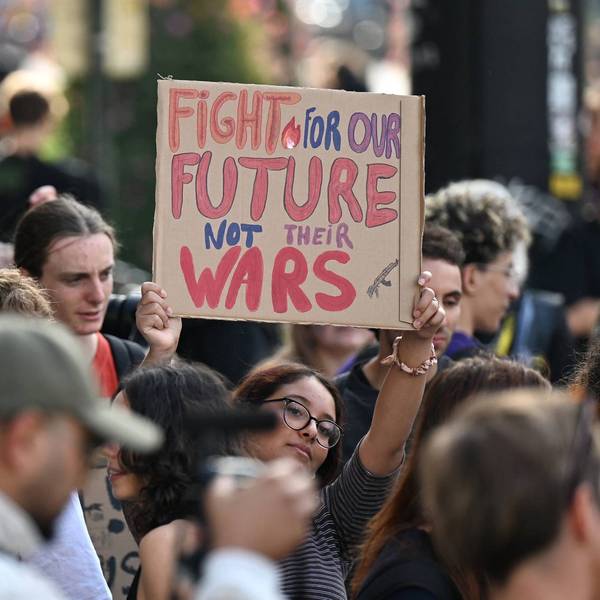
Over the weekend mass demonstrations spread to Germany, where the “welfare not warfare” cause has taken centre stage. Placards at the thousands-strong rally at Berlin’s Brandenburg Gate read “Merz Must Go,” “No to Cuts and War Budgets,” “Invest in People Not War.”
As in France the monopoly media focus on occasional outbursts of violence rather than the issues at stake. But this is a movement demanding a complete change of political direction across the continent.
German protesters are not the first to link cuts to social spending to ballooning military budgets. But the political choice being made is especially stark in Europe’s biggest economy.
Chancellor Friedrich Merz is a millionaire whose previous role at US asset-management giant Blackrock ties him to the most parasitical and unproductive expression of modern capitalism.
His government has imposed savage cuts on healthcare — raising the co-payer element for drugs and hospital stays that applies in Germany and cutting insurance exemptions for non-working spouses. It has taken an axe to pensions, which Merz openly says will no longer maintain pensioners’ living standards over time.
It has cut unemployment benefit even as deindustrialisation accelerates, courtesy of the move from piped Russian gas imports to costlier and ecologically more damaging liquefied natural gas shipments from the US.
All this has accompanied staggering increases in military spending — Germany even amended its constitution to exempt the armed forces from its famed balanced-book requirements — and the introduction of compulsory fitness-for-military-service checks at 18, which millions of young people rightly see as a stepping stone to conscription.
As the Morning Star’s German sister paper Junge Welt puts it, young people see investment in the young (across education, parental leave rights and child benefits) slashed; they see decent jobs disappearing as factories close; and “the administrators of this misery offer only one alternative to these hopeless young people: to die on the G36 rifle for German imperialism.”
These are the same dilemmas mobilising the young in France and Italy. In France, the movement is now readying for mass strike action on November 5 as unions and left forces call out the refusal of the Emmanuel Macron regime to change course.
The drive to war is real, Europe-wide, and exceptionally dangerous. All proposals for a negotiated end to the Ukraine war are dismissed as surrender by European governments and their direct involvement in the conflict is ever deeper.
We cannot tolerate the normalisation of the prospect of war “on the scale our grandparents and great-grandparents endured,” as promoted by Nato secretary-general and Trump boot-licker Mark Rutte. Such a war would kill millions and would be, contrary to the propaganda we are exposed to presenting Russia as an imminent threat, a war of choice by Western powers.
Besides its terrible risks, the war drive is, as the young people of Europe increasingly recognise, being used to justify the permanent degradation of public services and social security.
We need an alternative to austerity and war: a programme for state-led investment in reindustrialisation and the technologies and infrastructure projects needed to cope with climate change.
This is as true of Britain as of Europe — which is why, following a do-nothing Budget, the left needs to build a campaign for a new economic direction big enough to force ministers’ hand before next year’s Spending Review.
And as we see on the streets of Paris, Madrid, Rome and Berlin, it is as true of Europe as it is of Britain — exposing claims by Rachel Reeves and other EU-nostalgics who claim Brexit is the source of our economic problems as a total distraction from the fight for economic transformation we need.
Donald Trump sings and dances, says that it’s fun to kill everyone … unless he gets distracted or falls asleep.UK Prime Minister Andy Burnham admits to blatently lying and engaging in deception to become leader of the UK Labour Party and Prime Minister. He asks who could possibly object to the IDF starving people to death, conducting forced marches like the Nazis did, bombing all Gaza’s hospitals and universities, mass-murdering journalists, healthworkers and starving people queuing for food, killing and raping prisoners and murdering children. He says they’ve got a genocide to do for Israel and to stop objecting.Andy Burnham brings absurd comedy to politics
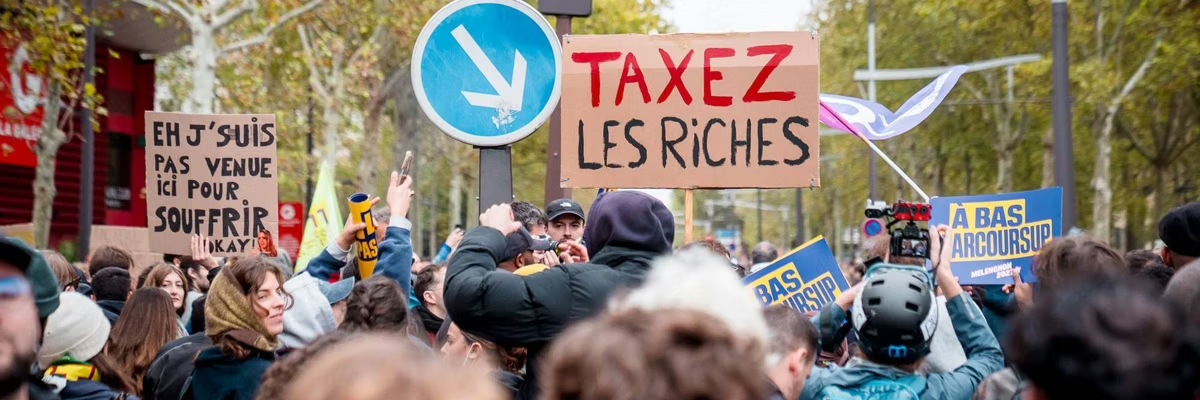
People march in Paris for education reform and against inequality on October 24, 2026. (Photo by Jean-Luc Mélenchon /X)
“Looking at countries like the United States, we don’t want to end up like them, where part of the population has everything and the others have nothing,” one French protester said.
Hundreds of thousands of people took to the streets across Europe on Saturday as anger continues to build over the rising cost of living and deteriorating social services.
While demonstrators emphasized different demands in different countries, the protest wave reflects a sense that the status quo has ceased to work for ordinary people, especially the young.
“I see so many more similarities than differences,” Alice de Brito, the vice president of French student union UNEF, told CNN of the protests. “We are all talking about the need for investments in education, in the universities, in youth in general. But we are also talking about the cost of living, about housing.”
France
Across France, between 410,000 and 800,000 people turned out in the continuation of protests that erupted in September when students began to mobilize against underfunding, teacher shortages, and other poor conditions in their schools. Adult workers have joined with the students, criticizing widespread inequality and the rising cost of living, leading to mass demonstrations on October 17 and again a week later.
“Looking at countries like the United States, we don’t want to end up like them, where part of the population has everything and the others have nothing,” Paris protester Louis Ledoux–Xatard told The Associated Press.
“Too many billionaires; we are preparing the revolution,” one group of protesters chanted, according to Al Jazeera.
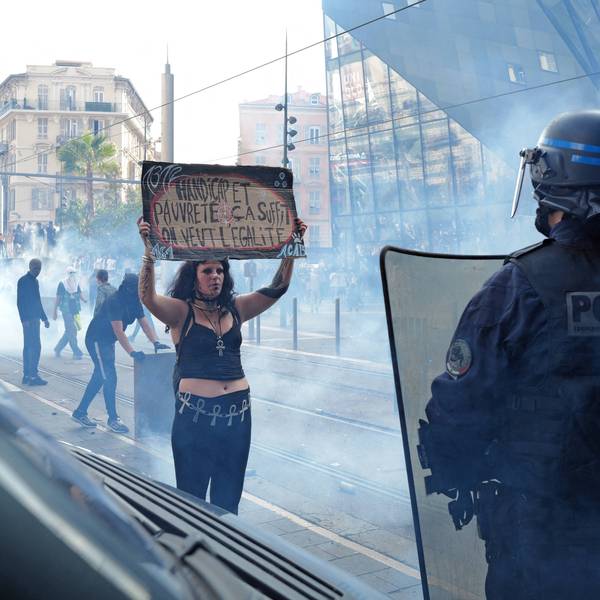
There were 289 protests in France, including in Marseilles, Nantes, Nice, Lyon, Bordeaux, and Orleans. Interior Minister Laurent Nunez said that almost 1,000 people were arrested, though the number was expected to grow. Two people sustained significant injuries.
“Behind every police officer, a compliant camera.”
The protest in Paris had originally been scheduled to run through the center of the city, but authorities relocated it to outskirts and banned marches organized by groups other than unions.
“It won’t stop the movement. It won’t stop students from demanding better conditions in schools,” nurse Soumaya Abed told AP of the changes.
Jean-Luc Mélenchon, who leads the left-wing France Unbowed party, criticized the government of President Emmanuel Macron for changing the route, but also praised the marchers for carrying on.
“Total victory for the social movement,” Mélenchon wrote on social media. “The march gathered at the new authorized point and is now flowing calmly over more than four kilometers. The provocations for disorder by the Paris police prefect and [French Prime Minister Sébastien] Lecornu are a total failure. For the authorities, it is time to give in, or soon they will have only the exit door left.”
Victoire totale du mouvement social. La marche s'est rassemblée au nouveau point autorisé et déferle dans le calme sur plus de quatre kilomètres. Les provocations aux désordres du préfet de police et de Lecornu sont un échec total. Pour les autorités, il est temps de céder, sinon… pic.twitter.com/S3d6k2DWf3
Media reported that the Parisian demonstration was largely peaceful until the end, when police released tear gas and fired water cannons and some black-clad protesters threw projectiles.
Reporters with Agence France-Presse said they saw:
police charge several times and vigorously use tear gas and batons against some, mostly young, protesters. “The police started moving towards everyone, telling them to get down and back off. They were just taking people down, you know, beating protesters,” one demonstrator bleeding from a baton blow to his face, who gave his first name as David, told AFP.
Other witnesses also described a repressive police response to The Guardian:
Mike, a 23-year-old student who also declined to give his surname, said: “Look around, they’re just teenagers. Is it normal for teenagers to be teargassed and beaten with batons?”
For Jessica, a 24-year-old student, said: “I just don’t understand why there’s so much violence. I feel like our right to protest is being trampled on.”
Mélenchon lambasted the police and the media for working together to discredit the movement.
“In Paris, to ruin the day and unwind, the so-called forces of law and order gas and fire into the crowd at the back of the procession, all in a bid to get footage for the domestic news channels that spent the whole week airing the images that spurred the Trappes killer,” he wrote on social media, referring to a racially motivated shooting west of Paris on Friday that killed one and wounded five.
In a second post, he added: “It continues with the policing of minds through the televisions of power. Tonight, staging of the « tails of the procession » to spew hatred against the popular movement. Without a single image of the masses in peaceful action. Behind every police officer, a compliant camera.”
He encouraged readers to “turn off the televisions! Form your own opinion without a guardian. Journey through social networks. Stay free to think for yourselves.”
Belgium
In neighboring Belgium, hundreds of people marched in Brussels in a continuation of demonstrations for improvements in the education system.
“We are here for young people’s future, for better work,” rally speaker Celia Ponce told the crowd, as The Brussels Times reported.
She also accused governments of wanting to “destroy public services.”
Protesters build barricades with bikes and scooters in Brussels, Belgium.
Police used tear gas to disperse some protesters and, in an incident reported by Reuters, kicked and hit one demonstrator after they fell during a chase.
Spain
Approximately 25,000 people marched in Madrid to support Spain’s pension system and demand that it keep pace with inflation and that a gender gap be eliminated, according to Al Jazeera.
“How beautiful Madrid is when it defends its rights,” Emilio Delgado, deputy spokesperson for left party Mas Madrid, wrote on social media. “We propose that no pension should be below the minimum wage. A lifetime of work deserves a dignified retirement.”
The protests come a month ahead of Spain’s general election, in which current Prime Minister Pedro Sanchez’s Spanish Socialist Workers’ Party will face off against the right-wing Popular Party. Popular Party leader Alberto Nunez Feijoo has promised to adjust pensions according to inflation if his party wins, but demonstrators are still concerned about what a right-wing victory would mean for the pension system.
People marched in Lisbon, continuing a movement that began October 10 in the city of Porto calling on the government to address the country’s housing crisis, according to The Resident.
Palco dos protestos promovidos pelo movimento Acampada de Lisboa, o Rossio voltou a acolher "um mar de gente" que reivindica soluções do Governo para a atual crise da habitação.
“We have no home, so we set up tents!” read the slogan of the March, organized by the Acampada de Lisboa movement.
The protesters also opposed new policies from Prime Minister Luis Montenegro that would weaken a limit on annual rent increases and make it easier to evict people who are unable to make rent payments, according to AP.
Italy
Thousands of people joined demonstrations across Italy to protest the affordability crisis as well as the right-wing government of Prime Minister Giorgia Meloni. Protests were called for eight cities including Milan, Turin, and Rome, with 10,000 attending the Milan demonstration alone.
“We are here because of the rising prices and because I believe that our government has no respect for its citizens,” a 17-year-old student participant, who did not give a name, told Al Jazeera. “There are four people in my family. My mother works in a factory, but my father is about to lose his job. It’s hard to make ends meet on just one salary.”
Thousands of protesters took to the streets across Italy to demonstrate against Giorgia Meloni’s right-wing government and the rising cost of living, as hundreds of soldiers were deployed to Milan as protests continue.
The Italian protests were a continuation of demonstrations that have taken place throughout October. There were fewer clashes between police and demonstrators on Saturday compared with earlier marches, though some protesters tried to enter the Colosseum before being pushed back.
Albania
In Albania, outrage over plans by US President Donald Trump’s son-in-law Jared Kushner to build a luxury resort near a protected wildlife area—which is widely seen as an example of government corruption—has dovetailed with demands by students for less corruption in the education system specifically as well as lower tuition fees and more funding.
A demonstration in the capital of Tirana on Saturday marked the 12th day of anti-government protests this month following a summer of mobilizations against the luxury hotel.
Some protesters lit fires and threw projectiles, while police used tear gas, rubber bullets, and water cannons.
Protesters in Albania have fought running battles with police, on a 12th day of anti-government protests.
Police in the capital, Tirana, used water cannon, tear gas and rubber bullets after Prime Minister Edi Rama warned he would take strong action to quell unrest. pic.twitter.com/6oZMYPU7Ei
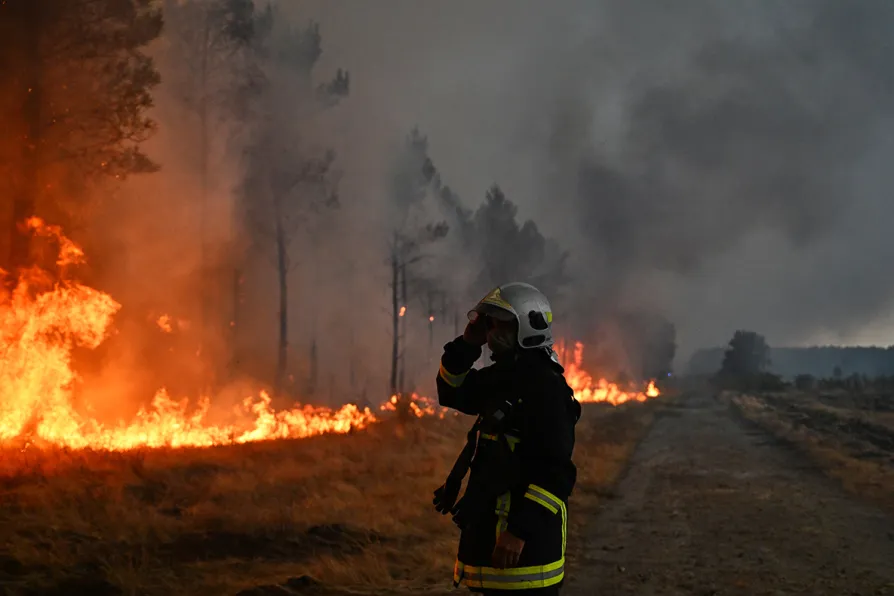
A firefighter gestures next to burning trees as a wildfire rages near Marcheprime, outside, Bordeaux, France, July 26, 2026
FRANCE holds emergency meetings on the evacuation of Bordeaux, a city of a million, as wildfires sweep ever closer. In Spain families are fleeing the capital, Madrid.
The reality of the climate emergency has come to Europe. There were plenty of warning signs — more severe heatwaves by the year, droughts and floods devastating harvests — including in Britain, where three of the five worst harvests on record have been since 2020 — and worsening wildfires.
In Britain this summer fires have burnt swathes of the Cairngorms and Eryri (Snowdonia), as well as Arthur’s Seat in Edinburgh for the second year running. As summer heatwaves grow longer and drier, we should not imagine our towns and cities are safe. As Fire Brigades Union leader Steve Wright told the Morning Star in May, “In London a suburban street burnt to the ground last year” (in Rainham) “and we had wildfires in Dorset and Wiltshire.”
Computer scientist Tim Berners-Lee, inventor of the World Wide Web, argues that addressing the climate crisis requires “World War II-scale mobilisation.”
…
Addressing the climate crisis involves radical restructuring — one reason climate activists were, even before Palestine solidarity campaigners, the victims of repressive new anti-protest laws.
That, in turn, means getting real about the class power of the forces blocking change. Proposed mechanisms for delivering action like citizens’ assemblies are a response to the sluggishness of existing institutions, but do not address its cause — the power of the capitalist class.
Agreeing what we ought to do doesn’t guarantee that it will happen: the climate movement needs to be one with the labour and peace movements, and recognise that this is fundamentally a class struggle and a battle against capitalism itself.
That dividing line becomes ever clearer, domestically and internationally.
The far right are the climate deniers at home; globally the denier-in-chief is the main imperialist power, the United States, whose agenda is to stop the rise of China, the world leader in renewables and green tech. The only existential threat as grave as climate change is world war — and the push towards that is also the biggest obstacle to climate action.
The cry on climate demos — “system change, not climate change” — rings true. We need to follow through on the implications.
Donald Trump urges you to be a Climate Science denier like him. He says that he makes millions and millions for destroying the planet, Burn, Baby, Burn and Flood, Baby, Flood.Nigel Farage urges you to ignore facts and reality and be a climate science denier like him and his Deputy Richard Tice. He says that Reform UK has received £Millions and £Millions from the fossil fuel industry to promote climate denial and destroy the planet.Elon Musk urges you to be a Fascist like him, says that you can ignore facts and reality then.
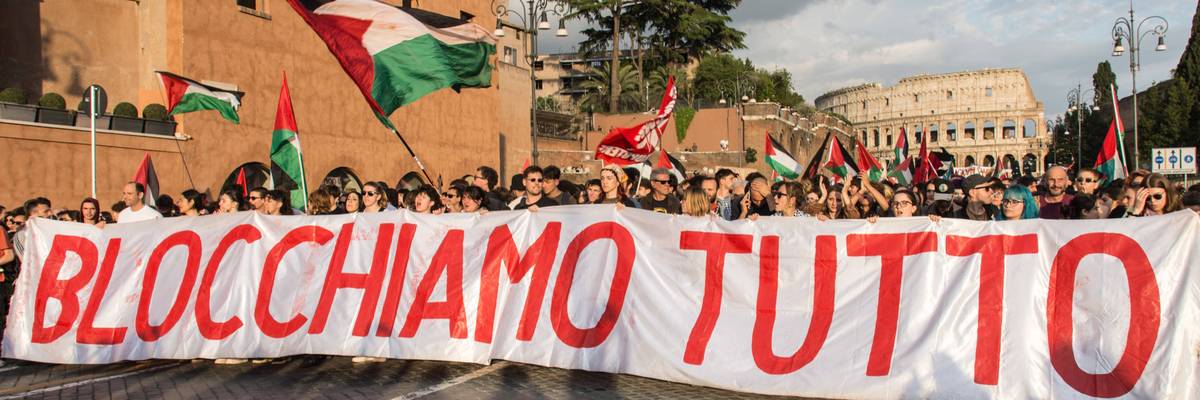
Demonstrators march with a banner reading, “We Block Everything,” during a May 1, 2026 Rome protest in solidarity with the Global Sumud Flotilla. (Photo by Andrea Ronchini/NurPhoto via Getty Images)
“This is a double violation of international law: First, Israel abducted them illegally at sea. Second, Israel is now transporting them, violently, illegally, to one of its notorious prisons.”
Former Greek Finance Minister Yanis Varoufakis on Friday slammed European leaders—and the West at large—for what he said is their complicity in Israel’s abduction of two leaders of the Gaza-bound humanitarian aid flotilla seized off the coast of Greece.
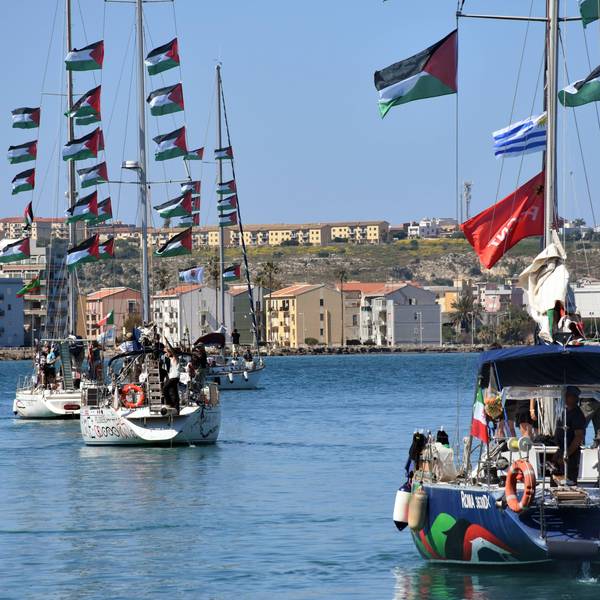
In what numerous critics called an act of piracy, Israeli authorities intercepted the Global Sumud Flotilla on Thursday in international waters 45 nautical miles west of the Greek island Kythira and 600 nautical miles from Gaza, according to Greenpeace, whose MY Arctic Sunrise was the aid convoy’s most prominent vessel.
Around 175 activists aboard 22 vessels were seized by Israeli forces. The BBC reported Friday that most of them have been released in Greece.
Some of the flotilla members said they were beaten and dragged while handcuffed. The Washington Postreported 34 people—including citizens of Australia, Colombia, Italy, Ukraine, and the United States—required medical attention for broken ribs, noses, and other injuries. Detained activists also said they were denied food and water and were forced to sleep on deliberately flooded floors.
Flotilla organizers said 31 of the remaining vessels will continue heading toward Palestine in a bid to “break the illegal siege of Gaza.”
Two members of the flotilla steering committee—Saif Abu Keshek and Thiago Ávila—were taken to Israel for interrogation.
Abu Keshek is a Spanish-Swedish citizen of Palestinian origin. Ávila is Brazilian. Israel’s Foreign Ministry claimed that Abu Keshek is “suspected of affiliation with a terrorist organization” and Ávila is “suspected of illegal activity.”
As is very often the case with Palestinians it has killed, Israel provided no evidence to support its claims against the accused.
Varoufakis noted on X that Ávila “has distinguished himself with repeated attempts to break the illegal, genocidal, Israeli blockage of Gaza.”
“Unlike the remaining abducted members of the Sumud Flotilla crew, which the Israeli navy disembarked in Crete, Saif and Thiago are detained and bound for an Israeli prison,” the Democracy in Europe Movement 2025 co-founder continued. “This is a double violation of international law: First, Israel abducted them illegally at sea. Second, Israel is now transporting them, violently, illegally, to one of its notorious prisons.”
It is not known where Israel will send the two men. Ávila was previously held at Ayalon Prison in Ramla, along with other activists seized from the Madleen last summer. Ávila reportedly refused deportation papers and launched a hunger strike, prompting prison authorities to place him in solitary confinement.
While it is not as notorious as the Sde Teiman military prison—where former inmates and Israeli staff have describedtorture, rape, murder, and other abuse of Palestinians—Ayalon Prison’s alleged human rights violations include torture, medical neglect, and deliberately degrading conditions.
“Meanwhile,” Varoufakis said Friday, “the Greek government is cooperating fully in Israel’s criminal behavior, effectively surrendering its search and rescue obligations and conniving with Israel to victimize the brave crews of the Sumud Flotilla who are steadfastly, through their activism, defending international law as well as the verdict of the International Court of Justice, which has clearly and unequivocally declared Israel’s continued naval blockade of Gaza and its occupation of the Palestinian territories illegal.”
“Through their complicity and their silence, the Greek government, the European Union, the mainstream media, the West more generally, are flouting, indeed they are trashing, their supposed, much publicized, ‘Western values,’” he added.
Varoufakis is calling on the world to demand:
The immediate release of Saif and Thiago;
An end to Israel’s criminal behavior in international waters;
The termination of Israel’s illegal Gaza blockade; and
That the Greek government and the European Union cease and desist from lending logistical and moral support to Israel’s genocide in Gaza and its ethnic cleansing campaigns in East Jerusalem and the West Bank.
Varoufakis’ call was echoed by the Global Sumud Flotilla, which demanded that “all governments do all they can to pressure the Israeli regime to release all the illegal abductees.”
Spanish officials including Prime Minister Pedro Sánchez also decried Thursday’s raid and demanded the release of the flotilla activists while calling for an end to EU-Israel Association Agreement, a bilateral trade and economic policy framework.
“Israel is once again violating international law by assaulting a civilian flotilla in waters that do not belong to it,” Sánchez said on X. “Our government is doing everything necessary to protect and assist the detained Spaniards. But that is not enough. The EU must suspend the association agreement NOW and demand that [Israeli Prime Minister Benjamin] Netanyahu comply with the law of our seas.”
On the other hand, US State Department spokesperson Tommy Piggott condemned the flotilla as a “pro-Hamas initiative” and called on allied countries “to take decisive action against this meaningless political stunt.”
The United States provides Israel with tens of billions of dollars in armed aid and diplomatic support including repeated vetoes of United Nations Security Council ceasefire resolutions for Gaza.
Israel maintains that its actions were legal. Its officials have repeatedly invoked the San Remo Manual on International Law Applicable to Armed Conflicts at Sea—often shortened to the San Remo Manual—to justify the interception and seizure of flotilla vessels attempting to reach Gaza on the high seas.
Thousands of demonstrators took to the streets of cities including Athens, Barcelona, Gaza City, Istanbul, Madrid, Milan, Naples, Paris, and Rome on Thursday as protesters showed solidarity with the flotilla members and condemned Israel’s actions.
"We will block everything". Mass protest in Rome after the seizure of the Global Sumud Flotilla
Meanwhile, Gazans continue to suffer from Israel’s bombing and blockade, which have killed or wounded more than 250,000 Palestinians and forcibly displaced, starved, or sickened around 2 million others.
Earlier this week, United Nations Assistant Secretary-General Khaled Khiari said that despite “some improvements in access and aid delivery… food security remains a challenge, while essential services, particularly water, sanitation, and health, are again on the brink of collapse.”
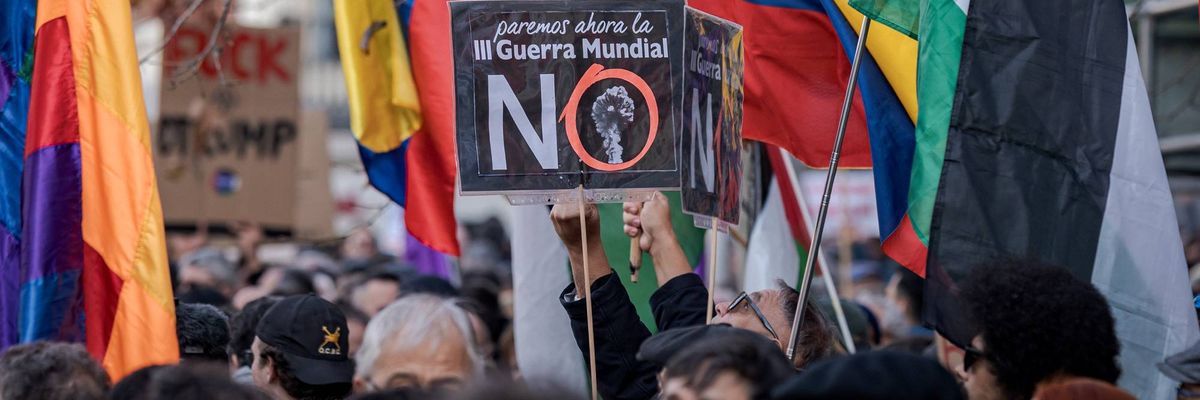
People gather outside the US Embassy in Madrid, Spain to protest the Trump administration’s attack on Venezuela on January 4, 2025. (Photo by Diego Radames/Anadolu via Getty Images)
“This is militarized authoritarianism,” said one advocacy group. “We must act to stop it now, before it spreads to enflame the entire region, if not the entire globe, in a dangerous, unnecessary conflict.”
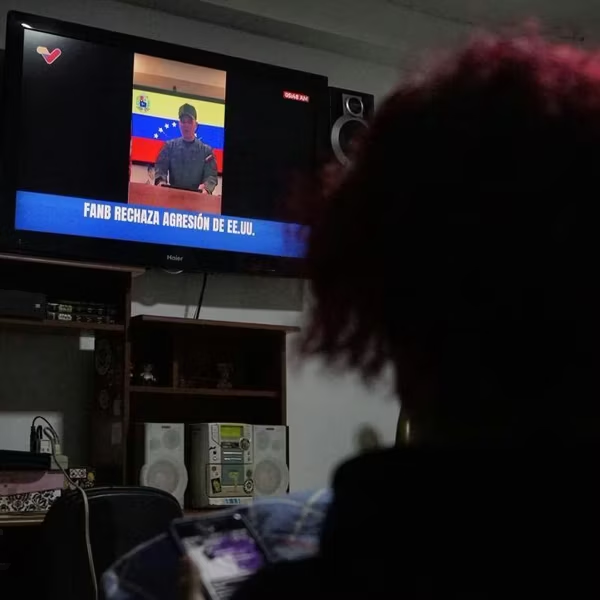
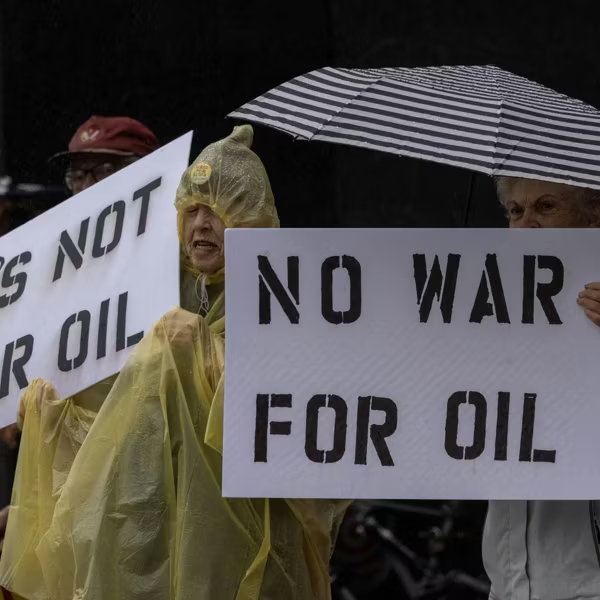
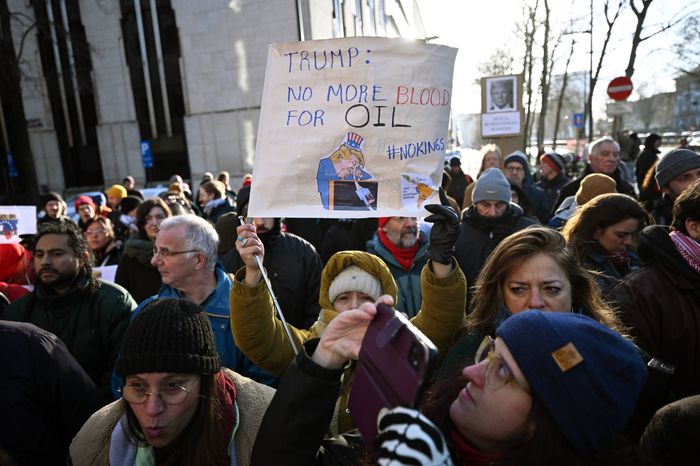
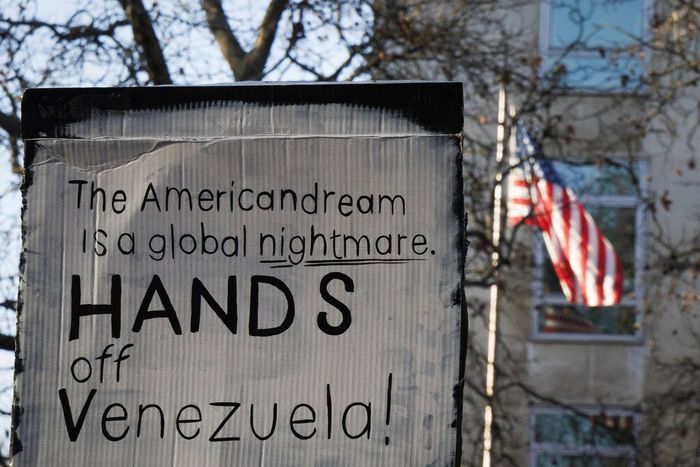
Protests broke out at US diplomatic outposts across the globe Saturday and Sunday following the Trump administration’s deadly attack on Venezuela and abduction of the nation’s president, brazen violations of international law that—according to the American president—were just the start of a sustained intervention in Venezuela’s politics and oil industry.
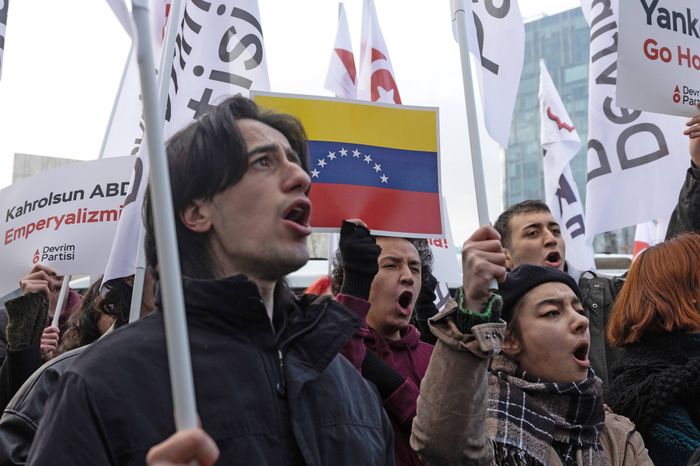
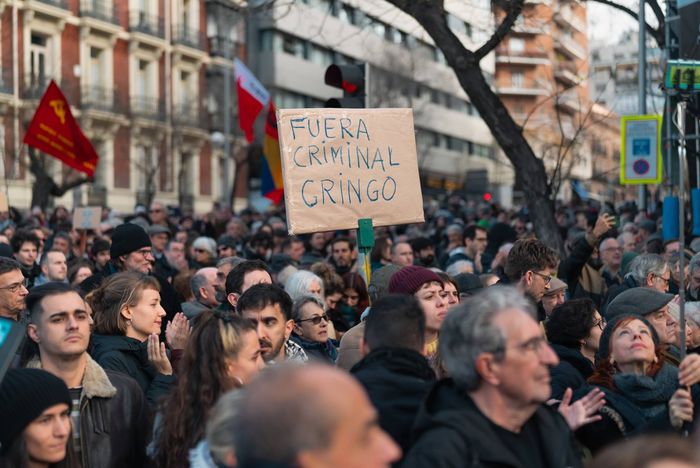
Demonstrators took to the streets of Brussels, Madrid, Ankara, Mexico City, Los Angeles, and other major cities worldwide to voice opposition to the US assault on Venezuela and Trump administration officials’ pledge to “run” the country’s government for an unspecified period of time, a plan that Venezuelan leaders have publicly met with defiance.
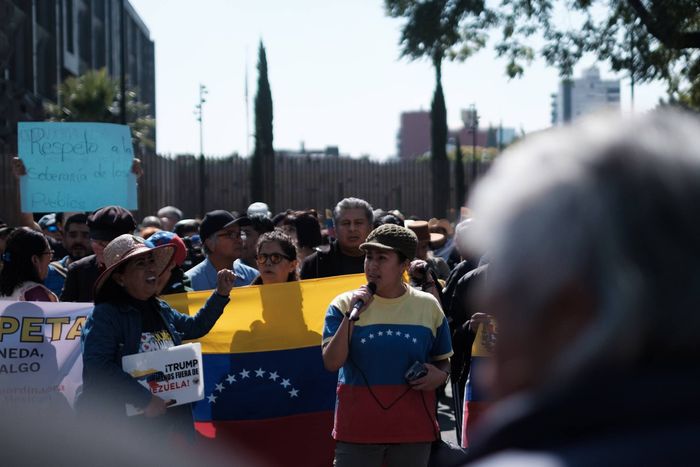
The US Mission to Mexico—one of several Latin American countries Trump threatened in the aftermath of the attack on Venezuela—warned in an alert issued Saturday that “a protest denouncing US actions against Venezuela continues to take place in front of the US Embassy in the Polanco neighborhood of Mexico City.”
“Protestors have thrown rocks and painted vandalism on exterior walls,” the alert read. “Social media posts about the protest have included anti-American sentiment. Embassy personnel have been advised to avoid the area.”
Social and political organizations mobilized to the US Embassy in Mexico City, Mexico on January 3, 2026. (Photo by Miguel M. Caamano/NurPhoto via Getty Images)
Hundreds gather in front of the US Embassy in Brussels, Belgium on January 4, 2025. (Photo by Dursun Aydemir/Anadolu via Getty Images)
Demonstrators hold posters and chant slogans during a protest in front of the US Embassy on January 4, 2026 in Ankara, Turkey. (Photo by Serdar Ozsoy/Getty Images)
A photograph taken on January 4, 2026 shows an anti-war placard in Brussels during a demonstration against the US attack on Venezuela. (Photo by Nicolas Maeterlinck/Belga/AFP via Getty Images)
Protesters gather during a demonstration in front of the US Embassy on January 4, 2026 in Madrid, Spain. (Photo by Olmo Blanco/Getty Images)
The global demonstrations came as some world leaders, including top European officials, faced backlash for failing to adequately condemn—or condemn at all—the US attack on Venezuela and continued menacing of a sovereign nation.
Ursula von der Leyen, president of the European Commission, said she supports “a peaceful and democratic transition,” without mentioning or denouncing the illegal abduction of Venezuelan President Nicolás Maduro and US bombings that reportedly killed at least 40 people, including civilians.
Greek Prime Minister Kyriakos Mitsotakis declared that “this is not the time to comment on the legality of the recent actions” as protesters gathered in Athens in opposition to the US assault.
“If you still believe that the European Union cares about international law, then look no further,” wrote Progressive International co-general coordinator David Adler, pointing to Mitsotakis’ statement.
“We are outraged, but this moment demands more than outrage. It demands organized, coordinated resistance.”
Mass protests and demands for international action to halt US aggression proliferated amid ongoing questions about how the Trump administration intends to carry out its stated plan to control Venezuela and exploit its oil reserves—objectives that experts say would run afoul of domestic and international law.
US Secretary of State Marco Rubio, who played a central role in planning the Venezuela attack and has been chosen by Trump to manage the aftermath, said Sunday that the administration intends to keep in place a military “quarantine” around the South American nation—including the massive naval force amassed in the Caribbean in recent months—to pressure the country’s leadership to bow to US demands.
“That’s a tremendous amount of leverage that will continue to be in place until we see changes, not just to further the national interest of the United States, which is number one, but also that lead to a better future for the people of Venezuela,” Rubio said in a television interview.
Rubio also suggested the president could deploy US troops to Venezuela and dodged questions about the legal authority the Trump administration has to intervene in the country. The administration has not sought congressional authorization for any of its attacks on vessels in the Caribbean or Venezuela directly.
US Rep. Greg Casar (D-Texas), chair of the Congressional Progressive Caucus, said Sunday that “in recent history, we’ve tried ‘running’ multiple countries in Latin America and the Middle East. It’s been a disaster for us, and for them, every single time.”
“Congress must pass a War Powers Resolution to get our military back to defending the US, instead of ‘running’ Venezuela,” Casar added.
“We must act to stop it now, before it spreads to enflame the entire region, if not the entire globe, in a dangerous, unnecessary conflict,” the group added. “We are outraged, but this moment demands more than outrage. It demands organized, coordinated resistance.”
Donald Fuhrump says that Amerikkka doesn’t bother with crimes or charges anymore, not being 100% Amerikkkan and opposing his real estate intentions is enough.

 Demonstrators with a banner reading ‘The Youth Is Angry’ attend a protest under the slogan ‘Gen Z Takes Care of It’ in Berlin, Germany, October 31, 2026