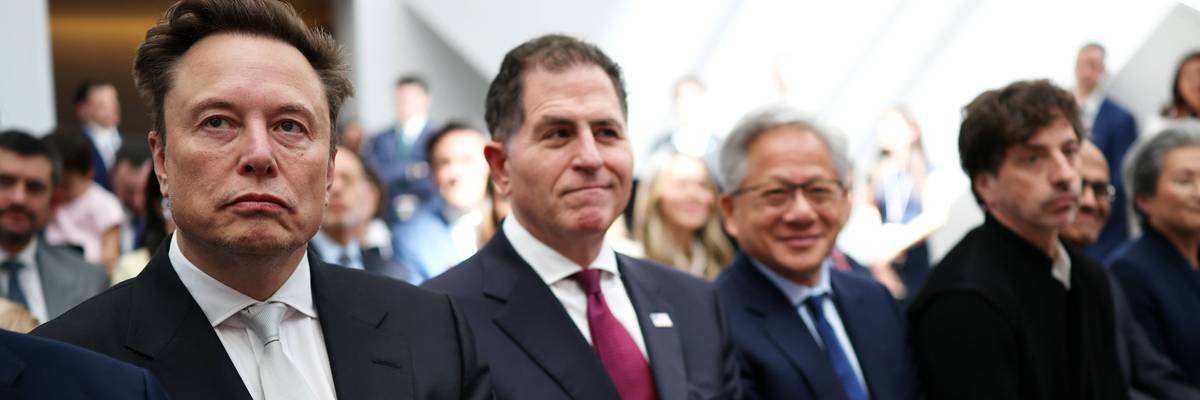
SpaceX CEO Elon Musk, CEO of Dell Technologies Michael Dell, Nvidia CEO Jensen Huang, and co-founder of Google Sergey Brin attend the Golden Age of American Innovation Summit on October 8, 2026 in Washington, DC.(Photo by Win McNamee/Getty Images)
“Trump and his anti-AI regulation posture is dragging the party to a politically suicidal place,” said one Democratic strategist.
American voters’ antipathy toward Big Tech companies has become a central theme of campaigns in the 2026 midterm elections, according to an analysis published by The Guardian on Thursday.
The Guardian noted that hundreds of midterm campaign ads attacking data centers have aired over the past two months, with both Republicans and Democrats accusing one another of being pawns of the artificial intelligence industry.
“And it’s not only data centers,” The Guardian added. “The public anxiety over AI and distaste for the billionaires developing it, as well as backlash over encroaching tech like surveillance cameras, has turned the tech industry into a ubiquitous villain this election cycle.”
Silicon Valley has become a punching bag for politicians even as Big Tech moguls have been throwing record sums of money to elect politicians sympathetic to their needs.
Super political action committees (PACs) “funded by tech billionaires are among the top spenders in this election cycle,” The Guardian explained. “Leading the Future, formed by OpenAI president Greg Brockman and venture capitalist Marc Andreessen, has raised more than $75 million to back tech-friendly candidates. [SpaceX CEO] Elon Musk has sunk $366 million into Republican causes, more than he spent on the 2024 presidential election.”
Much of the Big Tech money has been going toward Republican candidates this cycle, even though the industry has traditionally had close ties with elected Democrats.
Texas Democratic US Senate candidate James Talarico in recent days has been trying to turn Big Tech money being spent against him into an advantage, highlighting in particular the outsize role that Musk is playing funding the campaign of his Republican rival, Texas Attorney General Ken Paxton.
After Musk on Wednesday used his platform X to declare that “there is something deeply wrong with Talarico,” the Texas Democrat quickly returned fire.
“There is something deeply wrong with a political system,” Talarico wrote, “that allows one trillionaire to buy his own personal US senator.”
A report published by The Atlantic on Monday examined how the tech industry’s embrace of President Donald Trump during his second term has given Democrats an incentive to pummel the industry, particularly when polls show a bipartisan hostility to AI data centers.
In fact, Democratic strategists told The Atlantic that data centers have proven to be a top wedge issue capable of getting normally loyal GOP voters to think twice before voting for a Republican candidate.
“Trump and his anti-AI regulation posture is dragging the party to a politically suicidal place,” Democratic strategist Rob Flaherty told The Atlantic. “They are grabbing the wrong side of an 80–20 issue at exactly the wrong time.”
Democratic strategists started pushing the party to take a more populist approach toward the tech industry when polling data “showed surprising concern about AI” even in traditionally conservative rural districts, The Atlantic reported.
Rishi Bharwani, US director of tech regulation advocacy group Reset Tech, said much has changed since Democrats under former President Barack Obama embraced the industry as a positive force for society.
“What we all experienced was a ton of growth in the tech sector, the creation of numerous new billionaires, and even the world’s first trillionaire,” said Bharwani, “and a bunch of working families basically recognizing that they’re not sharing. These tech companies are actually undermining their economic security and their safety.”
Orcas discuss rotting brain, front Orca says Sundown Syndrome is a dead givaway and he wishes someone would Lock Him UpClimate science denier Donald Trump confirms that he knows nothing about democracy and that more liquid gold is being secured according to his policy of global privateering.Orcas discuss Donald Trump and the killer apes’ concept of democracy. Front Orca warns that Trump is crashing his country’s economy and that everything he does he does for the fantastically wealthy.
US president Donald Trump is surrounded by a new cohort of politicians and officials. While one of his campaign promises was to overthrow the “corrupt elites” he accuses of flooding the American political arena, his second term in office has elevated elites chosen, above all, for their political loyalty to him.
The media’s focus on Trump’s comments on making Canada the 51st US state and annexing Greenland and billionaire Elon Musk’s support for some far-right parties in Europe has obscured the ambitious programme to transform the federal government that the new political elite intends to implement.
In the wake of Trump’s inauguration on January 20, the Republican elites most loyal to the MAGA (“Make America Great Again”) leader, who staunchly oppose Democratic elites and their policies, are operating amid their party’s control over the executive and legislative branches (at least until the midterm elections in 2026), a conservative-dominated Supreme Court that includes three Trump-appointed justices, and a federal judiciary that shifted right during his first term.
However, the political project of the Trumpist camp consists less of challenging elitism in general than attacking a specific elite: one particular to liberal democracies.
Castigating democratic elitism
Typical anti-elite political propaganda, along the lines of “I speak for you, the people, against the elites who betray and deceive you,” claims that a populist leader would be able to exercise power for and on behalf of the people without the mediation of an elite disconnected from their needs.
Political theorist John Higley sees behind this form of anti-elite discourse an association between so-called “forceful leaders” and “leonine elites” (who take advantage of the former and their political success): a phenomenon that threatens the future of Western democracies.
Since the Second World War, there has been a consensus in US politics on the idea of democratic elitism. According to this principle, elitist mediation is inevitable in mass democracies and must be based on two criteria: respect for the results of elections (which must be free and competitive); and the relative autonomy of political institutions.
The challenge to this consensus has been growing since the 1990s with the increased polarization of American politics. It gained new momentum during and after the 2016 presidential campaign, which was marked by anti-elite rhetoric from both Republicans and Democrats (such as senators Bernie Sanders and Elizabeth Warren). At the heart of some of their diatribes was an aversion to “the Establishment” on the east and west coasts of the United States, where many prestigious financial, political and academic institutions are based, and the conspiracy notion of the “deep state”.
Trump’s populism from above: a revolt of the elites
The idea that democracy could be betrayed by “the revolt of the elites”, put forward by the US historian Christopher Lasch (1932-1994), is not new. For the anthropologist Arjun Appadurai, it is a particular feature of contemporary populism, which comes “from above.” Indeed, if the 20th century was the era of the “revolt of the masses”, the 21st century, according to Appadurai, “is characterized by the ‘revolt of the elites’.” This would explain the rise of populist autocracies (such as those currently led by Viktor Orban in Hungary, Recep Tayyip Erdogan in Turkey and Narendra Modi in India, and formerly led by Jair Bolsonaro in Brazil), but also the election successes of populist leaders in consolidated democracies (including those of Trump in the US, Giorgia Meloni in Italy, and Geert Wilders in the Netherlands, for example).
As Appadurai explains, the success of Trumpian populism, which represents a revolt by ordinary Americans against the elites, casts a veil over the fact that, following Trump’s victory in November, “it is a new elite that has ousted from power the despised Democratic elite that had occupied the White House for nearly four years.”
The aim of this “alter elite” is to replace the “regular” Democrat elites, but also the moderate Republicans, by deeply discrediting their values (such as liberalism and so-called “wokeism”) and their supposedly corrupt political practices. As a result, this populism “from above” carried out by the President’s supporters constitutes an alternative elite configuration, the effects of which on American democratic life could be more significant than those observed during Trump’s first term.
Beyond the idea of a ‘Muskoligarchy’
The idea that we are witnessing the formation of a “Muskoligarchy” –in other words, an economic elite (including tech barons such as Jeff Bezos, Mark Zuckerberg and Marc Andreessen) rallying around the figurehead of Elon Musk, whom Trump asked to lead what the president has called a “Department of Government Efficiency” (DOGE) –is seductive. It perfectly combines the vision of an alliance between a “conspiratorial, coherent, conscious” ruling class and an oligarchy made up of the “ultra-rich”. For the Financial Times columnist Martin Wolf, it is even a sign of the development of “pluto-populism”. (It is also worth noting that former president Joe Biden, in his farewell speech, referred to “an oligarchy… of extreme wealth” and “the potential rise of a tech-industrial complex.”)
However, some observers are cautious about the advent of a “Muskoligarchy.” They point to the sociological eclecticism of the new Trumpian elite, whose facade of unity is held together above all by a political loyalty, for the time being unfailing, to the MAGA leader. The fact remains, however, that the various factions of this new “anti-elite” elite are converging around a common agenda: to rid the federal government of the supposed stranglehold of Democratic “insiders.”
An ‘anti-elite’ elite against the ‘deep state’
In his presidential inauguration speech in 1981, Ronald Reagan said: “Government is not the solution to our problem; government is the problem.” The anti-elitism of the Trump elite is inspired by this diagnosis, and defends a simple political programme: rid democracy of the “deep state.”
This conspiracy theory has been taken to the extreme by Kash Patel, the candidate being considered to head the FBI. In his book, Government Gangsters, a veritable manifesto against the federal administration, the former lawyer writes about the need to resort to “purges” in order to bring elite Democrats to justice. He lists around 60 people, including Biden, ex-secretary of state Hillary Clinton and ex-vice president Kamala Harris.
Government Gangsters, Kash Patel’s controversial book. Google Books
The appointment of Russell Vought as head of the Office of Management and Budget at the White House, a person who is known for having sought to obstruct the transition to the Biden Administration in 2021, also highlights the hard turn that the Trump administration is likely to take.
Reshaping the state around political loyalty
To “deconstruct the administrative state”, the “anti-elite” elites are relying on Project 2025, a 900-plus page programme report that the conservative think-tank The Heritage Foundation, which published it, says was produced by “more than 400 scholars and policy experts.” According to former Project 2025 director Paul Dans, “never before has the entire movement… banded together to construct a comprehensive plan” for this purpose. On this basis, the “anti-elite” elite want to impose loyalty to Project 2025 on federal civil servants.
But this idea is not new. At the end of his first term, Trump issued an executive order facilitating the dismissal of statutory federal civil servants occupying “policy-related positions” and considered to be “disloyal”. The decree was rescinded by president Biden, but Trump on his first day back in office signed an executive order that seeks to void Biden’s rescindment. As President, Trump is also able to allocate senior positions within the federal administration to his supporters.
The “anti-elite” elite not only want to reduce the size of the state, as was the case under Reagan’s “neoliberalism”, but to deconstruct and rebuild it in their own image. Their real aim is a more lasting victory: the transformation of democratic elitism into populist elitism.