

https://novaramedia.com/2026/11/17/andy-burnhams-government-is-still-coming-for-jury-trials/
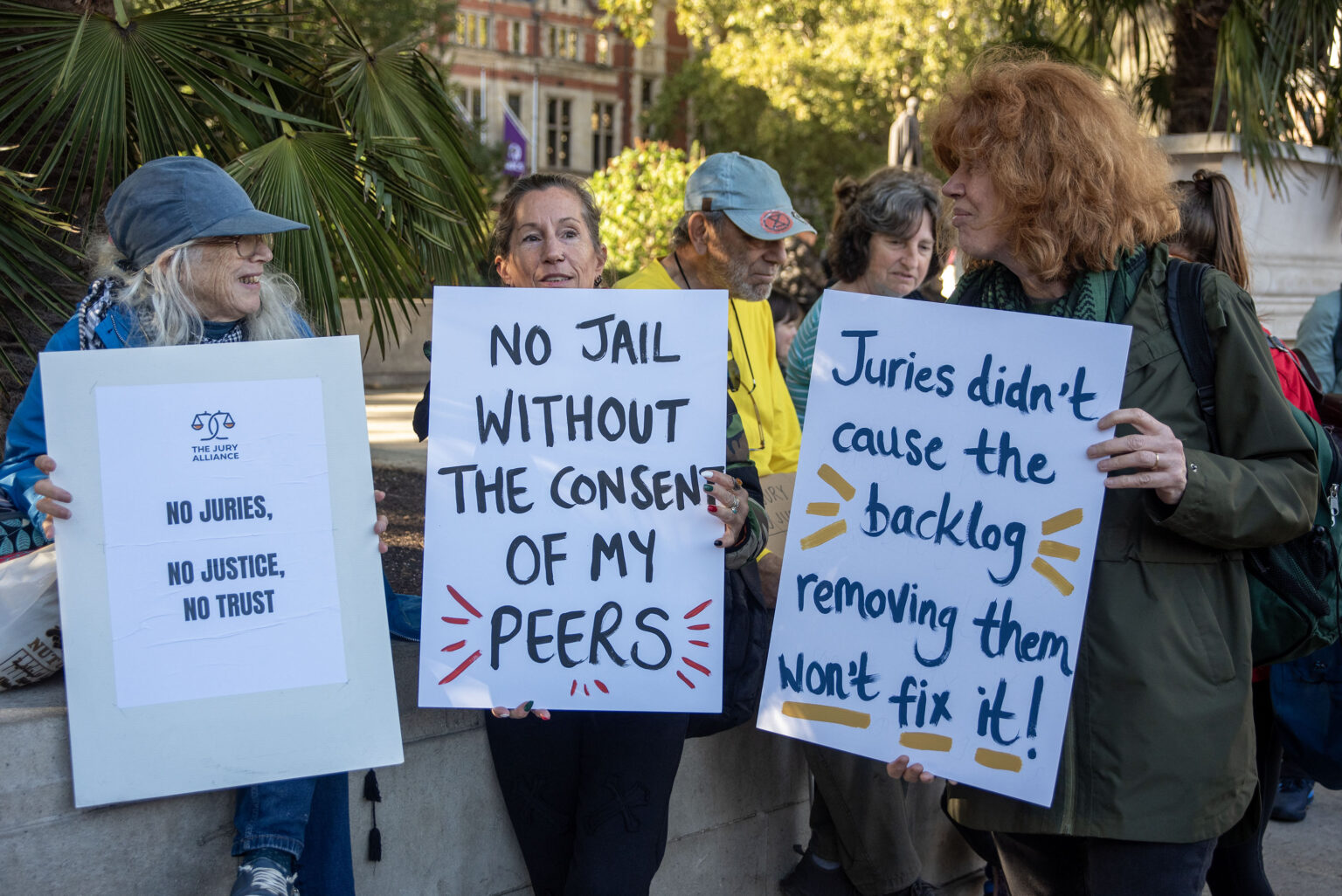
Palestine and climate protesters who are accused of breaking the law face being tried by magistrates instead of a jury of their peers, according to government plans to speed up the justice system.
Legal experts say the plans to slash access to jury trials will have profound consequences for protest cases, racialised minorities, public participation in the justice system and our fundamental rights.
The Starmer-era Courts and Tribunals Bill will remove defendants’ right to request a jury trial for offences of medium seriousness – known as “either-way” or “each-way” offences. It will also expand magistrates’ powers, reduce rights to appeal and earmark some offences for judge-only trials.
The bill was introduced in February by then-justice secretary David Lammy as an attempt to deal with severe court backlogs in England and Wales and help victims get justice faster. The backlogs in criminal courts are real, but the bill goes significantly beyond Lord Leveson’s recommendations for dealing with the issue.
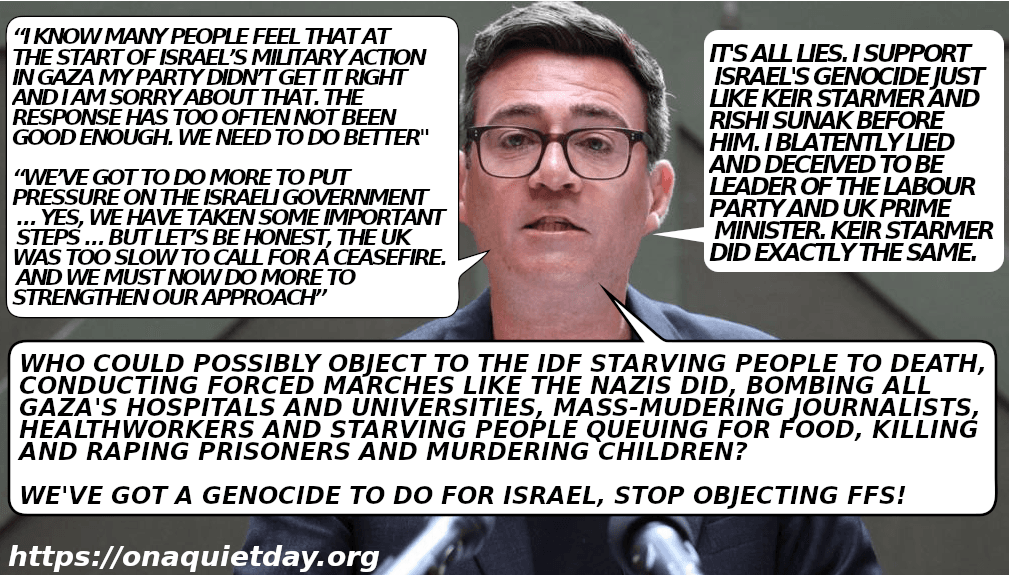
And while Andy Burnham’s government claims it has “changed course” by scrapping one part of the bill, in practice the legislation will still cut access to trial by jury.
…
Article continues at https://novaramedia.com/2026/11/17/andy-burnhams-government-is-still-coming-for-jury-trials/
This work by Middle East Monitor is licensed under a Creative Commons Attribution-NonCommercial-ShareAlike 4.0 International License.

Gaza’s Health Ministry on Friday described Israel’s decision to extend the detention of Kamal Adwan Hospital director Hussam Abu Safiya for another six months without charge or trial as a “compound crime” and a continuation of “the systematic targeting” of Palestinian medical personnel and health institutions, Anadolu reports.
In a statement, the ministry condemned the decision and held Israeli authorities fully responsible for Abu Safiya’s life and safety, as well as those of other detained medical workers.
“Abu Safiya’s continued detention constitutes a blatant violation of all international norms and conventions, particularly the Geneva Conventions protecting medical and humanitarian personnel,” it said.
“81 Palestinian health workers remain detained in Israeli prisons under harsh and inhumane conditions,” the ministry said.
“Detainees are subjected to physical and psychological torture, deliberate denial of legal rights, including legal representation, as well as medical neglect and deprivation of necessary health care,” it said.
The ministry warned that such practices pose “a real and direct threat” to the lives of detained health workers.
It called for the immediate and unconditional release of Abu Safiya and all health workers held by Israel.
The ministry also urged international rights and humanitarian organizations, including the World Health Organization, International Committee of the Red Cross and UN human rights office, to intervene and pressure Israel to halt violations against medical personnel.
The ministry stressed the need to hold those responsible for violations against health workers accountable.
On Wednesday, an Israeli court in Beersheba extended Abu Safiya’s detention under the “Unlawful Combatants Law” and rejected his lawyer’s request for his release on the grounds that he poses a danger to Israel.
Israeli forces detained Abu Safiya on Dec. 27, 2024, during a raid on Kamal Adwan Hospital, after he continued providing care to patients and wounded people despite the siege and Israeli bombardment.
In February 2025, Israel placed Abu Safiya under the “Unlawful Combatants Law,” which allows detainees to be held without charge and their detention to be repeatedly extended.
In July, the UN human rights office called on Israel to immediately release Abu Safiya or charge him with a criminal offense and ensure a fair trial, while also urging that he be transferred to a civilian hospital to receive necessary medical care.
READ: Israel extends detention of Gaza hospital director Abu Safiya by 6 months without charges
This work by Middle East Monitor is licensed under a Creative Commons Attribution-NonCommercial-ShareAlike 4.0 International License.

This work by Middle East Monitor is licensed under a Creative Commons Attribution-NonCommercial-ShareAlike 4.0 International License.

Around 350 Palestinian children are being held in Israeli prisons, where they face torture, starvation and deprivation of medical care, education and family visits, two Palestinian prisoner groups said Friday, Anadolu reports.
The Palestinian Commission of Detainees and Ex-Detainees Affairs and the Palestinian Prisoner Society issued a joint statement marking World Children’s Day, observed annually on Nov. 20.
The groups said around 350 Palestinian children, including three girls, are currently held in Israeli prisons.
More than 2,000 arrests of children have been recorded in the occupied West Bank, including East Jerusalem, since Israel launched its genocidal war on the Gaza Strip in October 2023, they added.
Dozens of children from Gaza were also detained during the war, but enforced disappearance and restrictions on visits have made it impossible to determine their numbers, whereabouts and detention conditions, according to the statement.
The groups said Israeli forces detain children in the occupied West Bank during home raids, at military checkpoints, on streets and at or near schools.
Dozens of Palestinian children are held under administrative detention without charge, they said, adding that repeated extensions deprive them of the right to defend themselves and leave them facing indefinite imprisonment.
According to the statement, children are sometimes bound and beaten from the moment of their detention before being interrogated for hours without a lawyer or family member present and deprived of sleep and rest.
“Children are held in overcrowded rooms lacking adequate ventilation and health care and are deprived of medical treatment, education and family visits,” the groups said.
Skin diseases, including scabies, have spread among detainees due to overcrowding and shortages of hygiene supplies, while medical treatment is delayed and appropriate medication withheld, according to the statement.
The groups added that children are subjected to starvation, severely affecting their health and physical condition.
They highlighted the case of Walid Khaled Ahmad, a child from Silwad, east of Ramallah, who died in Israel’s Megiddo Prison in March 2025.
The groups said an autopsy revealed severe wasting and an absence of muscle mass and body fat, identifying starvation and dehydration among the causes of his death.
The investigation into his death was closed without anyone being held accountable, the statement said, adding that Israeli authorities returned his frozen body to his family after holding it for more than a year.
The two groups criticized what they described as Israel’s impunity and the international community’s failure to protect Palestinian children.
They called for an end to the administrative detention of children, the release of detained minors and accountability for those responsible for torture, starvation and enforced disappearance.
They stressed that protecting Palestinian children is an international responsibility, warning that continued violations without accountability threaten the entire system of children’s rights.
Around 9,350 Palestinians are currently held in Israeli prisons, including approximately 350 children and 90 women, according to Palestinian and Israeli rights organizations.
Rights groups say detainees have faced torture, starvation and medical neglect, with dozens dying in Israeli custody.
Abuses against Palestinian detainees have intensified since October 2023 amid Israel’s genocide in Gaza, which has killed more than 74,000 Palestinians and injured over 175,000, most of them women and children.
READ: Palestine: More than 22,000 children killed by Israel in Gaza war
This work by Middle East Monitor is licensed under a Creative Commons Attribution-NonCommercial-ShareAlike 4.0 International License.
This work by Middle East Monitor is licensed under a Creative Commons Attribution-NonCommercial-ShareAlike 4.0 International License.

Israeli analysts say Prime Minister Benjamin Netanyahu is seeking to use the Iranian threat to push for another war in an effort to obstruct Gadi Eisenkot’s attempts to form a government or force the establishment of a unity government under his leadership, Anadolu reports.
Haaretz military analyst Amos Harel said Friday that Netanyahu has again placed the Iranian threat at the center of political debate after his claims about Arab parties “stealing the election” receded.
“The tale of how the Arab parties stole the election evaporated into thin air this week. The Iranian diversion, in contrast, is still alive and kicking,” Harel said.
“Netanyahu, fearful for his future, disconnected from most Israelis and indifferent to their fate, pulled out the Iranian threat again in a bid to prevent the opposition bloc from forming a coalition and perhaps to force the establishment of a unity government later on,” he said.
Eisenkot has been seeking to form a new government since Nov. 8 after being tasked by Israeli President Isaac Herzog following October’s election.
The election gave Netanyahu’s camp 53 of the Knesset’s 120 seats, compared with 67 for parties opposed to him, including 19 seats held by Arab parties.
Harel said Netanyahu has renewed claims of “urgent and extraordinary security threat from Iran,” which, according to Netanyahu, requires a unity government that includes Eisenkot — provided it is formed on terms favorable to Netanyahu and under his leadership.
“He (Netanyahu) is continuing to promote a possible attack on Iran under a transition government, with cooperation from the United States, or at least its tacit consent,” Harel added.
On Wednesday, The New York Times cited informed sources as saying that Netanyahu is seeking to persuade Washington to participate in a large-scale air campaign against Iran lasting four to seven days.
US President Donald Trump said Thursday that he was in no hurry to make a decision on Iran.
Army sees Iranian threat as not imminent
Harel said Israeli Chief of Staff Eyal Zamir opposes launching another attack on Iran at present, noting that the military believes “the danger from Iran is real but not immediate.”
According to Harel, the army prefers domestic political stability, public consensus, and coordination with the US administration before another confrontation, particularly given expectations of an Iranian response involving “ballistic missile and drone attacks on the home front, for an unknown length of time.”
“But the chief of staff, too, largely accepts the case that a third campaign against Iran will be needed in the future,” Harel said.
He noted that the assessment comes despite repeated declarations by Netanyahu and Trump since the first confrontation in June 2025 that “victory” had been achieved and the threat removed.
Israel, with US support, launched a war against Iran on June 13, 2025, that lasted 12 days, while Tel Aviv and Washington began a second war against Tehran on Feb. 28, 2026.
The sides reached a ceasefire in April before signing a framework memorandum of understanding in June, while its implementation later stalled due to continued disputes over Iran’s nuclear program, sanctions, and navigation security in the Strait of Hormuz.
“US President Donald Trump, after being swept by Netanyahu into two military adventures in the Persian Gulf (one quite successful, the other an abject failure), is weighing a third round against Iran, despite his drubbing in the midterm elections,” Harel said.
“Following the Republicans’ defeat in the midterms, the assessments in Washington were that the war in the Persian Gulf was over and done with, especially when the president attributed the GOP electoral failure to the war,” he added.
READ: Israel’s change bloc says replacing Netanyahu is ‘highest priority’
Netanyahu’s political interests
Maariv political analyst Ben Caspit also said Friday that Netanyahu is trying to push for another war against Iran following his election defeat.
“He is currently trying to persuade Trump to enter another round of confrontation with Iran, while the defense establishment sees no urgent need for such a move,” Caspit said.
He accused Netanyahu of placing “his personal interests” ahead of “the national interest — if that even exists in his calculations.”
– Push for unity government
Yedioth Ahronoth analyst Ron Ben-Yishai said Netanyahu is seeking to use intelligence concerning Iran to promote another war and potentially force the establishment of a unity government.
“The central disagreement between Jerusalem and Washington concerns how long it would take Iran to achieve those capabilities and, consequently, whether the threat warrants an immediate military strike or whether there is still time to wait,” Ben-Yishai said
“Prime Minister Benjamin Netanyahu can use the intelligence to argue both for forming a national unity government and for launching a joint military operation with the United States now,” he said.
Ben-Yishai said the “change bloc” and elements within the Israeli military establishment do not believe the intelligence “requires immediate action,” despite acknowledging its credibility.
He said that even if Iran succeeds in “producing chemical or biological warfare agents, or obtaining radioactive material for a dirty bomb,” turning them into unconventional weapons capable of targeting Israel or US bases would take considerable time.
He added that Iranian warplanes and drones have limited ability to carry out long-range attacks, arguing that ballistic missiles remain Tehran’s practical means of carrying and deploying hundreds of kilograms of toxic materials.
Disputes over government formation
After receiving the mandate to form a government on Nov. 8, Eisenkot called for a broad national emergency government to overcome political divisions and address Israel’s challenges.
Netanyahu, meanwhile, has proposed a unity government comprising Zionist and Haredi parties under his leadership, citing Likud’s 27 seats in the latest election compared with 21 for Eisenkot’s Yashar party.
On Nov. 14, Netanyahu invited Eisenkot to unconditional negotiations on forming a unity government, arguing that it was necessary to confront the Iranian threat while rejecting a government reliant on support from Arab parties.
Eisenkot described Netanyahu’s invitation as a “media maneuver” and said a unity government must be based on agreement over values and fundamental issues rather than merely a political deal.
Disagreements between the two sides center on the premiership and composition of the government, as well as issues including the conscription of ultra-Orthodox Jews, with Netanyahu insisting on leading a unity government despite Eisenkot having formally received the mandate to form one.
This work by Middle East Monitor is licensed under a Creative Commons Attribution-NonCommercial-ShareAlike 4.0 International License.