Massachusetts Town Passes Resolution Urging State to Hold ‘Lawless’ ICE Agents Accountable

Spread the love

Original article by Jake Johnson republished form Common Dreams under Creative Commons (CC BY-NC-ND 3.0). 
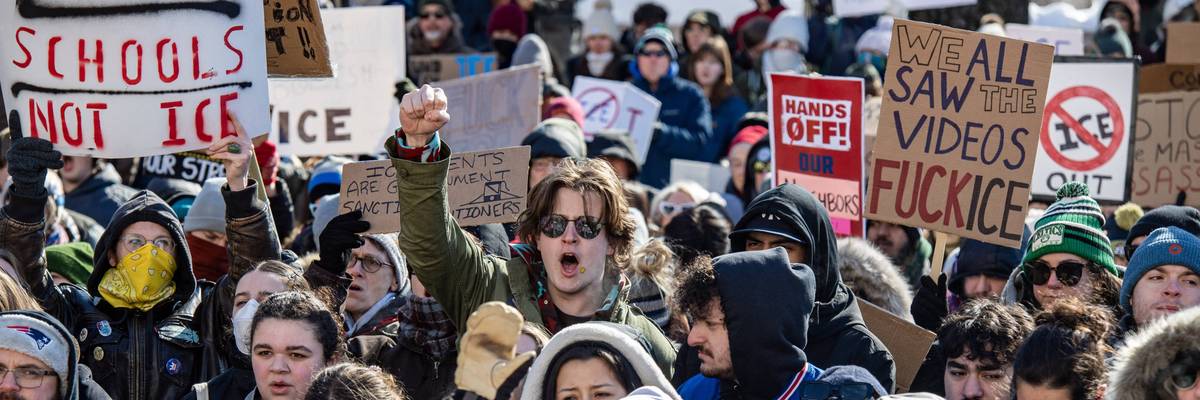
People participate in a protest against US Immigration and Customs Enforcement in front of the State House in Boston, Massachusetts on January 31, 2026. (Photo by Joseph Prezioso/AFP via Getty Images)

“I hope Amherst’s resolution kicks off a wave of similar resolutions in cities and towns across the state,” said the measure’s lead sponsor.

The town council of Amherst, Massachusetts passed a resolution on Monday urging state and local officials to hold federal immigration agents accountable for violating the Commonwealth’s laws, a move that advocates hailed as a model for lawmakers across the United States.

The resolution—which says agents of Immigration and Customs Enforcement (ICE) and Customs and Border Protection (CBP) have “repeatedly committed acts of violence against Massachusetts residents”—passed with unanimous support from the nine councilors who participated in the vote.

RECOMMENDED…
US-IMMIGRATION-POLITICS-PROTEST

From Maine to Minnesota and Beyond, Tens of Thousands March to Demand ‘ICE Out!’

Federal Agents Descend On Minneapolis For Immigration Enforcement Operations

As Democrats Push for ICE ‘Reforms,’ a Judge Shows How Flagrantly the Agency Already Violates Law

“ICE’s illegal operations have impacted residents of Amherst and surrounding communities directly, and we know that when any of our neighbors have their rights stripped away, none of us can take those rights for granted,” Councilor Jill Brevik, the resolution’s lead sponsor, said in a statement following the vote. “Silence and complying in advance created the environment that has enabled ICE agents to commit crimes and human rights abuses.”

“As a result, it is critically important for our local and state-level leaders to speak loudly and take clear action to fight back and change course,” Brevik added. “The work doesn’t end here, and I look forward to staying engaged. And I hope Amherst’s resolution kicks off a wave of similar resolutions in cities and towns across the state.”

The resolution calls on Massachusetts Gov. Maura Healey, a Democrat, to “immediately cease all cooperation agreements with ICE,” pointing to specific actions by federal immigration agents that “may be crimes under Massachusetts law, including but not limited to assault and battery, kidnapping, violation of constitutional rights, and assault and battery for the purpose of intimidation, and conspiracy, which may involve senior federal officials” including President Donald Trump.

Among the incidents highlighted by the resolution is ICE’s 2025 abduction of Tufts University PhD student Rümeysa Öztürk, who was targeted for deportation for writing an op-ed criticizing the US-backed Israeli assault on Gaza. Last month, an immigration judge terminated removal proceedings against Öztürk.

The resolution also condemns ICE and CBP agents for “illegally kidnapping an 18-year old with no warrant and detaining him for a week with no access to showers or sufficient food in Worcester County; illegally kidnapping and assaulting a lawful permanent resident in Essex County, stealing his belongings, and threatening his legal status; assaulting a resident of Middlesex County, smashing his car’s windows and dragging him from it; detaining a first-year college student at Boston Logan Airport and forcing her out of the country in defiance of a court order; and repeatedly using unlawfully excessive force in encounters with Massachusetts resident.”

“When our constitutional rights, our civil liberties, and our very lives come under attack by Trump’s lawless agents, we need every public official to stand with the people to fight back,” Jeff Conant, an Amherst resident who helped organize support for the newly approved measure, said Monday. “This commonsense resolution by our town council should serve as a model for every town and city in the Commonwealth and across the nation.”

The resolution demands that state and local officials “take affirmative steps to protect” Massachusetts residents, including by:

  • Making a public statement confirming the principles that federal officials and agents are subject to state criminal jurisdiction;
  • Taking affirmative steps to collect evidence of criminal acts committed by federal agents, including through the creation and dissemination of an accessible online tool for citizens to submit evidence; and
  • Issuing guidelines to local law enforcement to preserve evidence, especially in cases of federal noncooperation with investigations, and beginning investigations where evidence indicates that a crime has been committed, regardless of the power or prestige of the federal officeholder who is suspected of committing said crime.

John Bonifaz, constitutional attorney and president of Free Speech For People—an advocacy group that helped draft the resolution—said that “state and local prosecutors in Massachusetts and across the country have a sworn duty to enforce state criminal laws against federal agents who commit crimes in their states.”

“There is no such thing as absolute immunity for federal ICE agents. While the Supremacy Clause of the Constitution allows federal agents to carry out their lawful duties across the country, they do not have immunity to commit murder, to kidnap, to commit assault and battery, and to engage in illegal detentions,” he continued. “Massachusetts Attorney General Andrea Campbell and district attorneys across Massachusetts must enforce state criminal laws against ICE agents for their unlawful actions in this state.”

Original article by Jake Johnson republished form Common Dreams under Creative Commons (CC BY-NC-ND 3.0). 

Orcas discuss Donald Trump and the killer apes' concept of democracy. Front Orca warns that Trump is crashing his country's economy and that everything he does he does for the fantastically wealthy.
Orcas discuss Donald Trump and the killer apes’ concept of democracy. Front Orca warns that Trump is crashing his country’s economy and that everything he does he does for the fantastically wealthy.
Donald Fuhrump says that Amerikkka doesn't bother with crimes or charges anymore, not being 100% Amerikkkan and opposing his real estate intentions is enough.
Donald Fuhrump says that Amerikkka doesn’t bother with crimes or charges anymore, not being 100% Amerikkkan and opposing his real estate intentions is enough.
Elon Musk urges you to be a Fascist like him, says that you can ignore facts and reality then.

Continue ReadingMassachusetts Town Passes Resolution Urging State to Hold ‘Lawless’ ICE Agents Accountable

In 41 US States, Richest 1% Pay Lower Tax Rates Than Everyone Else

Spread the love

Original article by JAKE JOHNSON republished from Common Dreams under Creative Commons (CC BY-NC-ND 3.0). 

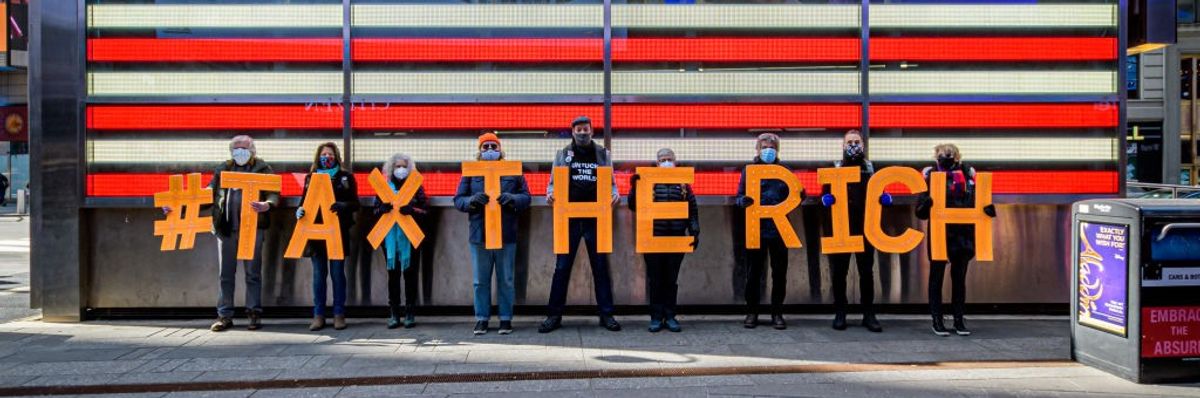
Protesters are pictured spelling out #TaxTheRich at Times Square on March 4, 2021. (Photo: Erik McGregor/LightRocket via Getty Images)

“Almost nobody says we should have the richest pay the least. And yet when we look around the country, the vast majority of states have tax systems that do just that.”

Nearly every state and local tax system in the U.S. is fueling the nation’s inequality crisis by forcing lower- and middle-class families to contribute a larger share of their incomes than their rich counterparts, according to a new study published Tuesday.

Titled Who Pays?, the analysis by the Institute on Taxation and Economic Policy (ITEP) examines in detail the tax systems of all 50 U.S. states, including the rates paid by different income segments.

In 41 states, ITEP found, the richest 1% are taxed at a lower rate than any other income group. Forty-six states tax the top 1% at a lower rate than middle-income families.

“When you ask people what they think a fair tax code looks like, almost nobody says we should have the richest pay the least,” said ITEP research director Carl Davis. “And yet when we look around the country, the vast majority of states have tax systems that do just that.”

“There’s an alarming gap here between what the public wants and what state lawmakers have delivered,” Davis added.

In recent years, dozens of states across the U.S. have launched what the Center on Budget and Policy Priorities recently called a “tax-cutting spree,” permanently slashing tax rates for corporations and the wealthy during a pandemic that saw billionaire wealth skyrocket and company profits soar.

A report released last week, as Common Dreamsreported, showed ultra-rich Americans are currently sitting on $8.5 trillion in untaxed assets.

According to ITEP’s new study, tax systems in just six states—California, Maine, Minnesota, New Jersey, New York, and Vermont—and the District of Columbia are progressive, helping to reduce the chasm between rich taxpayers and other residents.

Massachusetts, which has one of the more equitable tax systems in the nation, collected $1.5 billion in revenue last year thanks to its recently enacted millionaires tax, a measure that improved the state’s ranking by 10 spots in ITEP’s Tax Inequality Index. Minnesota has also ramped up its taxes on the rich over the past several years while expanding benefits for lower-income families, ITEP’s study observes.

“The regressive state tax laws we see today are a policy choice, and it’s clear there are better choices available to lawmakers.”

But the full picture of U.S. state and local systems is grim. In 44 states, tax laws “worsen income inequality by making incomes more unequal after collecting state and local taxes,” ITEP found.

Florida has the most regressive tax code in the U.S., with the richest 1% paying a mere 2.7% tax rate while the poorest 20% pay 13.2%.

Florida is among the U.S. states that don’t have personal income taxes, which forces them to rely on consumption and property taxes that are “nearly always regressive,” ITEP notes in the new analysis.

“Eight of the 10 most regressive tax systems—Florida, Washington, Tennessee, Nevada, South Dakota, Texas, Arkansas, and Louisiana—rely heavily on regressive sales and excise taxes,” the study says. “As a group, these eight states derive 52% of their tax revenue from these taxes, compared to the national average of 34%.”

Aidan Davis, ITEP’s state policy director, said that “we’ve seen a lot of states shift their tax systems to become even more regressive in recent years by enacting deep tax cuts for the wealthiest.”

The report points to Kentucky’s adoption of a flat tax and repeated corporate tax cuts, which “delivered the largest windfall to families in the upper part of the income scale and have been paid for in part through new or higher sales and excise taxes on a long list of items such as car repairs, parking, moving services, bowling, gym memberships, tobacco, vaping, pet care, and ride-share rides.”

Davis said that “we know it doesn’t have to be like this,” arguing there is a “clear path forward for flipping upside-down tax systems and we’ve seen a handful of states come pretty close to pulling it off.”

“The regressive state tax laws we see today are a policy choice,” said Davis, “and it’s clear there are better choices available to lawmakers.”

Original article by JAKE JOHNSON republished from Common Dreams under Creative Commons (CC BY-NC-ND 3.0). 

New Massachusetts ‘Tax the Rich’ Law Raises $1.5 Billion for Free School Lunch and More

1.4 Million Wealthy Americans Are Evading Nearly $66 Billion in Federal Taxes

With Funds Opposed by GOP, IRS to Target Ultrawealthy Tax Delinquents

The Lost Art (and Joy) of Taxing the Rich

300+ Economists, Millionaires, and Elected Officials to G20: ‘Tax Extreme Wealth’

Continue ReadingIn 41 US States, Richest 1% Pay Lower Tax Rates Than Everyone Else