Leeds May Day march. Photo: Neil Terry Photography
WORKERS rallied across Britain this weekend for May Day and International Workers’ Day in solidarity with all those in struggle for peace and justice, and in particular with their brothers and sisters in Palestine.
At Cardiff’s rally on Saturday — coinciding with World Press Freedom Day — the NUJ’s David Nicholson warned comrades that journalism was under attack at home and around the world, not least in Gaza and the West Bank.
“There were 1,000 journalists and media workers working in Gaza when Israel invaded in October 2023,” he said. “Almost 20 per cent have been killed by the Israeli military, with 171 dead and hundreds injured.
“This targeting of journalists is a war crime, and the NUJ and the International Federation of Journalists are building a case for the International Criminal Court.“
The Israeli government will not allow international journalists into Gaza — what have they got to hide,” he said.
UK Labour Party government Keir Starmer, Angela Rayner and Rachel Reeves explain that they are participants and complicit in Israel’s Gaza genocide providing Israel with army and air force support. They explain that they don’t do gas chambers but do do forced marches, starvation, destroy hospitals, mass-murders of journalists and healthcare workers.UK Foreign Minister David Lammy confirms that UK government and military are active participants in Israel’s genocides and that the F-35 parts that they suspended from supplying to Israel are instead simply diverted via the United States. He says see https://youtu.be/QILgUHrdWRE
Palestinians inspect the damage after an Israeli airstrike early this morning on Yaffa School, in Gaza City, April 23, 2025
MEDIA workers will gather outside the National Union of Journalists (NUJ) conference in Blackpool tomorrow to show support for their Palestinian colleagues and call on Israel to stop its troops targeting journalists.
Union members from across Britain and Ireland will read out the names of the more than 200 media workers killed in Palestine in the past 18 months, highlighting that journalists have been the “eyes and ears of the world as the tragic events there have unfolded daily.”
They are also calling for greater solidarity with workers “still putting their lives on the line every day to bring the world the news” from Gaza.The demonstration will also highlight journalists’ opposition to the ban on international media from entering Gaza to bear witness to the events there, “which is contributing to the suppression of information about what is happening.”
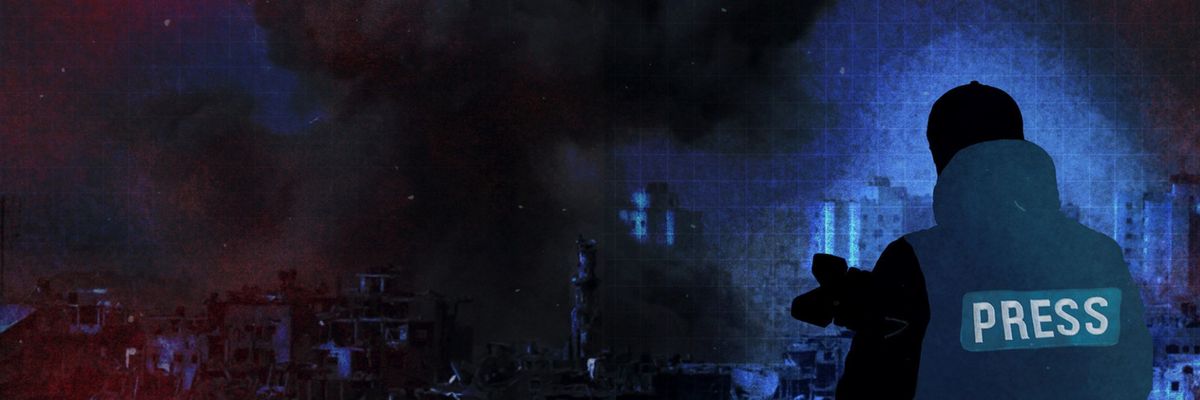
Forbidden Stories and its Gaza Project partners investigated Israel’s killing of journalists in Gaza and elsewhere. (Illustration: Forbidden Stories/The Gaza Project)
“This is one of the most flagrant attacks on press freedom that I can remember,” said one campaigner. “The impact on press freedom in Gaza, in the region, and the rest of the world is something we cannot accept.”
With more than 100 media professionals—nearly all of them Palestinian—killed in Gaza since October, a group of 50 reporters from 13 international organizations this week shared the results of a new investigative journalism initiative aimed at exposing the deadly toll Israel’s onslaught has taken on those reporting it to the world.
The Gaza Project—led by the Paris-based nonprofit Forbidden Stories—”analyzed nearly 100 cases of journalists and media workers killed in Gaza, as well as other cases in which members of the press have been allegedly targeted, threatened, or injured since October 7,” when Hamas-led attacks on Israel left more than 1,100 people dead and over 240 others kidnapped.
“Faced with what is being reported as the record number of journalists killed, Forbidden Stories, whose mission is to pursue the work of journalists who are killed because of their work, set out to investigate the targeting of journalists,” the group said
“For four months, Forbidden Stories and its partners investigated the circumstances of their killings, as well as those who have been targeted, threatened, and injured in the West Bank and Gaza,” it added. “These investigations point to a chilling pattern and suggest some journalists may have been targeted even though they were identifiable as press.”
🔴 How are Israeli drones killing journalists in Gaza?
Gaza Project member Committee to Protect Journalists (CPJ) has condemned what it called an “apparent pattern of targeting journalists and their families,” noting cases in which media workers were killed while wearing press insignia and after being threatened by Israeli officials.
“This is one of the most flagrant attacks on press freedom that I can remember,” CPJ program director Carlos Martínez de la Serna said of the ongoing war. “The impact on press freedom in Gaza, in the region, and the rest of the world is something we cannot accept.”
Basel Khair Al-Din, a Palestinian journalist in Gaza who believes he was targeted by a drone strike while wearing a press vest, said, “Whereas this press vest was supposed to identify and protect us, according to international laws, international conventions, and the Geneva Conventions, it is now a threat to us.”
“It’s this vest that almost got us killed, as has happened to so many of our fellow journalists and media workers,” he added.
Groups like Human Rights Watch (HRW) and Amnesty International have called for official investigations into Israeli killing of journalists including an October 13 attack that killed 37-year-old Lebanese Reuters videographer Issam Abdallah and wounded half a dozen other journalists who were covering cross-border clashes between Israeli troops and Hezbollah fighters in southern Lebanon.
Dylan Collins, an American deputy editor at Al Jazeera English, was wounded while administering first aid to Christina Assi, an Italian Agence-France Presse journalist whose legs were blown off in the attack.
Reuters determined that an Israeli tank crew “fired two shells in quick succession” at the journalists, who HRW said were “clearly identifiable as members of the media, and had been stationary for at least 75 minutes.” HRW “found no evidence of a military target near the journalists’ location.”
Amnesty International, meanwhile, asserted that the Israel Defense Forces (IDF) strike was “likely a direct attack on civilians that must be investigated as a war crime.”
Asa Kasher, the lead author of the IDF’s Code of Ethics, told Forbidden Stories that “no member of the press should have been killed under normal circumstances of hostilities in Gaza.”
“It shouldn’t happen, even a single one,” he added. “It’s illegal. It’s unethical. The person who does it should be brought to court.”
Israel’s alleged deliberate targeting of journalists is part of the evidence presented in a South Africa-led genocide case against Israel being reviewed by the International Court of Justice in The Hague.
Separately, the chief prosecutor at the International Criminal Court (ICC), also located in the Dutch city, is seeking arrest warrants for Israeli Prime Minister Benjamin Netanyahu, Israeli Defense Minister Yoav Gallant, and three Hamas leaders for alleged war crimes and crimes against humanity including extermination and forced starvation in the case of the Israelis and extermination, rape, and torture in the case of Hamas.
The international press freedom group Reporters Without Borders last month filed a third ICC complaint alleging “war crimes against journalists in Gaza.”
According to Palestinian and international officials, at least 37,718 Palestinians—mostly women and children—have been killed during Israel’s 264-day assault on Gaza, which has also left more than 86,300 people wounded and 11,000 others missing and feared dead and buried beneath the rubble of hundreds of thousands of homes and other bombed-out buildings.
Around 90% of Gaza’s 2.3 million people have also been forcibly displaced, and the Israeli siege on Gaza has caused widespread—and deadly—starvation and what the head of the United Nations food agency called a “full-blown famine” in northern parts of the strip.
Zionist Keir Starmes is quoted “I support Zionism without qualification.” He’s asked whether that means that he supports Zionism under all circumstances, whatever Zionists do.

 Leeds May Day march. Photo: Neil Terry Photography