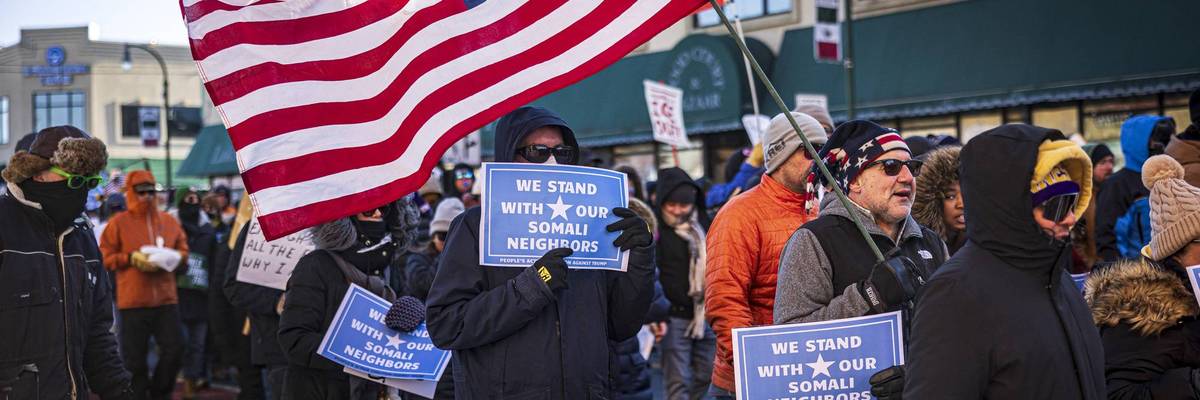
Protesters march during a rally calling for the removal of US Immigration and Customs Enforcement from Minnesota on December 20, 2025.(Photo by Kerem Yucel/AFP via Getty Images)
“I love my Somali friends and neighbors,” said one former Democratic official in the state. “If Trump tries to come for them, he needs to come through all of us.”
Fear is running high in Minnesota after President Donald Trump went on yet another racist tirade against the state’s Somali community on Thursday—this time verging into what was widely interpreted as a call for vigilante violence.
“The once Great State of Minnesota is being taken over by Somali Immigrants,” Trump wrote Thursday afternoon on Truth Social. “There is Violence, Murder, and Mayhem all over the State. The people of Minnesota must fight back.”
Trump raged against Democratic Gov. Tim Walz, whom he described as an “incompetent thief who doesn’t want to get involved,” and seemed to suggest that if ordinary Minnesotans took matters into their own hands, they’d have the blessing of the federal government.
“The Somalians [sic] should not be allowed to get away with what they are doing,” Trump said. “They view you as weak and stupid people. Fight back, Minnesota, fight back! If you need, the Federal Government will come to your rescue.”
Trump is trying to start a race war in Minnesota: "The once Great State of Minnesota is being taken over by Somali Immigrants. There is Violence, Murder, and Mayhem all over the State. The people of Minnesota must fight back. You have been robbed, and abandoned by your State… pic.twitter.com/YbNmJDBMFg
It’s hardly the first time Trump has slurred Somali immigrants. He’s previously referred to them as “garbage,” “very low-IQ people,” and “pirates,” and said they should all be deported from the country.
But Trump’s comments on Thursday went a step further than that, leaving community members on edge about the possibility that they could instigate violent attacks by his supporters.
“President Trump is placing a target on the backs of Somali Americans,” said Jaylani Hussein, the executive director of the Council on American-Islamic Relations in Minnesota, in a statement. “His words are not simply political rhetoric. They are a dangerous invitation to hatred and potentially violence.”
“Minnesota has led the nation in attacks on mosques, including fire-bombings,” he said. “We know firsthand what happens when hateful rhetoric turns into violence.”
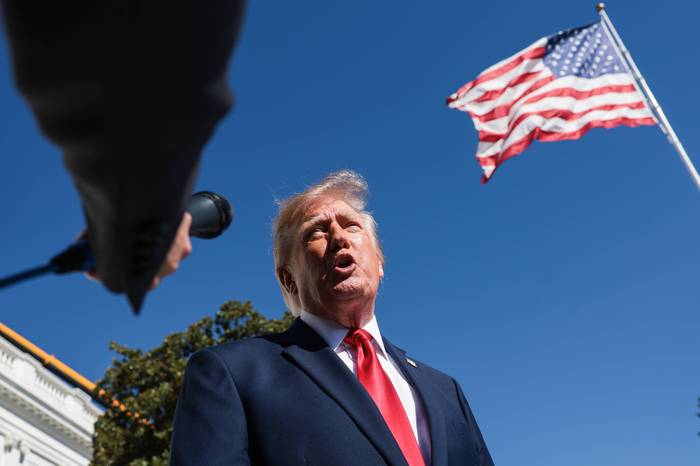
President Donald Trump speaks to reporters before boarding Marine One on the South Lawn of the White House on October 7, 2026 in Washington, DC. (Photo by Anna Moneymaker/Getty Images)
Faisa Ahmed, a Somali American political organizer and senior adviser to the reelection campaign of Minnesota Attorney General Keith Ellison, said unease ran deep in her home city of Minneapolis on Thursday night.
“Every Somali I know is walking through our own neighborhoods scared tonight,” she said.
“The president just told Minnesotans to ‘fight back’ against Somalis by name,” she added. “This is incitement, and everyone should call it that.”
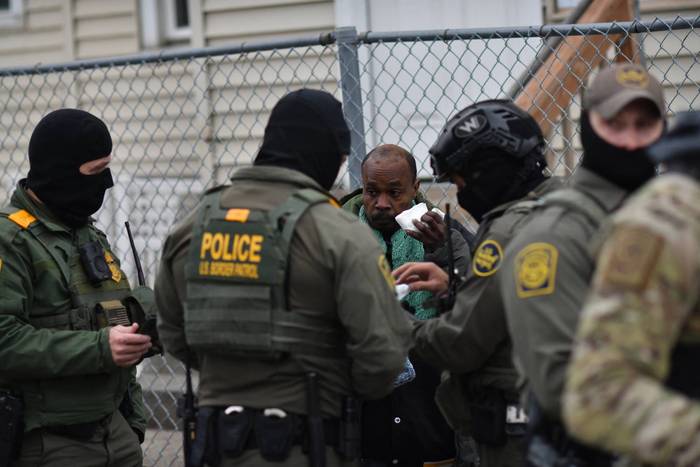
Though most of them are US citizens, Somalis were aggressively targeted when thousands of immigration agents descended on Minnesota during Trump’s Operation Metro Surge earlier this year.
US Border Patrol agents detain an unidentified man of Somali descent in Minneapolis, Minnesota, on January 8, 2026. (Photo by Octavio Jones/AFP via Getty Images)
Ellison, who has sued the administration for civil rights violations and pushed for agents to be investigated under state law, said he would not let this happen again.
“We’ve seen what Trump’s government coming to the ‘rescue’ looks like,” he wrote on social media Thursday. “It ended with two Minnesotans shot dead by federal agents, racial profiling, assaults, and the violation of our rights.”
“Never again. If Trump tries, I’ll drag him back to court,” he said. “Somali Minnesotans are our neighbors. They are part of Minnesota. And the Minnesota I know and love is so much better than this bigotry.”
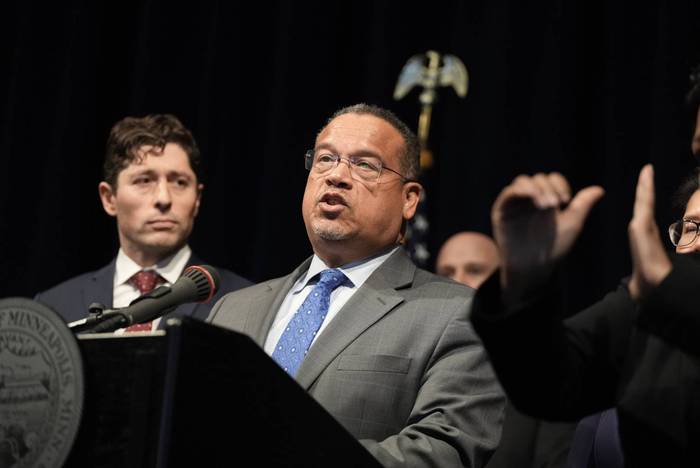
Minnesota Attorney General Keith Ellison, along with Minneapolis Mayor Jacob Frey, announced a lawsuit against the Trump administration’s deployment of ICE agents to the Twin Cities during a press conference at Minneapolis City Hall on Monday, January 12, 2026. (Photo by Richard Tsong-Taatarii/The Minnesota Star Tribune via Getty Images)
With less than a month to go before the midterm elections, Minnesota Republicans have sought to harness bigotry against Somalis to rally support.
Democratic candidate Doug Chapin, who is trying to unseat Republican House Majority Whip Tom Emmer in Minnesota’s 6th district, put it plainly during an event on Thursday night.
“I’ll call it what it is,” Chapin said. “The president is trying to foment a race war here in Minnesota.”
Minnesota CD6 Congressional candidate Doug Chapin says “the president is trying to foment a race war here in Minnesota.”
Doug says @tomemmer’s statement that “Somali Americans should be treated as enemy combatants and jailed” is beyond the pale and we deserve better in Congress. pic.twitter.com/gymFUEyTOy
But as the violent rhetoric has ramped back up, so have expressions of solidarity from community members who have called it out as a cynical political tactic.
“This is KGB-style fear-mongering before an election. Trump’s terrified he’s going to lose the House and Senate and get impeached,” said Mike Norton, the former vice chair of the Democratic Farmer-Labor Party in Minneapolis.
“I love my Somali friends and neighbors. They make Minnesota a better place,” Norton said. “If Trump tries to come for them, he needs to come through all of us.”
Elon Musk urges you to be a Fascist like him, says that you can ignore facts and reality then.Orcas discuss Donald Trump and the killer apes’ concept of democracy. Front Orca warns that Trump is crashing his country’s economy and that everything he does he does for the fantastically wealthy.
This work by Middle East Monitor is licensed under a Creative Commons Attribution-NonCommercial-ShareAlike 4.0 International License.
The United States Capitol building is seen in Washington DC, United States on April 22, 2026, [Celal Güneş – Anadolu Agency]
Foreign policy is rarely the principal factor shaping how Americans vote in congressional primaries or midterm elections. The 2026 cycle, however, appears to be different, as crises abroad increasingly spill over into concerns at home. The issues emphasised by Republican and Democratic candidates, the results of the primaries and shifts in public opinion suggest that Iran and the Palestinian question have emerged as additional factors in the domestic political contest. Iran has entered the electoral calculus through the economic costs of the war and majority opposition to military action, while the Palestinian issue has gained salience amid a discernible shift in American attitudes towards Israel and the Palestinians. These developments could influence the outcome of November’s midterms, against a backdrop of falling approval of the administration’s foreign policy and a growing Democratic lead in congressional polling.
The war with Iran shows this most clearly. Its repercussions have spread beyond foreign policy into the economy and the cost of living, the issues that weigh most heavily on American voters. The effects of the US-Israeli war on Iran have fed through into energy prices, inflation and interest rates in the United States, while consumer confidence has fallen to its lowest level. Public opposition is also substantial: 60 per cent of voters opposed US military action against Iran in a Quinnipiac poll conducted in July, and only 29 per cent approved of Trump’s handling of Iran in a Reuters/Ipsos poll in June.
Attitudes towards Israelis and Palestinians point to a notable shift in American public opinion, one that is increasingly reflected in the positions of the candidates of both parties and in the electoral mood. For nearly two decades, Gallup polling showed a wide and persistent sympathy gap in favour of the Israelis, exceeding 40 percentage points in many years and averaging 43 points between 2001 and 2018.
That gap had begun to narrow even before 7 October 2023, particularly among Democrats and younger Americans. In February 2023, Gallup found that, for the first time, Democrats sympathised more with the Palestinians than with the Israelis. The war in Gaza, however, accelerated and deepened that trend. The change has not been confined to Democrats. Movement within the Republican electorate, historically the constituency most sympathetic to Israel, has also contributed to the broader evolution of American opinion. Republicans still sympathise overwhelmingly with the Israelis, but that advantage has begun to erode. Gallup found that Republican sympathy for the Israelis had fallen by 10 percentage points since 2024, to its lowest level. More striking still is the emerging generational divide: among Republicans under 30, Pew found favourable views of the Israeli and Palestinian peoples almost evenly matched, at 42 and 40 per cent respectively. The most consequential movement, however, has come among independents. In 2025, they sympathised more with the Israelis than with the Palestinians by 42 to 34 per cent; a year later, that balance had reversed to 41 per cent for the Palestinians and 30 for the Israelis, a swing Gallup identifies as the principal driver of the latest change in public opinion. The trajectory across the three political groups underscores how far this realignment broadened during the war.
Between 2023 and 2026, Gallup recorded an increase in sympathy for the Palestinians from 49 to 65 per cent among Democrats, from 32 to 41 per cent among independents and, more modestly, from 11 to 13 per cent among Republicans.
The scale of the movement varied considerably across the partisan spectrum, but its consistent direction suggests that the war marked an important inflection point in a process already under way. Taken together, these trends indicate that the latest change is neither sudden nor transitory, but part of a deeper and more gradual realignment in American public opinion attitudes. Against this backdrop, Gallup’s finding in February this year that 41 per cent of Americans sympathised more with the Palestinians, compared with 36 per cent who sympathised more with the Israelis, appears less an isolated polling result than the culmination of a longer-term trend cutting across the country’s partisan divide.
The change is not confined to sympathy. It is increasingly extending to the terms of the US relationship with Israel itself, and particularly to whether American military and financial support should remain as extensive and as largely unconditional as it has traditionally been. A Quinnipiac University poll conducted between 18 and 22 June found that 48 per cent of registered voters considered the United States too supportive of Israel, the highest proportion since the question was first asked in 2017. That sentiment has begun to find expression in Congress. In April, 40 of the 47 members of the Senate Democratic caucus voted to block a $295 million sale of bulldozers to Israel, while 36 opposed a $151.8 million sale of 1,000-pound bombs. The votes marked a significant expansion of Democratic support for placing limits on arms transfers to Israel and reflected a widening gap between the two parties over the terms of US support. Within the Republican coalition, the change is more limited, but potentially significant. Support for Israel remains dominant within the party, yet an increasingly visible America First current on the right has begun to question whether extensive US military commitments to Israel serve American interests.
Tucker Carlson has become one of the most prominent voices articulating that argument, accusing the Republican establishment of placing Israel’s security ahead of America’s. Such arguments remain far from commanding the Republican mainstream, but their growing visibility, particularly alongside weakening support for Israel among younger Republicans, suggests that a debate once concentrated largely within the Democratic Party is beginning to reach parts of the American right as well.
The 2026 congressional primaries offer an early indication of how these shifts may play out in November, both in the issues candidates chose to emphasise and in the results themselves. According to Ballotpedia, 2,497 candidates ran in congressional primaries covering 468 seats: all 435 in the House of Representatives and 33 in the Senate. With two special Senate elections in Ohio and Florida, 470 congressional seats are being contested this year. Of those running, 2,232 sought House seats, the highest number since 2014, while 265 competed for the Senate, the third-highest figure over the same period. The cycle also featured 547 competitive primaries: 272 Democratic, 209 Republican and 66 conducted under the “top-two” system, in which parties do not hold separate primaries. Instead, all candidates appear on a single ballot, and the two who receive the highest votes advance to the general election regardless of party affiliation.
In the 2024 congressional primaries, the MAGA wing accounted for 43 per cent of Republican winners, compared with 40 per cent for traditional conservatives and 11 per cent for moderates, according to Brookings. On the Democratic side, the mainstream wing, the party’s dominant force, accounted for 67 per cent of winners, while progressives made up 30 per cent and democratic socialists remained marginal.
With no comprehensive breakdown of the balance of forces within either party yet available following the primaries, concluded in mid-September 2026, Brookings offers partial results that allow for a comparison between the two cycles. Its analysis is confined to the most competitive contests in 33 House districts and 10 Senate races, covering a total of 300 candidates.
Among Republicans, MAGA candidates won only around 26.7 per cent of the competitive races, while more than 92 per cent of Trump-endorsed candidates prevailed. Around half of those endorsed by Trump, however, were incumbents, giving them an inherent advantage in seeking re-election. Even with that qualification, Trump-backed candidates recorded a markedly higher success rate than MAGA candidates across these swing races.
Among Democrats, progressives won only 17.8 per cent of competitive races, while democratic socialists remained marginal, broadly in line with their showing in 2024. Yet other analyses suggest that progressives’ success rates were close to those of previous cycles, and that more progressive candidates won. The wing also registered notable victories, among them those of candidates endorsed by Zohran Mamdani in New York. An important caveat is that the 2026 figures measure each faction’s success rate in competitive races, rather than its share of all winners, as the 2024 figures do. They therefore offer an indication of the broader direction of travel, not a definitive numerical comparison between the two cycles.
These results point to a pattern among Democratic winners whose campaigns centred on issues of particular concern to their constituencies, rather than necessarily signalling an ideological shift to the left. More broadly, across the most competitive districts and states in 2026, the outcomes in both parties show an advantage for their mainstream, less ideological wings, reflecting the premium placed on general-election viability and the ability to reach voters beyond each party’s ideological core.
The issues on which the winners of the latest primaries campaigned offer an important measure of each party’s voter priorities, as well as a guide to what may matter most in the coming midterms. Republican candidates were more supportive of Israel than their Democratic counterparts, and less so of military and economic assistance to Ukraine.
Among Republicans, immigration, security and the border featured more prominently. Only 23.5 per cent of those running in swing or contested states defended the administration’s record on the economy and the cost of living, while none acknowledged shortcomings in its handling of these issues. Healthcare went unaddressed by roughly half of the party’s candidates, and most of those who did discuss it focused on containing spending. In competitive races in swing states, success was associated with a combination of Trump’s endorsement, electability and the avoidance of ideological positions that might narrow a candidate’s broader electoral appeal.
Among Democrats, the economy and the cost of living came to the fore, with affordability emerging as the overriding economic concern. Around 56 per cent of Democratic candidates addressed inflation, most using it to criticise the Trump administration’s record, while 94 per cent made healthcare an issue in their campaigns. In competitive districts, no candidate embraced an “open borders” policy or called for defunding the police, and many steered clear of more divisive positions, including on transgender issues. On immigration, the small number who took more conservative stances performed well. In safe Democratic seats with competitive primaries, progressive candidates backed by Zohran Mamdani defeated their rivals with a more left-wing message centred on economic inequality, immigration, the Palestinian question and higher taxes on the wealthy. The results underscored how the issues that decide a party primary can vary with the electoral character of the district.
Trump’s endorsement emerged as a powerful factor in Republican candidates’ performance, while the economy, the cost of living and healthcare featured prominently in Democratic messaging. Across both parties, candidates in competitive races sought to balance the issues that mobilise their party base with the need to appeal to swing voters.
Pew polling in 2026 shows a clear divide between Republican and Democratic priorities on illegal immigration, security and crime. In a Reuters/Ipsos poll conducted this month, 79 per cent of Republicans approved of Trump’s handling of immigration, revealing a marked gap between the Republican base and the public at large. Among Americans overall, only 36 per cent approved of his immigration policy and 55 per cent disapproved. Democratic priorities, according to Pew, are more heavily concentrated on the cost of living, healthcare, gun violence and climate, while only 17 per cent of Democrats regarded illegal immigration as a very big problem. Yet the economy, the cost of living and healthcare are concerns that extend well beyond Democratic voters. On healthcare policy, Democrats held a clear advantage over Republicans, 42 per cent to 28 per cent, and also led on climate, abortion and education, positions that broadly align with public opinion. Republicans, by contrast, led clearly on crime and more narrowly on immigration.
This alignment may help explain the broader electoral mood, which in recent months has tilted towards the Democratic Party ahead of the midterms. A Reuters/Ipsos poll in the middle of this month put Democrats at 44 per cent, against 37 per cent for Republicans. In 37 swing House districts, a Cook Political Report poll conducted in September found Democrats ahead by 49 per cent to 47 per cent. Trump had carried these districts collectively in 2024. In a separate poll, his approval rating fell to 32 per cent.
The seven Senate races rated Toss Up by the Cook Political Report are in Alaska, Iowa, Maine, Michigan, New Hampshire, Ohio and Texas, with Republicans currently holding five of those seats. The balance of the Senate stands at 53 Republicans and 45 Democrats, alongside two independents who caucus with the Democrats. This leaves Republicans defending more of the most competitive seats at a time when late-September polling shows Democrats ahead in several swing races. The battle for the Senate has therefore become more competitive, although current polling is not sufficient to determine which party will hold the chamber after the elections.
Domestic concerns nevertheless continue to carry greater electoral weight. Seventy per cent of voters said the cost of living was important to their vote in House elections, compared with 59 per cent for healthcare, 57 per cent for immigration and 41 per cent for the Israeli-Palestinian conflict, according to a national Quinnipiac University poll released on 24 June 2026.
The polling therefore does not suggest that foreign policy has displaced the economy as a principal determinant of electoral outcomes. It does, however, show that Iran and the Palestinian question have become factors whose impact on these elections can no longer be overlooked.
The views expressed in this article belong to the author and do not necessarily reflect the editorial policy of Middle East Monitor.
This work by Middle East Monitor is licensed under a Creative Commons Attribution-NonCommercial-ShareAlike 4.0 International License.
Orcas discuss rotting brain, front Orca says he wishes someone would lock him up, small Orca speaks bluntly.
Donald Trump sings and dances, says that it’s fun to kill everyone … unless he gets distracted or falls asleep.Climate science denier Donald Trump confirms that he knows nothing about democracy and that more liquid gold is being secured according to his policy of global privateering.
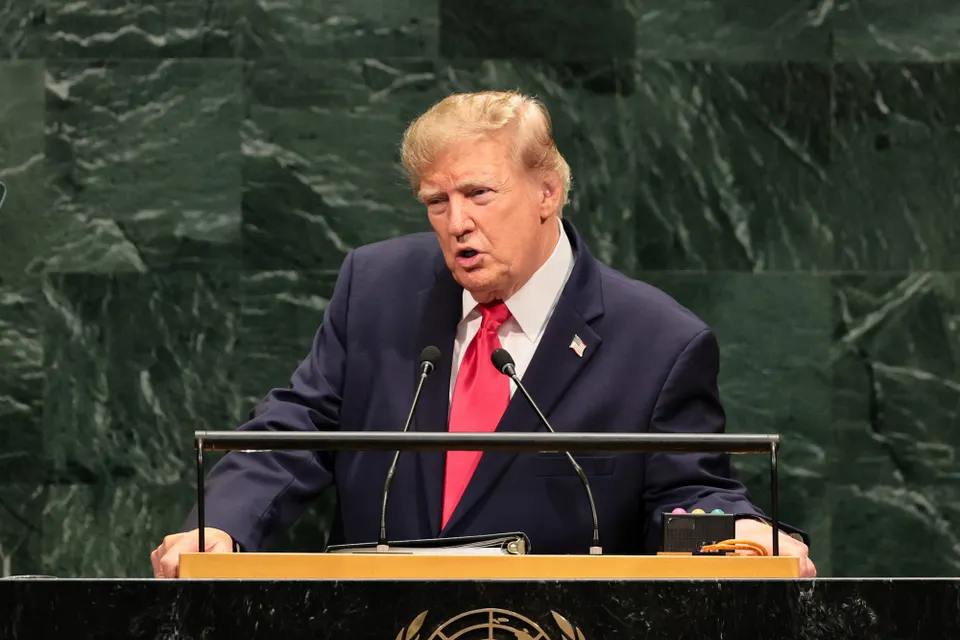
Donald Trump speaks at U.N. General Assembly | Michael M. Santiago/Getty Images)
Depleted missiles abroad and armed fortresses at home reveal a president running out of options as midterms loom
While Donald Trump has long dismissed any bad news about his war on Iran as lies dreamed up by a woke media, this faces a persistent problem: the checks and balances built into the US system cannot be so easily dismissed.
The Congressional Budget Office (CBO), for example, reports not to the White House but directly to Congress. To make matters even less palatable, when it comes to military issues, media outlets are apt to report major CBO reports at length.
A recent example was the Military Times’ detailed coverageof the CBO’s report on the cost of US combat operations in Iran up to mid-September – $38bn – and the vexed issue of the US’s huge usage of specialist munitions, especially ballistic missile interceptors, which can be far more expensive than the missiles they are designed to destroy. Helpfully – unless you’re in the White House – the publication also directly linked readers to the CBO report itself.
As the Military Times summarised: “CBO estimates the conflict has consumed between one-half and two-thirds of the US inventory of certain missile-defence interceptors since June 2025, leaving the military with fewer weapons available for a future conflict. Rebuilding those stocks could take at least five years, even if production rates increase, the agency found.”
One implication is thatany talk by Trump or his secretary of war, Pete Hegseth, of a potential further bombing assault on Iran is hardly plausible, as Iran would simply expand its targeting of US military and communications facilities across the region. This would further deplete the Pentagon’s limited stocks of defensive missiles, leaving US and allied states across the Middle East at risk.
There, he said the choice for Iran was to make a deal right after the midterm elections or for him to “annihilate the Islamic Republic and do it quickly, never giving them a chance to kill and destroy people and countries again”.
Even for Trump, it was a remarkable threat – accept my deal or I will destroy you – but it is easy to put it down as typical of the rhetoric he espouses. Yet there is much more to it than that. For a start, choosing the General Assembly’s autumn meeting, which has a high attendance of heads of state, as the audience for this statement suggests Trump sees the UN as part of the problem, a hindrance that limits global recognition of his own greatness.
Recognition of such greatness is also an important factor in his determination to build a massive triumphal arch in Washington. That proposal, which was supposedly to celebrate 250 years of US independence, is now undergoing a subtle change of design and purpose.
Until this week, the plan came under the aegis of the US National Park Service, and was comparable to existing arches around the world, such as the Arc de Triomphe in Paris. Grandiose, certainly, and no doubt intended to be seen as one of the great achievements of the greatest president ever, but intended only for show. Now, though the plans are currently being redrawn to serve a military purpose, as reported once again by the Military Times.
Writing on social media, Trump said he has “agreed to turn the arch into a top-grade Military Complex/Triumphal Arch, to house, store, and have the rapid ability to use large numbers of drones, plus Snipers, on both the roof and plaza areas, and additionally have and hold large quantities of sniper ammunition in storage”.
Unless Trump believes the United States is at risk of a sudden mass invasion from Iran, North Korea or even Cuba (or perhaps all three together), the only way his plan makes a weird kind of sense is if he thinks Washington faces a severe internal security challenge amounting to a civil war, given the arch will cover one of the main routes into the city.
At first sight, that seems over the top, but ‘the threat from within’ has been a persistent feature of the Trump worldview. It explains the emphasis on closing the border with Mexico, the extensive use of armed ICE agents and the frequent deployment of National Guard troops in large cities, including Washington, often in opposition to the state governors.
Where this is all relevant is that Trump is in trouble in the polls and may lose Congress in the forthcoming midterms, and possibly even the Senate. If that is worrying Trump, it is also a huge concern for his many seriously wealthy and powerful supporters – after all, 2028 is already looming uncomfortably large in their political calendar.
In this context, it is fair to say there are two possibilities for what comes next. One is that the US and the wider worldsurvive the next two years without catastrophe, a tolerably fair presidential election takes place in 2028, Trump leaves office, and a more moderate president is elected. The process of creating a post-Trump polity then proceeds at pace as the US recovers something of its good sense and international standing. Within a couple of years, the world sees Trump as being by far the worst and most dangerous occupant of the White House in history.
This may be the hope of many millions of people in the US and beyond, but don’t count on it. For all his unpredictability, Trump is very good news for an entrenched and monied core of supporters who are determined to thrive in the years ahead. By normalising many extreme positions, Trump is playing a very useful preparatory role, just as Hegseth is engaged in the key task of ridding the Pentagon’s senior military of the merest hint of wokery.
Far from the end of the game, if the midterm elections go badly for the Republicans, efforts will simply be redoubled to ensure that the rich and powerful prevail once more in 2028.
Orcas discuss Donald Trump and the killer apes’ concept of democracy. Front Orca warns that Trump is crashing his country’s economy and that everything he does he does for the fantastically wealthy.Climate science denier Donald Trump confirms that he knows nothing about democracy and that more liquid gold is being secured according to his policy of global privateering.Orcas discuss rotting brain, front Orca says he wishes someone would Lock Him Up, small Orca says he thinks that his meds have been changed.
This work by Middle East Monitor is licensed under a Creative Commons Attribution-NonCommercial-ShareAlike 4.0 International License.
U.S. President Donald Trump speaks to members of the press before boarding Marine One on the South Lawn of the White House in Washington, United States, on May 12, 2026. [Kyle Mazza – Anadolu Agency]
Most US voters say their finances have worsened since President Donald Trump returned to the White House, with less than three months to go before the November midterm elections, according to a Financial Times poll, Anadolu reports.
The Focaldata poll found that 53% of registered voters felt worse off under Trump, including nearly 57% of independents and almost one-quarter of Republicans. Nearly two-thirds said the US economy was moving in the wrong direction, while just 25% said it was heading in the right direction.
Voters also gave Democrats an advantage over Republicans on inflation and the cost of living, as well as jobs and the economy. Trump’s approval rating on inflation and living costs was particularly weak, with 64% disapproving, including nearly seven in 10 independents and about one-third of Republicans.
Overall, 55% disapproved of Trump’s performance, while his net approval among Republicans fell 8 percentage points from the previous month.
Democrats led Republicans 44% to 39% when voters were asked which party they were likely to support in November. Polls have indicated that Democrats are positioned to regain control of the House, while taking the Senate remains more difficult.
The findings come as inflation, high prices and declining consumer sentiment weigh on Americans. Inflation stood at 3.4% in July, while government data showed real wages declined last month.
White House spokesperson Kush Desai defended Trump’s record, saying, “The Trump administration continues to deliver on the President’s affordability agenda by lowering drug prices, reshoring American jobs, and cutting taxes while simultaneously touting a historic drop in violent crime nationwide and the most secure border in history.”
The online poll was conducted by London-based, nonpartisan Focaldata from Aug. 7 to 10 among 1,913 registered voters, with a margin of error of plus or minus 2.9 percentage points.
Orcas discuss Donald Trump and the killer apes’ concept of democracy. Front Orca warns that Trump is crashing his country’s economy and that everything he does he does for the fantastically wealthy.‘joking’. Orcas discuss rotting brain, front Orca says Sundown Syndrome is a dead givaway and he wishes someone would Lock Him Up