Tag: Militarization

  • Italian government to deploy troops to Milan after anti-austerity protests

    Spread the love

    Article by Ana Vračar republished from Break Through News under a Creative Commons Attribution-ShareAlike 4.0 (CC BY-SA) license.

    Roughly 400,000 students participated in mobilizations against policies imposed by Giorgia Meloni’s administration. Source: OSA/Facebook

    Giorgia Meloni’s government announced the deployment of 500 military troops to Milan following a weekend of mobilization against austerity measures.

    Giorgia Meloni’s administration has announced the deployment of 500 military troops to Milan after a weekend of intense protests and riots resulted in broken windows at luxury shops. 

    But while mainstream coverage has focused on exclusive brands hiding inventory from angry demonstrators, progressive organizations emphasize that the rage witnessed on the streets of several northern Italian cities is a result of the government’s own policies.

    “A Louis Vuitton bag can cost €5,600, while the monthly maximum for the wage guarantee fund in 2026 is €1,340,” wrote the grassroots union Unione Sindacale di Base (USB). In a statement on Tuesday, the union cited devastating national statistics, including data showing that over 14% of working-class families live in absolute poverty.

    Broken windows can be repaired, USB noted. “Five years of lost wages, an impoverished family, and a denied future cannot be recovered so easily.”

    Students oppose austerity at school and beyond

    Significant mobilizations preceded the weekend’s protests. On Friday, October 16, roughly 400,000 students flooded the streets for “No Meloni Day”. They criticized the government’s so-called securitization measures which in practice has meant stifling the right to protest, as well as the unabated turn toward war and armament.

    Protesters warned that by prioritizing these points over public services and working conditions, Meloni and her ministers knowingly undermine the future of a whole generation. 

    Read more: Curfews imposed in French cities as rebellion against austerity grows nationwide

    Echoing developments in France, where teachers’ unions have supported students’ demands over recent weeks of historic struggle for a stronger public education system, educators in Italy began circulating appeals to do the same.

    “The established order is the worst of all possible worlds – or comes very close to it – and our schools are a mirror of this: they are falling apart, alienating, militarized,” the appeal reads. “Places where the need to stretch one’s legs is labeled ‘indiscipline,’ and where the ‘foreigner’ is blamed for the decline in knowledge, rather than two decades of underfunding and neglect.”

    Real solutions, not repression, needed to address social crisis

    Trade unions, teachers, and students all denounced the repression authorities unleashed in response to the protests – both after mobilizations in cities and during school occupations. 

    “This government – incapable of offering solutions to the social crisis raging across the country – is once again attempting to manage the streets and social discontent solely through the lens of ‘public order,’ while intensifying repression and shrinking the space available for political activity,” emphasized youth organization Cambiare Rotta.

    Students opposed the governments focus on militarization Source Cambiare RottaFacebook

    Teachers specifically called upon others in the system not to endorse crackdowns on students while invoking democratic values. “Democracy today resists in the French and Spanish squares, in the occupied Italian schools, in the resistance to the genocide of the Palestinian people, in the words and deeds of those who oppose the piecemeal world war,” they wrote.

    “It is not to be found in threats, in tear gas, in police officers inside schools, or in students maimed by the weapons of our law enforcement. It is not to be found in the unjust rules that too many persist in defending.”

    Read more: Mediterranean dockworkers launch historic international strike

    The increased protest activity has given hope that the spark that inspired massive mobilizations throughout 2025 might resurface. It comes less than two weeks before a new general strike – and an international dockworkers’ strike in which Italian port workers are set to play a notable role – on October 30.

    Article by Ana Vračar republished from Break Through News under a Creative Commons Attribution-ShareAlike 4.0 (CC BY-SA) license.

  • Trump’s Venezuela Drug War Gambit and the Militarization Playbook at Home

    Spread the love

    This article by Michelle Ellner republished from Common Dreams under Creative Commons (CC BY-NC-ND 3.0).

    National Guard troops are deployed to the Washington Monument as part of US President Donald Trump’s mobilization of law enforcement on August 12, 2025 in Washington, DC. (Photo by Andrew Leyden/Getty Images)

    Whether it’s a wall in the desert or barricades in front of the White House, the message is the same: Perceived threats, real or manufactured, are met with troops, not talks.

    US President Donald Trump has quietly authorized the Pentagon to carry out military operations against what his administration calls “narco-terrorist” networks in Latin America. On paper, it’s a counter-narcotics policy. In practice, it serves as a green light for open-ended US military action abroad, bypassing congressional approval, sidestepping international law, and stretching the definition of “national security” until it becomes a catchall justification for the use of force.

    The directive allows the US to target groups unilaterally labeled as both criminal and terrorist. Once that designation is made, the military can operate without the consent of the targeted country, a move that violates international law. In a region with a long history of US-backed coups, covert wars, and destabilization campaigns, the risk of abuse isn’t hypothetical; it’s inevitable.

    While the order applies across Latin America, Venezuela stands at the top of the list. The Trump administration has accused President Nicolás Maduro’s government of working with transnational cartels, and has doubled the bounty on him to $50 million (double the bounty for Osama bin Laden). It’s a lawfare tactic designed to criminalize a head of state and invite mercenaries and covert operatives to participate in regime change. The accusations fueling this escalation have grown increasingly far-fetched casting Maduro in turn as a partner of Colombia’s FARC, the head of the “Cartel de los Soles,” a patron of Venezuela’s Tren de Aragua, and now, as an ally of Mexico’s Sinaloa Cartel. a charge even Mexico’s own president says has no evidence, revealing how politicized and unfounded this allegation is.

    The core premise of the accusation is that Maduro is involved in a cocaine trafficking network of Venezuelan military and political figures called Cartel de los Soles. The Venezuelan government denies the cartel’s existence, calling it a fabrication to justify sanctions and regime change efforts. Multiple independent investigations have shown no hard evidence exists and that this narrative thrives in a media-intelligence echo chamber. Reports from outlets like Insight Crime cite anonymous US sources; those media stories are then cited by policymakers and think tanks, and the cycle repeats until speculation becomes policy.

    The communities in Caracas and Los Angeles, in the Venezuelan plains, and in the US-Mexico border may seem worlds apart, but they are facing the same war machine.

    Fulton Armstrong, a professor at American University and a former longtime US intelligence officer, has stated that he knows no one in the intelligence community, apart from those currently in government, who believes in the existence of the Cartel de los Soles.

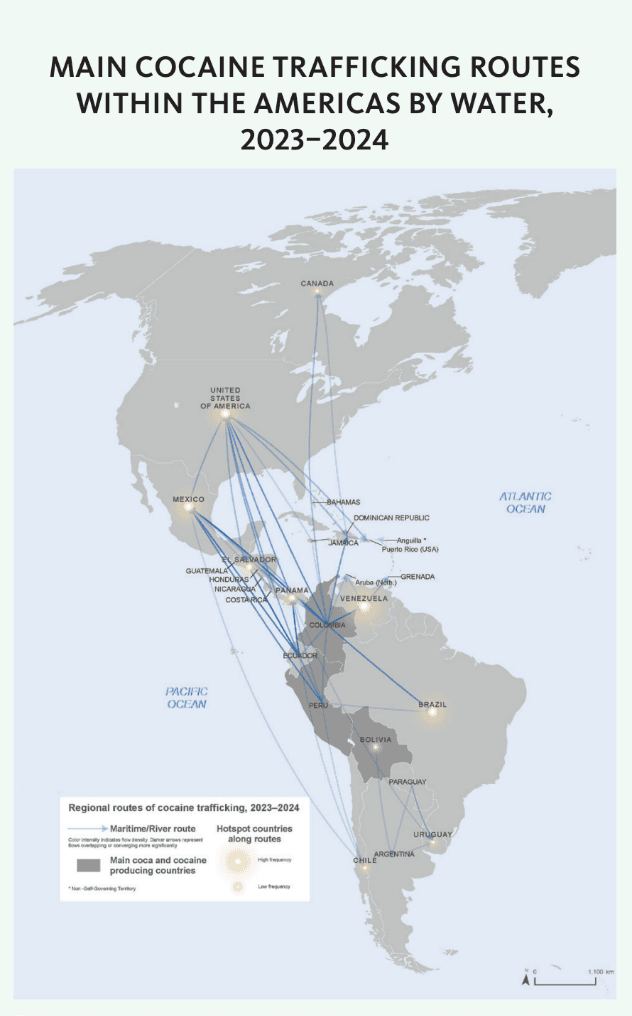
    Drug monitoring data also contradict this narrative. The Washington Office on Latin America (WOLA) reports that only about 7% of US-bound cocaine transits through the Eastern Caribbean via Venezuela, while approximately 90% takes Western Caribbean and Eastern Pacific routes. The United Nations Office on Drugs and Crime’s 2025 World Drug Report likewise confirms that trafficking remains concentrated in major Andean corridors, not through Venezuela. Yet Venezuela is targeted anyway, not for its actual role in the drug trade, but because neutralizing its government has become a pillar of US foreign policy, seen in Washington as a step toward reshaping the country’s political system and prying open its economy to foreign control.

    The “narco-terror” label put on Venezuela also attempts to rope Venezuela into the US fentanyl crisis, despite the absence of evidence that the country plays any role in fentanyl trafficking. Even US drug enforcement assessments make no mention of Venezuela as a source or transit point.

    This link exists only in political rhetoric, a way to fold Venezuela into a domestic public health crisis and recycle the same logic used to brand it a “national security threat.” That accusation dates back to 2015 when then-President Barack Obama created the legal and political scaffolding for an open-ended campaign of coercion. Once the “narco-terror” framework is in place, Washington can sustain and escalate military measures over time, regardless of the immediate pretext.

    This framing turns a political standoff into a declared security imperative. It broadens the range of permissible military tools, from ISR (intelligence, surveillance, reconnaissance) to direct action.

    The pattern is familiar. In Panama (1989), Colombia (2000s), and Honduras (2010s), US militarized antidrug campaigns failed to dismantle supply chains or reduce trafficking volumes. What they did accomplish was shifting routes, militarizing criminal actors, and destabilizing governments, and left societies more fragile—costing lives and destroying communities in the process.

    The Mirror at Home: Militarization and Communities of Color

    The same militarized logic driving US policy in Venezuela is being applied inside the United States. In August 2025, President Trump signed an executive order placing the DC Metropolitan Police Department under federal control and deployed the National Guard, citing a public safety “emergency,” despite official data showing violent crime at multiyear lows. Even US law enforcement statistics contradict the White House narrative, but the administration dismissed them, casting the city as overrun by “roving mobs,” “wild youth,” and “drugged-out maniacs.”

    DC is only one example. The same militarized logic has sent thousands of troops to the US-Mexico border, converted military bases into detention centers from Texas to New Jersey, and stationed soldiers inside Immigration and Customs Enforcement detention facilities in over 20 states. In Los Angeles, Marines and National Guard units patrolled immigrant neighborhoods in a show of force, a deployment beaten back only by mass community resistance and the threat of labor action.

    Whether it’s a wall in the desert or barricades in front of the White House, the message is the same: Perceived threats, real or manufactured, are met with troops, not talks. The playbook never changes: In Venezuela, the “threat” is cast as narco-terrorism; in the US, it’s a “border surge” or a manufactured public safety emergency built on racially coded depictions of Black and brown communities. In both cases, the logic is identical: Treat political disputes and social crises as security emergencies, sideline diplomacy and community solutions, usurp greater executive powers, and make military force a routine tool of governance.

    The Real Threat

    Trump’s “narco-terror” authorization uses the language of fighting drugs and crime to mask a deeper project: expanding the military’s role in governance and normalizing its use as a tool of political control both at home and abroad.

    In Latin America, that means more interventions against governments the US wants to topple. At home, it means embedding the military deeper into civilian life, particularly in Black and brown neighborhoods.

    The communities in Caracas and Los Angeles, in the Venezuelan plains, and in the US-Mexico border may seem worlds apart, but they are facing the same war machine. Until we reject militarization in all its forms, the targets will keep shifting, but the people under the gun will look the same.

    This article by Michelle Ellner republished from Common Dreams under Creative Commons (CC BY-NC-ND 3.0).