Tag: Monsanto

  • ‘A National Outrage’: Days After Monsanto Ruling, Trump EPA Approves More Forever Chemical Pesticides

    Spread the love

    Article by Jessica Corbett republished from Common Dreams under Creative Commons (CC BY-NC-ND 3.0).
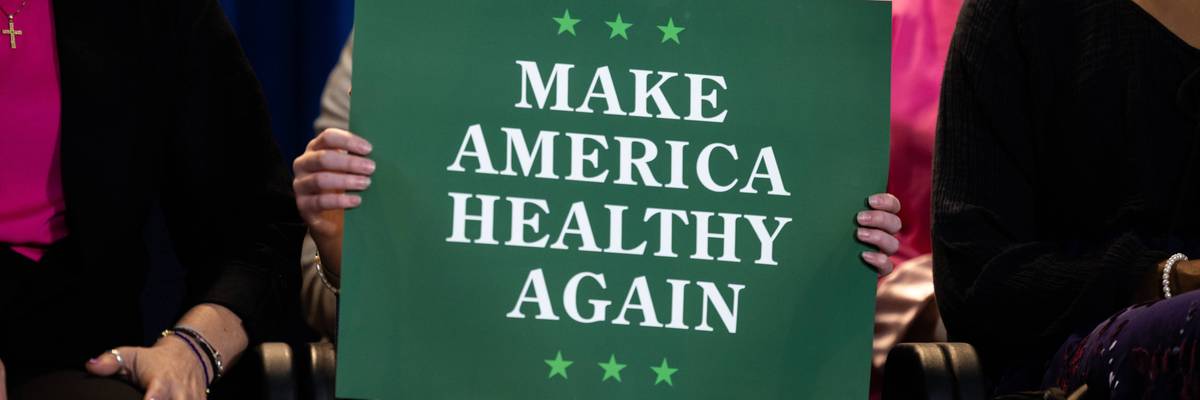
    Supporters of the Make America Healthy Again movement are seen at a news conference at the Department of Health and Human Services headquarters in Washington, DC on April 22, 2025. (Photo by Nathan Posner/Anadolu via Getty Images)

    Ripping “Trump’s reckless push to ignore science and embrace these extremely harmful, long-lasting pesticides,” one critic said his legacy will be the millions “his shortsighted policies will sicken and prematurely kill.”

    The US Environmental Protection Agency on Tuesday continued its betrayal of President Donald Trump’s campaign promise to “Make America Healthy Again,” approving the use of multiple “forever chemical” pesticides on crops despite public health concerns.

    Per- and polyfluoroalkyl substances (PFAS) are called forever chemicals because they don’t naturally break down—instead accumulating in human and animal bodies as well as the environment. They have been used in everything from fabrics for clothing and furniture to firefighting foam to nonstick cookware, and are tied to various health problems, including increased risk of some cancers.

    RECOMMENDED…
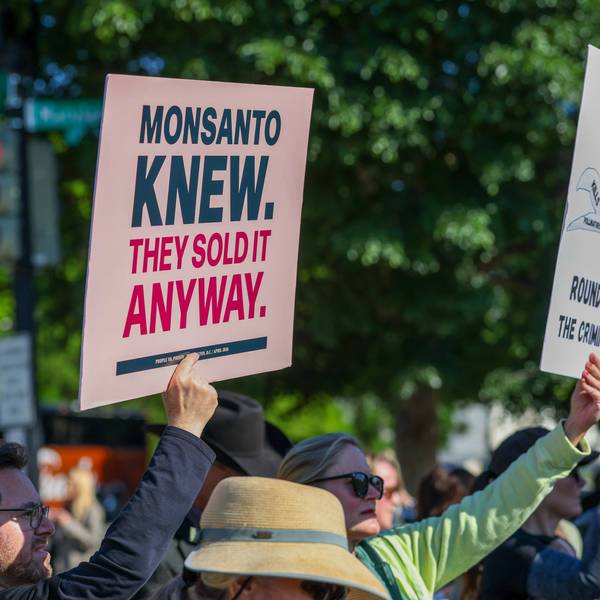
    Rally Held As Supreme Court Hears Arguments For Monsanto v. Durnell

    ‘Trump’s Name Written All Over It’: Supreme Court Sides With Monsanto Over Roundup Cancer Victims

    Zohran Mamdani jumps into a public pool

    As Trump’s Reflecting Pool Disaster Turns ‘Dystopian,’ Fully-Dressed Mamdani Jumps Into NYC Public Pool With a Joyful Smile

    The Trump EPA on Tuesday finalized its approval of using two PFAS pesticides, diflufenican and epyrifenacil, on corn and soybeans, the two most widely grown crops in the United States.

    The agency also expanded its allowances for another previously approved forever chemical pesticide, bifenthrin, and greenlighted the first food use of chlormequat, a non-PFAS pesticide tied to reproductive issues.

    “While the Biden administration had approved one PFAS pesticide in the prior four years, this is the third and fourth approval of a PFAS pesticide under Trump in just his second year in office,” the Center for Biological Diversity (CBD) noted in a Tuesday statement. “The previous two PFAS pesticide approvals were cyclobutrifluram and isocycloseram.”

    As the center detailed:

    The EPA has stated in press materials that these new fluorinated pesticides are not PFAS. That assertion is based on the fact that they do not meet the chemicals office’s unilateral regulatory PFAS definition. But the new pesticides do meet the much more widely accepted PFAS definition that was developed transparently by dozens of scientists around the world. That definition has subsequently been endorsed by more than 150 leading PFAS researchers, is used by nearly every US state for regulating PFAS, and specifically was written into past versions of the National Defense Authorization Act.

    Using the scientific definition of a PFAS that is widely accepted in this country and around the world, these pesticides are PFAS.

    The EPA had even initially acknowledged that these pesticides met the more broadly accepted PFAS definition on its fluorinated pesticides webpage. Yet three weeks after creating the webpage, it removed any mention of the conflicting definition, instead portraying the agency’s unilateral definition as the only PFAS definition.

    Under the Freedom of Information Act, CBD obtained documents showing that those website revisions were overseen by EPA Office of Chemical Safety and Pollution Prevention’s assistant administrator, Douglas Troutman, and Kyle Kunkler—a former American Soybean Association (ASA) lobbyist controversially installed as the office’s deputy assistant administrator for pesticides—and reviewed by agency Administrator Lee Zeldin.

    While ASA president and Ohio soybean farmer Scott Metzger welcomed the Tuesday approvals, saying that “we appreciate EPA Administrator Lee Zeldin and the agency” for advancing the registrations, Nathan Donley, CBD’s environmental health science director, was deeply critical and tied the developments to the Trump administration’s other actions serving the pesticide industry.

    “It’s a national outrage that Trump’s EPA is expanding use of dangerous, cancer-linked PFAS pesticides just days after the Supreme Court limited the American people’s right to sue pesticide companies,” said Donley, referring to last week’s ruling in favor of Monsanto and against thousands of people who argue that its glyphosate-based weedkiller Roundup caused their cancer.

    In addition to the Trump administration backing Bayer—which bought Monsanto in 2018—in the case before the high court, the president in February issued an executive order mandating the production of glyphosate. Since returning to office last year, Trump has also faced criticism for EPA approvals of other pesticides, from atrazine to dicamba, and for his administration’s MAHA report that echoes industry talking points.

    Donley declared Tuesday that “Trump’s reckless push to ignore science and embrace these extremely harmful, long-lasting pesticides ensures his legacy won’t be the many monuments he’s built to himself, but the many millions of people his shortsighted policies will sicken and prematurely kill.”

    Article by Jessica Corbett republished from Common Dreams under Creative Commons (CC BY-NC-ND 3.0).

    Orcas discuss rotting brain, front Orca says disinhibition and swearing are typical and common symptoms
    Orcas discuss rotting brain, front Orca says disinhibition and swearing are typical and common symptoms
  • ‘This Is Absurd’: Major Banks Continue to Fund Climate Chaos in Global South

    Spread the love

    Original article by OLIVIA ROSANE republished from Common Dreams under Creative Commons (CC BY-NC-ND 3.0). 

    ActionAid found that since the Paris agreement, banks have funded the largest Big Ag companies doing business in the Global South to the tune of $370 billion and the fossil fuel sector to the tune of $3.2 trillion.

    Since the international community promised to limit global heating to 1.5°C above preindustrial levels, the world’s major banks have funneled 20 times more money to climate-polluting industries in the Global South than Global North governments have given those same countries to address the climate emergency.

    That’s just one of the findings of How the Finance Flows: The Banks Fueling the Climate Crisis, an ActionAid report released Monday.

    “This report names the biggest offenders in the banking world and calls on them to see that they are destroying the planet, while harming the present and future for their children,” Ugandan climate activist Vanessa Nakate wrote in the foreword. “It’s time to hold financial institutions to account, and demand that they end their funding of destructive activity.”

    https://twitter.com/vanessa_vash/status/1698683769710952796?ref_src=twsrc%5Etfw%7Ctwcamp%5Etweetembed%7Ctwterm%5E1698683769710952796%7Ctwgr%5E21ba57345d6aeb813133d6ed52f516caddebf1a7%7Ctwcon%5Es1_c10&ref_url=https%3A%2F%2Fwww.commondreams.org%2Fnews%2Fbanks-fund-climate-chaos

    The report focuses on the financing of two major climate-heating industries in the 134 nations of the Global South: fossil fuels and industrial agriculture.

    “People generally know that fossil fuels are the number one cause of greenhouse gas emissions. But what is less understood is that industrial agriculture is actually the second biggest cause of climate emissions,” Teresa Anderson, the global lead on climate justice at ActionAid International, said during a press briefing ahead of the report’s release.

    This is because of the sector’s link to deforestation, as well as the emissions required to produce industrial fertilizers, she added.

    In total, since the 2015 Paris agreement, banks have funded the largest Big Ag companies doing business in the Global South to the tune of $370 billion and the oil, gas, and coal sectors to the tune of $3.2 trillion.

    “Global banks often make public declarations that they are addressing climate change, but the scale of their continued support of fossil fuels and industrial agriculture is simply staggering.”

    The top three banks that invested the most in these sectors were the Industrial and Commercial Bank of China at $154.3 billion, China CITIC Bank at $134.7 billion, and the Bank of China at $125.9 billion. Citigroup came in fourth at $104.5 billion, followed by HSBC at $80.8 billion.

    While China features prominently in the report as the world’s largest economy, Anderson noted that much of what it produces ends up purchased by consumers in the Global North.

    The top three banks in the Americas funding big agriculture and fossil fuels were Citigroup, JPMorgan Chase, and Bank of America. While Citigroup was the leading regional funder of fossil fuels, JP Morgan Chase gave the most to industrial agriculture.

    In Europe, the top funders after HSBC were BNP Paribas, Société Générale, and Barclays, while Mitsubishi UFJ Financial rounded out the top Asian funders.

    Where is all that money going? When it comes to agriculture, the leading recipient was Bayer, which bought out Monsanto in 2018. Banks have given it $20.6 billion to do business in the Global South since 2016.

    Much of the fossil fuel money went to China’s State Power Investment Corporation and other Chinese companies; commodities trader Trafigura; and the usual fossil fuel suspects like ExxonMobil, BP, Shell, Saudi Aramco, and Petrobras.

    “This is absurd,” Anderson said of the findings. “Global banks often make public declarations that they are addressing climate change, but the scale of their continued support of fossil fuels and industrial agriculture is simply staggering.”

    ActionAid called the report the “flagship” document of its Fund Our Future campaign to redirect global money from climate crisis causes to climate solutions. The report calls on banks to make good on their climate promises and stop funding fossil fuels and deforestation, as well as to put additional safeguards in place to protect the rights of local communities, raise the ambition of their goals to reach “real zero” emissions, and improve transparency and other measures to make sure the projects they fund are behaving ethically.

    “This can be stopped,” Farah Kabir, the country director of ActionAid Bangladesh, said during the press briefing. “The banks cannot continue to fund fossil fuel industries and industrial agriculture.”

    In addition, the report offers recommendations to Global North governments to ensure a just transition to a sustainable future for everyone. These included setting stricter regulations for the banking, fossil fuel, and agricultural industries as well as ending public subsidies for these sectors and channeling the money to positive solutions like renewable energy and agroecology.

    However, the form that funds take when sent to the Global South makes a big difference, said ActionAid USA executive director Niranjali Amerasinghe. Instead of coming in the form of private loans, it needs to be in the form of public money.

    “Providing more loans to countries that are already in significant debt distress is not going to support their transition to a climate-compatible future,” she said.

    One reason that loans are counterproductive is that nations that accept them are forced to provide a return on investment, and currently the main industries that offer this are in fact fossil fuels and industrial agriculture.

    In addition to public funds, debt forgiveness or restructuring and new taxes could also help these countries with their green transition. If companies like Exxon or Bayer doing business in the Global South “were taxed in an equitable way, that would allow those governments to raise public revenue that can then be used to support climate action,” Amerasinghe said.

    In particular, the report emphasizes agroecology as a climate solution that should be funded in Global South countries.

    “Climate change is real in Zambia.”

    Mary Sakala, a frontline smallholder farmer from Zambia, spoke at the press briefing about how the climate crisis and current agricultural policy put a strain on her community.

    “Climate change is real in Zambia,” she said, adding that it had brought flooding, droughts, pests, and diseases that meant that “families currently, as I’m speaking right now, sleep on an empty stomach.”

    Sakala saw hope in agroecology, which would help with food security and resilience, and make farmers less dependent on the government and large companies.

    “We need policies to allow [us] to conserve our environment in a cultural way, to help us eat our food,” Sakala said. “We want… every seed to be utilized and saved and shared in solidarity.”

    And she said that the companies and governments of the Global North have a duty to help them get there.

    “Those people who are continuing to pollute and let the climate change increase, those people need to pay us, because we are suffering from the things that others are doing,” she said.

    Original article by OLIVIA ROSANE republished from Common Dreams under Creative Commons (CC BY-NC-ND 3.0).