Fuel taxes would rise, whilst parking spaces would be steadily reduced and frequent driving tests mandated in accordance with the plans.
New plans from the Green Party show measures to significantly reduce motorway speed limits from 70mph down to just 55mph.
The move has sparked criticism from the Conservatives, who said Green leader Zack Polanski is waging a “war on drivers”.
Other Green Party measures proposed for motorists would see taxes on driving “increased incrementally”, whilst parking spaces would be “steadily reduced” to discourage their use.
According to reports, drivers would also be expected to re-take their driving test every five years, with driving considered “not a right, but a privilege”.
The reported plans would see speed limits on motorways and dual carriageways reduced to 55mph, down from their current 70mph. Picture: Alamy
The official Green Party transport policy reads: “On major roads outside built up areas, the maximum speed limit allowed would be 55mph, to maximise the efficiency of fuel use as well as improving safety.”
They add that the speed limits on motorways and dual carriageways would be dropped by 15mph, and 20mph limits would be imposed on all built up areas.
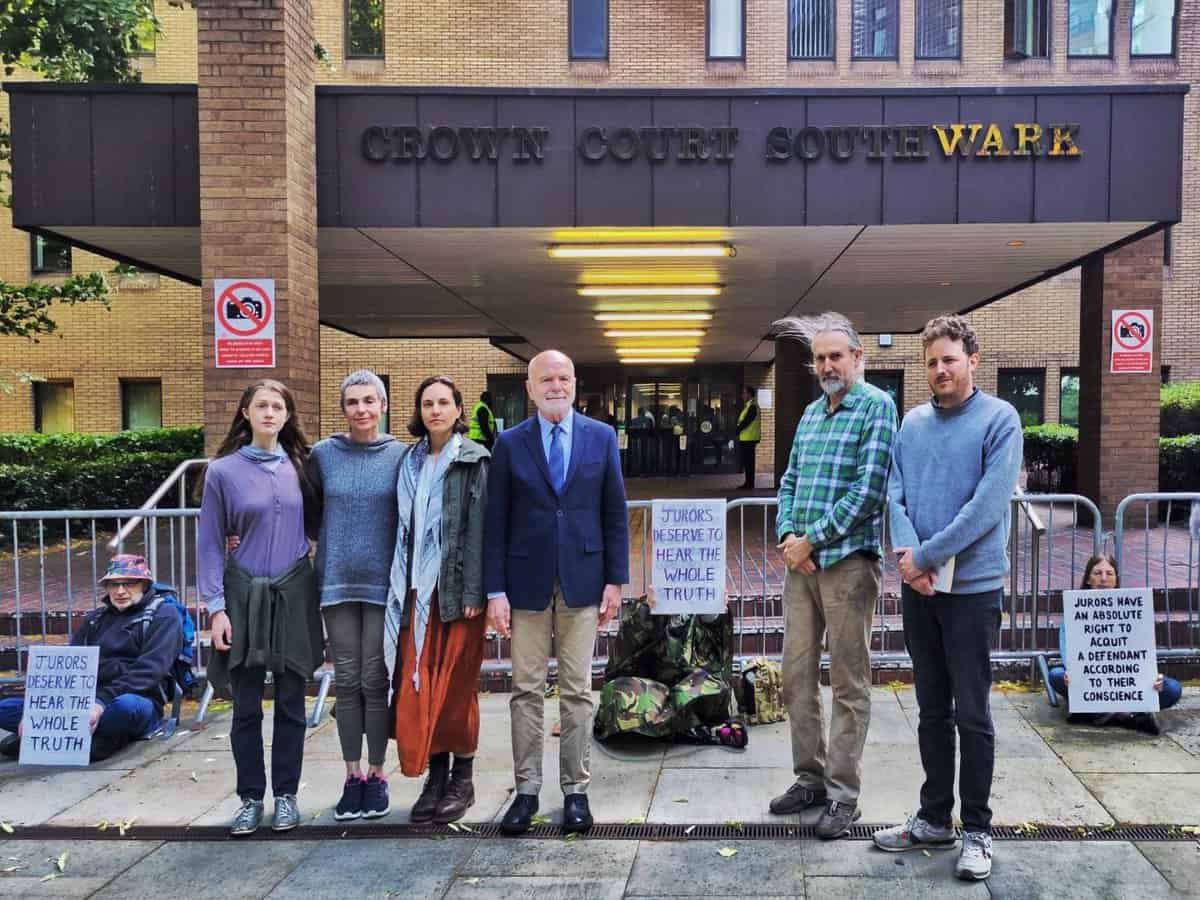
UN Special Rapporteur on Environmental Defenders under the Aarhus Convention Michel Forst attended the trial of five Just Stop Oil supporters at Southwark Crown Court. He attended as an observer because of his serious concerns.
For planning to block a motorway encircling London, five Just Stop Oil activists were recently sentenced to a minimum of four years in prison.
Just Stop Oil wants to end the extraction and burning of coal, oil and gas in the UK by 2030. The group’s demands are consistent with what scientists have said is necessary to limit climate change. The same scientific advice underpins international agreements the UK has signed.
Just Stop Oil’s methods, which include stopping traffic by sitting on roads, are also peaceful. So why are its members facing a long stretch behind bars?
Such a severe sentence for non-violent protest has “no equivalent in modern times” according to Graeme Hayes and Steven Cammiss. Hayes is a reader in political sociology at Aston University while Cammiss teaches law at the University of Birmingham. Both have sat in on several high-profile climate protest cases.
Protesters facing prosecution in England and Wales were once partially protected by what’s known as Hoffman’s bargain. This maintained that the state would show restraint and offer lenient sentences to non-violent protesters deemed to be acting proportionately. Last week’s ruling seems to show that this meagre allowance is now dead.
Just Stop Oil has vowed to continue its campaign of disruptive protest.
The Court of Appeal reaffirmed that Hoffman’s bargain should apply to such cases in 2021 with a ruling that exonerated the Stansted 15, protesters who obstructed a Home Office deportation flight in 2017. However, the court rejected the Stansted 15’s “necessity defence”, the argument that they were obliged to do what they did to avoid a greater harm. This precedent has been upheld in subsequent cases, including climate protest trials.
Conspiracy to cause public nuisance, which the Just Stop Oil five were found guilty of, is a relatively new offence (introduced in the Police, Crime, Sentencing and Courts Act 2022) that carries a maximum prison term of ten years. People who feel compelled to take part in disruptive protest due to the existential threat of climate change risk a decade in jail without being able to explain their actions to a jury.
“The legal philosopher Antony Duff suggests that criminal cases are a means of holding fellow citizens to account for their behaviour,” Hayes and Cammiss say.
“A trial fails in this regard if it doesn’t let defendants account for their behaviour in ways that are meaningful to them.”
UK anti-protest law is now so restrictive that even minor concessions seem like major victories. Retired social worker Trudi Warner was cleared of contempt of court in April for holding a placard outside London’s Old Bailey, affirming the right of juries to acquit based on their conscience. The result was lauded as a “huge win for democracy” by civil liberty campaigners.
The reality is far from comforting and should in fact trouble everyone, says Emily Barritt, a senior lecturer in environmental law at King’s College London:
“Punishing protesters won’t solve the problems that they are highlighting. Lethal air, filthy rivers, collapsing food chains, the climate crisis – these problems will all continue unabated, and soon become much more inconvenient than having to get off the bus to walk the last mile to work.”
Roads are sacred, the climate less so
Should the right of motorists to travel unimpeded take precedence over a collective demand for a liveable climate? Whatever most people think, the archetypal “angry motorist” is a constituency which Britain’s political elite appear eager to woo.
Labour proclaimed itself the only party “truly on the side of drivers” at the recent election, fending off an accusation from the Conservative party that Keir Starmer had “declared war on motorists across Britain”.
Matthew Paterson, a professor of international politics at the University of Manchester, sees this as a strategy of the political right to remain relevant as the climate crisis unfolds – a bet that the public will baulk at the necessary disruption of decarbonisation.
Yet channelling Britain’s road rage did not prevent an electoral wipeout for Rishi Sunak and the Conservatives. Rebecca Willis, a professor in energy and climate governance at Lancaster University, was unsurprised.
Action on climate change commands broad public support in the UK. Dave Head/Shutterstock
“The Conservatives’ private polling must have confirmed what public opinion research has consistently told us: there are vanishingly few votes to be won through an agenda of delaying action on climate change,” she says.
Hayes and Cammiss also note the result of a snap poll which showed 61% of respondents considered the record jail sentences for the five Just Stop Oil activists too harsh.
Public consent for the UK’s crackdown on peaceful protest cannot be taken for granted. Even so, Oscar Berglund, a researcher in political economy at the University of Bristol, expects more and longer prison sentences for protesters.
“These are political sentences and climate activists [have] become political prisoners,” he wrote via email.
“Removing the politics of climate change from the courtroom doesn’t change that.”
The Conversation would like to thank our readers and subscribers for their continued support after Imagine won best science newsletter of the year at the Publisher Newsletter Awards.
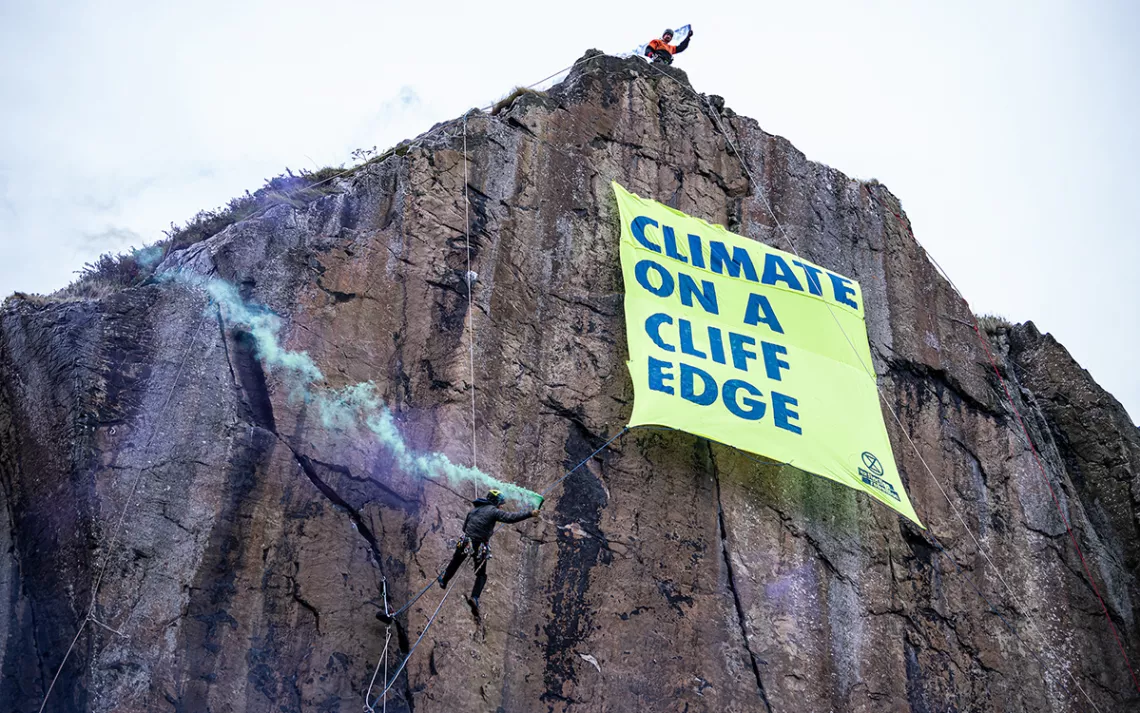
Experienced climbers scale a rock face near the historic Dumbarton castle in Glasgow, releasing a banner that reads “Climate on a Cliff Edge.” One activist, dressed as a globe, symbolically looms near the edge, while another plays the bagpipes on the shores below. | Photo courtesy of Extinction Rebellion and Mark Richards