Original article by Jessica Corbett republished from Common Dreams under Creative Commons (CC BY-NC-ND 3.0).
“We’ve got to work fast to end fossil fuel operations near our homes, schools, and hospitals and trade fossil fuel infrastructure for healthy, clean energy,” said one co-author.
“The evidence is clear that fossil fuels—and the fossil fuel industry and its enablers—are driving a multitude of interlinked crises that jeopardize the breadth and stability of life on Earth.”
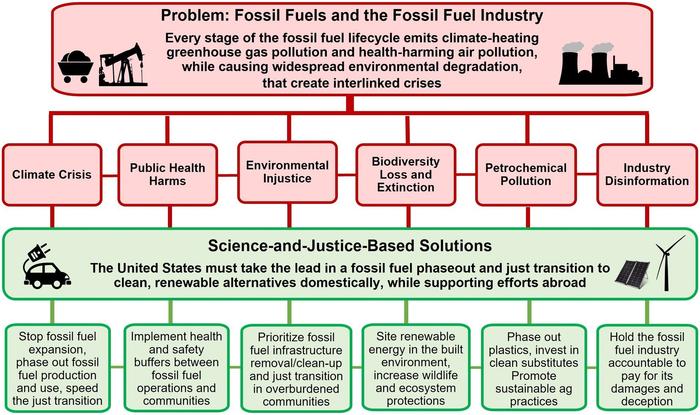
That’s the first line of the abstract for an article published Monday by top scientists who reviewed “the vast scientific evidence showing that fossil fuels and the fossil fuel industry are the root cause of the climate crisis, harm public health, worsen environmental injustice, accelerate biodiversity extinction, and fuel the petrochemical pollution crisis.”
The new paper in the peer-reviewed journal Oxford Open Climate Change highlights the diverse impacts of “every stage of the fossil fuel life cycle” and stresses that the “industry has obscured and concealed this evidence through a decadeslong, multibillion-dollar disinformation campaign aimed at blocking action to phase out” its deadly products.
“The fossil fuel industry has spent decades misleading us about the harms of their products and working to prevent meaningful climate action,” said co-author Naomi Oreskes, professor of the history of science at Harvard University, in a statement. “Perversely, our governments continue to give out hundreds of billions of dollars in subsidies to this damaging industry. It is past time that stops.”
“The most polluted communities should be prioritized for clean energy investments and removal and cleanup of dirty fossil fuel infrastructure.”
While the researchers focused on the United States, “as the world’s largest oil and gas producer and dominant contributor to these fossil fuel crises,” their review—including proposed “science-and-justice-based solutions” for an economywide effort to “forge a path forward to sustaining life on Earth”—applies to the whole world, which is quickly heating up due to emissions from coal, gas, and oil.
The article features sections on the fossil fuel-driven climate crisis, public health harms, environmental injustice, biodiversity loss and extinction, petrochemical pollution, and industry disinformation. Each section lays out the “problem” and “solutions.”
The climate emergency section includes details such as “the production and combustion of oil, gas, and coal are responsible for nearly 90% of human-caused carbon dioxide (CO2) emissions and approximately 79% of total greenhouse gas emissions,” and “failures in political will to implement necessary climate action have made the 1.5°C benchmark nearly impossible to achieve without overshoot,” referring to a primary goal of the 2015 Paris agreement.
Although the current U.S. administration has demonstrated its alliance to the fossil fuel industry—including with President Donald Trump’s recent energy emergency declaration—the scientists still emphasized what’s possible in the country.
“In the USA, powerful policy levers are available to governments and civil society at the local, state, national, and international levels to phase out fossil fuels and transition to a clean, renewable energy economy,” they wrote. “These levers include regulation (e.g. applying and enforcing existing laws), legislation (e.g. polluters pay laws, fossil fuel subsidy reform, land use laws limiting drilling), and litigation (e.g. holding fossil fuel companies accountable, defending existing law).”
They also warned that “last-ditch efforts to prolong the fossil fuel industry are proliferating. These include counterproductive false solutions, like carbon capture and storage (CCS), which would perpetuate fossil fuel use while capturing only some of the resulting emissions, and hydrogen made from fossil fuels.”
The public health section notes that “air pollution from fossil fuel combustion accounts for 8.7 million (equaling 1 in 5) premature deaths per year worldwide and 350,000 premature deaths per year in the USA. In a single year, air pollution from oil and gas production in the USA resulted in 410,000 asthma exacerbations, 2,200 new cases of childhood asthma, and 7,500 premature deaths in 2016.”
Co-author David J.X. González, an assistant professor of environmental health sciences at the University of California, Berkeley, said Monday that “we’ve got to work fast to end fossil fuel operations near our homes, schools and hospitals and trade fossil fuel infrastructure for healthy, clean energy.”
“Oil, gas, and coal will continue to condemn us to more deaths, wildlife extinctions, and extreme weather disasters unless we make dirty fossil fuels a thing of the past.”
The paper points out that “climate change is increasing incidence of physical and mental health impacts and mortality through multiple pathways: worsening extreme events including heatwaves, severe storms, floods, droughts, and wildfires; shifting ranges of disease vectors; threats to food security; and displacement and forced migration, which restrict access to healthcare and other basic services.”
“These harms, though broadly felt, also disproportionately impact marginalized communities which are already disproportionately burdened by other socioenvironmental hazards, as well as susceptible populations including young children, people with certain disabilities, people experiencing homelessness, pregnant people, people with chronic diseases, and older adults,” the publication continues.
University of Montana associate professor of environmental studies Robin Saha, another co-author, said that “decades of discriminatory policies, such as redlining, have concentrated fossil fuel development in Black, Brown, Indigenous, and poor white communities, resulting in devastating consequences.”
“For far too long, these fenceline communities have been treated as sacrifice zones by greedy, callous industries,” Saha added. “The most polluted communities should be prioritized for clean energy investments and removal and cleanup of dirty fossil fuel infrastructure.”
The paper’s other co-authors are Robert Bullard of Texas Southern University, Boston University’s Jonathan J. Buonocore and Mary D. Willis, Trisia Farrelly of the Cawthron Institute, William Ripple of Oregon State University, and the Center for Biological Diversity’s Nathan Donley, John Fleming, and Shaye Wolf.
“The science can’t be any clearer that fossil fuels are killing us,” declared Wolf, the paper’s lead author and the center’s climate science director. “Oil, gas, and coal will continue to condemn us to more deaths, wildlife extinctions, and extreme weather disasters unless we make dirty fossil fuels a thing of the past. Clean, renewable energy is here, it’s affordable, and it will save millions of lives and trillions of dollars once we make it the centerpiece of our economy.”
Original article by Jessica Corbett republished from Common Dreams under Creative Commons (CC BY-NC-ND 3.0).

- Elect Leaders Who Will Act on the Climate Crisis—and the Mental Health Crisis It Fuels
- ‘The Burning of Fossil Fuels Is Killing Us,’ WHO Warns in COP 26 Report
- ‘This Is the Climate Emergency’: Dozens of Sudden Deaths Reported as Canada Heat Hits Record 121degF
- Report Details Record-Breaking Health Threats of Climate Crisis, Fossil Fuel Subsidies
- The ‘Climate Crisis Is a Health Emergency’: New Report Warns US Fracking Boom Making People and Planet Sick