How do Labour, Conservatives, Greens and Lib Dems compare on their promises for the environment
Groups and campaigners have called on parties to make climate and nature a core issue at the general election as meticulous scrutiny begins on party policies ahead of the general election.
Party manifestos are yet to be published, however environmental experts at Friends of the Earth have scored Labour, the Conservatives, Greens and the Lib Dems on their green commitments so far.
It comes as no surprise that the Conservative Party have come in a dismal last, scoring pretty disastrously on most of the ten policy areas analysed. Campaign group Greenpeace recently slammed the Tory Party for leaving the country, “crumbing, bereft of hope, and its climate record in tatters” after the last 14 years.
Most alarmingly the Tory Party scored the only 0 out of 10 in the category of ‘defending democracy’ based on its recent introduction of draconian legislation clamping down on protest.
Also unsurprisingly the Green Party came in top, with the Lib Dems second and Labour third. Labour’s commitment to creating Great British Energy has been praised by green campaigners. However Friends of the Earth has said the party must go further, as its score lagged behind the Lib Dems and Greens and “falls well short of what’s needed to deliver on the climate and nature emergencies”.
Friends of the Earth stressed that the ratings are a snapshot of the current moment, and policies published in the coming weeks will better reveal how the party’s commitments shape up in real terms.
Overall, the environmental group scored the Conservatives 27/100, Labour 51/100, the Lib Dems 68/100 and the Green Party 82/100.
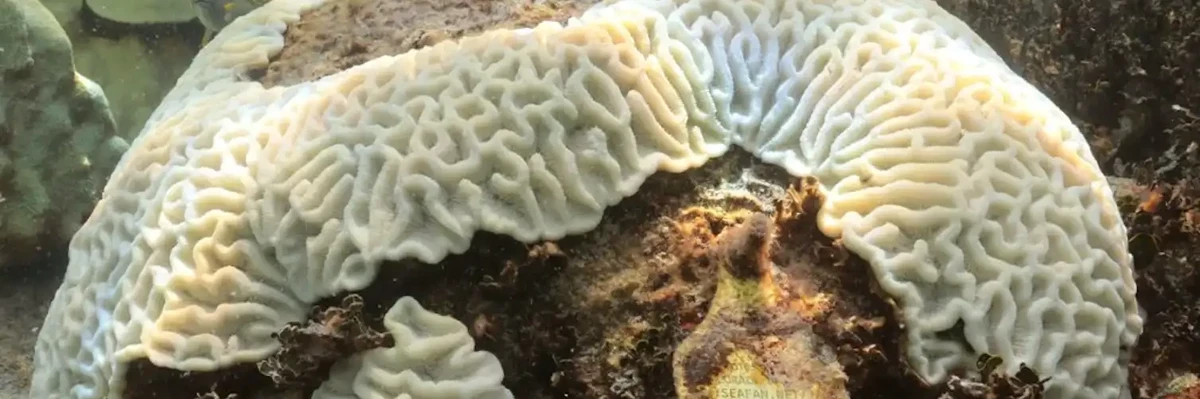
A bleached mound of coral at the Cheeca Rocks monitoring site in the Florida Keys National Marine Sanctuary that had been previously tagged shows the coral skeleton. (Photo: NOAA AOML)
“We had to add additional bleaching alert levels to appropriately categorize just how hot it was,” said a coral reefs expert at the agency.
The phrase “off the charts” is no exaggeration in the National Oceanic and Atmospheric Administration’s latest warning about a global coral bleaching event that scientists have linked to rising ocean temperatures and heat stress.
Derek Manzello, coordinator of NOAA’s Coral Reef Watch Program, told reporters Thursday that about 60.5% of the world’s coral reefs are now experiencing heat stress severe enough to cause bleaching, which can make the reefs more vulnerable to disease and harm the biodiversity they support.
Manzello said at the press briefing that after observing the first months of the coral bleaching event, which began in early 2023, NOAA changed its existing bleaching alert system because conditions were so abnormally warm in the Atlantic Ocean, Gulf of Mexico, and Caribbean Sea.
The agency’s new bleaching alert system categorizes heat stress for coral reefs on a scale of 1-5, with Alert Level 5 representing ocean heat that could kill “approximately 80% or more of corals on a particular reef,” Manzello said.
“We had to add additional bleaching alert levels to appropriately categorize just how hot it was,” he said, with Level 5 “analogous to a Category 5 hurricane or cyclone.”
“I hate that I have to keep using that word ‘unprecedented.’… But, again, we are seeing unprecedented patterns again this year.”
The world’s oceans, Manzello, said, are going “crazy haywire.”
In the Caribbean this year, heat stress off the coasts of Panama, Costa Rica, Nicaragua, and Colombia are now at levels that in previous years weren’t seen until the summer months.
“I hate that I have to keep using that word ‘unprecedented,’” Manzello told The New York Times. “But, again, we are seeing unprecedented patterns again this year.”
The bleaching that took place last year resulted in coral mortality of at least 50% and as high as 93% in reefs off the coast of Huatulco, Mexico, according to a team of Mexican scientists.
In the Atlantic, fossil fuel-driven planetary heating has been exacerbated by El Niño—the natural phenomenon that causes warmer-than-normal ocean surface temperatures—and has caused the “most unprecedented and extreme” bleaching-level heat stress observed in the past year.
Manzello said 99.7% of reef areas in the Atlantic have experienced heat stress that could cause bleaching.
“The Atlantic Ocean has been off the charts,” he said.
Scientists have recorded four global bleaching events since 1998 and have linked all of them to warmer ocean temperatures. Since 1950, the world has lost half of its coral reefs, according to a 2021 study.
Along with serving marine life, a quarter of which rely on coral reefs at some point in their life cycles, reefs also protect coasts from storms, whose growing severity in recent years scientists have also linked to planetary heating.
The current bleaching event has affected reefs off the coasts of at least 62 countries and territories.
Scientists earlier this year confirmed that 2023 was the hottest year in human history and the warmest year on record for the world’s oceans, which absorb more than 90% of excess heat from greenhouse gas emissions.
“I am very worried about the state of the world’s coral reefs,” Manzello said. “We are seeing [ocean temperatures] play out right now that are very extreme in nature.”
Image of the Green Party’s Carla Denyer on BBC Question Time.
Reacting to a new report from the Office for Environmental Protection which says: “government will not meet its ambition that most water bodies will be on the road to good condition or else already in that state by 2027,” Green Party co-leader Carla Denyer said:
“The Green Party wants to see much greater protection of nature in law, and that includes our rivers.
“We would set up an Independent Commission for Nature that would set targets for nature protection and restoration, enforced through the courts.
“This would be groundbreaking and make future governments act to protect our waterways from agricultural and industrial pollution.
“It would allow for the first time the possibility of individuals, communities and conservation groups taking legal action on behalf of nature. Currently, every time our rivers, seas or land is polluted, prosecution is left to hopelessly underfunded quangos.
“We also need water companies in public ownership and an end to leaking sewage.
“We need to give space for all of nature to thrive, and that includes protecting our rivers.”
In the first study of its kind, published in the journal Science, scientists from dozens of research institutes reviewed 665 trials of conservation measures, some from as far back as 1890, in different countries and oceans and across species types, and found they had had a positive effect in two out of every three cases.
RED REBELS TAKE PART IN A FUNERAL FOR NATURE PROCESSION (BEN BIRCHALL/PA)
Hundreds of protesters dressed in red and and black walked through Bath on Saturday.
Broadcaster Chris Packham joined hundreds of protesters in a “funeral procession” for the natural world destroyed by climate change.
Some protesters dressed in red and hundreds more wearing black walked through the streets of Bath, Somerset, on Saturday.
“Mourners” in the performance art piece walked to a drum beat and carried a willow funeral bier of a mother earth figure, created by artist Anna Gillespie.
Environmentalist Mr Packham wore a black tie with an Extinction Rebellion logo as he spoke to the crowd.
The protest aimed to sound “code red for nature” and highlight “the UK’s position as one of the most nature-depleted countries in the world”, ahead of Earth Day on Monday.