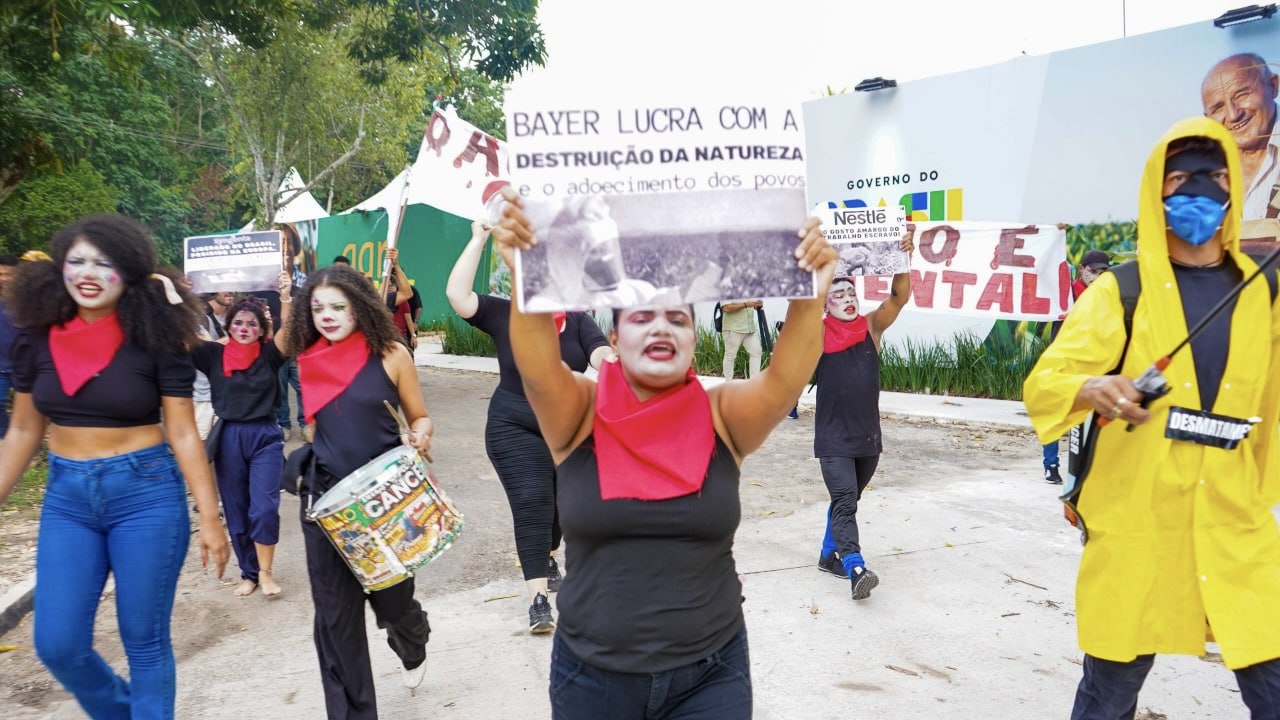
MST activists held a protest on November 11 in the Agrizone at COP 30, an area dedicated to discussions related to agribusiness. The action aimed to denounce agribusiness as the main driver of the environmental crisis in Brazil. Photo: @alain.grao / COP30 Collaborative Coverage
Embrapa’s event at the Climate Conference is sponsored by giants such as Bayer, Nestlé, and Syngenta, accused of practices that exacerbate socio-environmental damage
The United Nations Climate Conference COP30, is currently underway in Belém, Brazil and will conclude on November 21. It has become increasingly clear that, just as the Landless Rural Workers’ Movement (MST) and several other organizations, movements, collectives, and groups warned, agribusiness is at the forefront of the supposed search for solutions to the environmental crisis. This, in itself, sheds light on the fact that the Conference has become a large business expo, in which the assets will be our territories, communities, and nature.
According to Embrapa itself (the Brazilian Agricultural Research Corporation, a state entity), Agrizone is “a large showcase of technologies, science, and international cooperation focused on sustainable agriculture and the fight against hunger in a context of climate change.” However, in practice, the space will serve as a stage for agribusiness to do business, promote its image, and increase its profits – at the expense of the destruction of nature, the concentration of land, and the expulsion of peasant communities and traditional peoples. Under the discourse of “sustainability,” what we will see is the old logic of exploitation disguised as green.
Starting with its sponsors. It is unthinkable that a space that claims to combat hunger and the environmental crisis would have Bayer, Nestlé, and OCP among its financiers. These are three companies that directly contribute to the deepening of the environmental crisis. In 2024, Bayer had to pay more than USD 2 billion in compensation to a man in the US who was proven to have contracted cancer because of one of its main products: the pesticide Roundup. The product is no longer sold in that country, but in Brazil it circulates freely. It is estimated that the company faces 170,000 similar lawsuits.
One of the panels that Nestlé will lead at Agrizone is called “Remodeling food in Brazil.” This is a very suggestive title, given that the company is already engaged in this “remodeling” – at the expense of the health of the Brazilian people. According to the company’s own criteria, 54% of its sales are products with very low health ratings. In this context, it has already been proven that the Swiss company adds more sugar to its products destined for Africa and Latin America.
Office Chérifien des Phosphates (OCP) is a Moroccan state-owned company focused on the extraction of phosphate, which is mainly used in the production of pesticides. The company holds 70% of global phosphorus reserves. However, most of its production comes from the Bou Craa mine in Western Sahara, a country under colonial occupation by the Moroccan kingdom. In other words, OCP literally maintains its production at the expense of looting and stealing minerals that belong to the people of the Sahara.
Agrizone panels will be dominated by giants that plunder nature
The giants of agribusiness, the ultra-processed food industry, and mining, in addition to sponsoring Agrizone, will also dominate the debate panels at the event.
Syngenta, together with Itaú Bank, will coordinate the panel “Cooperation for long-term financing in the restoration of degraded areas.”
The question to be asked is whether the transnational corporation is willing to restore areas that it itself degrades? After all, the company is responsible for a quarter of the market for profenofos, an insecticide used mainly on corn, soybean, cotton, and other crops. It turns out that this pesticide “is extremely harmful to aquatic organisms, birds, and bees. It is a powerful neurotoxin (similar to sarin gas) that can affect brain development in humans, especially in children,“ said Laurent Gaberell, head of agriculture and biodiversity at the NGO Public Eye, which published a report on the subject. In Brazil, Syngenta’s largest market, ”profenofos residues are found in the drinking water of millions of people,” the report points out.
It is also worth remembering that Syngenta was responsible for the murder of Keno, an MST activist, in 2015, in Paraná. The murder took place in a field of illegal Syngenta transgenic experiments in the city of Santa Tereza do Oeste, western Paraná, near the Iguaçu National Park. The area was occupied by about 150 members of Via Campesina. The activists were shot at by about 40 agents from NF Segurança, a private company hired by Syngenta. In addition to Keno’s murder, Isabel Nascimento was also shot and lost sight in her right eye.
In addition to Syngenta, Natura will also be at Agrizone. The cosmetics company will lead the panel “from circular carbon to sustainable cooperation.” Natura was fined by Ibama in 2010 for biopiracy. The fine, in the amount of 21 million reais, was imposed “for allegedly irregular access to biodiversity.” In addition, the company was the subject of a complaint to the Parliamentary Inquiry Commission in the Federal Senate in 2023 for exploiting traditional communities in Pará. According to testimony from Indigenous leaders at the time, cooperatives linked to Natura paid three reais per day for harvesting andiroba and copaiba seeds, which are typical of the Amazon. However, the cooperatives sold a liter of seeds for 1,000 reais, and the company further increased this profit margin.
Ultra-processed food giant PepsiCo will be the protagonist in the panel “Every drop counts: growing potatoes in a changing climate.” Residues of the pesticide glyphosate have been identified in several of the company’s products, including Doritos chips. Potential health damage can begin at very low levels, from 0.1 parts per billion (ppb) of glyphosate. But in the company’s products, levels between 289.47 ppb and 1,125.3 ppb were found. The consequences of glyphosate on the body include gastrointestinal disorders, obesity, diabetes, heart disease, depression, autism, infertility, cancer, Alzheimer’s disease, Parkinson’s disease, and gluten intolerance.
Agribusiness controls Agrizone
Although Agrizone was officially conceived by Embrapa, control of the space is, in fact, in the hands of agribusiness. It is no surprise that important players in the sector here in Brazil, such as the Brazilian Agribusiness Association (ABAG), the Brazilian Rural Society (SRB), and Amaggi will be in the spotlight.
There is no way to build concrete solutions to the environmental crisis when the main causes of this scenario are sitting at the table, coordinating the “board room.” In Brazil, agribusiness (and the entire industrial complex surrounding it) is the main cause of this crisis. It is responsible for 74% of greenhouse gas emissions in the country.
All the supposed sustainable discourse maintained by those entities and companies in this sector – which will dominate the Agrizone panels – will actually serve two functions. First, to camouflage the real way agribusiness operates, which is based on the appropriation and destruction of nature’s common goods, in addition to the exploitation of traditional peoples. Second, in the face of the environmental crisis that they themselves have caused, to implement false solutions based on the financialization of nature – as is the case with the carbon market.
For an Embrapa that serves the people, not corporations
Embrapa is a strategic public company for the country. It suffered a profound attack during the Bolsonaro administration. However, it was not agribusiness, which was hand in hand with Bolsonaro, that defended it, but the Brazilian people and their public servants.
Therefore, it is essential that it be effectively focused on the interests of the Brazilian people and not under the control of transnational giants linked to agribusiness. The challenges related to food sovereignty and combating the environmental crisis will not come from those who profit from hunger and diseases caused by ultra-processed foods and pesticides. They will come from those who have been resisting the advance of capital for centuries and cultivating emancipated forms of relationship with nature.
This article was first published on the MST website.
Donald Trump urges you to be a Climate Science denier like him. He says that he makes millions and millions for destroying the planet, Burn, Baby, Burn and Flood, Baby, Flood.Nigel Farage urges you to ignore facts and reality and be a climate science denier like him and his Deputy Richard Tice. He says that Reform UK has received £Millions and £Millions from the fossil fuel industry to promote climate denial and destroy the planet.
What makes Pope Francis and his 183-page encyclical so radical isn’t just his call to urgently tackle climate change. It’s the fact he openly and unashamedly goes against the grain of dominant social, economic and environment policies.
While the Argentina-born pope is a very humble person whose vision is of a “poor church for the poor”, he seems increasingly determined to play a central role on the world stage. Untainted by the realities of government and the greed of big business, he is perhaps the only major figure who can legitimately confront the world’s economic and political elites in the way he has.
However his radical message potentially puts him on a confrontation course with global powerbrokers and leaders of national governments, international institutions and multinational corporations.
The backlash has begun even before the encyclical has been officially published. US presidential candidate Jeb Bush, a Catholic, feels the pope should stay out of the climate debate, joining other Republicans, fossil fuel lobbyists and climate denier think-tanks in seeking to discredit Pope Francis’s intervention.
What makes the pope so radical?
There are several meanings of the word “radical” that can be applied to the Pope and in particular his forthcoming encyclical.
First, radical can be understood as going back to the roots (from Latin radix, root). The majority of Catholics live in the Global South; in Latin America and sub-Saharan Africa. Francis is the first pope from the Global South, and naming himself in honour of Saint Francis of Assisi, “a man of poverty and peace who loved nature and animals”, signalled to the world a commitment to going back to the roots of human existence.
The pope knows the plight of the majority world. Before he became Archbishop of Buenos Aires, he was a priest in the vast, poor neighbourhoods, the villas miserias or slums, of Argentina’s capital.
Improving the lives of slum dwellers and addressing climate change is, for Pope Francis, one and the same thing. Both require tackling the structural, root causes of inequality, injustice, poverty and environmental degradation.
Even as the quality of available water is constantly diminishing, in some places there is a growing tendency, despite its scarcity, to privatize this resource, turning it into a commodity subject to the laws of the market. Yet access to safe drink- able water is a basic and universal human right, since it is essential to human survival and, as such, is a condition for the exercise of other human rights. (p. 23)
This stands in stark contrast to, for example, Peter Brabeck-Letmathe, the chairman of Nestlé, the world’s largest food and bottled water company, who thinks water is a normal commodity with a market value, and not a human right. Nestlé is far from unusual. Its stance is backed up by the official water privatisation policies of the World Bank, IMF and other international institutions.
In fact, the encyclical is a radical – for a pope and international leader, unprecedented – attack on the logic of the market and consumerism, which has been expanded into all spheres of life.
The document states:
Since the market tends to promote extreme consumerism in an effort to sell its products, people can easily get caught up in a whirlwind of needless buying and spending. Compulsive consumerism … leads people to believe that they are free as long as they have the supposed freedom to consume. But those really free are the minority who wield economic and financial power. (p. 149-150)
The pope rejects market fundamentalism, instead arguing that “the market alone does not ensure human development and social inclusion.”
The strategy of buying and selling “carbon credits” can lead to a new form of speculation which would not help reduce the emission of polluting gases worldwide. This system seems to provide a quick and easy solution under the guise of a certain commitment to the environment, but in no way does it allow for the radical change which present circumstances require. Rather, it may simply become a ploy which permits maintaining the excessive consumption of some countries and sectors. (p. 126)
The pope’s right. The same criticisms of carbon markets have been made by myself and others.
Climate change is a global problem with grave implications: environmental, social, economic, political and for the distribution of goods. It represents one of the principal challenges facing humanity in our day. (p. 20)
While the pope is not a politician – or maybe precisely because he is not one – he commands high moral and ethical authority that goes beyond traditional partisan lines. His encyclical speaks truth to power, and he might be the only person with both the clout and the desire to meaningfully deliver a message like this:
Many of those who possess more resources and economic or political power seem mostly to be concerned with masking the problems or concealing their symptoms, simply making efforts to reduce some of the negative impacts of climate change. However, many of these symptoms indicate that such effects will continue to worsen if we continue with current models of production and consumption. There is an urgent need to develop policies so that, in the next few years, the emission of carbon dioxide and other highly polluting gases can be drastically reduced, for example, substituting for fossil fuels and developing sources of renewable energy. (p. 21)
The bosses of Shell, ExxonMobil and other fossil fuel companies will not like this message, as it threatens their fundamental business model, and it also stands in contrast to the underwhelming ambitions of the G7 leaders who recently pledged to phase out fossil fuels only by 2100.
The time for bold, radical action on the environment as well as poverty eradication has come. This seems to be Pope Francis’ message: “The same mindset which stands in the way of making radical decisions to reverse the trend of global warming also stands in the way of achieving the goal of eliminating poverty.” (p. 128)
We need to think beyond the current, taken-for-granted logic that believes only markets and consumerism can solve the world’s social and environmental problems. The pope himself believes the situation is so grave that only a new, “true world political authority” will be able to address these problems.
This article was updated on 18 June to include quotes from the final encyclical rather than the earlier draft leaked to L’Espresso magazine.
The broadcaster’s in-house content studio has been paid to promote fossil fuel firms and petrostates with a history of persecuting journalists.
The BBC has produced dozens of films and articles for oil and gas companies, agricultural giants, fossil fuel states, and high-emission transport firms in recent years, DeSmog can reveal.
Experts say the BBC has been “greenwashing” the image of companies and countries contributing to global emissions by trumpeting their dubious climate credentials and promoting their favoured solutions to the crisis.
The content was produced by BBC StoryWorks, a studio that produces videos, podcasts, and articles paid for commercial clients, which it publishes on BBC channels outside the UK.
On its website, BBC StoryWorks boasts that it leverages the reputation of the BBC – “our century-long pedigree as the world’s most trusted storytellers” – to create content for commercial clients “that moves and inspires curious minds, across platforms and across the globe”.
BBC StoryWorks produces traditional adverts for its clients, as well as content “with an editorial style” (known as “branded” or “native” content).
Branded content appears outside the UK on the BBC website – the most viewed news platform in the world – and on its non-UK broadcast channels, in a similar format to normal editorial output. However, branded content promotes the paying client and typically features interviews with the client’s senior executives. It is only distinguished by a disclaimer that it has been paid for by an external organisation.
BBC Studios – which includes StoryWorks – generated £1.8 billion of sales in the year 2023/24, according to the broadcaster’s annual accounts. The BBC‘s financial deficit is projected to reach nearly £500 million next year, with the licence fee – its primary funding source – having been frozen for several years by the last Conservative government.
In recent months, the BBC has created content for a number of oil and gas companies, including the French fossil fuel company Engie, which owns a number of coal-fired power plants and relies heavily on gas for its energy production.
BBC StoryWorks has also produced content for liquified natural gas (LNG) companies, and has touted the energy source as a cleaner alternative to other fossil fuels. This is despite experts warning that the booming LNG industry could contribute more heavily to the climate crisis than the ongoing use of coal, the most carbon-intensive fossil fuel.
Agriculture accounts for 21 percent of global greenhouse gas emissions, and BBC StoryWorks has produced films for some of the world’s biggest food and farming firms, including Nestlé and Bayer, often promoting the disputed green technologies backed by the industry. As previously revealed by DeSmog, BBC StoryWorks has produced dozens of documentaries sponsored by the pesticide giant Corteva, publicising the technologies developed and sold by the firm.
Petrostates with a history of human rights abuses – including the imprisonment of journalists – have also been promoted by BBC StoryWorks.
An investigation by DeSmog and Drilled previously revealed that many of the world’s most trusted English-language news outlets regularly promote the fossil fuel industry’s narratives on climate-related topics. Bloomberg, The Economist, the Financial Times, the New York Times, Politico, Reuters, and the Washington Post all have internal commercial studios that create advertising content for fossil fuel firms.
The BBC is committed to science-led climate reporting and in 2021 signed the Climate Content Pledge, promising to do “more and better climate story-telling on screen across all genres.”
However, critics say that BBC StoryWorks is using the broadcaster’s reputation – including its role as a public service broadcaster – to make money from commercial content that often flouts its editorial values.
“The contracts to make this sort of content are won on the back of the BBC’s reputation as an honest and impartial broadcaster,” Patrick Howse, the BBC’s former Baghdad bureau chief, told DeSmog. “Accepting money from sources like this, to make content like this, risks undermining the BBC’s own hard-won reputation and will ultimately put it on the wrong side of history.
“This is a huge disservice to the BBC’s audiences, and a betrayal of the many brave and conscientious BBC journalists around the world who see holding power to account and telling the truth as their raison d’etre.”
Last year was the warmest year since global records began in 1850. The world’s foremost climate science body, the UN’s Intergovernmental Panel on Climate Change (IPCC), has said that “immediate and deep emissions reductions” are needed “across all sectors” to limit global warming to 1.5C – the global target established by the 2015 Paris Agreement.
In June 2024, UN Secretary-General António Guterres said that advertising agencies had “aided and abetted” the fossil fuel industry, “acting as enablers to planetary destruction”.
“Fossil fuels are not only poisoning our planet – they’re toxic for your brand,” he said.
A BBC StoryWorks spokesperson said that the studio “operates entirely separately from the BBC’s editorial operations” and that its output “is clearly labelled as commercial content”.
However, content labelling doesn’t always help readers and viewers to understand that it has been paid for by a commercial client. A 2018 Boston University study found that only one in 10 people recognised native advertising – which includes branded content – as advertising rather than reporting.
The BBC StoryWorks spokesperson added that, “BBC StoryWorks operates under robust and established governance and is required to comply with the BBC’s guidelines as set out in the publicly available Advertising and Sponsorship Guidelines.
“Central to these guidelines is a commitment to factual accuracy in any piece of content. All of the content cited in this article was approved as compliant with the BBC’s advertising guidelines prior to its publication.”
Fossil Fuel Firms and False Solutions
In April and June, BBC StoryWorks published two articles paid for by Engie, a global energy company with annual revenues of $60 billion, which is part-owned by the French state. The articles promoted Engie’s green credentials, claiming it has a mission “to accelerate the energy transition”, despite the firm’s extensive fossil fuel interests.
Though ENGIE has ambitious renewable development objectives, it plans to expand its LNG terminals in Europe, is one of the top European developers of gas power plants globally, and has agreed to import American shale gas beyond 2040.
Between 2016 and 2022, the firm sold 16 of its coal plants – a 60 percent reduction in its coal capacity. However, Engie chose to sell these assets rather than close them down. This transferred the polluting plants to different owners, meaning that the plants will still contribute to global emissions.
The BBC StoryWorks articles didn’t provide information about the company’s existing polluting activities, or the global need to rapidly scale-down oil, gas, and coal production.
Professor Peter Newell, an academic at the University of Sussex specialising in environmental politics, told DeSmog: “Because branded content looks like regular BBC journalism which the public trust as independent, it compromises the integrity of the organisation and its public role, including to help society respond seriously to the climate crisis.”
In 2021, the broadcaster launched a “Humanising Energy” series “presented by” the World Energy Council, a global forum for sustainable energy development, followed by a second series in 2023.
The two series featured dozens of five-minute films paid for by individual firms, showcasing their supposed climate solutions. These films typically involved one-on-one interviews with people either creating or benefiting from these green innovations, as well as cinematic shots of the technologies being deployed.
A screenshot of a BBC StoryWorks film from its ”Humanising Energy“ series. Credit: BBC
Sponsors of films in the two Humanising Energy series included the fossil fuel companies Engie Brazil, Gasum (the largest distributor of LNG in the Nordic countries), CLP Holdings (which has said it won’t phase out its coal assets before 2040, and hasn’t committed to phasing out its gas assets), Mabanaft, and Invenergy, the energy services firm Voith, and the engine manufacturer Cummins.
All of these films touted the supposed climate credentials of the featured companies, without examining their contribution to global emissions or the viability of the featured technologies.
In January 2024, Cummins agreed to pay a record $1.7 billion fine – the second largest environmental penalty ever in the U.S. – after facing charges that it equipped roughly one million vehicles with devices that bypassed emissions sensors. The company didn’t admit wrongdoing.
Just a few months earlier, BBC StoryWorks produced a film for Cummins boasting of the firm’s efforts to help decarbonise commercial vehicles.
The Invenergy film focused on its construction of an LNG plant in El Salvador. While the content attempted to show how the plant was providing energy and jobs to the local community, it also tried to tout the environmental benefits of natural gas.
During the film, an Invenergy spokesperson suggested that natural gas generates 30 percent less carbon dioxide than other fossil fuels, neglecting the fact that natural gas is composed largely of methane, which is over 80 times more potent than CO2 across a 20 year period. Even relatively small methane leaks during the process of extracting, shipping, and processing natural gas contribute significantly to global emissions.
One of the films in the Humanising Energy series – “The evolution of home energy” – promoted the role of hydrogen in supplying home heating. Yet, while green hydrogen is widely accepted as necessary for decarbonising heavy industry and other sectors where alternative renewable energy sources are unworkable, it is not considered viable for heating homes.
A peer-reviewed assessment of over 50 independent studies in 2024 concluded that hydrogen use in domestic heating is inefficient, costly and resource-intensive compared to other low-carbon options such as heat pumps.
The BBC StoryWorks film was paid for by DNV, a Norwegian company that claims to be “the world’s leading resource of independent energy experts and technical advisors”, including the oil and gas sector. DNV says on its website that it “delivers broad technical expertise and experience to enable hydrogen to play a key role in the energy transition”.
A DNV spokesperson said that, “While DNV does work with oil and gas companies and organisations across renewable energy production, it is not involved in the direct production or distribution of energy… Our approach to energy solutions is rooted in comprehensive research and rigorous testing, and our position as an independent third party is a central part of our identity and our work.”
The Humanising Energy series also featured twofilms advocating for the development and deployment of sustainable aviation fuels (SAFs) – one paid for by the aviation giant Boeing, and one paid for by the energy and chemicals company Sasol alongside the gas company Linde.
A screenshot of a BBC StoryWorks film, sponsored by Boeing, from its ”Humanising Energy“ series. Credit: BBC
SAFs have been criticised as being environmentally damaging and currently economically unviable. The Advertising Standards Authority this month banned a Virgin Atlantic advert for making the “misleading” claim that it had developed a “100 percent sustainable aviation fuel”.
In August 2022, the International Council on Clean Transportation (ICCT) said that the amount of money invested by airlines in SAFs was “insufficient” and that it seemed as though the technology was simply “about burnishing airlines’ images” by inflating their environmental credentials.
Sasol told DeSmog that its SAF initiatives were not an example of greenwashing and that it believes SAFs hold the “promise to be an enabler of our own decarbonisation and contribute to decarbonising aviation.”
Aviation contributes approximately 2.5 percent of worldwide greenhouse gas emissions, yet BBC StoryWorks has produced content for a number of airlines in recent months and years, including Uzbekistan Airways (March 2024), China Southern Airline (2022), and Korean Air (2017).
BBC StoryWorks has also worked extensively with other polluting transport companies.
It produced an advertising campaign for the shipping and cruise company Cunard that appeared on BBC StoryWorks social media pages in July 2024. Europe’s 218 cruise ships emitted as much sulphur oxides as one billion cars in 2022.
BBC StoryWorks has also produced brandedcontent for the car company Hyundai, as well as for Lexus, Volkswagen, and Jaguar. In addition, the studio has produced a six-part series paid for by the Indian multinational motorcycle company Royal Enfield.
Transport contributes roughly one quarter of all energy related greenhouse gas emissions, while outdoor air pollution is estimated to cause more than 3.2 million premature deaths worldwide every year.
“This important investigation reveals that BBC StoryWorks has been doing the greenwashing work of major polluting firms driving the climate crisis by obscuring their role and promoting their preferred ‘solutions’, however discredited by science,” Professor Newell told DeSmog.
Greenwashing is when a company falsely brands something as eco-friendly, green or sustainable. In 2017, the BBC itself produced a guide to the “seven ways to spot businesses greenwashing”.
Big Ag Polluters
BBC StoryWorks has also been paid to produce content for major agricultural polluters and their lobbyists. This content has often promoted the technological hacks that food and farming giants claim will reduce the sector’s emissions, rather than the more fundamental changes in production and consumption that scientists say will be crucial in limiting Big Ag’s climate impact.
In 2023, BBC StoryWorks produced an advertising campaign for the pesticides giant Bayer, the world’s second largest crop chemicals company, boasting of the firm’s efforts to facilitate “scientific breakthroughs”.
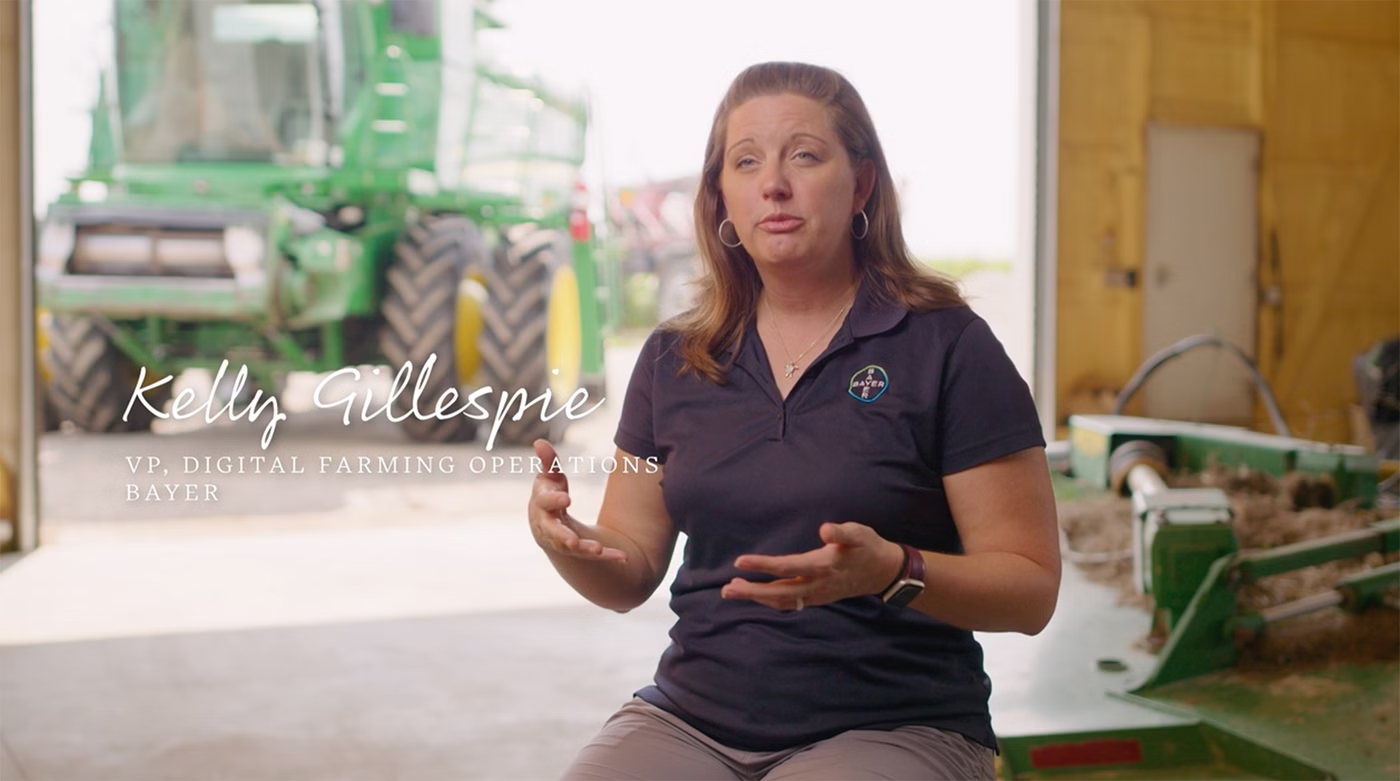
In addition, as part of a branded content series in late 2023 entitled “The Climate and Us”, BBC StoryWorks was paid by Bayer to produce a film on the digital apps helping farmers to monitor and reduce their emissions.
The film, which featured an interview with Bayer’s vice president of digital farming operations, promoted the firm’s technologies with no additional comment from experts on its efficacy, or Bayer’s stance on climate change.
A screenshot of a BBC StoryWorks film, sponsored by Bayer. Credit: BBC
According to the Pesticides Action Network, over a third of Bayer’s sales derive from products that are highly hazardous to the environment, animal or human health. (The methodology for this classification is strongly disputed by Bayer on the grounds that it uses different criteria to internationally accepted rules).
Bayer told DeSmog that it is “committed to ambitious sustainability goals and has a positive track record while recognising the ongoing challenge.”
Experts say that the overuse of chemical pesticides is harming the future of food production. Biodiversity is in sharp decline across the world, and numbers of birds and pollinators are plummeting in Europe.
Bayer, which makes almost $10 billion in agrochemical sales every year, has also faced millions of dollars in lawsuits over health issues allegedly related to its products, including from farmers.
In 2023, DeSmog revealed that BBC StoryWorks had produced three documentary series and 26 articles – viewed at least 65 million times – sponsored by Corteva, one of the world’s largest pesticide firms.
The BBC said that the Corteva-sponsored content, which focused on sustainable food production, was editorial in nature and not influenced by its corporate client. However, experts said the documentaries gave a “totally biased” picture of global food problems, while the content promoted a number of the technologies developed by Corteva.
BBC StoryWorks also produced two articles in 2023 paid for by Australian Dairy – the country’s industry trade group.
The first article promoted the supposed contribution of milk and dairy to a healthy diet, while the second advocated for “precision farming” – in other words, using technology to ensure that resources are used efficiently and to track climate impacts.
Scientists and health professionals agree that dairy products are not necessary for a healthy diet, and they agree that for people who are able to have a varied diet, lower meat and dairy consumption is healthier than diets higher in milk and dairy.
Experts also doubt that precision farming can be rolled out widely enough to meaningfully reduce agricultural emissions. The environmental group Friends of the Earth has said that: “Faced with global climate and biodiversity emergencies, better ‘optimisation’ of existing production processes cannot possibly go far enough to meet the challenges we face.”
According to a March 2024 Harvard Law paper, which surveyed more than 200 environmental and agricultural scientists, meat and dairy production must be drastically reduced – and fast – to align with the Paris Agreement. The report concluded that global emissions from livestock production need to decline by 50 percent during the next six years, with “high-producing and consuming nations” taking the lead.
Sophie Nodzenski, a senior campaign strategist on food and agriculture at Greenpeace International told DeSmog: “Tinkering with the status quo is no longer an option. Meat and dairy companies are climate killers. The livestock sector is one of the leading sources of human-made methane emissions, which move us faster and further past the 1.5C threshold, worsening global heating.
“Meat and dairy companies must stop misleading the public with pseudo solutions and focus on reducing their livestock herds drastically to bring down emissions instead. This reduction can give us a fighting chance against climate chaos.”
In 2023, BBC StoryWorks also produced content for the world’s largest food and drink company Nestlé, boasting of the company’s efforts to support sustainable farming through “regenerative agriculture”.
The film failed to acknowledge that Nestlé – whose 87.5 million tonnes of annual emissions are similar to those of Chile – spent 14 times more on “marketing and administration” in the last year than it did on regenerative agriculture over the previous five years combined.
A screenshot of a BBC StoryWorks film, sponsored by Nestlé. Credit: BBC
“Nestlé’s strong focus on using regenerative agriculture to compensate for the greenhouse gas emissions from livestock farming – one of Nestlé’s main strategies to achieve net zero – is not backed by robust scientific evidence,” Nodzenski said.
“Increasing carbon storage in soils, as well as forests and other vegetation, is necessary, but should not replace a drastic reduction of greenhouse gas emissions from livestock farming – one of the main sources of Nestlé’s emissions.”
The Nestlé film was part of a “Food for Thought” series backed by the trade body FoodDrink Europe, whose members feature major polluters including Cargill, Coca-Cola, and Unilever.
A Nestlé spokesperson said: “We continue to invest in and deliver on our net zero roadmap. By the end of 2023, we had reduced our greenhouse gas (GHG) emissions by 13.5 percent in absolute terms since 2018. Our GHG reduction targets are third-party approved by the Science Based Targets initiative and include a 20 percent absolute cut by 2025 and 50 percent by 2030 covering all sources of agricultural emissions in our supply chain.
“We continue to ramp up our climate efforts using world class research and development, including via the Nestlé Institute for Agricultural Sciences.
“Nestlé has committed to invest $1.2 billion to pay premiums to farmers for ingredients grown using regenerative agriculture practices, provide technical assistance and support investment.”
Petrostates
Over recent years, BBC StoryWorks has also produced content for some of the world’s leading fossil fuel states, many of which have a poor record on human rights and press freedom.
This year’s flagship COP29 climate summit will be held in Baku, Azerbaijan. The country is a petrostate with oil and gas production accounting for roughly half of its GDP and over 90 percent of its exports. The country, run under an authoritarian system with little effective political opposition, plans to increase fossil fuel production by a third over the next decade.
Azerbaijan’s government has also been accused by of a media crackdown by the advocacy group Human Rights Watch ahead of November’s summit, arresting 25 journalists and activists in the past year.
However, since November 2023, BBC StoryWorks has produced several adverts promoting Azerbaijan as a place to visit, while greenwashing its image.
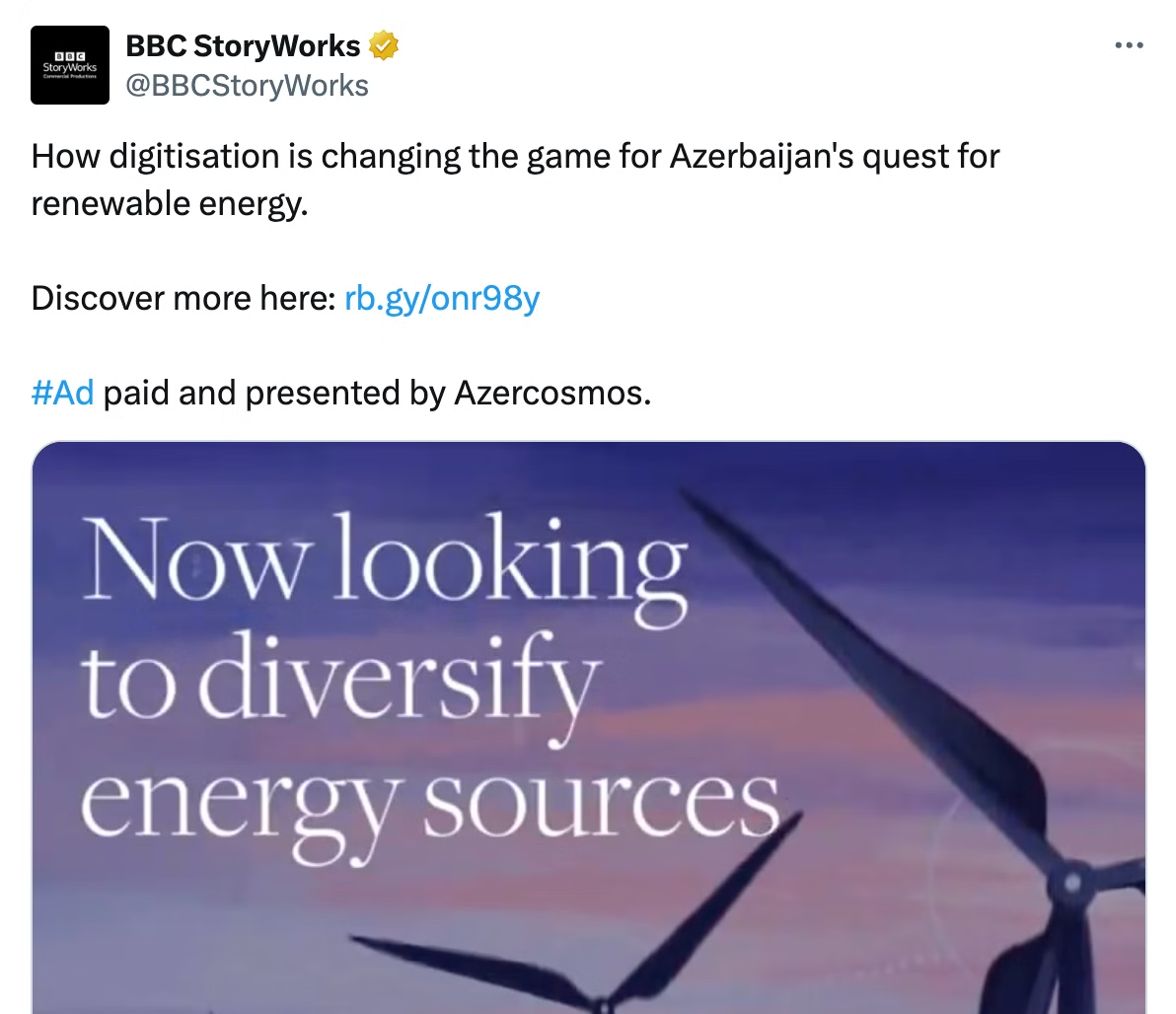
For example, in December 2023, the studio released an advert paid for by the country’s space agency Azercosmos, attempting to show “How digitisation is changing the game for Azerbaijan’s quest for renewable energy.”
The advert was accompanied by an article claiming that Azerbaijan plans to transition “from an oil- and gas-based economy into a thriving modern hub.” The article did not mention the country’s plan to expand fossil fuel production, which contravenes globally agreed efforts to limit rising temperatures.
A screenshot of a BBC StoryWorks advert, sponsored by Azercosmos. Credit: BBC
BBC StoryWorks has also produced content promoting the United Arab Emirates (UAE), the host of the 2023 COP28 climate summit and another petrostate with a poor human rights record.
In 2023, the studio produced a branded content podcast series on behalf of Abu Dhabi Tourism, featuring five 20-minute episodes each “highlighting the message that Abu Dhabi [the capital of the UAE] is a destination for every kind of traveller”.
The series was shortlisted for a 2023 World Media Award and, in the award submission, the BBC said it “challenged preconceived notions and [positioned] the city as a cultural gem worth exploring”. The series was downloaded 115,000 times, according to the BBC.
The UAE derives roughly 40 percent of its income from oil and gas, and this isn’t the only time that BBC StoryWorks has produced content promoting the petrostate.
The story stated that the UAE is “planning to increase oil production to more than five million barrels a day by 2030”, but said that the country “has been looking toward more sustainable energy sources”. It went on to say that “Clean energy projects are coming of age” in the UAE, “from record-breaking solar parks and green hydrogen to waste-to-energy plants”.
The UAE’s overall climate action has been rated as “critically insufficient” by the Climate Action Tracker, an independent scientific project that monitors government climate action and measures it against the Paris Agreement.
Weeks before COP28, the country’s national oil company, ADNOC, awarded contracts worth $17 billion for the development of new offshore gas fields.
The Gulf state also has a poor record on human rights and press freedom. The UAE continues to arrest and imprison activists, academics, and lawyers who speak out against its monarchic rulers. UAE authorities also continue to discriminate against women, LGBTQ communities, and migrants.
According to Reporters Without Borders, “The government prevents both local and foreign independent media outlets from thriving by tracking down and persecuting dissenting voices.”
“The rise of renewable energies in oil-rich regions” article also attempted to promote the ways in which “women are playing an increasing role in the renewable energy sector”. The story cited the fact that women are leading green initiatives in Kuwait, and Jordan.
However, many Gulf states routinely discriminate against women. In Kuwait for example, the country’s personal status laws discriminate against women in matters of marriage, divorce, and child custody.
Despite this, BBC StoryWorks has frequently promoted the country. In December 2023, the studio published an advert from the Kuwait Fund, the country’s state-run development agency, boasting of its efforts to help “disadvantaged regions, women and minorities”.
Reporters Without Borders states that Kuwait’s censorship laws prohibit journalists “from criticising the government, the emir, the ruling family, its allies or religion”. In particular, it is “difficult for journalists to tackle migrant worker rights, women’s rights and corruption.”
Oil and gas revenues account for roughly 60 percent of Kuwait’s GDP.
BBC StoryWorks has also produced content for the petrostate Qatar, promoting the country as a tourist destination despite its record of discriminating against women and minorities.
BBC StoryWorks has a history of working for repressive regimes, including China. The U.S. publication Deadline reported in December 2022 that BBC StoryWorks had partnered with at least nine Chinese state-affiliated bodies, including a media outlet banned from broadcasting in the UK.
“Those commissioning and paying for this content are deliberately using the BBC’s brand to greenwash or whitewash their own reputations. It’s an exercise of cynical manipulation,” the BBC’s former Baghdad bureau chief Patrick Howse told DeSmog.
“Commissions like this are lucrative and therefore attractive to a corporation that has been deliberately and severely financially squeezed by the UK government over a long period. This has forced the BBC to seek money from wherever it can find it, and this poses a risk to its editorial independence and honesty, which will ultimately undermine the trust of the BBC’s audience.”
Barack Obama has called on world leaders to “step up and step up now” to avert climate breakdown, singling out China and Russia for being foremost among countries that are failing to cut planet-heating emissions quickly enough.
Obama said that while progress has been made at the Glasgow climate talks, including significant pledges made by countries to reduce methane emissions and to end deforestation, “we are nowhere near where we need to be at” in cutting emissions and that “most nations have failed to be as ambitious as they need to be”.
HSBC coordinated efforts to try and water down action on climate change in the banking sector by seeking to delay a key deadline and scrap mandatory science-based targets for a major net-zero alliance, the Bureau can reveal.
Nearly 1,000 representatives from the fossil fuel industry, big business and nuclear power companies have registered to attend the COP26 climate summit in Glasgow, according to an analysis by The Ferret.
They include executives from Shell, BP, Equinor, Chevron, Total, Gazprom and other major oil and gas companies, as well as multinational corporations such as McDonald’s, Bayer, Walmart, HSBC, PepsiCo, Nestlé and Microsoft.
There are also delegations from the coal industry, tobacco companies and pesticide manufacturers. Eleven people from two climate sceptic think-tanks have registered for the summit.
‘As long as we have a Government dominated by vested interests, the UK will make no progress on climate action.’
Wera Hobhouse is the Liberal Democrats’ justice spokesperson and MP for Bath.
To reach net zero, we need an end date for the use of fossil fuels. Yet, the Government is taking us backwards on tackling climate change. Any wonder when they are bankrolled by fossil fuel interests and climate sceptics? As long as we have a Government dominated by vested interests, the UK will make no progress on climate action.
Earlier this week, an investigation revealed that the Conservative party and its MPs received £1.3m in gifts and donations from climate sceptics and fossil fuel interests since the election in 2019.