Labour’s Otherworldly Manifesto

Spread the love
Zionist Keir Starmes is quoted "I support Zionism without qualification." He's asked whether that means that he supports Zionism under all circumstances, whatever Zionists do.
Zionist Keir Starmes is quoted “I support Zionism without qualification.” He’s asked whether that means that he supports Zionism under all circumstances, whatever Zionists do.

https://www.rosalux.de/en/news/id/52233/labours-otherworldly-manifesto
Keir Starmer’s party is set to win by a landslide, but its ambitions are simultaneously unrealistic and uninspiring

AUTHOR: Keir Milburn

“Stability is Change!” This seemingly paradoxical, almost Orwellian statement is the principal slogan of the Labour Party’s current parliamentary election campaign. Labour leader Keir Starmer used the slogan at the party’s manifesto launch, and it provides a key prism for understanding the manifesto and its weaknesses.

There is little doubt that the UK electorate is in the mood for change. The widespread, off-stated consensus in the country is that nothing works. The National Health Service is so chronically underfunded that doctor’s appointments are difficult to get and long waiting lists proliferate. The trains are shockingly expensive but utterly unreliable.

The list could go on and on, but the image most frequently used to sum up the situation comes from the failure of the privatized water services. A lack of investment in infrastructure accompanied by the looting of those companies for huge shareholder dividend payouts has led to the near constant release of untreated sewage into the UK’s river system. It flows from there onto our beaches. The British are quite literally swimming in shit!

These problems are identified quite clearly in the Labour Party manifesto, but the diagnosis of their causes and therefore their solutions proves much less convincing. Labour may have a plan to win in July, but how it will govern in the interests of its voters is anybody’s guess.

The totality of Labour’s spending pledges amounts to just 0.2 percent of GDP, smaller even than the Conservative pledges of 0.8 percent and dwarfed by the previous two Labour manifestos, which promised 2.1 percent and 3.2 percent respectively. Even the pro-market Institute for Fiscal Studies called Labour’s plans “tiny, going on trivial”.

These policies do not point to stability, not least because they do not address the 18 billion pounds of government spending cuts that the Conservatives have already baked into the government budget going forward. The effects of implementing such cuts on government services — which have already suffered so badly under 14 years of severe austerity — makes it hard to imagine that Labour will stick to this commitment. It seems likely that money will be found to prevent the worst of these cuts through technical changes in accounting between the government and the notionally independent Bank of England.

Beyond this paddling, however, the need for investment in the UK is huge. Both public and private investment in the country has collapsed since 2008. It has the lowest business investment in the G7 and ranks just twenty-eighth out of the 31 OECD countries. In the face of this, Labour, hamstrung by self-imposed fiscal rules on bringing down government debt and pledges not to raise the main forms of taxation, are promising so little investment that their plans seem unbelievable.

Until last February, Labour was promising to immediately strengthen workers’ rights through a New Deal for Workers, and to spend 28 billion pounds per year to decarbonize the economy through its Green Prosperity Plan. The Labour Party’s current openness to corporate funding and lobbying, including the imposition of over 30 parliamentary candidates with corporate lobbying backgrounds, has led to a dramatic watering down of these pledges. The Green Prosperity Plan has been reduced to just 3.5 billion pounds, but the form that spending will take reveals another logic or worldview which may come to the fore as crises mount.

The word “securonomics”, an ugly portmanteau favoured by shadow chancellor Rachel Reeves, makes an appearance in the manifesto, introducing the idea that public investment should support and de-risk private investment in strategically key sectors. The chief vehicle for this will be a National Wealth Fund “capitalised with £7.3 billion over the course of the next parliament”. What precisely this will look like has yet to be determined, but The National Wealth Fund “will have a target of attracting three pounds of private investment for every one pound of public investment”. This is an explicit return to and acceleration of the kind of public-private partnerships that lost legitimacy in the UK during the fallout from the disastrous Public Finance Initiative under New Labour.

Recommended article at https://www.rosalux.de/en/news/id/52233/labours-otherworldly-manifesto
Continue ReadingLabour’s Otherworldly Manifesto

Reeves’s new book lifts whole Wikipedia sections

Spread the love

Rachel Reeves engages in a New Labour tradition of plaguarism in her book. Tony ‘c********r’ Blair and Alastair Campbell engaged in huge plaguarism in drafting the Dodgy dossier and were also found out in short order.

Original article republished from the Skwawkbox.

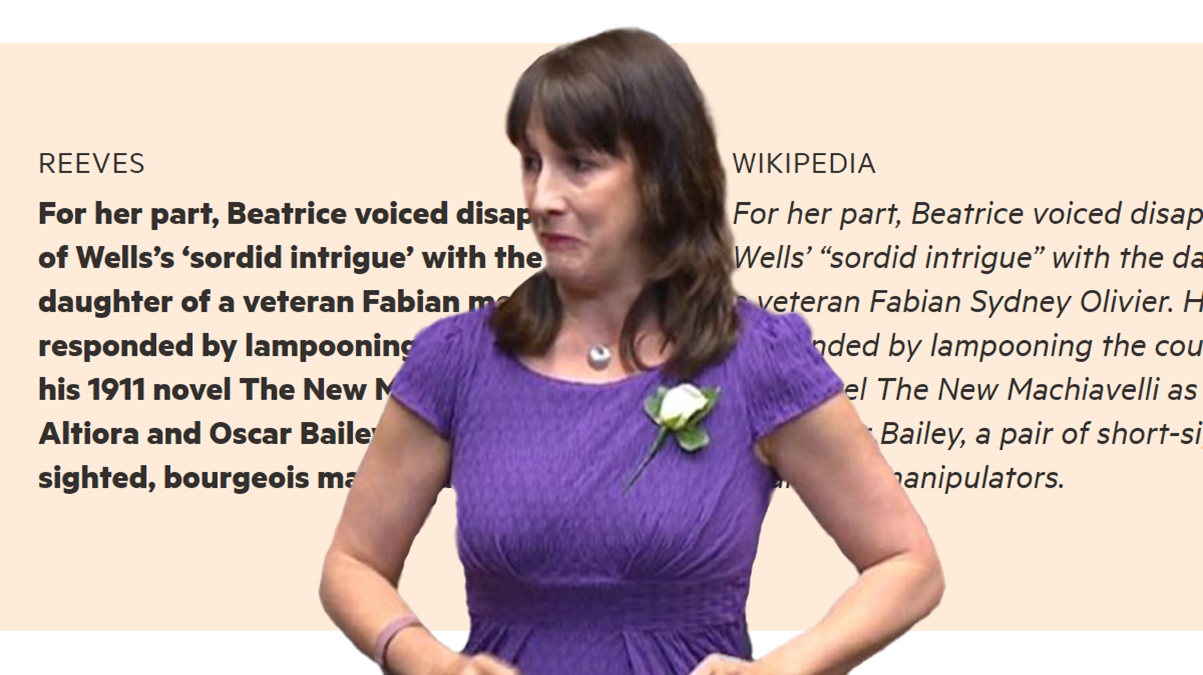
Shadow Chancellor denies plagiarism, but at least twenty sections are identical to Wikipedia entries or slightly reworded

Rachel Reeves  seriously plaguarised wikipedia in her book. Image thanks to the Skwawkbox.
Rachel Reeves seriously plaguarised wikipedia in her book. Image thanks to the Skwawkbox.

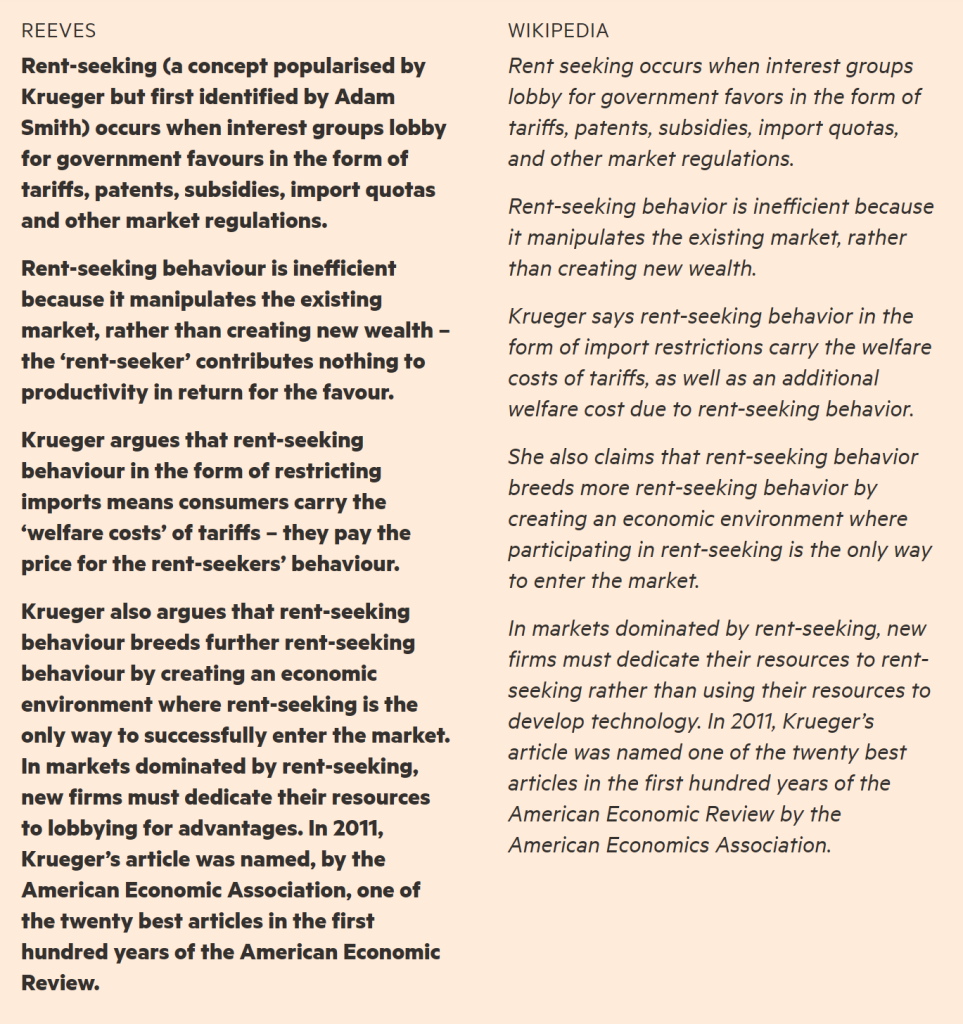
Shadow Chancellor Rachel Reeves’s new book is littered with examples of text lifted exactly, or very nearly, from Wikipedia, according to the Financial Times.

The paper identified at least twenty examples, with some exact and others only slightly modified, including this lengthy passage:

Rachel Reeves seriously plaguarises wikipedia. Image thanks to The Skwawkbox.

Ironically, a theme of the book is others taking credit for the work of women.

The publisher admitted that sections had been included without modification, but ‘allies’ of Reeves denied plagiarism. Her spokesperson said to the FT:

We strongly refute the accusation that has been put to us by this newspaper. These were inadvertent mistakes and will be rectified in future reprints.

Original article republished from the Skwawkbox.

Continue ReadingReeves’s new book lifts whole Wikipedia sections

Stuart Hall: New Labour has picked up where Thatcherism left off

Spread the love

https://www.theguardian.com/politics/2003/aug/06/society.labour

The Labour election victory in 1997 took place at a moment of great political opportunity. Thatcherism had been rejected by the electorate. But 18 years of Thatcherite rule had radically altered the social, economic and political terrain in British society. There was, therefore, a fundamental choice of direction for the incoming government.

One was to offer an alternative radical strategy to Thatcherism, attuned to the shifts that had occurred in the 1970s and 1980s; with equal social and political depth, but based on radically different principles. What Thatcherism seemed to have ruled out was another bout of Keynesian welfare-state social democracy. More significantly, Thatcherism had evolved a broad hegemonic basis for its authority, deep philosophical foundations, as well as an effective popular strategy. It was grounded in a radical remodelling of state and economy and a new neo-liberal common sense.

This was not likely to be reversed by a mere rotation of the electoral wheel of fortune. The historic opportunities for the left required imaginative thinking and decisive action in the early stages of taking power, signalling a new direction. The other choice was, of course, to adapt to Thatcherite, neo-liberal terrain. There were plenty of indications that this would be New Labour’s preferred direction. And so it turned out. In a profound sense, New Labour has adapted to neo-liberal terrain …

https://www.theguardian.com/politics/2003/aug/06/society.labour

Continue ReadingStuart Hall: New Labour has picked up where Thatcherism left off

Shall we talk about what’s obvious and accepted?

Spread the love

At least it’s accepted in certain quarters{!} that I have demonstrated it beyond reasonable doubt…

The context is an insane PM in charge of a Fascist regime – isn’t that what it is when there’s a dictatorial leader that cannot countenance any dissent and the police are inseparable from the government? Isn’t that what it is when the big, fat [4/10/15 edit: , totally ridiculous twat of a} policeman is a political appointee and so keen to kill people who oppose the glorious leader? [4/10/15 That absolute New Labour arse was promoted by Blunkett on a pretext]. Well c’mon there are lessons from history here. You have an authoritarian leader and any effective dissent must be crushed with that Fascist boot.

Was it not so in 2005? The glorious war leader was not so glorious. Wasn’t he actually unglorious? Didn’t they need that Fascist deed … that history tells us that they go for?

ed: There is a key

[4/10/15 and isn’t that key so obvious? Weren’t so many people aware then? There are contemporary accounts. Things like – paraphrased – you are such an absolute useless New Labour Fascist ****. ] You won’t get it all, but there’s enough in the public domain. He was on a nasty mission of persecuting a particular political activist for being an effective political activist attacking the un/glorious leader.]

Continue ReadingShall we talk about what’s obvious and accepted?

Politics news allorts

Spread the love

Commentary and analysis on recent UK politics events.

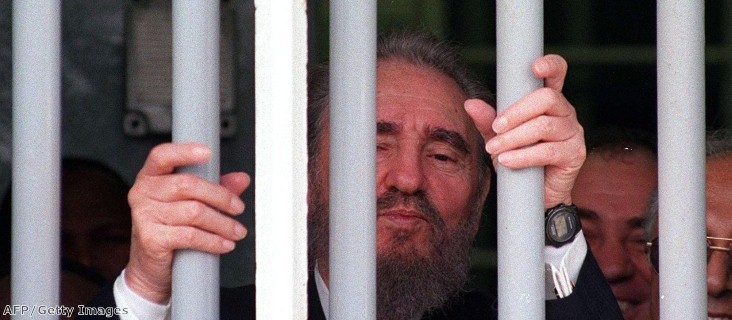
Fidel Castro peers out of the bars of Nelson Mandela's former cell on Robben Island during a recent visit.
Fidel Castro peers out of the bars of Nelson Mandela’s former cell on Robben Island during a recent visit.

There’s a very good article about the sanitization through political values of Nelson Mandela and the South African campaign against Apartheid at politics.co.uk. I’ll quote some but urge you to read the whole article.

For decades, Cuba supported the armed struggle liberation movements in South Africa, Cape Verde, Guinea-Bissau, Angola and Mozambique. In 1961, when Che Guevara attended a summit in Geneva as industry minister, he attacked “the inhuman and fascist policy of apartheid” and demanded the expulsion of South Africa from the UN, all decades before Britain could bring itself to challenge the racist government.

The climax of the decades-long campaign came when Cuba supported liberation forces in Angola against South African interference. In the 1988 battle of Cuito Cuanvale, a victory celebrated across southern Africa, South African soldiers were defeated a volunteer Cuban army , dragging PW Botha and FW de Klerk to the negotiating table.

Mandela described Cuba as “our friend”, a country which “helped us train our people, who gave us resources that helped us so much in our struggle”. He added: “The defeat of the racist army at Cuito Cuanavale has made it possible for me to be here today. What other country can point to a record of greater selflessness than Cuba has displayed in its relations with Africa? For the Cuban people internationalism is not merely a word but something that we have seen practiced to the benefit of large sections of humankind.”

When challenged on his friendship with Castro by Clinton, Mandela replied: “We should not abandon those who helped us in the darkest hour in the history of this country.”

Welfare reforms cut food budgets to as low as £20 a week – survey

Low-income households spend an average of £2.10 per person per day on groceries, having cut their daily food budget drastically since the summer, according to the latest instalment of a survey on the impact of welfare reform.

The detailed survey of more than 87 families found that a third said they now spent less than £20 a week on food, partly to cope with spiralling gas and electricity bills, while more than half said they had no money left once bills were paid.

A combination of shrinking incomes and rising living costs, coupled with high personal debts meant the “reality of everyday life has got tougher” for low-income families since April when a series of welfare changes, such as the bedroom tax, were introduced, the report said.

Former spy chief quits Cambridge college ahead of Iraq war revelations

Sir Richard Dearlove, the former head of MI6, has resigned as Master of Pembroke College, ahead of the potential release of his account of the events leading to the Iraq war

Sources close to Dearlove have spoken about how he feels Chilcot should recognise the role played by Blair and his spokesman Alastair Campbell in the reports which suggested Saddam could use chemical weapons to target British troops in Cyprus – a claim which put Britain on a path to war in Iraq.

Continue ReadingPolitics news allorts