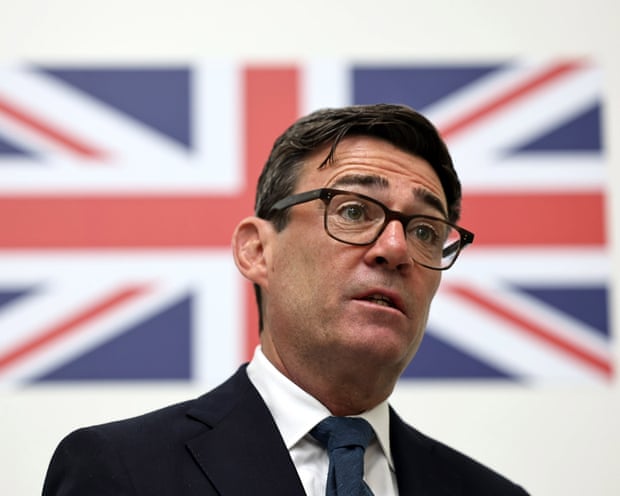
Burnham: ‘I want Britain to believe in itself again.’ Photograph: Neil Hall/EPA
[Guardian] Exclusive: PM, who is facing pressure over whether to approve North Sea oil and gasfields, makes strongest comments yet on issue
The UK must fully commit to reaching net zero by 2050, Andy Burnham has argued in his strongest comments yet on the issue, saying it is no longer possible for Britons to believe they are not already affected by a changing climate.
Writing for the Guardian about new plans for a mass of community-led local green energy projects, the prime minister said the UK must “believe in itself”, and set out his determination to reach net zero targets, which have been rejected by the Conservatives and Reform UK.
The tone marks a contrast to the summer, when Burnham faced criticism for a seemingly muted response to the heatwaves, droughts and wildfires that affected the UK, with his main initiative being a ban on portable barbecues.
“I am determined that we meet the commitment on which Labour was elected and reach net zero by 2050,” Burnham said. “I want Britain to believe in itself again.”
Saying he wanted to connect local communities to green power projects – to reach net zero targets and make energy more affordable – Burnham said: “I am acutely aware that our changing climate is a major concern for many Britons, not least because we have just emerged from our hottest summer on record.”
Comment by dizzy: While this is very encouraging, it is unexpected and suggests a real change in direction. Burnham’s article seems far more restrained than the Guardian’s review leads us to believe, funding of £30m is nothing and it seems devolved rather than owned by his government. There’s a saying in UK and possibly elsewhere: The proof is in the pudding. It can be interpreted to mean wait and see what comes later.
[18/9/26 I think that this is probably BS. We’ve seen Burnham & Co do it before with this
UK Prime Minister Andy Burnham admits to blatently lying and engaging in deception to become leader of the UK Labour Party and Prime Minister.
where an announcement is made, it’s a delaying tactic and what happens months later falls hugely short of what we were led to believe.
Specifically, it may well be BS to mislead and misdirect for the forthcoming Holborn and St. Pancras by-election where the Green Party’s Zack Polanski is a candidate, to give the impression that he cares about the climate and may not wave through Jackdaw and Rosebank, only then to wave through Jackdaw and Rosebank. Burnham’s statement is big on talk, commitments even but the actuality is minimal.]
Donald Trump urges you to ignore facts and reality and be a Climate Science denier like him. He says that he makes millions and millions for destroying the planet, Burn, Baby, Burn and Flood, Baby, Flood.Nigel Farage urges you to ignore facts and reality and be a climate science denier like him and his Deputy Richard Tice. He says that Reform UK has received £Millions and £Millions from the fossil fuel industry to promote climate denial and destroy the planet.
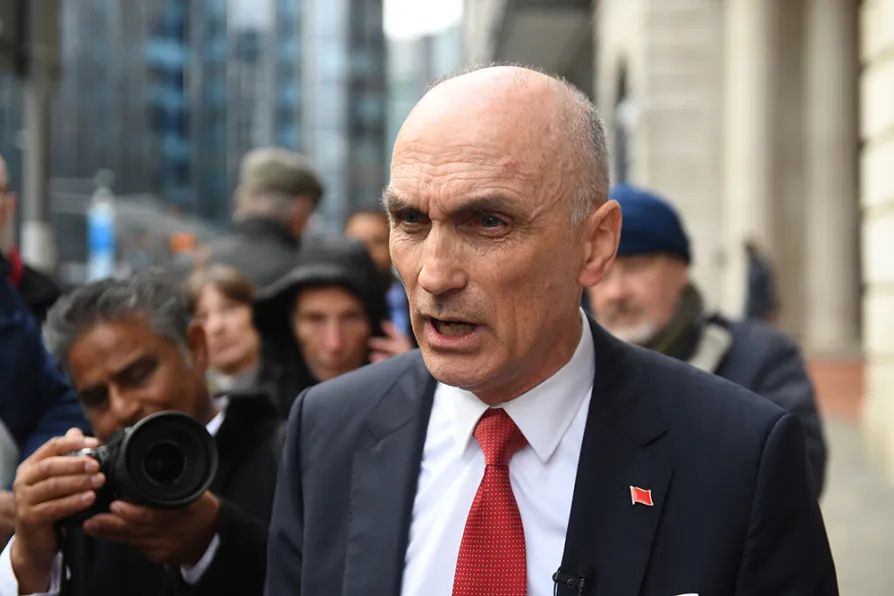
Chris Williamson outside the Birmingham Civil Justice Centre
WORKERS PARTY deputy leader Chris Williamson quit the party in protest at George Galloway’s decision to contest the Holborn and St Pancras by-election.
Mr Williamson, a former Labour MP, has come out in support of Green Party leader Zack Polanski, the main left challenger to Labour in the constituency.
“I have a huge amount of respect for George Galloway, but I believe we should get behind Zack Polanski on this occasion,” he wrote on social media.
“My firm view is that the left must collaborate to defeat the Labour Party, Reform UK, Conservatives and Lib Dems because these parties are all in the pocket of the neoliberal Zionist war machine.
“Zack is best placed to do that in this by-election.”
Mr Williamson’s defection is a blow to the Workers Party, since he was the most prominent politician in its ranks other than Mr Galloway himself.
Nigel Farage objects to criticism of the IDF. He asks how could anyone object to them starving people to death, forced marches like the Nazis did, bombing Gaza’s hospitals and universities, mass-murdering journalists, healthworkers and starving people queuing for food, killing and raping prisoners and murdering children. He calls for people to stop obstructing his genocide for Israel.Keir Starmer objects to criticism of the IDF. He asks how could anyone object to them starving people to death, forced marches like the Nazis did, bombing Gaza’s hospitals and universities, mass-murdering journalists, healthworkers and starving people queuing for food, killing and raping prisoners and murdering children. He calls for people to stop obstructing his genocide for Israel. New Labour UK Prime Minister Andy Burnham continues Labour party policy of active support and complicity in Israel’s genocide.UK Prime Minister Andy Burnham admits to blatently lying and engaging in deception to become leader of the UK Labour Party and Prime Minister.
A photo of an empty classroom. Credit: Unsplash(CC0)
Thousands of schools closed their doors, and a third of all pupils were recorded absent in Wales as temperatures hit 37°C.
School pupils in England and Wales lost more than 15 million teaching hours during June’s heatwave, which caused a spike in absences and forced many schools to close their doors or reduce hours over safety concerns.
According to DeSmog’s analysis, at least 760,000 students in the two countries missed lesson time due to school closures. Temperatures broke previous records and parts of the UK reached over 37°C between 23 and 26 June.
Where schools remained open, absences spiked, with absence rates reaching 36.5 percent in Wales on 25 June, the hottest day ever recorded in the country during the month of June.
The heatwave – one of five to batter the UK this summer – lasted for eight days and triggered a red health alert across many parts of the UK, with hospitals forced to cancel operations, workplaces shortening hours, and people warned not to travel. There were nearly 2,900 excess deaths caused by the May and June heatwaves.
The government recommends schools close only as a last resort, when conditions are unsafe. At least 1,730 schools shut their doors or closed early, far more than previously thought, DeSmog’s new analysis showed.
In an email to parents announcing closures, one Oxford school stated: “It reached 30 degrees at 11:30 in some classrooms without children in them”. Other schools reported classroom temperatures over 40°C.
Many other parents opted to remove their children from schools over safety concerns. One parent told DeSmog that she took her five-year-old child out of school after pupils returned home with severe heat rashes.
Where schools remained open, nearly 12 percent of students were absent in England, almost 50 percent higher than the same period in the previous year.
A version of this article was published by The Guardian.
In May, the Climate Change Committee, an independent government advisory body, warned that students would lose an estimated 14 days of learning to extreme heat every year without action to avoid 4°C global warming by the end of the century.
School children in southern England could experience “severe cognitive performance loss for over 80 percent of the spring and summer months,” it said.
Experts told DeSmog that missed school days could come at high costs for school students – from lower exam results to poorer mental health.
Nicola Gray from the University of Huddersfield, who led research into the impact of closures during the Covid-19 pandemic, told DeSmog: “School provides basic social services, social connection, and nutrition [through free school meals]. It provides the qualifications needed for decent housing, a decent job. So much is rooted in the school system.
“We do not want the education and training of our students to dip precisely at the time when they’re gonna need new skills and the best possible futures in a changing climate.”
A spokesperson for the Department for Education (DfE) told DeSmog: “Hot weather can be a struggle, but schools did a fantastic job keeping children learning safely during this summer’s heatwave. Schools put measures in place, so they remained the best place for children to be, even during a heatwave – because every day in school counts.”
The DfE said that it was “investing to make schools more resilient to a changing climate – including through a £710 million Renewal and Retrofit Programme and almost £20 billion to rebuild over 750 schools.”
Spiking Absence Rates
This summer was the UK’s hottest on record, according to provisional data by the Met Office. Extreme heat across Europe and many other parts of the world caused deaths, wildfires, and widespread disruption.
DeSmog collected information on more than 1,700 affected schools based on dozens of national and local news reports, and analysed it using census data to calculate the total number of students impacted by closures.
Neither the government nor local councils currently publish official data on school closures due to extreme weather events. UK councils told DeSmog that schools made individual decisions based on their safeguarding plans.
DeSmog also analysed government data on pupil absences during the heatwave at schools that remained open, which showed a major spike in students missing school time in both England and Wales.
While closures led to over 5.9 million lost learning hours, pupils missed an estimated 9.5 million additional hours due to heat-related absence.
On the hottest day (25 June) in Wales, absence rates were four times the year’s average – and the highest recorded during the year so far – with over a third of all pupils out of school.
Total figures are likely to be a conservative estimate, due to the lack of official data on closures and given government data on absences only covers pupils at state-funded schools up to the age of 15.
Georgia Price*, a mother of two in Sussex, told DeSmog that she decided to keep her son at home rather than sending him to school.
“He spent Tuesday with 30 five-year-olds in one class, with no fan and no ventilation. On Tuesday night, parents on the WhatsApp group were saying that their kids came home with horrendous heat rashes that were remaining overnight,” she said. “He’s not going to be able to learn in an environment like that.”
Deprivation
Closures affected at least 465,000 families, with many more impacted by absences.
Nicola Gray told DeSmog that those on lower incomes would likely be the hardest hit.
“Do students have the internet connection needed for remote learning? Do they have devices? Do they have a private space to work? With the best will in the world, some people may face difficult situations for learning.”
Gloucestershire, Somerset, and Bristol were among the counties worst affected, with 65,000, 48,000, and 46,000 pupils impacted respectively.
Among schools that remained open in England, the highest rate of student absence was seen in the South East, South West, and West Midlands. All three regions saw absence rates reach above 13 percent (double the yearly average).
“School closures can put students in the most deprived areas at a disadvantage,” said Charlotte O’Regan, schools engagement lead at the Sutton Trust, a charity focused on social mobility. “While some schools or parent organisations are able to pay to ensure that their environments are suitable for study, we know that state school leaders are already having to face difficult decisions when it comes to funding.
“We saw a significant widening of the attainment gap during the pandemic, and we have to make sure that the weather doesn’t become yet another barrier holding back those worst off.”
Adaptation
Parents, academics, and campaigners all said that rapid adaptations are needed in schools to keep children safe and able to study in increasing temperatures.
“We should learn from what happened in June,” Georgia Price said. “There are quite simple changes you should make to make it more comfortable. Stagger classes, teach in smaller groups, have portable air-con units.”
Nicola Gray likewise stressed that adaptations were vital for keeping kids in school.
“The best way to have the best life outcomes for our children and young people is for them to be in school. The government could and should have a proactive approach to providing short- and medium-term support,” she said.
Solutions could include changes to school buildings like fitting shutters to keep out the heat, installation of solar panels to power air conditioning and fans, and short-term adaptations like changing school uniform rules and learning in smaller groups, she suggested.
Recent polling commissioned by Global Witness revealed widespread support for such measures. Seventy-five percent of people support the installation of solar-powered air conditioning in schools and hospitals, the polling found.
Unions are also calling for a maximum temperature limit for classrooms such as the one introduced in New York state, which has set a limit of 31°C.
“If you’re not kitted out to make a comfortable environment then you should close,” Price said.
Labour Party chair Bridget Phillipson, who was England’s education secretary during the June heatwave, told Parliament at the time: “We do recognise the need to make sure that as we refurbish and rebuild schools across our country, we make sure that they are well placed to cope with some of the fluctuations in temperature that we’re seeing.”
Phillipson said, however, that in the meantime it was “for school leaders as to how they manage that best”.
Donald Trump urges you to ignore facts and reality and be a Climate Science denier like him. He says that he makes millions and millions for destroying the planet, Burn, Baby, Burn and Flood, Baby, Flood.Nigel Farage urges you to ignore facts and reality and be a climate science denier like him and his Deputy Richard Tice. He says that Reform UK has received £Millions and £Millions from the fossil fuel industry to promote climate denial and destroy the planet.Orcas comment on killer apes destroying the planet by continuing to burn fossil fuels.
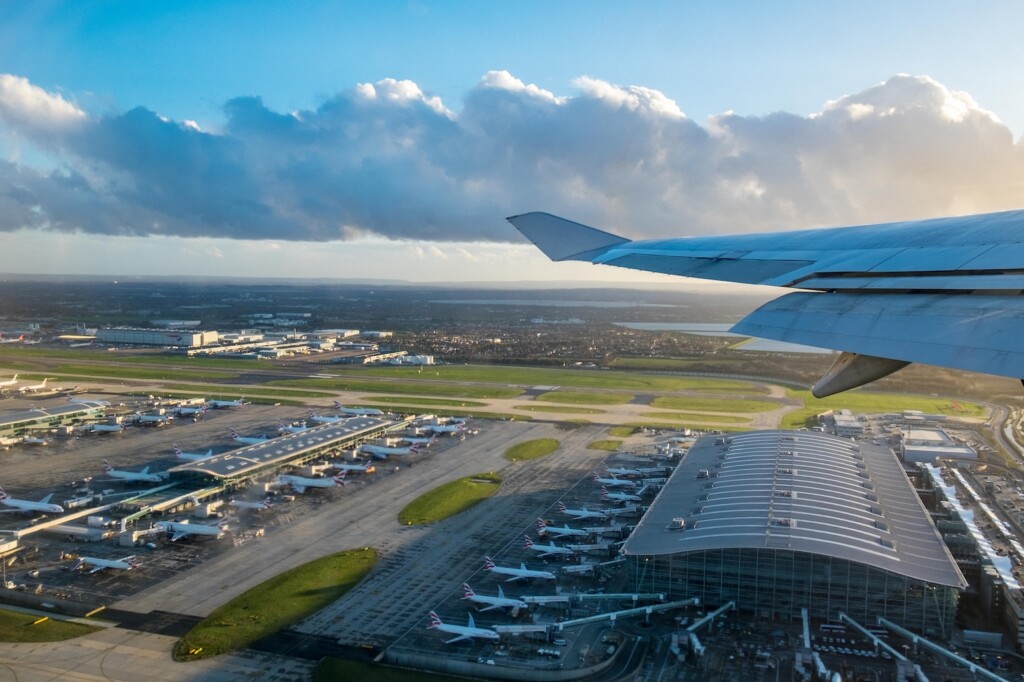
The UK government has slashed its hopes for electric planes and “sustainable aviation fuels” (SAFs), ahead of giving the green light to a third runway at Heathrow.
An “ambitious” rollout of new technologies and efficiency upgrades will only cut flight emissions by a quarter over the next two decades, according to forecasts quietly released in June.
This would leave aviation emissions in 2050 nearly 50% higher than expected under the “jet-zero” strategy, launched by the previous Conservative government in 2022.
The Labour government has signalled its support for a contentious third runway at Heathrow airport, with a final planning decision expected by 2029.
Ministers have justified this expansion by citing the rollout of clean-aviation technologies.
Yet, the updated forecasts suggest that rising flight numbers and a reduced role for “techno-fixes” will leave aviation emissions stubbornly high in 2050 – the UK’s legal target for net-zero.
If this is to be compatible with UK climate goals, then these higher emissions from flights in 2050 would need to be taken out of the atmosphere using costly and largely unproven “carbon dioxide removal” technologies – or by planting gigantic new forests.
Emissions up
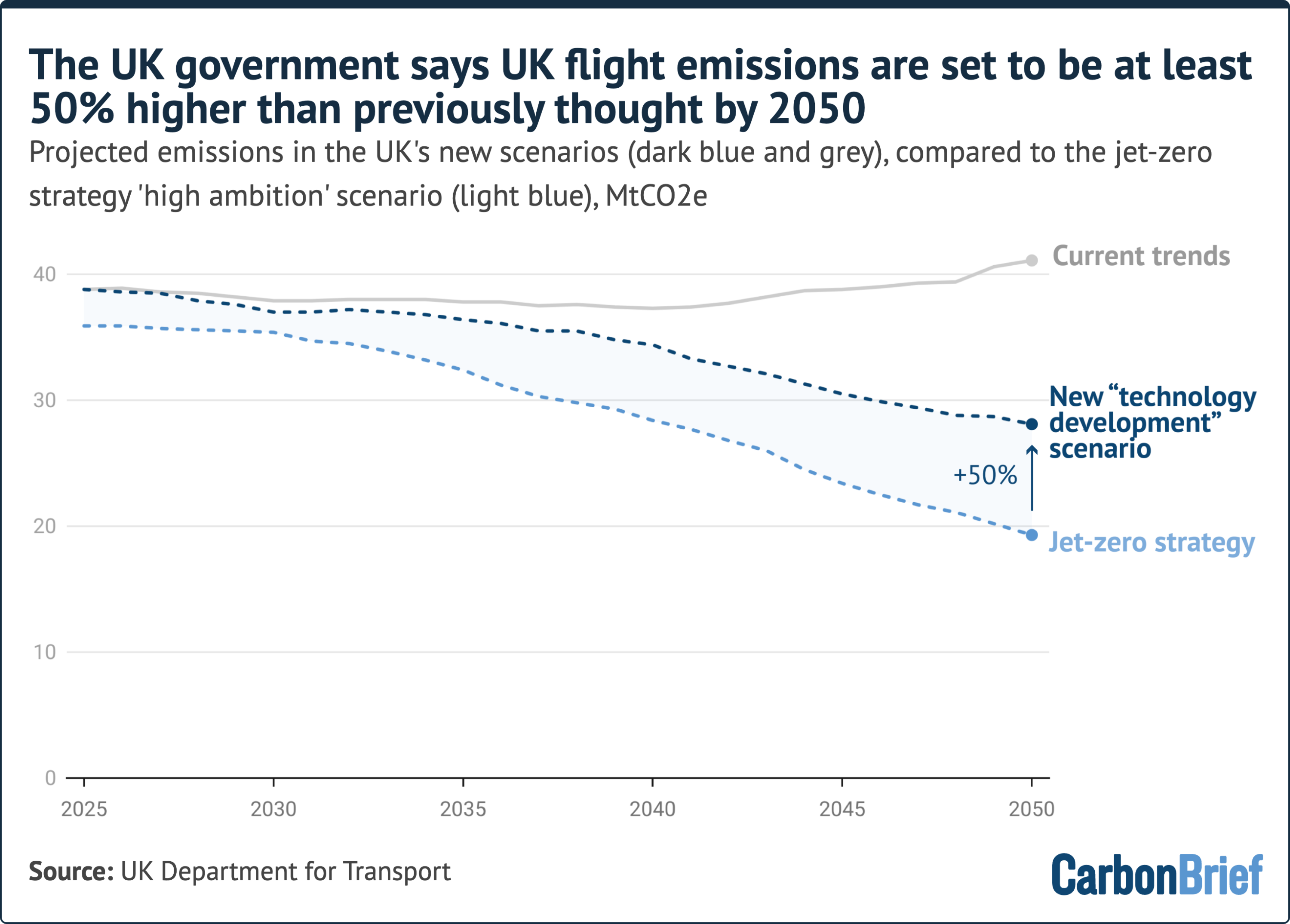
The previous government’s “jet-zero” strategy committed the UK to a “high ambition” pathway that would have seen aviation emissions peak at 38.2m tonnes of carbon dioxide equivalent (MtCO2e) in 2019 and drop to 19.3MtCO2e in 2050.
At the time, the Conservative government said this “clear goal” was achievable, alongside airport expansion and rising flight numbers.
Its strategy relied heavily on the extensive use of early-stage technologies, such as SAFs and battery-powered planes, as well as wider fuel-efficiency improvements.
In public statements, Labour has broadly continued this approach, backing new airport runways while supporting SAFs as a way to curb aviation emissions.
However, the government’s latest forecast, quietly published ahead of the formal approval of a new runway at Heathrow, sets far lower expectations for these technologies.
Its “technology development” pathway, with “ambitious carbon abatement measures”, only sees emissions drop to 28.1MtCO2e in 2050. As the chart below shows, this is around 9MtCO2e higher than the jet-zero strategy’s stated goal – a roughly 50% increase.
The shift is down to much lower expectations for SAF uptake, fuel-efficiency improvements and the roll-out of battery-powered planes, as well as lower international carbon prices.
The government now expects SAFs to make up 30% of aviation fuel by 2050, rather than 50%. It also concedes that SAFs will save less carbon over their lifecycle than previously thought.
SAFs have faced considerable criticism, due to limited supplies and uncertainty around the extent to which they cut emissions. Even meeting the UK’s relatively modest goal of 22% SAF uptake by 2040 would require enormous – potentially unattainable – volumes of waste products, which are currently the main source of the fuel.
For its new forecasts, the government commissioned a separate analysis of likely aircraft fuel-efficiency improvements over the next few decades. This analysis, from the Aviation Impact Accelerator, yielded “less optimistic” projections than earlier work.
Fuel-efficiency improvements have therefore been revised downward from 2% per year in the “jet-zero” strategy to 1.3% in the new “technology development” scenario.
There is also a reduced role for battery-powered planes, with only some of the smallest zero-emissions aircraft expected to be in use by 2035.
Crucially, even making the more limited emissions cuts in the new “technology development” pathway would require greater efforts to decarbonise the aviation sector.
If the UK fails to implement new policies or innovations, while flight numbers continue to rise, then aviation emissions would be even higher in 2050 than they are today.
This is illustrated by the pink “current trends” pathway in the chart above, in which emissions increase to 41.1MtCO2e by 2050.
This is roughly double the amount targeted by the jet-zero strategy and recommended by government climate advisors, the Climate Change Committee (CCC).
Budget ‘busting’
The new forecasts all account for the growth of several UK airports, including “planned Heathrow expansion”. Overall, passenger numbers would be at least 50% higher by 2050.
In contrast, the CCC and other experts have advised that the rise in passenger numbers may need to be limited, in order to keep emissions down.
In order to meet the UK’s net-zero target, any aviation emissions that remain in 2050 would need to be offset by planting many thousands of hectares of new forest, or by relying on costly and largely unproven CO2 removal technologies.
Tim Johnson, director at the Aviation Environment Federation (AEF), says the new forecasts present “a more honest and realistic vision of what’s possible in the next 24 years”. However, he tells Carbon Brief:
“Less reliance on cleaner technology and fuels reopens the debate about the role and scale of greenhouse gas removals and ways to tackle the projected 50% growth in demand for air travel.”
AEF calculations, based on government data and shared with Carbon Brief, suggest that emissions from the third runway at Heathrow would initially be relatively modest, reaching 3.5MtCO2e per year in 2050. Its emissions would then be expected to rise significantly beyond the legal 2050 net-zero deadline.
Previously, the Labour government has explicitly cited SAFs and other new technologies as part of its justification for expanding Heathrow airport.
Dr Lois Pennington, a research associate at the University of Manchester who has analysed Heathrow’s emissions impact, says the government’s new forecast shows “we are projected to be well over aviation’s share of the carbon budget even before a third runway is considered”.
She tells Carbon Brief:
“For Heathrow, it means expansion can no longer be waved through on the promise of technology, and any approvals will be in the full knowledge that it will bust our legally binding carbon budgets.”
Nigel Farage urges you to ignore facts and reality and be a climate science denier like him and his Deputy Richard Tice. He says that Reform UK has received £Millions and £Millions from the fossil fuel industry to promote climate denial and destroy the planet.Donald Trump urges you to ignore facts and reality and be a Climate Science denier like him. He says that he makes millions and millions for destroying the planet, Burn, Baby, Burn and Flood, Baby, Flood.Orcas comment on killer apes destroying the planet by continuing to burn fossil fuels.
Operation theatre illustration by Kerry Cleaver for Carbon Brief.
More than 1,000 operations at NHS hospitals were cancelled due to heat during the UK’s record May and June heatwaves, Carbon Brief can reveal.
This includes 167 orthopaedic surgeries, such as knee and hip replacements, as well as heart, eye and skin cancer operations.
At least 10 emergency surgeries – those for “life-threatening” conditions – had to be cancelled because of the record-breaking heat, according to the investigation.
Carbon Brief sent freedom-of-information (FOI) requests to 140 NHS trusts to investigate the impact of heatwaves on operations being cancelled in England and Wales.
Areas with the most operations cancelled due to heat include Surrey and Sussex, south Essex and parts of London – all regions experiencing among the highest temperatures.
High temperatures can threaten patient safety by stopping the ventilation systems used in theatres from working, increasing the risk of infection, experts tell Carbon Brief.
Less than half of the NHS trusts provided details of heat-related surgery cancellations – and Carbon Brief understands that many hospitals do not routinely record this information.
Carbon Brief’s figure is therefore likely to be a significant underestimate, but still provides an unprecedented insight into a surgical system “poorly prepared” for heatwaves and the impact on patients.
Overheating operations
The record-breaking heatwaves that have repeatedly struck the UK in 2026 – amplified by climate change – have already been linked to thousands of deaths.
Extreme heat also threatens healthcare systems. News outlets have reported on the NHS “struggling”, as it faces record A&E demand, hospital wards reaching “unsafe” temperatures and equipment failing due to heat.
Among these reports was coverage of hospitals being forced to cancel operations, or even abandon them midway through, as surgical theatres became intolerably hot.
To investigate this problem, Carbon Brief sent FOI requests to the 140NHS trusts and health boards in England and Wales responsible for hospitals with surgical theatres.
They were asked about all the operations that were cancelled due to extreme heat during the May and June heatwaves, when “amber” and “red” heat warnings were in place.
In total, 59trusts and health boards responded with details of 1,110 heat-related cancellations across the 17-day period covering 22-28 May and 18-27 June.
(Of the 63 trusts that responded but did not provide details of heat-related disruption, many said that they simply did not record this data, rather than stating that heat was not a problem. See Methodology for more details.)
The map below shows the location of these cancelled surgeries, which cover everything from routine hernia operations to heart surgeries.
Surrey and Sussex Healthcare NHS Trust reported the most cancellations – 140 in total – all in the surgery unit at Crawley Hospital. This hospital was in one of the hottest parts of the country in June, with temperatures approaching 36C.
Other hotspots for cancellations include south Essex, Dudley in the West Midlands, south Wales and parts of London. Many of the hardest-hit hospitals were in southern England, where temperatures were highest.
Of the trusts that provided full datasets of all surgery cancellations in the period, around 7% were heat-related. This data illustrates how heat is placing more strain on an already stretched NHS, adding to existing issues such as staff shortages and lack of beds.
Nearly all of the cancelled surgeries were “elective”, meaning they were scheduled in advance and not immediately life-saving. Nevertheless, the list of cancellations includes at least eight heart operations and seven skin-cancer removals.
There were also 10 “emergency” operations cancelled due to heat in surgical theatres. Another 18 surgeries had to be abandoned mid-way through.
Dr Dmitri Nepogodiev, a public health researcher focusing on surgery at the University of Birmingham, says hospitals will always prioritise “time-sensitive, life-threatening” surgeries.
Nevertheless, he tells Carbon Brief that every cancellation can cause significant “distress” and harm to patients’ quality of life, adding:
“Behind all of these statistics…are real people who have probably already been waiting a long time.”
Each dot in the graphic below indicates a cancelled surgery. Of the 596 for which trusts provided details, 167are orthopaedic surgeries, such as knee and hip replacements.
Eye surgeries, gynaecological and urological surgeries are also among the most frequently cancelled, broadly reflecting how common such procedures are.
Richard Egan, an endocrine surgeon and a national clinical director within NHS Wales,notes the knock-on effects of cancelling surgeries for several days during heatwaves. He tells Carbon Brief:
“That’s a significant impact on waiting lists…For every week that patients are waiting on a waiting list, their condition could get worse and deteriorate.”
‘Increased risks’
When providing specific reasons for cancellations, most NHS trusts simply indicated that surgical theatres were “too hot and humid”.
Sometimes, this was accompanied by comments about “risk of infection” or “overheating for both patients and staff”.
There are several reasons why it can get “too hot” for operations to take place, but the main one is that the complex ventilation systems installed in theatres can stop working above a certain temperature, explains Dr Ed Robinson, an NHS anaesthetist. He tells Carbon Brief:
“An operating theatre is a very tightly engineered clinical environment. There are quite complicated ventilation systems, which dilute airborne contaminants, remove fumes from different [medications] and anaesthetic gases.
“We have generalised airflow systems that make the air in theatre flow outwards to adjacent areas, so pathogens and fumes get carried away from the patient into non-clinical areas. When it gets to a certain heat, those systems can fail.”
These systems are also responsible for controlling heat and humidity levels inside theatres, says Robinson.
When the systems fail, it is not possible to guarantee patient safety, he continues, meaning surgeries may need to be cancelled.
Although most hospitals simply stated that it was “too hot” for operations to take place during the heatwaves, there were 48 cases where staff specified that this was due to air conditioning or ventilation units that were either broken or unable to sustain appropriate temperatures.
“Extreme heat can increase risks and make it harder to deliver care under the conditions clinicians would consider ideal.”
If air in operating theatres is too humid, excess moisture can condense on surgical implements and transmit infections, he says.
Extreme heat and humidity inside theatres can also pose a risk to staff having to wear heavy protective clothing. Robinson explains:
“Staff are usually wearing PPE [personal protective equipment]. If it’s orthopaedics, they will be wearing ‘leads’ a lot of the time. This is because they will be doing lots of X-rays, and there’s no time to descrub and rescrub every time.
“So if the ventilation system is not working, you’re going to overheat [and] that’s going to affect your ability to concentrate and perform a safe operation. You just wouldn’t start under those conditions.”
There are also “certain pieces of equipment and medications” that are not “validated to be used outside of certain ranges of temperature”, he says.
This includes specialised “cement” used to secure hip and knee replacements, which can set too quickly at higher temperatures, according to Lane.
‘Poorly prepared’
Following the record-breaking heat of 2022, one study found that surgical services in the UK were “poorly prepared for heatwaves”.
Based on staff surveys, the study concluded that ambient temperatures “could not be controlled” in two-fifths of NHS operating theatres.
With hospitals once again under significant pressure this summer, health secretary Yvette Cooper told the Guardian that the NHS “has to make sure we are preparing for summer pressures now in the same way we prepare for winter”.
Nepogodiev notes that the problem of extreme heat extends from increased patient numbers to staff shortages, which can be the result of a range of wider factors such as heat-related train cancellations. He tells Carbon Brief.
“There isn’t a single magic solution because it’s a kind of complex, multifactorial challenge – so it also underlines the importance of broader preparedness.”
Egan, who is investigating ways to prepare surgical theatres for extreme heat, says the response so far has been “ad hoc”. He suggests it may be possible to continue with less risky operations, even at higher humidity levels.
As it stands, many NHS hospitals are old and not designed for increasingly extreme temperatures.
Government advisers at the Climate Change Committee (CCC) have recommended that all healthcare buildings should work to “maintain safe and appropriate temperatures” by 2035.
The UK’s national adaptation programme already says NHS England will work to “adapt NHS infrastructure to extreme weather events and overheating risks”, by incorporating adaptation measures into plans for new buildings.
However, years of underinvestment have left many sites with what the King’s Fund thinktank calls “deteriorating buildings” and “outdated technology”.
Following the extreme heat this summer, the government has announced £32m from a £1.5bn spending programme for projects that strengthen hospitals’ “resilience to extreme heat, including improved “cooling and ventilation systems”.
RCS England president Lane tells Carbon Brief that heat-related surgical cancellations underline the need for investment in hospitals, ventilation systems and modern equipment:
“NHS staff work incredibly hard to adapt, often reorganising services and finding practical solutions to keep care running, but resilience alone cannot compensate indefinitely for outdated infrastructure or sustainability.”
Methodology
Carbon Brief contacted 140 NHS trusts and health boards in England and Wales, only including those that perform surgical procedures. Mental health trusts, community trusts and other specialist trusts were therefore excluded.
These requests covered the periods 22-28 May 2026 and 18-27 June 2026, when heatwaves affected much of England and Wales.
At the time of filing the FOIs, these were the two periods when the UK Health Security Agency (UKHSA) had issued “amber” or “red” heat-health alerts across much or all of England. There were also comparable weather warnings in place across Wales for some of this time.
(Scotland and Northern Ireland were excluded from the analysis, on the basis that they did not experience such extreme heat.)
The FOI requests asked for details of all surgical procedures – both elective and emergency – that were cancelled during this period. Specifically, the requests also asked trusts to state which cancellations were related to extreme heat. Of these, 59provided details of surgeries that were cancelled due to heat.
Of the remaining 63 that responded to the FOI requests, only a fewstated explicitly that there were no surgeries cancelled due to heat. Most either said that they did not record this information, or provided lists with standard cancellation reasons that may – or may not – indicate heat as a factor, such as “failure of equipment”. The remaining 19did not respond to the request by the time of publication.
NHS trusts and health boards responded to Carbon Brief’s FOI requests in a large variety of ways, reflecting the inconsistent way in which heat-related cancellations are recorded.
Among those that disclosed data, some provided all the information requested while others only provided parts. Some would not provide exact numbers when the number of cancellations was five or less. In those cases, Carbon Brief assumed that two surgeries had been cancelled. (This assumption accounts for fewer than 50 of the 1,110 cancellations.)
The full dataset is available here, with details of all the surgeries cancelled and the reasons given for their cancellations.
Donald Trump urges you to ignore facts and reality and be a Climate Science denier like him. He says that he makes millions and millions for destroying the planet, Burn, Baby, Burn and Flood, Baby, Flood.Nigel Farage urges you to ignore facts and reality and be a climate science denier like him and his Deputy Richard Tice. He says that Reform UK has received £Millions and £Millions from the fossil fuel industry to promote climate denial and destroy the planet.Orcas discuss Donald Trump and the killer apes’ concept of democracy. Front Orca warns that Trump is crashing his country’s economy and that everything he does he does for the fantastically wealthy.



 Chris Williamson outside the Birmingham Civil Justice Centre