


https://morningstaronline.co.uk/article/trump-rants-milibands-green-pact-california

 Energy Security and Net Zero Secretary Ed Miliband (left) and California state governor Gavin Newsom sign a clean energy agreement at the Foreign Office in London, February 16, 2026
ENERGY Secretary Ed Miliband did his shift in US President Donald Trump’s firing line today after signing a green energy pact with California Governor Gavin Newsom.
Mr Trump used an interview to say “the UK’s got enough trouble without getting involved with Gavin Newscum,” using an infantile and derogatory nickname for the Californian, who is widely expected to run for president in 2028.
“Gavin is a loser. Everything he’s touched turns to garbage. His state has gone to hell, and his environmental work is a disaster,” he added.
The US president’s blunt warning that it was “inappropriate” for Britain to be dealing with the governor doubtless had Sir Keir Starmer in a cold sweat, since the Prime Minister is desperate to avoid giving offence to the White House.
However, Sir Keir no longer has the political wherewithal, after last week’s brush with eviction from office, to rein in Mr Miliband, regarded as one of the cabinet’s few effective performers.
Mr Newsom, who has been attacking Trump on everything from the behaviour of ICE to the climate crisis, signed a memorandum of understanding in London with Mr Miliband.
It seeks to deepen existing co-operation between Britain and California, with a new framework to develop clean energy technologies and stronger links between businesses and researchers in Britain and the US state.
Britain and California will also share practical expertise on protecting biodiversity and building resilience amid extreme weather, the Energy department announced.
…
Article continues at https://morningstaronline.co.uk/article/trump-rants-milibands-green-pact-california
Marc Hudson, University of Sussex
Last autumn, a UK government report warned that climate-driven ecosystem collapse could lead to food shortages, mass migration, political extremism and even nuclear conflict. The report was never officially launched.
Commissioned by Defra – the Department for Environment Food and Rural Affairs – and informed by intelligence agencies including MI5 and MI6, the briefing assessed how environmental degradation could affect UK national security.
At the last minute the launch was cancelled, reportedly blocked by Number 10. Thanks to pressure from campaigners and a freedom of information request, a 14-page version of the report was snuck out (no launch, not even a press release) on January 22.
That report says: “Critical ecosystems that support major food production areas and impact global climate, water and weather cycles” are already under stress and represent a national security risk. If they failed, the consequences would be severe: water insecurity, severely reduced crop yields, loss of arable land, fisheries collapse, changes to global weather patterns, release of trapped carbon exacerbating climate change, novel zoonotic disease and loss of pharmaceutical resources.
In plainer terms: the UK would face hunger, thirst, disease and increasingly violent weather.
An unredacted version of the report, seen by the Times, goes further. It warns that the degradation of the Congo rainforest and the drying up of rivers fed by the Himalayas could drive people to flee to Europe (Britain’s large south Asian diaspora would make it “an attractive destination”), leading to “more polarised and populist politics” and putting more pressure on national infrastructure.
The Times describes a “reasonable worst case scenario” in the report, where many ecosystems were “so stressed that they could soon pass the point where they could be protected”. Declining Himalayan water supplies would “almost certainly escalate tensions” between China, India and Pakistan, potentially leading to nuclear conflict. Britain, which imports 40% of its food, would struggle to feed itself, the unredacted report says.
The report isn’t an outlier, and these concerns are not confined to classified briefings. A 2024 report by the University of Exeter and think-tank IPPR warned that cascading climate impacts and tipping points threaten national security – exactly the risk outlined in the Defra report.

The government has not publicly explained why the launch was cancelled. In response to the Times article, a Department for Environment, Food and Rural Affairs spokesperson said: “Nature underpins our security, prosperity and resilience, and understanding the threats we face from biodiversity loss is crucial to meeting them head on. The findings of this report will inform the action we take to prepare for the future.”
Perhaps there are mundane reasons to be cautious about a report linked to the intelligence services that warns of global instability. But the absence of any formal briefing or ministerial comment is itself revealing – climate risks appear to be treated differently from other risks to national security. It’s hard to imagine a report warning of national security risks from AI, China or ocean piracy getting the same treatment.
This episode is not even especially unusual, historically. Governments have been receiving warnings about climate change – and downplaying or delaying responses – for decades.
In January 1957, the Otago Daily Times reported a speech by New Zealand scientist Athol Rafter under the headline “Polar Ice Caps May Melt With Industrialisation”. And Rafter was merely repeating concerns already circulating internationally, including by a Canadian physicist whose similar warning went around the world in May 1953. Climate change first went viral more than seven decades ago.
By the early 1960s, scientists were holding meetings explicitly focused on the implications of carbon dioxide build-up. In 1965, a report to the US president’s Science Advisory Council warned that “marked changes in climate, not controllable though local or even national efforts, could occur”.
Senior figures in the UK government were aware of these discussions by the late 1960s, while the very first environment white paper, in May 1970, mentions carbon dioxide build-up as a possible problem.
But the story we see today was the same. Reports are commissioned, urgent warnings are issued – and action is deferred. When climate change gained renewed momentum in the mid-1980s, following the discovery of the ozone hole and the effects of greenhouse gases besides carbon dioxide, the message sharpened: global warming will come quicker and hit harder than expected.
Margaret Thatcher finally acknowledged the threat in a landmark 1988 speech to the Royal Society. But when green groups tried to get her to make specific commitments, they had little success.
Since about 1990, the briefings have barely changed. Act now, or suffer severe consequences later. Those consequences, however, are no longer theoretical.
Partly, it’s down to inertia. We have built societies in which carbon-intensive systems are locked in. Once you’ve built infrastructure around, say, the private petrol-powered automobile, it’s hard for competitors to offer an alternative. There’s also a mental intertia: it’s hard to let go of assumptions you grew up with in a more stable era.
Secrecy plays a role too. As the Defra report illustrates, uncomfortable assessments are often softened, delayed or buried. Then, if you do accept the need for action, you are then up against the problem of responsibility being fragmented across sectors and institutions, making it hard to know where to aim your efforts. Meanwhile, social movements fighting for climate action find it hard to sustain momentum for more than three years.
Here’s the final irony. Conspiracy theorists and climate deniers insist governments are exaggerating the threat. In reality, the evidence increasingly suggests the opposite. Official assessments tend to lag behind scientific warnings, and the most pessimistic scenarios are often confined to technical or classified documents.
The situation is not better than we are told. It’s actually far worse.
Don’t have time to read about climate change as much as you’d like?
Get a weekly roundup in your inbox instead. Every Wednesday, The Conversation’s environment editor writes Imagine, a short email that goes a little deeper into just one climate issue. Join the 47,000+ readers who’ve subscribed so far.
Marc Hudson, Visiting Fellow, SPRU, University of Sussex Business School, University of Sussex
This article is republished from The Conversation under a Creative Commons license. Read the original article.


It should be accepted that the climate criminals have destroyed the World’s – collectively our World’s – climate for profit despite being fully aware of the consequences of their actions. This has caused extreme weather events worldwide, far more extreme hurricanes, wildfires and floods while here in the UK we’ve suffered far worse flooding and almost constant raining. We are now starting to see and feel the first consequences of the climate criminals’ actions.
The climate criminals knew this, Donald Trump knows or should be treated as knowing it despite denying it. I would be so angry if I was young or even a little younger. Capitalists have destroyed younger peoples’ lives, nature and the environment for ever for short-term profit.
Their punishment doesn’t need to follow logic e.g. punish their descendents, why not? I’m thinking along the lines of dispossessing them – since they love money so much – and prevent them from all sources of income.
ed: It’s not acceptable to punish their descendents unfortunately, would breach their human rights. Can create the concept of ‘dirty money’ the proceeds from and polluted by climate destruction that should be seized from individuals. later ed: It follows that if an individual’s income has been sourced from climate destruction for some time, then it should all be seized. later later edit: This is not new of course. It is established that people should not benefit from crimes or the proceeds of crimes. What’s needed is to formally recognise climate destruction as a crime. I would expect that to no doubt happen in coming years. A different approach would be to accept the obvious consequences of climate destruction i.e. that those crimes are committed through the action of climate destruction.
I need to give this some thought and it may not be too soon …
https://www.theguardian.com/news/ng-interactive/2026/jan/31/climate-crisis-flood-risk-britain
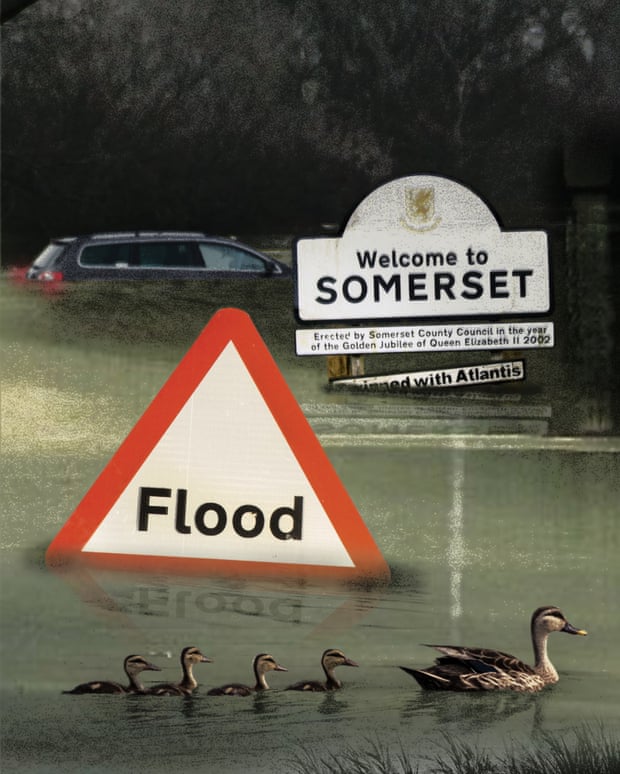
When flooding hit the low-lying Somerset Levels in 2014, it took two months for the waters to rise. This week it took two days, said Rebecca Horsington, chair of the Flooding on the Levels Action Group and a born-and-bred resident. A fierce barrage of storms from the Atlantic has drenched south-west England in January, saturating soils and supercharging rivers.
“It’s déjà vu,” she said. “The stress and anxiety is palpable in the community. We’ve all been here before, we know what happens and it shouldn’t. But since 2014, the weather events are becoming more and more frequent and the rain just dumps now.”
The climate crisis is here and now and this is its face in Britain, scientists told the Guardian. But the devastating impacts are accelerating faster than the work to keep communities protected, they said: torrential winter rains are arriving 20 years earlier than climate models projected. While those forced from homes engulfed by filthy water are suffering today, a darker question is looming: will some settlements have to be abandoned?
Storm Chandra, which pummelled the south-west this week, followed hot on the heels of Storms Goretti and Ingrid. New 24-hour rainfall records were set in places in Dorset, Devon and Cornwall. Setting new records is the new normal in the climate crisis.
Somerset council declared a major incident on Tuesday and across the south-west homes and businesses were flooded, communities cut off, schools closed, trains cancelled and dozens of people were rescued from stranded vehicles.
“These events are getting more frequent and more serious,” said Bryony Sadler, a hairdresser from Moorland, a village on the Levels. She was planning an evacuation of her family and animals when the Guardian spoke to her this week as the waters rose. “The rain is heavier and more intense, the winds stronger.”
…
Article continues at https://www.theguardian.com/news/ng-interactive/2026/jan/31/climate-crisis-flood-risk-britain